Tile Adhesive Removal Sydney: Grinding-Only Costs
Removed the tiles? Find out what it costs to grind off tile glue in Sydney, including how adhesive thickness, floor condition and access affect grinding prices.
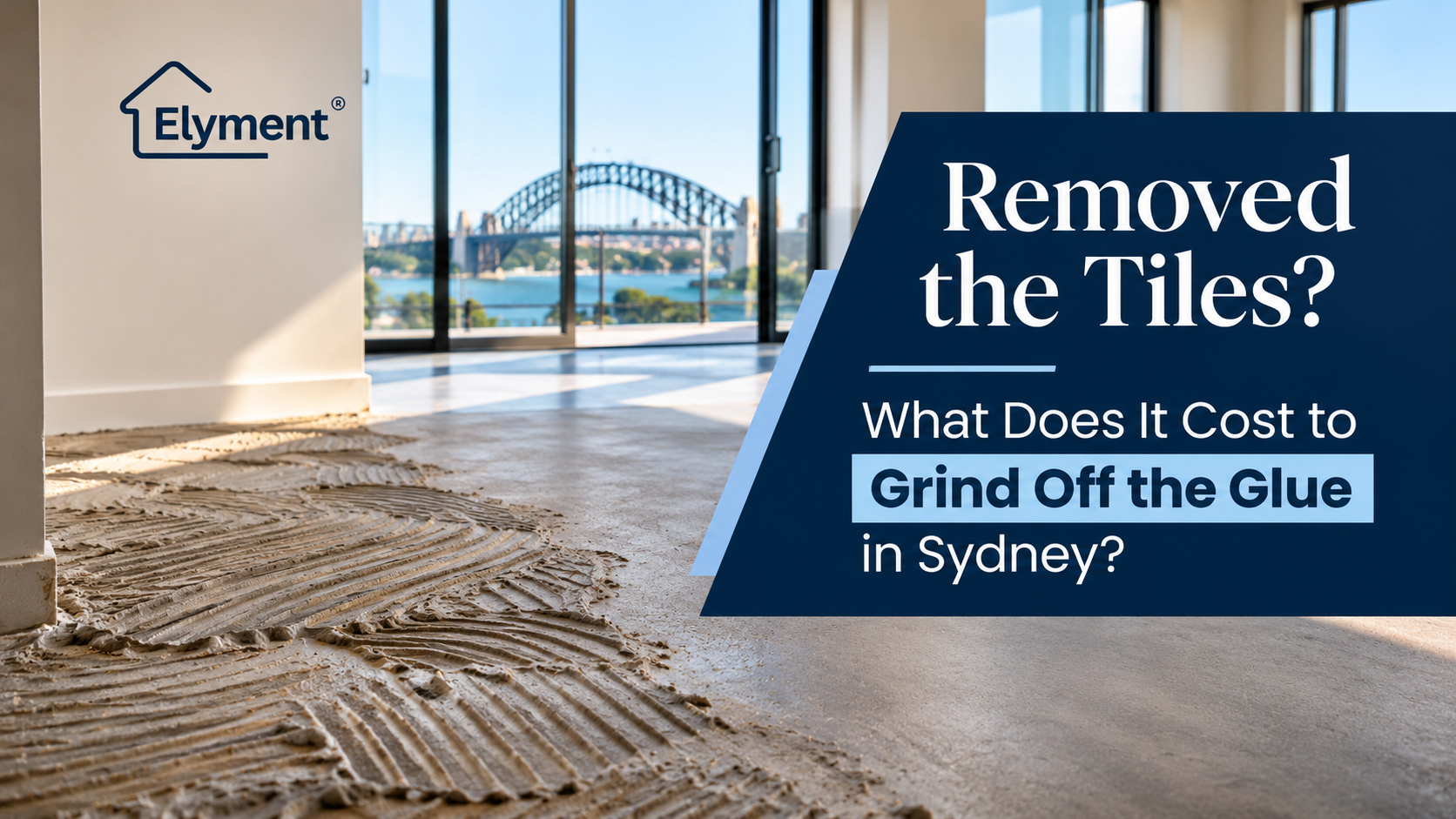
Tile adhesive removal in Sydney can cost approximately $10 to $60 per square metre based on published local contractor pricing. When tiles have already been removed, a grinding-only quotation depends on the remaining adhesive thickness, floor area, perimeter detailing, site access and the preparation standard required for the replacement flooring. Providing a wide photograph of the exposed floor and a close-up of the residue can help contractors assess the remaining scope before arranging a site inspection.
ELYMENT Insights | Flooring, Renovations & Property Operations | Sydney, NSW | 27 November 2026
Removing the existing tiles may appear to be the most physically demanding stage of a flooring renovation. Yet for many Sydney property owners who undertake the demolition themselves or engage a separate removal contractor, the next challenge begins when the concrete becomes visible.
Instead of a clean substrate, the exposed floor may contain hardened adhesive ridges, irregular mortar patches and material left behind around walls, doorways and kitchen cabinetry.
The customer is no longer purchasing tile demolition. They are purchasing a defined surface preparation outcome.
That distinction matters when obtaining quotations, allocating the remaining renovation budget and coordinating the installation of new flooring.
What Does Tile Adhesive Removal Cost When the Tiles Are Already Gone?
Published pricing from Carpet Removal Sydney's adhesive removal service indicates a general range of approximately $10 to $60 per square metre for removing glue from concrete.
Its separate tile removal service information also distinguishes tile uplift from subsequent concrete grinding, illustrating why customers who have completed demolition should request a different scope of work.
These figures are useful for preliminary budgeting, but they should not be interpreted as a fixed rate applicable to every Sydney property.
A grinding-only quotation may include equipment mobilisation, mechanical adhesive removal, perimeter grinding, dust extraction, collection of grinding residue and final surface inspection.
Where the tiles have already been lifted and removed from the property, demolition labour and tile disposal should not automatically form part of the new quotation.
What the Published Price Range Means for a Renovation Budget
Applying the published adhesive removal range to different floor areas illustrates the potential variation in preliminary budgets.
Illustrative Tile Adhesive Removal Budgets in Sydney
20 m² exposed floor area
- At $10/m²: $200
- At $60/m²: $1,200
40 m² exposed floor area
- At $10/m²: $400
- At $60/m²: $2,400
60 m² exposed floor area
- At $10/m²: $600
- At $60/m²: $3,600
100 m² exposed floor area
- At $10/m²: $1,000
- At $60/m²: $6,000
Source: Published Sydney contractor adhesive removal pricing. These calculations are illustrative only and are not Elyment quotations. Minimum job charges, access restrictions, GST treatment, additional preparation and waste-handling requirements must be confirmed separately.
A small bathroom or laundry may not achieve the same effective square-metre rate as a large, unobstructed living area because equipment transport, site protection and machine setup are required regardless of the floor size.
The Adhesive Left Behind Determines the Remaining Work
Two floors from which identical ceramic tiles have been removed can present substantially different grinding requirements.
One may retain only scattered adhesive patches. Another may contain continuous, hardened trowel ridges across almost the entire concrete surface.
The difference affects machine productivity, tooling selection, grinding passes and the amount of material requiring collection.
Sydney specialist Resin Me Epoxy distinguishes between different adhesive behaviours and explains how thicker residues may require preliminary material reduction before controlled grinding.
How Remaining Tile Adhesive Affects Grinding-Only Quotations
Light, scattered adhesive residue
- Likely preparation requirement: Localised or general mechanical grinding.
- Potential cost impact: Lower preparation intensity.
Continuous hardened adhesive ridges
- Likely preparation requirement: Broader coverage and potentially additional passes.
- Potential cost impact: Increased machine time.
Thick mortar or bedding remnants
- Likely preparation requirement: Bulk material reduction followed by grinding.
- Potential cost impact: Additional labour and material handling.
Adhesive around walls and cabinetry
- Likely preparation requirement: Specialist perimeter and hand grinding.
- Potential cost impact: Higher manual detailing requirements.
Damaged or contaminated substrate
- Likely preparation requirement: Assessment and potentially additional remedial preparation.
- Potential cost impact: Separate scope may be required.
The practical objective is not to remove unnecessary structural concrete. It is to remove unsuitable residue and achieve the surface condition required by the next flooring system.
Why a Smaller Kitchen Can Be More Expensive per Square Metre
Grinding productivity is influenced by the relationship between open floor area and restricted edges.
Consider two hypothetical Sydney renovation projects, both requiring adhesive removal after tile uplift.
Project A: An Open Living and Dining Area
- Approximately 40 m² of accessible concrete.
- Relatively consistent adhesive coverage.
- Limited internal obstructions.
- Suitable access for a commercial floor grinder.
The operator can maintain relatively continuous machine movement, reducing the number of interruptions required to reposition equipment.
Project B: A Kitchen, Laundry and Connecting Hallway
- Approximately 40 m² across several restricted spaces.
- Adhesive remaining beneath cabinet edges.
- Multiple doorways and internal corners.
- Greater dependence on hand-held grinding equipment.
Although both projects contain the same floor area, the second can require more detailed manual preparation.
The resulting difference is not necessarily caused by the quantity of adhesive. It may arise from the proportion of the floor that cannot be reached efficiently with a larger machine.
This is why quotations for professional concrete grinding in Sydney should consider the configuration of the property alongside the measured floor area.
The Replacement Flooring Determines Where Grinding Should Stop
Adhesive removal does not have one universal finishing standard.
Before a grinding-only quotation is finalised, the contractor should understand what will be installed over the exposed concrete.
Preparation Considerations for Replacement Flooring Systems
New ceramic or porcelain tiles
- Sound, compatible substrate with unsuitable residue removed.
Hybrid flooring
- Removal of raised adhesive and verification of required floor flatness.
Vinyl flooring
- Smoothness and compatibility to minimise visible surface imperfections.
Glue-down engineered timber
- Suitable bonding surface, moisture assessment and adhesive compatibility.
Epoxy flooring
- Removal of contaminants and the specified concrete surface profile.
Polished concrete
- Separate assessment of appearance, staining, aggregate exposure and finishing requirements.
Grinding sufficient for a subsequent levelling compound may not provide the smoothness required for direct vinyl installation. Equally, a preparation-ground slab should not be assumed to be suitable as an exposed decorative concrete floor.
The preparation requirements of the selected flooring manufacturer and installation contractor should guide the final scope.
Does Removing Tile Glue Also Level the Concrete?
Not necessarily.
Mechanical grinding removes unwanted surface material and can reduce selected high points. It does not fill depressions, repair every defect or automatically achieve the flatness tolerances required by replacement flooring.
Once adhesive has been removed, the substrate may reveal low areas, demolition damage, cracks or remnants of previous repairs.
Where these conditions affect installation, floor levelling and substrate preparation may need to be assessed as a separate operation.
Separating these activities helps property owners distinguish between the cost of removing the existing adhesive and the cost of achieving the required installation tolerances.
What Sydney Property Owners Should Exclude From a Grinding-Only Quote
When demolition has already been completed, the new contractor should receive a clearly defined starting point.
The following activities should not be automatically included unless they remain necessary:
- Mechanical uplift of existing tiles.
- Collection and disposal of previously removed tiles.
- Removal of unrelated flooring materials.
- Complete demolition of existing screed or bedding systems.
- Application of levelling compounds.
- Installation of replacement flooring.
- Decorative concrete polishing or sealing.
Grinding residue and the associated cleaning requirements are different from disposal of the tiles themselves. Responsibility for both should be established before work begins.
Where residual tile fragments or substantial bedding remain, the quotation may need to include selected elements of flooring demolition and removal alongside grinding.
Two Photographs Can Improve the Initial Quotation
Customers requesting tile adhesive removal frequently provide the floor area without showing the condition of the exposed surface.
For a contractor, two appropriately framed photographs can provide more useful preliminary information than an area measurement alone.
Photograph One: The Entire Exposed Floor
Take a wide photograph from a doorway or room corner, showing as much of the floor as possible.
The image should help identify:
- The overall layout and accessible working area.
- The distribution of remaining adhesive.
- Kitchen cabinets, walls and other obstructions.
- Doorways and transitions between rooms.
- Whether tile debris remains on site.
Photograph Two: A Close-Up of the Adhesive
Take a detailed photograph of a representative section of residue, preferably including an already exposed adhesive edge where available.
This can help the contractor assess visible ridges, approximate coverage and the apparent difference between the adhesive and underlying concrete.
Do not scrape, drill or disturb unknown materials simply to obtain a photograph. Images cannot reliably establish adhesive composition, asbestos content, bonding strength or the full condition of concealed substrates.
Alongside the two photographs, provide:
- Property suburb and approximate floor area.
- Confirmation that the tiles have already been removed.
- Whether the demolished tiles have been disposed of.
- The proposed replacement flooring.
- Apartment level, access arrangements and any strata restrictions.
Dust Controls Remain Necessary After Demolition
Completing the tile removal stage does not eliminate the occupational health requirements associated with concrete grinding.
SafeWork NSW guidance on crystalline silica identifies mechanical processing of silica-containing materials as an activity requiring appropriate risk management.
Grinding cement-based adhesive and concrete can generate respirable crystalline silica dust. Suitable extraction equipment, work-area controls, respiratory protection where required and appropriate cleaning methods remain important components of professional preparation work.
In older Sydney properties, unidentified adhesive or underlying flooring materials may also require assessment for asbestos before mechanical disturbance. SafeWork NSW's asbestos guidance provides information about managing these risks.
For apartment renovations, approved working hours, common-property protection and equipment access should also be coordinated with building management.
Define the Handover Before Booking the Flooring Installer
A grinding contractor and a flooring installer may have different interpretations of a prepared floor.
The grinding contractor may have completed the agreed removal of raised adhesive, while the installer may identify additional requirements concerning flatness, moisture, bonding or surface smoothness.
Before accepting a quotation, establish whether the agreed handover is:
- Removal of unsuitable tile adhesive and surface residue.
- Preparation for a subsequent priming and levelling operation.
- Preparation to a specified flooring installation or coating requirement.
These are distinct outcomes and may involve different preparation activities.
Clear handover requirements reduce the likelihood of booking the installation contractor before the substrate is suitable for the intended flooring.
ELYMENT | SYDNEY FLOORING & PROPERTY OPERATIONS
Tiles Already Removed? Show Us What Remains.
Send a wide photograph of the exposed floor, a close-up of the remaining adhesive and your approximate floor area. Elyment can review the grinding requirements, site access and preparation needed for your next flooring finish across Sydney and NSW.
Request a Grinding-Only Assessment
ADHESIVE REMOVAL • GRINDING • FLOOR PREPARATION
Paying for the Work That Still Needs to Be Done
For Sydney property owners who have already completed tile demolition, the remaining preparation budget should reflect the actual condition of the exposed floor rather than the original flooring removal package.
Adhesive thickness, accessible working area, perimeter detailing and the requirements of the replacement flooring establish the commercial basis for the next stage.
Providing accurate photographs and agreeing on the required handover condition can help establish a more meaningful quotation and support better coordination between demolition, preparation and installation contractors.
About Elyment: Elyment coordinates flooring removal, concrete preparation, floor levelling and renovation delivery across Sydney and NSW, supporting property owners, builders and project stakeholders throughout the preparation and installation process.
Pricing information is indicative and based on published contractor references. Actual quotations depend on site conditions, material assessment and the agreed scope of works.
Sources and References
Elyment Resources
- Elyment: Professional Concrete Grinding in Sydney
- Elyment: Floor Levelling and Substrate Preparation
- Elyment: Sydney Flooring Demolition and Removal Services
Contractor Pricing and Technical Resources
- Carpet Removal Sydney: Thinset, Mastic and Glue Removal From Concrete
- Carpet Removal Sydney: Tile Removal Services
- Resin Me Epoxy: Glue and Adhesive Removal
Government and Regulatory Resources
- SafeWork NSW: Work Safely With Crystalline Silica and Engineered Stone
- SafeWork NSW: Asbestos Guidance
ELYMENT | SYDNEY FLOORING & PROPERTY OPERATIONS
Tiles Already Removed? Show Us What Remains.
Send a wide photograph of the exposed floor, a close-up of the remaining adhesive and your approximate floor area. Elyment can review the grinding requirements and preparation needed for your next flooring finish across Sydney and NSW.
Get a Grinding AssessmentADHESIVE REMOVAL • GRINDING • FLOOR PREPARATION
Relevant next actions
Explore the ELYMENT service most closely connected to this article.