Tile Removal Cost Sydney: Real Quotes, Grinding and Strata
Getting a tile removal quote in Sydney? Learn how site access, waste disposal and apartment strata rules affect pricing, scheduling and unexpected project costs
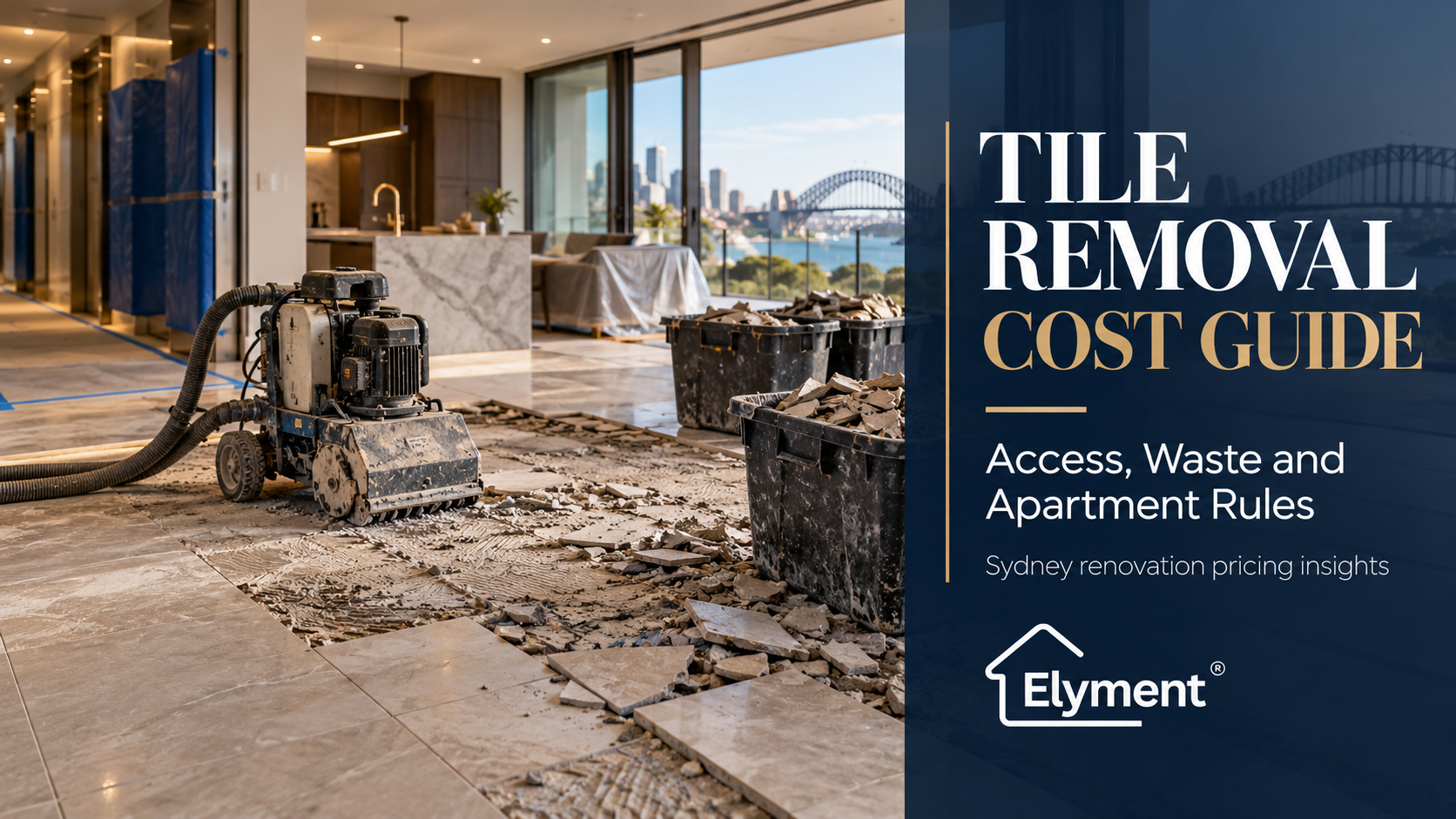
Tile removal cost in Sydney cannot be estimated reliably from floor area alone. Published pricing guides place ordinary tile uplift broadly around $30–$80 per square metre, while concrete grinding can add approximately $20–$55 per square metre, depending on the work required. These are indicative market figures, not fixed contractor rates. Waste disposal, substrate repairs, GST, strata approvals and restricted apartment access can materially change the final quotation.
The Price of Removing Tiles Is Not the Price of Preparing a Floor
A tile removal quotation can appear remarkably straightforward. A contractor measures the floor, calculates the area and provides a price for removing the existing tiles.
For Sydney homeowners, apartment owners and renovation managers, that figure is often mistaken for the complete cost of making the floor ready for replacement.
The distinction becomes important when the removal team finishes demolition but the exposed concrete is still covered in adhesive, uneven mortar or damaged surface material.
The original quotation may have covered exactly what was requested. Yet the next flooring contractor cannot proceed without further preparation.
This is where renovation costs become difficult to control.
The problem is not necessarily that a contractor has charged too much. It may be that the project was priced as one demolition activity when the owner needed a coordinated sequence of removal, disposal, grinding and substrate preparation.
Understanding the difference is essential before accepting a tile removal quote in Sydney.
What Does Tile Removal Cost in Sydney in 2026?
Published Australian flooring guides and Sydney service price lists provide a useful starting point for budgeting.
However, published prices are not a substitute for a site-specific quotation. Some cover tile uplift only, while others include loading, disposal or surface preparation.
The following ranges are broad market indicators assembled from published guides. They should not be interpreted as a single contractor's price list or guaranteed Sydney rates.
Standard Tile Removal
- Indicative price: $30–$80/m²
- Important considerations: Tile material, fixing method, access, demolition complexity and whether disposal is included.
Concrete Grinding and Adhesive Removal
- Indicative price: $20–$55/m²
- Important considerations: Adhesive thickness, grinding depth, concrete condition, tooling and dust extraction requirements.
Comprehensive Removal and Preparation
- Indicative price: Around $120–$150/m² in one published guide.
- Important considerations: An illustrative combined scope involving removal, disposal, grinding and levelling. Not applicable to every property.
Pricing note: Figures are indicative 2026 published market references. Sources differ in their inclusions and GST treatment. Waste disposal, minimum call-out charges, specialist repairs and strata requirements may be charged separately.
Published references include Sydney tile removal pricing information, Australian flooring removal and preparation cost guidance and Sydney floor removal and complete preparation estimates.
The combined preparation figure should not simply be added to the separate removal and grinding bands. It describes a different work package, and doing so could double-count activities already included.
A quote at the lower end of a published range is not automatically incomplete. Equally, a higher quotation is not necessarily better.
Meaningful comparison requires the same work, access assumptions, disposal responsibilities and finished substrate condition.
Why the Same Floor Area Can Produce Different Quotations
Square metres establish the quantity of flooring to be removed. They do not establish the labour, equipment or site controls required to complete the work.
Consider three common Sydney renovation settings. These are illustrative scenarios, not individual customer projects.
A Ground-Floor Renovation With Direct Access
A house with accessible parking, clear rooms, standard bonded tiles and a short route to a waste vehicle offers relatively straightforward working conditions.
Equipment can be moved into position efficiently, demolition waste can be transported directly outside, and the contractor may be able to complete the work without repeated interruptions.
This is the kind of setting against which simpler published removal rates are most relevant, provided the assumed floor build-up is confirmed.
An Apartment With Lift Restrictions
A similarly sized floor in a Sydney apartment may involve lift bookings, corridor protection, restricted work hours, limited vehicle access and additional manual handling.
The demolition area has not increased, but the resources needed to complete the project may have.
The contractor may need to allow more time for setup, equipment transport, waste movements and building compliance.
A Renovation With Extensive Adhesive or Mortar
Another property may offer excellent access but contain heavily bonded porcelain, slate or older tiled finishes over substantial mortar.
Removing the visible tiles may leave a substrate that requires additional grinding, local repairs or levelling.
In this case, the major cost difference may be the preparation work rather than the building's access conditions.
These comparisons demonstrate why a tile removal quote should describe more than area and price.
Waste Disposal: The Part of the Quote That Deserves Its Own Line
Tile demolition creates a heavy and sometimes difficult waste stream.
Ceramic, porcelain, slate, mortar and adhesive residue may require mechanical handling, suitable containers, loading labour and transport to an appropriate receiving facility.
A quotation stating "remove existing tiles" does not necessarily establish who pays for offsite disposal.
Before work starts, owners should confirm whether the quoted amount covers:
- Collection of tile fragments and mortar from the work area.
- Suitable rubble containers, bags or waste skips.
- Labour required to load and move demolition material.
- Transport from the property to an authorised receiving facility.
- Applicable waste facility and disposal charges.
- Final debris removal and cleaning within the agreed work area.
The NSW Environment Protection Authority explains that construction and demolition waste must be transported to a facility that can lawfully receive it.
Both the waste owner and transporter can have legal responsibilities concerning lawful disposal.
Where the material's classification or composition is uncertain, the contractor should establish the appropriate disposal pathway before removing it from site.
An unusually inexpensive disposal allowance should prompt questions about the proposed handling method, rather than an automatic assumption that the contractor has access to cheaper facilities.
Concrete Grinding Can Be a Separate Cost, Not a Standard Inclusion
One of the most consequential distinctions in a tile removal quote is whether the underlying floor will be ground after demolition.
Mechanical tile removal can expose residual adhesive, raised mortar lines, isolated high spots and uneven concrete.
Those conditions may interfere with the installation of hybrid flooring, engineered timber, vinyl, new tiles or specialist coatings.
Diamond grinding can be used to remove suitable surface residues and create the required profile for subsequent floor preparation.
But not all grinding quotations describe the same outcome.
Tile Removal
- Intended outcome: Existing tiled finish removed.
- Common limitation: Adhesive and mortar may remain.
Adhesive Grinding
- Intended outcome: Specified surface residue and high spots treated.
- Common limitation: Does not necessarily correct general floor unevenness.
Local Patch Repairs
- Intended outcome: Selected damaged or recessed areas repaired.
- Common limitation: Repair extent depends on exposed conditions.
Floor Levelling
- Intended outcome: Substrate geometry corrected to the specified requirement.
- Common limitation: Product, depth, priming and moisture conditions require assessment.
The critical question is what condition the contractor has agreed to deliver when the grinding work is complete.
A clean-looking slab is not proof that it satisfies the flatness, strength, moisture or surface-profile requirements of the proposed flooring system.
For a closer examination of this handover risk, see how adhesive ridges left after tile removal affect floor levelling.
Sydney Apartment Renovations: Approval Comes Before the Work Booking
Apartment owners must consider more than demolition logistics.
Under NSW strata legislation, the nature of the proposed renovation can determine whether owners corporation approval is required and which approval pathway applies.
The NSW Government's strata renovation guidance identifies installing or replacing wood, tile or other hard flooring as a type of minor renovation requiring the relevant approval process.
Work affecting waterproofing, structural components or other major renovation categories can require a different approval pathway.
The property's specific by-laws and the complete proposed work scope must also be considered.
What Should Be Confirmed With Strata?
- Required approvals for removal and replacement flooring.
- Permitted demolition and grinding hours.
- Requirements for protecting common property, lifts and corridors.
- Waste-loading locations and vehicle access arrangements.
- Contractor insurance, access and induction requirements.
- Acoustic performance requirements for the replacement flooring.
- Restrictions or approvals relating to waterproofing and common property.
In some apartment buildings, scheduling the work can take longer than carrying out the physical tile removal.
Owners should therefore avoid committing to a contractor's start date until the necessary approvals and access arrangements have been resolved.
When Does Access Increase the Cost of Tile Removal?
Sydney properties present widely different equipment and waste access conditions.
Inner-city apartments, established terrace houses, high-rise residential buildings and suburban houses can require substantially different mobilisation arrangements.
The following conditions can increase labour or logistics requirements:
- Restricted parking or loading access.
- Long distances between the work area and the waste vehicle.
- Stair access where suitable machinery cannot be brought in by lift.
- Limited permitted working hours.
- Building-specific protection or supervision requirements.
- Difficult internal access for grinding equipment.
- Multiple separated rooms requiring repeated machine setup.
Not every restriction produces a separate charge. Some contractors account for access in their overall labour and equipment allowances.
What matters is whether the actual site conditions match the assumptions used to prepare the quotation.
The broader operational implications are explored in why parking and loading access can change Sydney floor removal costs.
What Happens When the Tiles Conceal Additional Work?
A contractor cannot always verify every layer beneath an existing tiled floor before demolition begins.
Previous renovations may have introduced another tile layer, thicker mortar, patching material, an older underlay or other concealed construction.
These conditions can affect removal methods, disposal quantities and the preparation required afterwards.
A reliable quotation should distinguish between the work that can be assessed before demolition and conditions that require further investigation.
Common Exclusions Requiring Clarification
- Additional concealed tile layers or substantial bedding.
- Removal of screed or previous floor levelling materials.
- Unexpected substrate damage requiring repair.
- Structural investigation or repairs.
- Specialist hazardous-material identification and remediation.
- Waterproofing removal or reinstatement.
- Extensive grinding or floor levelling beyond the original scope.
- Reinstallation of skirting, cabinetry or other fixtures.
Where unexpected conditions are discovered, the appropriate response is to document the issue, assess its significance and agree on any necessary variation before the additional work proceeds.
Continuing into unidentified floor assemblies without assessment can create safety, structural and contractual risks.
This issue is examined in greater detail in how concealed tile layers change demolition scope and scheduling.
Dust Control Is a Safety Requirement, Not a Premium Optional Extra
Tile demolition and concrete grinding may generate respirable crystalline silica dust when silica-containing materials are disturbed.
SafeWork NSW identifies concrete, mortar, stone and many tiles as materials that can contain crystalline silica.
The risks arise when processing creates airborne particles capable of entering the lungs.
The contractor must select appropriate controls for the materials, equipment and conditions involved.
These may include suitable dust extraction, wet methods where appropriate, respiratory protection, work-area isolation and controlled cleanup procedures.
Property owners should be cautious of an unsupported promise that demolition will be entirely dust-free.
Appropriate management controls reduce exposure risks. They do not make the physical disturbance of building materials disappear.
See SafeWork NSW's crystalline silica guidance for information on affected materials and exposure hazards.
The Quote Comparison That Matters: What Is Actually Included?
Two tile removal quotes should be compared against a common scope rather than their headline totals alone.
A useful comparison separates confirmed inclusions, assumptions, excluded work and potential variations.
Area
- What to verify: Measured square metres, rooms, thresholds and edges.
Tile Removal
- What to verify: Materials and floor layers covered by the price.
Disposal
- What to verify: Loading, transport and lawful waste disposal included.
Grinding
- What to verify: Included area and intended concrete surface condition.
Repairs
- What to verify: Whether patching or levelling is included or excluded.
Access
- What to verify: Parking, stairs, lifts, working hours and protection.
Variations
- What to verify: How unexpected conditions will be assessed and approved.
Handover
- What to verify: The condition in which the floor must be left.
Price and Payment
- What to verify: GST, contract requirements, payment milestones and deposit arrangements.
For NSW residential building work covered by the relevant contract legislation, written contract requirements apply once the value exceeds $5,000 including GST.
NSW home building law also generally limits deposits to 10% of the contract price for work within that regime.
Owners can review the NSW Government's residential building contract guidance before entering into an agreement.
The Real Budget Risk Is an Unpriced Stage Between Trades
Consider a renovation programme in which the existing tiles must be removed before new flooring arrives.
The demolition contractor completes the agreed removal. The waste has been collected and the work area is cleared.
The installation contractor then inspects the exposed concrete.
Residual adhesive, slab variation or surface damage prevents the proposed floor from being installed under the specified requirements.
The project now needs an additional assessment, revised preparation work and possibly a change to the installation schedule.
This can introduce costs beyond the extra grinding or levelling:
- Another contractor visit or equipment mobilisation.
- Rescheduling the next flooring trade.
- Revising strata access or lift bookings.
- Delaying cabinetry, skirting or other finishing activities.
- Additional site protection and project supervision.
Not every project will encounter these costs.
The purpose of careful scope planning is to avoid making necessary work visible only after the next trade has arrived.
This is particularly important where a kitchen renovation, apartment refurbishment or commercial fit-out operates within a restricted handover period.
Before Accepting a Tile Removal Quote, Check These Six Decisions
1. What is being removed? Confirm the tiled areas, skirting details, expected floor assembly and removal depth.
2. Who manages the waste? Establish whether loading, transport and lawful disposal are included in the agreed price.
3. Is concrete grinding included? Identify the preparation method and the surface condition expected at completion.
4. Has the building approved the work? Resolve applicable strata requirements, working hours, lift bookings and common property protection.
5. What remains unpriced? Ask about concealed layers, levelling, repairs, moisture and specialist remediation.
6. Who accepts the prepared substrate? Coordinate the demolition handover with the requirements of the incoming flooring installer.
A quotation that provides these answers is more useful for cost management than one which offers only a low square-metre figure.
Plan the Removal. Know What's Included.
Sydney Floor Preparation & Renovation Delivery
Review tile removal, concrete grinding, waste management, strata requirements and floor preparation before committing to your renovation schedule.
Discuss Your Renovation Project →
Project Planning • Floor Preparation • Delivery Coordination
A Reliable Tile Removal Quote Defines the Finished Responsibility
Tile removal cost in Sydney is shaped by several related decisions: what is being demolished, how the material is removed, where the waste goes and what condition the floor must reach afterwards.
Indicative market prices provide a starting point, but they do not establish the complete cost of every renovation.
Apartment access, strata approvals, restricted work periods and substrate preparation can all alter the actual work package.
The most useful quotation is therefore one that establishes a clear separation between included demolition, confirmed preparation, excluded activities and any additional work that requires approval.
For Sydney owners, builders and project managers, that clarity supports more accurate budgeting, fewer scope disputes and a better coordinated handover to the next renovation stage.
Sources and References
- Carpet Removal Sydney: The Cost of Removing Floor Tiles
- FloorVenue: How Much Does Floor Tile Removal Cost?
- Floor Plan Studio: How Much Does Floor Removal Cost in Sydney?
- NSW Environment Protection Authority: Construction and Demolition Waste
- NSW Government: Strata Renovations
- SafeWork NSW: Crystalline Silica and Engineered Stone Guidance
- NSW Government: Residential Building Contracts
- Elyment: Tile Removal Before Floor Levelling — The Adhesive Ridges That Stop New Flooring Sitting Flat
- Elyment: Why Did a Sydney Floor Removal Quote Change Because Parking Was the Hardest Part?
- Elyment: Tile Removal Sydney — How a Hidden Second Tile Layer Changes the Quote and Timeline
Know the Scope. Understand the Cost.
Review tile removal, waste disposal, grinding, strata conditions and subfloor preparation before committing to your renovation programme.
Review Your Project REMOVAL • GRINDING • DISPOSAL • PROJECT COORDINATIONRelevant next actions
Explore the ELYMENT service most closely connected to this article.