Timber Floor Installation Sutherland Shire: Select vs Feature Grade
Planning timber floor installation in Sutherland Shire? Compare Select and Feature grades, including style, price differences and long-term value before buying.
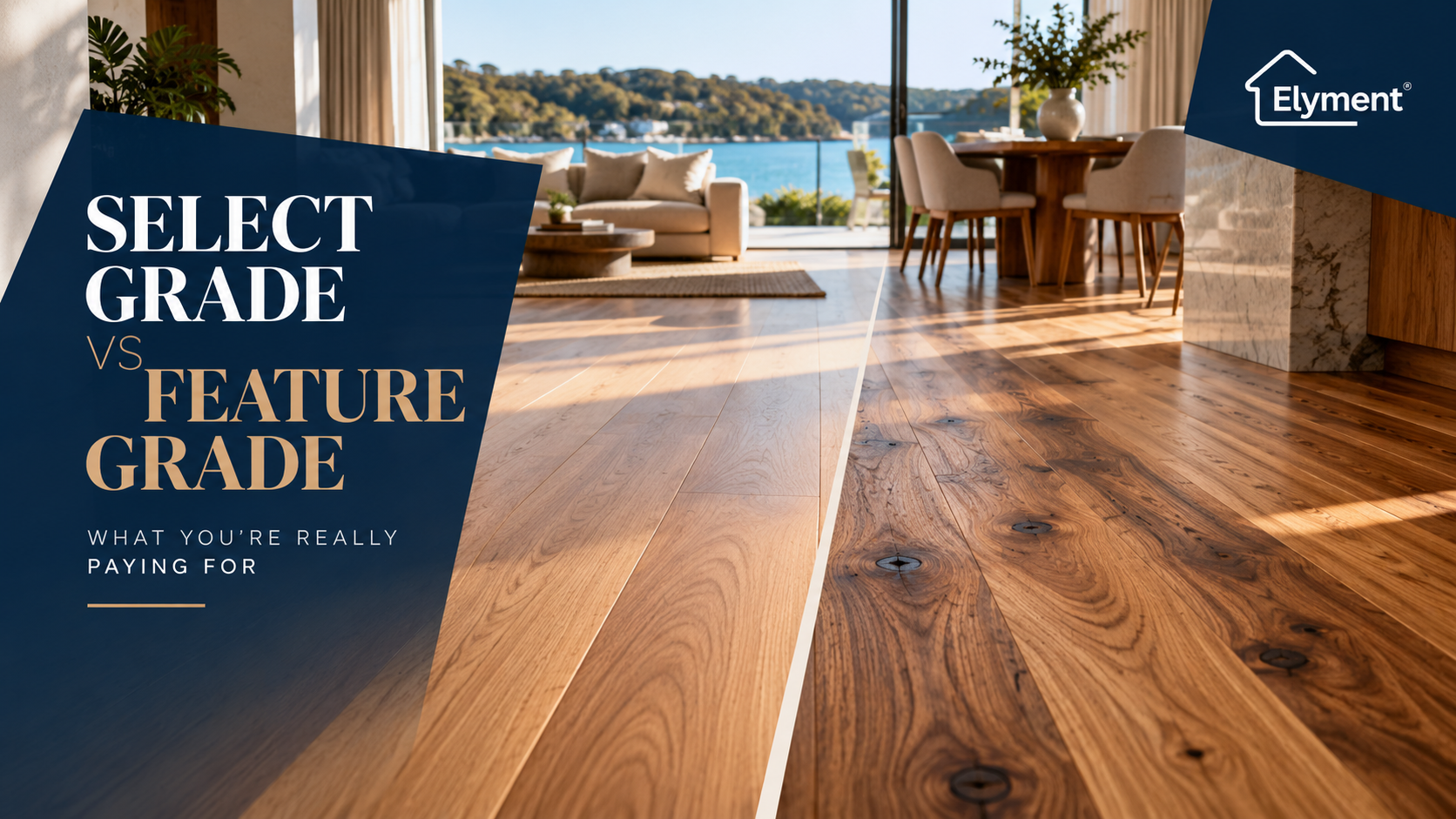
Select Grade timber flooring generally has fewer and smaller visible knots, gum veins and natural markings than higher-feature grades, but it is not automatically harder or more durable. For Sutherland Shire homeowners, the premium is primarily an appearance decision. Compare representative samples, confirm the supplier's grading rules and request itemised installation quotes. NSW strata projects also require flooring approval and acoustic considerations.
ELYMENT Insights | Home Improvement & Flooring | 23 October 2026
The Most Expensive Timber Floor Is Not Necessarily the Better One
A renovated house in Caringbah might feature uninterrupted expanses of pale timber, discreet joinery and generous natural light. In that setting, a floor with relatively few knots may be central to the architectural brief.
A family home in Gymea or Engadine may take a different approach. Visible grain movement, darker gum veins and natural knots can complement older materials, exposed brickwork or character-focused interiors.
Neither homeowner is necessarily buying inferior timber. They are purchasing different visual outcomes.
That distinction matters when comparing quotes for timber floor installation in Sutherland Shire. Select Grade is frequently presented as a premium product, while Feature Grade can appear to be the economical alternative.
Yet the price difference does not establish that one floor will withstand furniture movement, household traffic or surface wear better than the other.
The real purchasing decision is whether the proposed grade will deliver the appearance the homeowner expects once dozens or hundreds of individual boards are installed together.
What Select Grade and Feature Grade Actually Describe
Timber appearance grading controls the nature and extent of visible features within the boards.
The Australasian Timber Flooring Association's hardwood flooring guidance explains the principal appearance grades associated with Australian Standard AS 2796 for hardwood flooring.
Select Grade
- Typical characteristics: Fewer and generally smaller permitted natural features, including knots and gum veins.
- Visual outcome: Cleaner, more restrained appearance without eliminating natural timber variation.
Medium Feature / Standard Grade
- Typical characteristics: Greater allowance for visible natural markings and variations in character.
- Visual outcome: Balanced appearance with more noticeable timber character.
High Feature Grade
- Typical characteristics: More prominent and extensive natural features, subject to the applicable grading rules.
- Visual outcome: Stronger visual character and a more rustic or expressive finish.
There is an important qualification: the commercial description Feature Grade does not necessarily identify one universal grading specification.
Some manufacturers use proprietary descriptions such as Character, Natural, Rustic or Feature. Engineered timber suppliers may operate grading systems that differ from those applied to Australian solid hardwood.
Buyers should establish whether the flooring is graded to an applicable Australian Standard or to the manufacturer's own published rules.
Select Grade also does not mean knot-free. Nor does grading guarantee a particular colour range, board length or arrangement of features across the floor.
As ATFA's consumer guidance on floor colour and grade makes clear, species, natural colour variation and board arrangement substantially influence the final appearance.
Fewer Knots Do Not Automatically Mean a Tougher Floor
One of the most misleading assumptions in timber purchasing is that a cleaner-looking board must be stronger or harder-wearing.
Appearance grade is not a consumer durability rating. For comparable products of the same species and construction, paying for fewer visible features does not inherently improve surface hardness.
Where a timber product is proposed for a structural application, its suitability must still be established through the relevant product specification, structural requirements and installation design.
For day-to-day residential performance, owners should consider several separate factors:
- Timber species: Species-specific hardness and characteristics influence susceptibility to dents and everyday damage.
- Product construction: Solid and engineered timber have different constructions, installation requirements and movement characteristics.
- Surface finish: Coating formulation, application and maintenance affect the floor's resistance to wear and staining.
- Subfloor condition: Moisture, flatness and substrate stability can affect performance regardless of appearance grade.
- Installation and maintenance: Correct fixing, expansion allowance and ongoing care remain essential.
A homeowner choosing between Select Grade and Feature Grade Spotted Gum should therefore compare the actual products on offer, not assume that cleaner grain indicates superior physical performance.
A properly specified Feature Grade floor may be a better purchasing decision than a more expensive Select Grade floor if the natural markings suit the intended design.
The Showroom Sample Can Create the Wrong Expectation
A short sample board is useful for assessing finish and general colour. It is less reliable as a representation of an entire room.
This matters particularly with Australian hardwoods such as Blackbutt and Spotted Gum, where natural variation can be a prominent design characteristic.
A sample may show a particularly clean section of timber, while the delivered batch contains a wider distribution of permissible features.
Alternatively, a Feature Grade sample may concentrate dramatic markings that appear less prominent once boards are distributed over a large area.
A Better Sample Approval Process
- Confirm the exact product: Record the manufacturer, species, construction, profile, dimensions, finish and stated grade.
- Request a representative sample: Where practical, inspect a multi-board panel or several boards rather than one small offcut.
- Compare in the intended room: View the boards in natural and artificial light alongside cabinetry, paint and joinery.
- Understand permitted variation: Ask for written grading descriptions and examples showing the range of features that may be supplied.
- Document the approval: Record the accepted product and appearance expectations before ordering.
This is especially useful for open-plan living areas, where the appearance of the floor is determined by the combined distribution of many boards.
A photograph of one attractive board should not become the sole reference used to assess the finished installation.
Why the Installer's Board Layout Matters as Much as the Grade
Timber grading primarily concerns the characteristics of individual boards. It does not automatically determine where those boards will appear within a completed floor.
Consider an otherwise restrained living room where several heavily marked boards end up grouped in the most visible section near a full-height window.
Even if the boards meet the agreed grading rules, the finished floor may look substantially different from the homeowner's expected arrangement.
A competent installation plan should consider:
- Distribution of darker and lighter boards.
- Placement of more prominent knots and gum veins.
- Board-length distribution and end-joint staggering.
- Direction of installation and the principal viewing angle.
- Transitions between rooms and adjacent floor finishes.
- Manufacturer requirements and available cutting allowance.
These considerations should not be interpreted as a promise that every natural marking can be positioned according to personal preference.
Excessive rejection or selective placement may require additional material, sorting time and labour.
The sensible approach is to agree on reasonable distribution expectations before installation starts.
Elyment has separately examined how engineered timber offcuts can affect plank layout. Appearance selection adds another consideration to that installation planning.
Where the Select Grade Premium Actually Appears in a Quote
Select Grade can attract a higher supply price because meeting a more restrictive visual specification may reduce the proportion of boards available from a particular production run.
However, there is no universal percentage premium. Pricing depends on the species, product construction, supplier, availability, dimensions, grading rules and market conditions.
More importantly, the material price difference does not necessarily represent the difference in the completed flooring project.
Timber Supply
- What should be disclosed: Brand, species, grade, dimensions, quantity and unit rate.
- Why it matters: Establishes the actual price difference between the selected products.
Waste Allowance
- What should be disclosed: Ordered quantity versus installed area, including cuts and spare material.
- Why it matters: Prevents an unrealistic material comparison based only on room area.
Removal and Disposal
- What should be disclosed: Existing flooring removal, waste handling and any exclusions.
- Why it matters: Separates demolition costs from the new timber selection.
Subfloor Preparation
- What should be disclosed: Grinding, repairs, levelling, moisture assessment and applicable treatments.
- Why it matters: Identifies work necessary before either grade can be installed.
Installation Labour
- What should be disclosed: Fixing method, board layout, stair work and special installation requirements.
- Why it matters: Shows whether additional sorting or selection labour has been allowed.
Finishing Details
- What should be disclosed: Coatings where applicable, trims, skirting, thresholds and stair nosings.
- Why it matters: Clarifies what is required to complete the installed finish.
Commercial Conditions
- What should be disclosed: GST, deposit, delivery, lead time, variations and warranty terms.
- Why it matters: Allows meaningful comparison of total project commitments.
For a defensible comparison, request two quotations using the same species, board dimensions, construction, finish, installation method and site preparation assumptions, with grade as the principal variable.
If one quotation changes several product specifications, the price difference cannot reasonably be attributed to grading alone.
Elyment's flooring supply and installation checklist provides further context on ordering, lead times, product quantities and installation scope.
The Hidden Cost of Rejecting Boards After Delivery
A disagreement about timber appearance can become a programme problem rather than simply a product complaint.
Suppose a homeowner approves a small Select Grade sample and later decides that several delivered boards contain too much visible character.
Those boards may nevertheless be compliant with the agreed grading specification.
If the owner requests a more selective appearance beyond the contract requirements, the resulting changes may involve:
- Additional sorting and inspection time.
- More timber to replace boards excluded for appearance reasons.
- Supplier discussions and possible restocking restrictions.
- Interrupted installation or rescheduled trades.
- Extra handling and revised delivery arrangements.
- Disagreement about whether additional work is a variation.
Genuine nonconforming goods should be assessed separately from a later change in aesthetic preference. Consumer rights are not displaced by a grading description or a supplier's returns policy.
The practical safeguard is a documented acceptance standard agreed before the supply order becomes commercially difficult to change.
The Sutherland Shire Decision: Two Different Renovation Briefs
The following illustrative scenarios show why the same appearance grade does not suit every project.
A Contemporary Renovation in Miranda
An owner is replacing an older floor in a home with minimal cabinetry, continuous pale finishes and large areas of glazing.
The architectural preference is for relatively uninterrupted grain and fewer prominent markings. The selected supplier's Select Grade product may justify its additional cost because the cleaner appearance is central to the interior scheme.
The decision should still be based on representative boards and written grade expectations rather than an assumption of better durability.
A Character Renovation in Sutherland
Another owner is updating an established family home with warm timber joinery, natural materials and a less uniform visual brief.
A higher-feature product may provide the desired appearance without the additional supply premium associated with a more restrictive grade.
The saving, if one is available, may be better directed towards substrate rectification, the preferred surface finish or other necessary renovation works.
These are design and procurement choices, not evidence that one grade performs better in service.
Floor Preparation Must Not Become the Budget Trade-Off
A homeowner may spend more on cleaner-looking boards while underestimating the cost of preparing the floor beneath them.
This is particularly relevant in Sydney properties where the existing floor may conceal adhesive, deteriorated underlay, uneven concrete or other substrate defects.
Before confirming supply, establish whether the project requires:
- Removal of existing timber, carpet or other flooring.
- Adhesive removal or concrete grinding.
- Moisture assessment and compatible moisture control.
- Local repairs or floor levelling.
- Assessment of timber sheet substrates, battens or joists.
- Changes to door clearances, transitions or skirting.
The exact requirements depend on the flooring product and installation system.
Elyment's floor flatness and preparation guidance explains why product-specific requirements should be established before installation.
Where suitable, floor levelling and concrete grinding can form part of the coordinated preparation scope.
A more expensive appearance grade does not compensate for inadequate substrate preparation.
Apartment Owners Have a Separate Approval Question
For an apartment renovation in Cronulla, Sutherland or another strata-managed property, the grade decision sits alongside approval and acoustic requirements.
The NSW Government's strata renovation guidance identifies installing or replacing timber and other hard flooring as a minor renovation generally requiring approval, subject to the applicable legislation and scheme arrangements.
The guidance also identifies acoustic certification among the information required when proposing hard flooring.
Owners should confirm:
- Relevant strata by-laws and approval procedures.
- Acoustic performance requirements for the flooring system.
- Suitable underlay or other acoustic construction details.
- Contractor information and proposed work dates.
- Access, deliveries, waste handling and permitted working hours.
These matters relate to the complete flooring assembly and how it is installed. A Select Grade appearance designation does not establish acoustic compliance.
Grade selection should not delay approval documentation or displace necessary technical checks.
A Purchase Decision That Can Be Defended After Installation
Before committing to either appearance grade, homeowners should be able to answer five questions:
- Which published grading rules apply to the exact timber product being supplied?
- Have representative boards been inspected and the expected variation documented?
- Has the installer explained the intended distribution of colour and natural features?
- Does the quote isolate the material premium from preparation, labour and finishing costs?
- Are site conditions and any strata approval requirements addressed before ordering?
The conclusion is not that Select Grade is overpriced or that Feature Grade is always better value. Each can be appropriate for a different architectural brief and purchasing budget.
In Sutherland Shire renovation projects, the stronger decision is the one supported by a clear appearance specification, realistic samples, coordinated preparation and an itemised installation scope.
Paying more for Select Grade can be worthwhile when its more restrained appearance is genuinely important. Paying more merely because the grade sounds superior is a much weaker justification.
Review Your Timber Flooring Project Before You Commit
ELYMENT | PROPERTY & RENOVATION SERVICES
Discuss flooring selection, removal, subfloor preparation, installation scope and project coordination for your Sydney renovation.
Sutherland Shire | Sydney & NSW | Flooring & Renovation Planning
Sources and References
Industry Guidance
- Australasian Timber Flooring Association (ATFA): Hardwood Flooring Guidance
- Australasian Timber Flooring Association (ATFA): Floor Colour and Grade – Consumer Guidance
Government Guidance
Related Elyment Resources
- Engineered Timber Flooring Sydney: Can Offcuts Spoil Layout?
- Flooring Supply and Installation Sydney: What to Confirm Before You Order Hybrid, Vinyl or Timber
- Floor Flatness Tolerance Guide: Hybrid, Vinyl and Timber Specs Before Installation
- Elyment: Floor Levelling and Concrete Grinding Sydney
ELYMENT | PROPERTY & RENOVATION SERVICES
Review Your Timber Flooring Project Before You Commit
Discuss flooring selection, removal, subfloor preparation, installation scope and project coordination for your Sydney renovation.
Request a ReviewSutherland Shire | Sydney & NSW | Flooring & Renovation Planning
Relevant next actions
Explore the ELYMENT service most closely connected to this article.