Timber Floor Removal Cost Sydney: De-Nailing and Storage
Keeping timber boards after floor removal in Sydney? De-nailing, careful handling and storage may be extra. Check what your quote includes to avoid added costs.
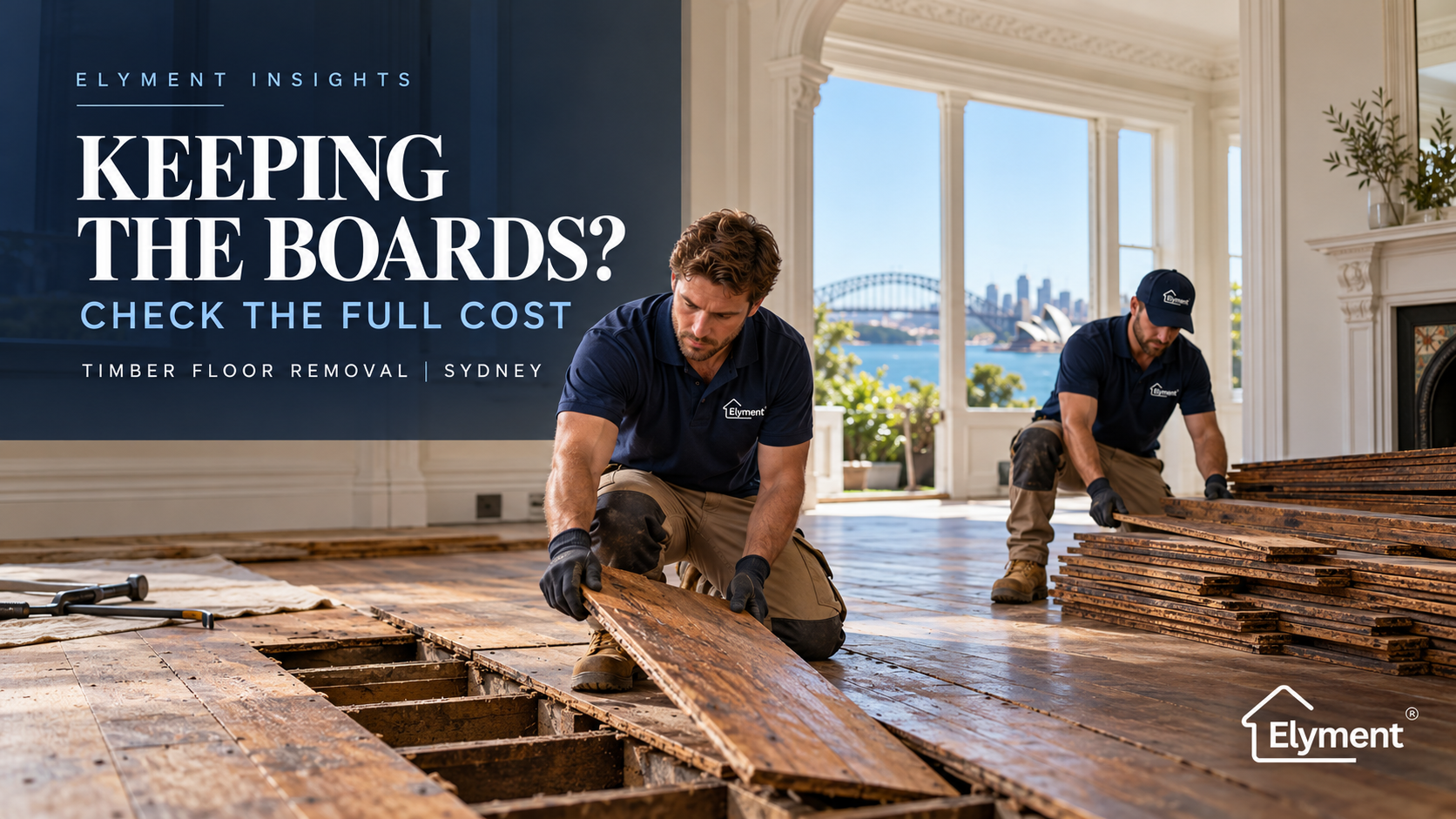
In Sydney, timber floor removal quotes do not automatically include de-nailing, packing, transporting or storing boards that an owner wants to retain. These are separate labour and logistics activities. NSW property owners should confirm the agreed removal method, ownership of salvaged timber, handling responsibilities, storage charges and any negotiated salvage credit before work begins. A removal price alone does not establish what happens to the boards afterwards.
ELYMENT Insights | Sydney & NSW Property Operations
The Old Floorboards May Be Valuable. Keeping Them Is Not Necessarily Free.
In an established Sydney home, original hardwood floorboards can carry architectural, historical and practical value. A renovation may require the boards to be removed, yet the owner may want them returned for another room, future repairs or a separate restoration project.
That decision introduces a commercial distinction that is frequently missed during early quoting.
Removing timber for disposal is one service. Removing it for the owner to retain is potentially a different service, even when both begin with the same installed floor.
Conventional removal is generally planned around safe, efficient stripping and the agreed condition of the remaining substrate. Retention introduces further handling, protection, recording and delivery requirements.
The central pricing question is therefore not whether timber can be salvaged. It is which party is paying for each operation between the installed floor and the owner's eventual possession of the recovered boards.
This is especially relevant to nail-fixed strip flooring in older houses across Sydney's Inner West, Eastern Suburbs and North Shore, where renovations may uncover original hardwood boards or later secret-nailed installations.
A Floor Removal Quote Can Contain Eight Different Cost Items
The phrase "remove and retain existing timber" sounds comprehensive. In practice, it leaves several material decisions unanswered.
An itemised quotation should distinguish the physical removal from subsequent salvage services.
- 1. Timber uplift
- What needs to be defined: Whether boards are removed for disposal or carefully lifted for retention.
- Possible pricing basis: Floor area, labour time or agreed scope.
- 2. Floorboard de-nailing
- What needs to be defined: Removal or safe treatment of nails and other fixings attached to retained boards.
- Possible pricing basis: Labour allowance or measured quantity.
- 3. Sorting and identification
- What needs to be defined: Separating reusable boards, damaged lengths, offcuts and material requiring further work.
- Possible pricing basis: Included allowance or additional labour.
- 4. Packing and protection
- What needs to be defined: Bundling, wrapping, labelling, pallets, spacers and appropriate protective materials.
- Possible pricing basis: Materials and labour.
- 5. Site handling
- What needs to be defined: Carrying boards downstairs, through occupied spaces, or to an approved loading area.
- Possible pricing basis: Labour, access and handling requirements.
- 6. Transport
- What needs to be defined: Loading, vehicle requirements, delivery destination and unloading arrangements.
- Possible pricing basis: Vehicle, distance and handling.
- 7. Storage
- What needs to be defined: Storage location, duration, access, timber protection and responsibilities.
- Possible pricing basis: Agreed storage charge and duration.
- 8. Return delivery
- What needs to be defined: Whether reclaimed timber will be transported back to the property or another installer.
- Possible pricing basis: Separate delivery or handling allowance.
These are potential scope components, not mandatory charges on every project. A contractor may include some activities in a consolidated price. Others may require separate arrangements.
For owners comparing timber floor removal cost in Sydney, understanding the inclusions matters more than comparing an unqualified price per square metre.
De-Nailing the Salvaged Boards Is Not the Same as Clearing the Subfloor
A particularly important ambiguity concerns the term "de-nailing".
On a nail-fixed hardwood floor, two different surfaces may require attention once the boards have been lifted.
The boards being retained
Recovered floorboards may contain protruding nails, concealed fixings, broken fasteners or metal embedded near their tongues.
If the owner intends to keep the timber, the quotation should clarify whether these fixings will be removed, made safe for handling, or left for a subsequent timber restoration specialist.
Removing nails without damaging surrounding timber can require additional manual labour. Some fixings may be difficult to extract cleanly, particularly where timber is brittle or nail heads have broken.
The substrate left behind
Meanwhile, the remaining timber subfloor, battens, plywood or concrete base may contain separate protruding fixings.
These affect the preparation requirements of the next flooring contractor.
Elyment's analysis of problems secret nails can leave in Sydney subfloors explains why clearing and inspecting the receiving surface should be treated as a distinct handover task.
Commercial implication: A quote that includes removing nails from the floor base does not necessarily include preparing every salvaged board for storage or reuse.
The Cheapest Removal Price May Produce the Most Expensive Handover
Consider a hypothetical Sydney renovation involving 45 square metres of mechanically fixed hardwood flooring. The owner wants to retain the timber while a new flooring system is installed.
One quotation allows for efficient uplift and disposal. Another provides for controlled removal, separation of usable lengths and transfer of the retained material to an agreed collection point.
The first quotation may carry the lower headline removal price. However, it does not satisfy the owner's stated requirement to keep the boards.
If the client subsequently requests de-nailing, protective packing, off-site transport and several weeks of storage, those activities may require additional pricing and programme allowances.
Equally, an expensive salvage-inclusive proposal should not automatically be considered better. Its value depends on whether the included services are actually required.
The correct comparison is a like-for-like description of deliverables:
- What material is being removed?
- In what condition must the retained material be handed over?
- Where will that handover occur?
- Who is responsible after the handover?
- Which later services remain excluded?
This turns a vague renovation allowance into a defined procurement decision.
Who Actually Owns the Timber After It Leaves the Property?
Reclaimed timber may have resale potential, architectural appeal or value as matching replacement material. However, these possibilities should not be confused with an automatic financial credit.
The removal agreement should expressly establish ownership and the intended disposition of the material.
For example, the parties may agree that:
- All identified salvageable boards remain the property of the client.
- The contractor removes and returns the specified timber as part of the agreed scope.
- The owner authorises particular materials to be disposed of or transferred to another party.
- A separately negotiated salvage credit applies to timber the contractor is expressly permitted to retain.
Each arrangement can have different commercial consequences. The parties should document which arrangement applies rather than relying on an assumption about ownership once materials leave site.
A salvage credit is an agreement, not an entitlement
Some owners expect contractors to purchase old hardwood as part of the removal job. That may not reflect the commercial market available for the particular timber.
Recovered boards can vary in species, length, condition, contamination, fixing damage and future usability. Removing, transporting and processing them may cost more than an interested buyer is prepared to pay.
A contractor may agree to a credit in specific circumstances, but there is no reason to assume that all reclaimed timber attracts a buyback offer.
Where a credit is negotiated, the quotation should record the agreed amount or calculation method, eligible material, ownership transfer point and any conditions affecting the credit.
The credit should also be distinguished from avoided disposal costs. One does not automatically establish the other.
Storage Changes the Contract From Removal to Material Custody
Retaining old floorboards can create a time gap between removal and their next use.
A Sydney renovation may involve painting, structural work, replacement subfloors or other trades before the reclaimed timber is needed again.
During that period, the boards require a defined storage arrangement.
Critical questions include:
- Is storage on-site, at the owner's premises or at a third-party facility?
- Who arranges and pays for the storage space?
- How long is the initial storage period?
- What happens if the renovation programme extends beyond the agreed period?
- How will the boards be protected from moisture, handling damage and construction traffic?
- Who can access or release the material?
- What insurance and loss or damage responsibilities have been agreed?
Temporary storage should not be mistaken for specialist timber conditioning. If the material will later be reinstalled, the receiving installer must assess its condition and suitability for the intended environment.
The NSW Environment Protection Authority's renovation guidance recognises reuse and recovery of building materials, including timber, as alternatives to disposal. However, deciding to retain a material does not eliminate the practical handling obligations.
In Sydney Strata Buildings, Getting the Boards Out Can Become a Separate Job
An established detached house may have direct access to a driveway or garage. An apartment renovation can present an entirely different logistical problem.
Recovered boards may need to travel through lift lobbies, protected corridors, narrow stairwells or restricted loading facilities.
Long timber lengths can be especially inconvenient when building access and manoeuvring space are limited.
NSW Government guidance on strata renovation approvals identifies changes involving wood and other hard flooring as work that can require formal approval under the relevant strata arrangements.
Before work begins, owners and project managers should confirm applicable by-laws and requirements for access, common-area protection, permitted work hours, loading and temporary storage.
The additional cost may have little to do with the timber itself. It may instead arise from labour-intensive movement and restricted access conditions.
A quote should specify whether the contractor's handover obligation ends inside the apartment, at the building loading dock or at a separate delivery address.
De-Nailing and Packing Also Carry Safety Responsibilities
Salvaged timber is not automatically safe to handle simply because it has been removed without major visible damage.
Protruding nails, splinters, sharp edges, unstable stacks and repeated carrying can introduce physical hazards.
SafeWork NSW's hazardous manual tasks guidance identifies repetitive force, awkward postures and lifting or carrying demands among the relevant workplace risk factors.
The agreed work method should address safe removal and handling, appropriate equipment, stable packing and suitable movement routes.
Owners should also avoid treating unexplained older coatings, suspect residues or concealed materials as automatically suitable for uncontrolled sanding or processing.
Where the renovation exposes potentially hazardous materials, the relevant assessment and safe-work requirements must be addressed before further disturbance.
What a Written Scope Should Establish Before Work Starts
For NSW residential building work, the NSW Government's home building contract guidance explains the relevant written-contract requirements, including those applying to work valued above $5,000 including GST.
Regardless of whether a particular removal job reaches that threshold, a clear written salvage scope helps reduce disagreements.
A practical retained-board agreement should establish the following:
1. Material identification
Which rooms, board types or flooring areas are designated for retention.
2. Removal method
Whether the allowance provides for selective uplift rather than conventional disposal-led removal.
3. Condition and limitations
What is expected at handover, including how existing defects and unavoidable removal damage will be addressed.
4. De-nailing responsibility
Whether fixings will be removed from retained boards, the remaining floor base, or both.
5. Packing and identification
Who supplies protection and whether quantities and lengths will be recorded.
6. Transport and storage
The destination, initial duration, access arrangements and charges.
7. Ownership and salvage credit
Who retains title to the material and whether a specific credit or transfer has been agreed.
8. Variations and release
How extra work is approved and when responsibility for the stored material transfers.
If more extensive work becomes necessary after the floor is opened, any variation should be documented and agreed under the applicable contractual process before additional work proceeds.
The Next Flooring Contractor Still Needs a Defined Handover
A retained-timber arrangement should not distract from the condition of the floor left inside the building.
Depending on the original installation, removal may expose damaged plywood, loose battens, concealed fixings, adhesive residues or concrete requiring further preparation.
A demolition contractor's responsibility for the recovered timber and the flooring preparation team's responsibility for the exposed substrate should therefore be defined separately.
Elyment's Sydney flooring removal and preparation services address the wider project sequence, including removal planning, concrete grinding, floor levelling and handover requirements.
Property owners considering reuse can also refer to Elyment's separate assessment of whether old herringbone parquet can be recovered for reuse. That technical recovery question differs from the contractual responsibilities involved in retaining nail-fixed floorboards.
The Commercial Decision Is About Deliverables, Not Just Square Metres
An owner who intends to discard old timber and an owner who wants the boards returned may require materially different removal services.
Neither approach has one universally correct price structure.
The important distinction is that timber removal, de-nailing, sorting, packing, transport and storage are separate activities whose inclusion should be established before the project starts.
Ownership should be recorded rather than assumed. Any salvage credit should be negotiated rather than promised.
For Sydney property owners, builders and renovation managers, the most reliable quotation is one that makes both the physical work and the commercial handover unmistakably clear.
ELYMENT | SYDNEY PROPERTY OPERATIONS
Clarify the Removal Scope Before the Boards Come Up
Review selective timber removal, retained-material handling, site access, storage arrangements and flooring preparation requirements before confirming your Sydney renovation programme.
Sources and References
Regulatory and Government Sources
- NSW Environment Protection Authority: Household Building and Renovation
- NSW Government: Strata Renovations and Approvals
- SafeWork NSW: Hazardous Manual Tasks
- NSW Government: Home Building Contracts
Elyment Services and Related Articles
- Elyment: Timber Floor Removal Sydney — 4 Problems Secret Nails Can Leave in the Subfloor
- Elyment: Sydney Flooring Removal and Preparation Services
- Elyment: Parquet Flooring Removal Sydney — Can Old Herringbone Blocks Be Lifted Cleanly Enough for Reuse?
- Elyment: Contact and Project Enquiries
ELYMENT | SYDNEY PROPERTY OPERATIONS
Clarify the Removal Scope Before the Boards Come Up
Review selective timber removal, retained-material handling, site access, storage arrangements and flooring preparation requirements before confirming your Sydney renovation programme.
Review My ProjectRelevant next actions
Explore the ELYMENT service most closely connected to this article.