Timber Floor Removal Sydney Over Glued Rubber Underlay: Do the Boards and Acoustic Mat Need Separate Removal?
Removing timber floors over glued rubber underlay in Sydney? Learn whether boards and acoustic mat need separate removal, plus labour, damage and disposal risk.
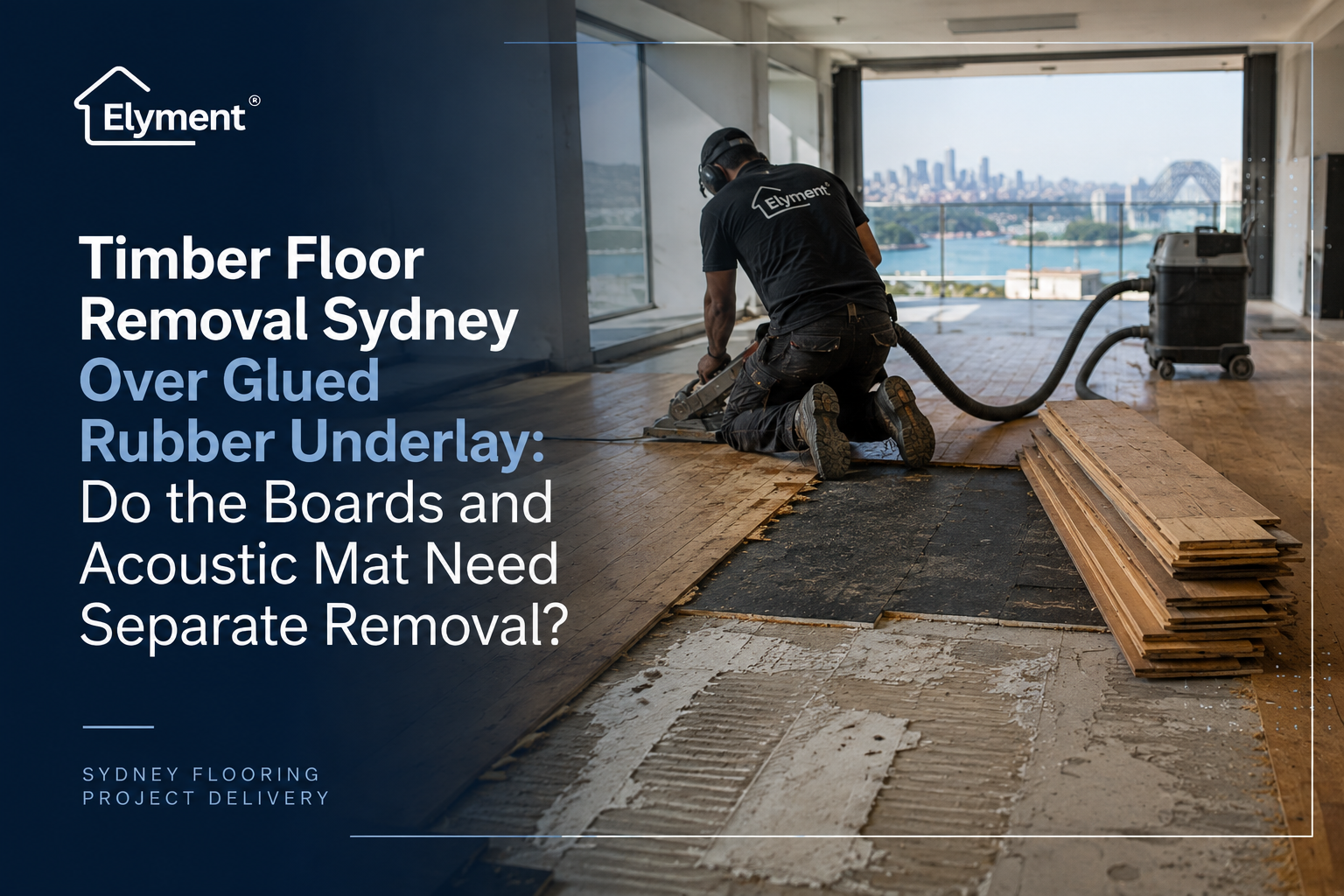
Engineered timber and glued rubber acoustic underlay do not automatically need to be removed in separate stages. On Sydney projects, the correct sequence depends on which bond releases first, how the rubber behaves under removal equipment, the condition of the substrate and what flooring is being installed next. A controlled test area should establish whether combined uplift is practical or whether timber, acoustic mat and residual adhesive need separate removal passes.
A glued engineered timber floor can look like a single demolition layer from above. Beneath it, however, a Sydney apartment or premium residential renovation may contain a considerably more complicated assembly: timber boards bonded to resilient rubber underlay, the underlay bonded again to the substrate, and two separate adhesive interfaces holding the system together.
Once removal starts, those interfaces do not necessarily fail in the order the project team expects.
One board may release cleanly from the acoustic mat. The next may pull a section of rubber with it. Another zone may leave the complete mat bonded to the slab while adjoining areas expose adhesive, levelling compound or concrete.
That makes this a demolition-sequencing problem rather than simply an engineered timber removal problem.
The Floor Behaves as a Bonded Assembly
A typical direct-stick acoustic timber system can contain several distinct layers:
- Engineered timber boards.
- Timber flooring adhesive.
- Rubber or another resilient acoustic underlay.
- A second adhesive securing the acoustic layer.
- Levelling compound, patching material or another preparation layer.
- The structural concrete slab or timber-based substrate beneath.
Each interface can have a different bond strength. Age, adhesive coverage, moisture history, traffic, substrate preparation and previous repairs can make the removal behaviour vary even within the same room.
This is materially different from deciding whether sheet material beneath timber is structural. Elyment's analysis of plywood exposed during timber floor removal deals with identifying whether a rigid sheet should remain. With glued rubber underlay, the central issue is instead how a flexible bonded layer changes the demolition sequence and the condition of the substrate handed to the next trade.
Separate Removal Is a Method, Not a Rule
There is no operational benefit in specifying two separate demolition stages simply because the floor contains two materials.
If a test section shows the engineered timber and acoustic mat releasing together without damaging the substrate excessively, taking parts of the system up as a composite layer can reduce unnecessary handling.
In other circumstances, forcing both layers out simultaneously can make the work less controlled. Rubber underlay can stretch, tear or remain partly bonded while the rigid timber fractures above it. The resulting mixed surface may slow the removal equipment and make it difficult to see what condition the preparation layer underneath is actually in.
A staged approach can therefore be more effective:
- Open a controlled test zone and identify the complete floor build-up.
- Determine which interface is releasing most predictably.
- Remove the engineered timber using a method suited to the board and adhesive system.
- Change the removal method or tooling where necessary for the resilient acoustic layer.
- Strip or mechanically prepare residual adhesive to the standard required by the next flooring system.
- Inspect the exposed substrate before grinding, patching or levelling is authorised.
The important distinction is that the removal methodology should follow the floor that is actually found, rather than a generic assumption made from photographs of the finished timber.
The Test Area Can Change the Entire Programme
On a larger Sydney apartment project, the first few square metres can provide more useful information than an aggressive start across the entire living area.
The project team is trying to establish several things at once:
- Does the timber separate from the rubber?
- Does the rubber separate from the substrate?
- Is the underlay tearing into thin fragments or lifting in manageable sections?
- Is adhesive remaining hard, flexible, tacky or smeared?
- Is old levelling compound coming away with the acoustic system?
- Does the substrate remain sound when the bonded layers are removed?
- Are different rooms constructed differently?
These findings affect labour, equipment selection, waste volume, access bookings and the start date for the preparation crew.
They can also prevent the removal contractor from delivering what looks like a bare floor while leaving a surface that is not technically ready for the next system.
When Two Separate Removal Passes Usually Give Better Control
Separate board and acoustic-mat removal becomes particularly useful when the upper and lower bonds behave differently.
- Timber releases but rubber stays largely intact
- Likely removal approach: Remove timber first, then strip the acoustic layer.
- Main project consideration: Allows the resilient layer to be treated with a method suited to rubber rather than timber.
- Rubber tears into small sections beneath the boards
- Likely removal approach: Controlled timber uplift followed by dedicated mat removal.
- Main project consideration: Reduces mixed debris and makes the remaining bond easier to assess.
- Acoustic adhesive remains strongly attached to the slab
- Likely removal approach: Timber removal, mat stripping, then adhesive preparation.
- Main project consideration: The slab may still require a substantial third preparation stage.
- Boards and underlay release together consistently
- Likely removal approach: Composite removal may be practical in suitable areas.
- Main project consideration: Waste handling and substrate damage still need to be monitored.
- Levelling compound lifts with the underlay
- Likely removal approach: Pause and inspect before wider removal continues.
- Main project consideration: The project may have changed from floor stripping to substrate remediation.
The most efficient method can also change during the job. Open-plan living areas may behave differently from hallways, wardrobes, perimeter zones and previous repair sections.
Rubber Underlay Changes the Waste and Labour Equation
Acoustic mat adds a less obvious cost to timber floor removal because the quantity of material is not the only issue. How it leaves the floor influences how much manual handling and secondary cleaning the project requires.
Timber mixed with torn rubber and adhesive can create bulky, irregular waste. If the board and underlay are removed separately, the project may instead create more individual handling stages. Disposal requirements can also depend on the receiving facility and whether materials arrive mixed or separated.
For apartment work, this affects more than the skip.
Additional removal stages can mean:
- Longer lift protection periods.
- Additional waste movements through common property.
- More demolition time inside approved work-hour windows.
- Changes to loading-zone or contractor parking requirements.
- Later mobilisation for grinding or floor levelling.
- Rescheduling of timber, hybrid, carpet or other replacement-floor deliveries.
Elyment's broader Sydney flooring preparation framework treats demolition, surface preparation and install-ready handover as connected stages because a delay or hidden condition in one stage directly affects the next.
The Acoustic Layer Is Not Automatically the Final Layer to Remove
Once the rubber mat is gone, the substrate may still be far from ready.
A removal scope may expose:
- Rubber transfer attached to adhesive.
- Trowel ridges from the original underlay installation.
- Patching compound with inconsistent bond.
- Previous self-levelling material.
- Local slab repairs.
- Cracks or joints hidden by the acoustic system.
- High spots created by previous preparation work.
This is why the words "timber and underlay removal" are not, by themselves, a complete handover specification.
The project should define what condition the floor must reach after demolition. A slab being handed to a floor-levelling contractor may require a different standard from one being handed to an installer using a particular direct-stick adhesive system.
Similar problems occur when rubber residue is left behind after other floor coverings. Elyment's review of rubber residue that can interfere with self-levelling preparation explains why a surface that appears visually clear may still be unsuitable for the next bonded system.
Grinding Should Not Be Treated as Automatic
After the acoustic mat is removed, project teams often assume that concrete grinding is simply the next step.
It may be, but the substrate should first be identified and the remaining material assessed. Some adhesive can be removed or reduced through stripping methods before concrete is mechanically processed. Weak preparation layers may need removal. Other areas may need local correction rather than indiscriminate full-depth grinding.
Older or unusual adhesive should also be investigated rather than automatically treated as ordinary modern flooring glue. Elyment's analysis of black adhesive exposed after timber removal illustrates why material identification can become a hold point before aggressive mechanical preparation.
Where concrete grinding is required, the safety requirements change again. SafeWork NSW identifies grinding concrete as processing a crystalline silica substance and requires businesses undertaking such work to assess and control respirable crystalline silica risks. Project teams can review current requirements through SafeWork NSW's crystalline silica guidance.
For further project context, Elyment has also examined dust and safety controls in Sydney concrete-grinding scopes.
In Sydney Strata, Removing the Old Acoustic Mat Creates a Documentation Question
Acoustic underlay is particularly significant in Sydney apartment renovations because its removal can eliminate part of the previous hard-floor acoustic system.
That does not mean an old rubber mat should automatically be retained. Its condition, compatibility and documented performance may not suit the replacement floor.
It does mean the new floor build-up should be resolved before demolition is treated as an isolated task.
Current NSW Government strata renovation guidance identifies installing or replacing wood, tile and other hard flooring as minor renovation work and notes that an acoustic certificate may need to be provided as part of a flooring application.
The National Construction Code also contains sound-transmission requirements for relevant separating floors in Class 2 and Class 3 buildings. The Australian Building Codes Board's sound transmission and insulation handbook provides broader technical context for impact and airborne sound performance.
Building-specific by-laws and approval conditions still need to be checked. A previous acoustic mat should not be assumed to prove that the proposed replacement system is acceptable.
The Replacement Floor Should Influence the Removal Scope
A recurring project-delivery mistake is commissioning demolition before the next flooring contractor has defined what substrate they need.
Consider four different outcomes after the same engineered timber floor is removed:
- New direct-stick engineered timber: Adhesive compatibility, flatness, moisture and acoustic build-up become central.
- Floating timber or hybrid flooring: Residual high points, flatness and underlay requirements may control preparation.
- Carpet: The project may tolerate a different preparation standard, although unstable residue and severe irregularity still require correction.
- Microcement, epoxy or exposed concrete: The final substrate condition becomes substantially more demanding because adhesive shadows and surface inconsistency can affect the finished appearance or bond.
This means the removal contractor, floor-preparation contractor and installer should agree on the handover point before the acoustic system disappears.
Where Costs Commonly Move
The headline square metres of engineered timber do not explain the entire cost of this type of removal.
- Upper adhesive strength
- Why it matters: Controls how readily the boards separate from the acoustic mat.
- Underlay bond strength
- Why it matters: Determines whether a second stripping pass is straightforward or labour intensive.
- Rubber fragmentation
- Why it matters: Small bonded fragments increase secondary scraping and clean-up.
- Adhesive residue
- Why it matters: May introduce an additional preparation stage after the floor appears removed.
- Weak levelling compound
- Why it matters: Can turn a removal scope into broader substrate remediation.
- Apartment access
- Why it matters: Lift windows, loading, common-area protection and waste movements affect productivity.
- Required handover standard
- Why it matters: A finish-ready substrate generally requires more work than simple floor-covering uplift.
A more defensible quote therefore separates the visible flooring area from the uncertainties underneath it. Where the floor build-up cannot be confirmed before mobilisation, a test area or clearly defined latent-condition process can reduce disputes later.
A Better Scope Defines the Stopping Point
For owners, builders and project managers, one of the most useful questions is not simply, "Are you removing the timber?"
The better questions are:
- Does the quoted scope include the rubber acoustic underlay?
- Does it include both adhesive interfaces?
- What happens if the boards and mat lift together?
- What happens if the acoustic layer remains fully bonded?
- Is weak levelling compound included or treated as a variation?
- Does the price end at demolition, or at an install-ready substrate?
- Who decides whether grinding or levelling is required?
- Has the replacement flooring system already been confirmed?
- For strata property, are the new acoustic specifications and approvals aligned with the programme?
These questions move the project away from a simplistic rate for timber floor removal Sydney and towards a defined delivery sequence with a measurable stopping point.
FLOOR REMOVAL & PROJECT REVIEW
Confirm the Removal Sequence Before the Floor Is Opened Up
Planning engineered timber removal over glued acoustic underlay? Review the floor build-up, demolition stopping point, substrate preparation, strata requirements and next-trade handover before boards, rubber and adhesive are stripped without a defined sequence.
The Practical Answer
Timber boards and glued rubber acoustic underlay do not need to be separated simply for the sake of creating two demolition stages.
What matters is controlled removal.
If the boards and mat release together cleanly, parts of the system may be removed as a composite assembly. If the rubber remains bonded, tears unpredictably or prevents efficient timber uplift, separate removal passes generally provide better control. If the acoustic system exposes unstable compound or significant adhesive contamination, the scope may need to move again from demolition into substrate preparation.
For Sydney projects, particularly strata apartments, the best outcome is reached when removal is planned backwards from the floor that will replace it. The old boards, acoustic mat, adhesives, substrate condition, approval requirements and next installer are all parts of the same delivery sequence.
Sources and References
- Elyment: Plywood Exposed During Timber Floor Removal
- Elyment: Sydney Flooring Preparation Framework
- Elyment: Rubber Residue That Can Interfere With Self-Levelling Preparation
- Elyment: Black Adhesive Exposed After Timber Removal
- SafeWork NSW: Crystalline Silica Guidance
- Elyment: Dust and Safety Controls in Sydney Concrete-Grinding Scopes
- NSW Government: Strata Renovation Guidance
- Australian Building Codes Board: Sound Transmission and Insulation Handbook
- Elyment: Contact / Project Review
Confirm the Removal Sequence Before the Floor Is Opened Up
Planning engineered timber removal over glued acoustic underlay? Review the floor build-up, demolition stopping point, substrate preparation, strata requirements and next-trade handover before boards, rubber and adhesive are stripped without a defined sequence.
Request a ReviewRelevant next actions
Explore the ELYMENT service most closely connected to this article.