Timber Floor Removal Sydney: Glued Boards and Underfloor Heating
Removing glued timber flooring in Sydney? Understand the risks to underfloor heating, adhesive removal and subfloor preparation before starting renovation work.
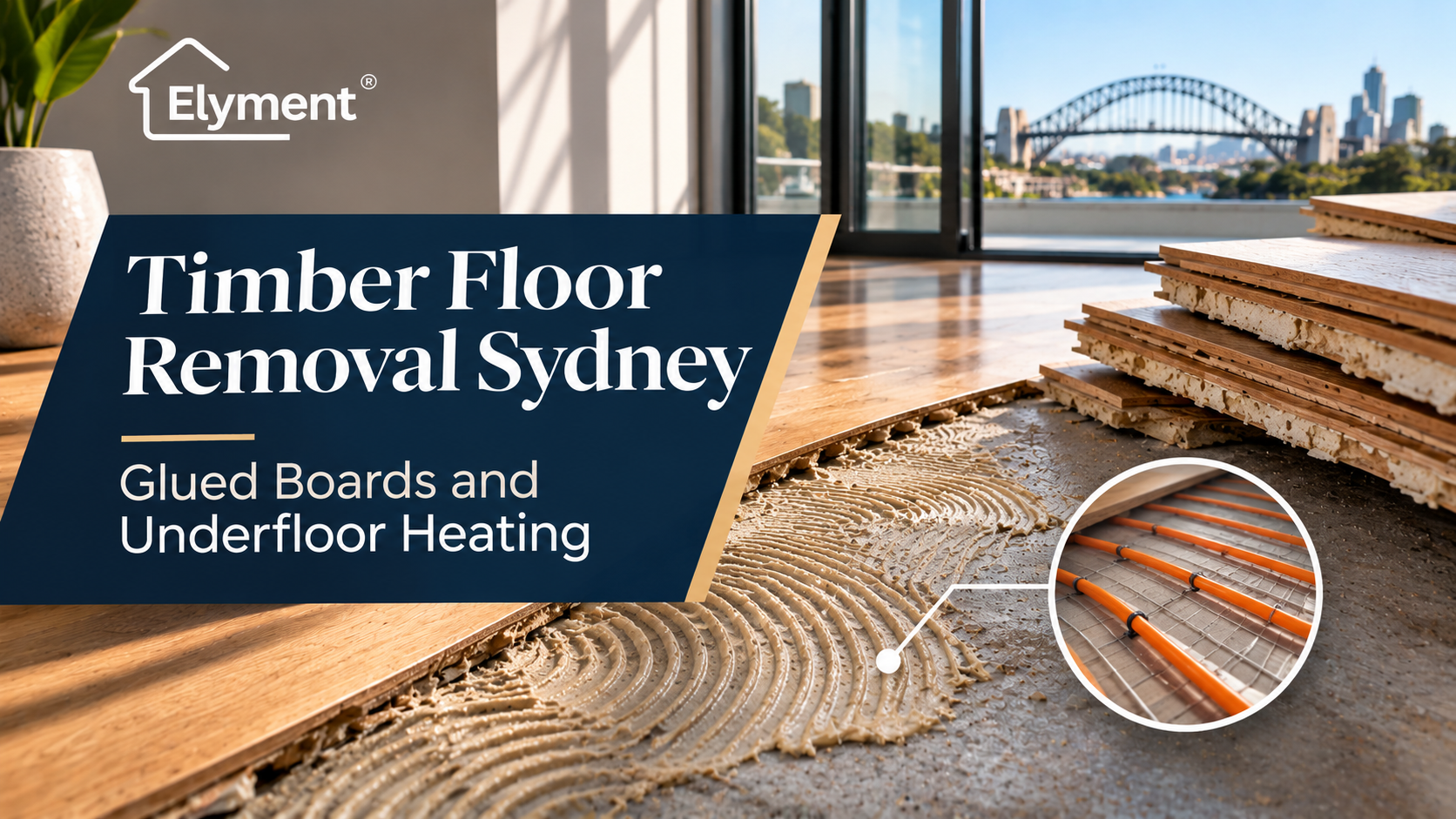
Glued timber flooring can sometimes be removed without damaging existing underfloor heating, provided the heating system is sufficiently protected beneath a sound substrate. For Sydney and NSW renovations, owners should provide heating installation records, known floor construction details and system retention requirements before requesting quotations. Both timber uplift and subsequent adhesive removal must be assessed, with an appropriately qualified heating specialist involved where concealed components could be affected.
ELYMENT Insights | Flooring, Renovation & Project Delivery | Sydney, NSW | 25 November 2026
Replacing an engineered oak floor in a Sydney apartment can initially appear to be a straightforward renovation. The existing boards are dated, the replacement flooring has been selected, and the owner wants the work completed before moving furniture back into the property.
Then comes a detail that changes the removal specification: the timber is glued down, and an operational underfloor heating system sits somewhere beneath it.
For the removal contractor, the question is no longer simply how efficiently the boards can be lifted. It is whether the timber and its adhesive can be separated without compromising an existing building service that the owner expects to retain.
That requirement needs to be established before quotations are compared, equipment is selected or installation dates are confirmed.
The Owner Is Procuring More Than Timber Removal
Conventional timber floor removal generally focuses on separating the existing boards, disposing of waste and preparing the underlying surface for another finish.
Where underfloor heating must remain operational, the project has an additional deliverable: preservation of the heating infrastructure.
The distinction is commercially important. A contractor quoting to remove 70 square metres of glued timber may be pricing a fundamentally different operation from one instructed to remove the same flooring while protecting concealed heating cables or hydronic pipework.
The second specification may require additional investigation, specialist attendance, restricted mechanical preparation and a different substrate handover standard.
Without these requirements being disclosed, comparing removal rates alone can produce a misleading assessment of value.
The Three Things Owners Should Provide Before Requesting a Quote
1. Underfloor Heating Installation Records
The most useful information is often documentation retained from the original construction or renovation.
- Heating manufacturer and system model.
- Installation drawings showing heating zones.
- Photographs taken before the heating system was covered.
- Electrical test results or hydronic commissioning records.
- Warranty documents and previous repair records.
- Contact details for the original heating installer, where available.
A thermostat photograph can help identify the controls, but it does not necessarily establish the heating element's location, installation depth or current condition.
Missing documentation should be declared rather than replaced with assumptions.
2. The Known Construction of the Existing Floor
The removal contractor needs to understand what separates the timber adhesive from the heating infrastructure.
Available building records may identify a construction consisting of engineered timber, flexible flooring adhesive, cementitious levelling compound, heating elements and a structural concrete slab.
Other properties may have heating pipes embedded deeper within a screed or slab, or proprietary heating panels located closer to the finished flooring.
These arrangements create different removal constraints. The visible timber surface alone does not establish which construction exists underneath.
3. Whether the Heating Must Remain Operational
The owner should clearly communicate one of three intentions:
- The heating system must be retained and remain operational after renovation.
- Preservation is preferred, but replacement may be considered if necessary.
- The existing heating system is being permanently decommissioned.
Each instruction changes the contractor's scope, the investigation required and the financial decisions available if unexpected conditions are encountered.
Why Glued Timber Creates a Different Removal Problem
Floating timber flooring is generally separated from its substrate by an underlay. Direct-stick timber, by contrast, is bonded to the surface beneath it.
The adhesive that has successfully held the flooring in position for years can become the principal obstacle during demolition.
When glued boards are lifted, several outcomes are possible. Timber fibres may remain attached to the adhesive, the adhesive may remain bonded to the substrate, or portions of the underlying preparation layer may separate with the boards.
Where heating components sit within that preparation layer, the consequences extend beyond ordinary substrate damage.
Elyment's examination of why grinding follows engineered timber floor removal explains the relationship between board uplift and subsequent adhesive preparation. Over heated floors, that second operation requires additional restrictions.
A clean-looking demolition result is not sufficient if the heating system has been compromised in the process.
The Heating Location Changes the Quotation
Electric heating embedded in a thin levelling layer
- Removal concern: Damage to cables or sensors during adhesive removal.
- Quotation consideration: Specialist assessment and restricted preparation methods.
Electric heating embedded deeper in a concrete slab
- Removal concern: Unverified protective depth and concealed connections.
- Quotation consideration: Confirm the permitted extent of surface preparation.
Hydronic pipes embedded in screed
- Removal concern: Damage to pipework if screed is disturbed.
- Quotation consideration: Heating specialist review and appropriate system testing.
Proprietary heating panels beneath timber
- Removal concern: Damage to panel assemblies during separation.
- Quotation consideration: Manufacturer-specific assessment and possible panel replacement.
Unknown floor construction
- Removal concern: Uncertain component location and material thickness.
- Quotation consideration: Investigation before unrestricted removal is authorised.
None of these construction types establishes a universally safe grinding depth. The acceptable preparation method depends on the actual installation, its condition and the requirements of the replacement flooring.
The Adhesive Removal Scope Deserves Its Own Approval
One of the most important contractual decisions concerns what happens after the timber boards have been removed.
A demolition contractor may successfully lift every board while leaving cured adhesive and timber backing attached to the floor. Under conventional circumstances, further mechanical preparation may be appropriate.
However, an instruction to grind the surface back to bare concrete may conflict directly with an instruction to preserve heating embedded within a layer above the concrete.
The quotation should therefore distinguish between:
- Removal and disposal of existing timber boards.
- Reduction or removal of bonded timber adhesive.
- Retention of sound material protecting the heating system.
- Repairs to disturbed preparation layers.
- Preparation required by the replacement flooring system.
Where complete adhesive removal would threaten the heating infrastructure, an alternative specification may be considered. Retaining selected adhesive residue or applying an additional compatible preparation layer is only appropriate where the substrate is sound and the relevant product manufacturers accept the proposed system.
Additional material can also affect finished floor height, doorway transitions and heating performance.
Elyment's analysis of levelling compound thickness over underfloor heating provides further context for evaluating the proposed replacement floor construction.
When a Heating Specialist Needs to Be Involved Before Demolition
Not every project requires continuous specialist attendance. However, the need for specialist involvement should be determined before removal begins, particularly where system preservation is a contractual requirement.
Early involvement is particularly important when:
- The location or depth of the heating components cannot be established.
- The system has existing faults or inconsistent performance.
- Heating cables may sit immediately beneath the timber adhesive.
- Substantial screed or levelling compound removal is anticipated.
- The existing floor requires aggressive mechanical preparation.
- Heating isolation, disconnection or subsequent recommissioning is required.
- The owner requires documented confirmation that the system remains functional.
For electric heating systems, the NSW Government's electrical licensing requirements apply to electrical wiring work, irrespective of the project's value.
Electrical isolation, disconnection, testing and reconnection should be coordinated with a suitably licensed electrician.
Australian heating supplier Thermogroup's technical guidance emphasises the importance of testing electric heating systems at different stages of installation. For renovation projects, documented pre-work and post-work assessments provide a practical basis for evaluating whether removal has affected the system.
Hydronic systems require assessment by an appropriately qualified heating specialist, including any necessary pressure testing and commissioning checks. The appropriate test conditions must be determined for the specific installation.
Turning off the thermostat alone does not constitute verified electrical isolation.
A Sydney Apartment With 70 Square Metres of Heated Timber
Consider an illustrative apartment renovation on Sydney's North Shore.
The owner intends to replace 70 square metres of glued engineered timber while retaining the existing electric floor heating. The original installer is unknown, but the heating appears to function normally.
Two quotations are received.
The first includes timber removal, waste disposal and grinding back to bare concrete. The second separates timber uplift from adhesive preparation and includes an allowance for specialist assessment before the final preparation method is authorised.
Although the first quotation may initially appear more economical, it assumes that removing all material above the slab is an acceptable outcome.
If the heating cables are located within the levelling compound, that assumption may conflict with the owner's instructions to retain the system.
The second quotation acknowledges that the required substrate finish cannot be confirmed until the relationship between the adhesive, preparation layer and heating components is understood.
The comparison should therefore consider the complete renovation outcome, not merely the price of removing the visible timber.
What Happens if the Protective Layer Starts Coming Away?
A firmly bonded timber board can pull sections of an underlying cementitious preparation layer away during removal.
This issue is explored in Elyment's guide to levelling compound separation beneath glue-down timber.
On a heated floor, the damaged layer may also provide physical protection for the heating infrastructure.
Where heating components become visible, unexpected material separation occurs or the known protective layer is disturbed, the affected operation should stop pending specialist assessment.
The subsequent decision may involve localised substrate repairs, an alternative adhesive treatment, a revised floor build-up or planned heating replacement.
Continuing removal simply to meet the original demolition schedule can increase the extent of damage and reduce the available repair options.
Strata Approval Should Reflect the Complete Floor Assembly
For apartments in Sydney, the proposed works may involve more than replacing one timber surface with another.
Heating infrastructure, acoustic layers, structural concrete and services associated with common property may introduce additional responsibilities.
The NSW Government's strata renovation guidance identifies hard-floor installation among works that may require minor renovation approval. More extensive changes affecting structural elements or common property may require different approvals.
Owners should establish the applicable renovation approval pathway, review the scheme's by-laws and confirm responsibilities for the existing heating system before demolition is authorised.
Any revised floor construction should also consider the building's acoustic requirements and approved finished floor specification.
Where older flooring or unidentified adhesive layers may contain hazardous materials, SafeWork NSW's asbestos guidance should inform the assessment before potentially hazardous materials are disturbed.
Assign Responsibility Before the Flooring Contractor Arrives
A renovation involving retained heating should establish clear responsibilities across the participating trades.
Property owner or project manager
- Provide available records, approve preservation requirements and coordinate access.
Heating specialist or licensed electrician
- Assess the system, undertake applicable isolation and testing, and confirm requirements for retention.
Timber removal contractor
- Remove the flooring within the agreed scope and report unexpected construction conditions.
Subfloor preparation contractor
- Prepare the retained surface using an agreed method consistent with heating protection requirements.
Replacement flooring installer
- Confirm acceptance of the substrate and compatibility of the new flooring assembly.
The handover should establish who accepts the heating test results, who approves the prepared substrate and who authorises subsequent work.
Without that allocation, each contractor may reasonably assume another party is responsible for protecting or validating the heating system.
Preservation Needs a Defined Financial Boundary
Preserving an existing heating system may avoid unnecessary replacement expenditure, but preservation is not automatically the least expensive option.
Additional labour, specialist inspections, restricted preparation, substrate repairs and replacement-floor compatibility requirements can influence the final cost.
Before committing to the renovation, owners should establish how unforeseen conditions will be managed, how additional investigation will be priced and who can approve a change from preservation to replacement.
This creates a commercial decision point before further costs are incurred.
It also allows replacement flooring deliveries and installation bookings to be coordinated around the confirmed condition of the existing floor rather than an assumed demolition completion date.
Common Questions About Timber Removal Over Underfloor Heating
Can glued timber flooring be removed without damaging electric floor heating?
Sometimes. The feasibility depends on the location and condition of the heating components, the adhesive bond, the intervening protective layers and the proposed removal method. Preservation cannot be guaranteed from surface inspection alone.
Can timber adhesive be ground off over underfloor heating?
Mechanical adhesive removal may be possible where the heating system is adequately protected and the permitted preparation method has been established. Unrestricted grinding should not proceed over an unidentified heating installation.
Does underfloor heating need to be tested after timber removal?
Where the heating system is being retained, appropriate testing should be planned before and after relevant works. A specialist should determine the necessary electrical or hydronic checks and confirm the requirements before the floor is covered again.
What if the owner cannot find the original heating records?
Missing records should trigger further assessment. Specialist identification, non-destructive investigation and an authorised inspection may help establish the construction, although no single investigation necessarily confirms every concealed component or its depth.
ELYMENT | SYDNEY FLOORING & PROJECT DELIVERY
Establish What Must Stay Before Removing What Must Go
Review timber removal, adhesive preparation, concealed heating, renovation sequencing and substrate handover requirements before committing to your next flooring project.
Request a Flooring Project Review
The Real Measure of a Successful Removal
Removing glued timber flooring over underfloor heating is not simply a demolition exercise. It is a renovation operation involving an existing asset that may need to remain functional long after the original floor has been discarded.
For Sydney property owners, the most important information should enter the project before the quotation: what heating system exists, how the floor is constructed and whether retaining the heating is a requirement or a preference.
Elyment has previously examined the protection of underfloor heating during tile removal. With glued timber, the additional challenge is defining an adhesive-removal specification that preserves the heating while producing an acceptable substrate for the replacement finish.
The successful outcome is not necessarily a completely exposed concrete slab. It is a documented, suitable substrate, an appropriately assessed heating system and a renovation programme that can proceed without avoidable uncertainty.
Sources and References
External Sources
- NSW Government – Electrical Licensing Requirements
- Thermogroup – What Happens in Case of a Fault With My Floor Heating?
- NSW Government – Strata Renovation Guidance
- SafeWork NSW – Asbestos Guidance
Related Elyment Articles
- Engineered Timber Floor Removal Sydney: Why Grinding Follows
- Underfloor Heating Going In? The Self-Levelling Compound Thickness Mistake That Can Create Hot Spots
- Self-Levelling Cement Under Glue-Down Timber: Can the Adhesive Pull the Leveller Off the Slab?
- Tile Removal Over Underfloor Heating: Can the Tiles Come Up Without Damaging the System?
ELYMENT | SYDNEY FLOORING & PROJECT DELIVERY
Establish What Must Stay Before Removing What Must Go
Review timber removal, adhesive preparation, concealed heating, renovation sequencing and substrate handover requirements before committing to your next flooring project.
Plan Your Flooring ProjectRelevant next actions
Explore the ELYMENT service most closely connected to this article.