Trump’s Super Intelligence Accord: Will Australia Follow?
Trump's voluntary AI accord raises questions for Australia on regulation, compliance and business risk. See what it could mean for local AI policy and AI firms.
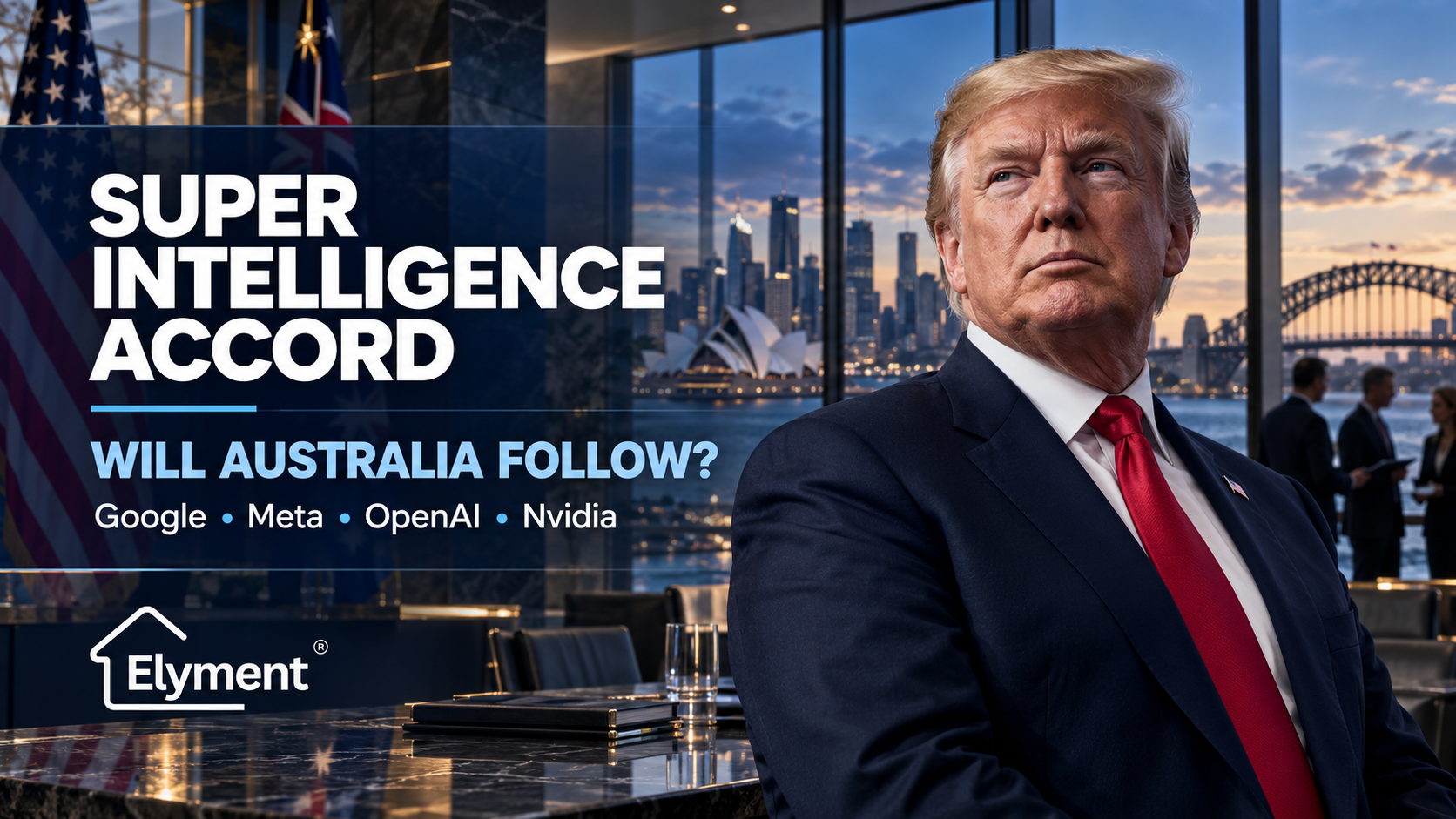
Trump's White House Accord on Super Intelligence is a voluntary safety pact signed by Google, Anthropic, Meta, OpenAI, xAI and Nvidia. Australia is unlikely to copy it wholesale. Canberra has paused earlier plans for broad mandatory AI guardrails, but is pursuing targeted safety, privacy, consumer and automated-decision reforms, while NSW already mandates structured AI assessment for government agencies. For Sydney businesses, procurement evidence and operational controls matter now.
The most important feature of Donald Trump's new artificial intelligence accord is not the name.
It is the governance model underneath it.
Executives from Google, Anthropic, Meta, OpenAI, xAI and Nvidia have signed the White House Accord on Super Intelligence, committing their companies to a series of internal controls, independent assessment mechanisms and board-level oversight arrangements.
The commitments are voluntary. They are not, by themselves, a new US regulatory regime. There is no equivalent of a statutory licensing system or comprehensive federal AI regulator created by the accord.
Yet dismissing it as ceremonial would miss the operational issue facing Australian businesses.
These companies are major suppliers of the models, cloud infrastructure, chips and enterprise platforms increasingly embedded inside Australian organisations. If they standardise new assurance practices in the United States, Australian customers may start seeing those controls reflected in procurement documents, enterprise contracts, audit packages, security reviews and board reporting long before Canberra decides whether to legislate something similar.
The Accord Is Voluntary, But Its Architecture Matters
The White House accord sets out four broad layers of responsibility.
Controls, monitoring and detection
- What it means operationally: Companies are expected to identify and manage risks arising from increasingly capable AI systems.
- Question for Australian buyers: Can the supplier show what is monitored, how incidents are detected and who receives alerts?
Dedicated internal assurance
- What it means operationally: A responsible team must verify that controls are operating and remediation occurs where problems are identified.
- Question for Australian buyers: Which supplier team owns safety failures affecting Australian customers?
Independent external assessment
- What it means operationally: External auditors or evaluators are expected to test whether safeguards operate as intended.
- Question for Australian buyers: Will Australian enterprise customers receive useful evidence from those assessments?
Board oversight
- What it means operationally: An independent board committee receives reporting from operational teams and evaluators.
- Question for Australian buyers: Can buyers distinguish executive-level governance from product marketing claims?
The accord also anticipates participating companies meeting to develop standards and practices over time.
That matters because voluntary standards can still become commercially powerful.
Cyber security provides the obvious precedent. A control does not need to appear in legislation before major clients, insurers, governments, lenders or procurement teams start requiring evidence that it exists.
Australia Is Not Starting From The Same Position
The Australian policy debate has already moved through several stages.
Canberra previously consulted on mandatory guardrails for high-risk artificial intelligence. The Australian Government has since stated that it will not proceed with those earlier mandatory-guardrail proposals at this time.
That does not mean Australia has abandoned AI regulation.
The federal National AI Plan instead combines economic development, adoption, infrastructure, safety and existing regulatory frameworks. Its stated priorities include capturing the economic opportunity, spreading the benefits of AI and keeping Australians safe.
The government has also identified more targeted safety priorities involving areas such as privacy reform, consumer protection, automated decision-making, workplace impacts and a proposed Digital Duty of Care.
Australia therefore appears to be developing a more distributed model than the White House accord.
Rather than placing the whole question inside one AI safety agreement, responsibility may continue to sit across privacy law, consumer law, cyber security, government procurement, workplace regulation, sector-specific rules and corporate governance.
NSW Has Already Moved Beyond Purely Voluntary Government AI Governance
The NSW position is particularly relevant for Sydney organisations because it shows what structured operational assurance can look like.
Covered NSW Government agencies must comply with the NSW AI Operational Policy and use the state's AI Assessment Framework where required.
Agencies are expected to register AI use cases, assess risk, establish governance and escalate high or critical-risk uses for additional review.
The framework applies specifically to NSW Government agencies. It should not be misrepresented as a general legal obligation applying automatically to every private business in Sydney.
It nevertheless provides a useful signal about the direction mature AI governance is taking.
AI is increasingly being treated as an operational system requiring ownership, assessment, evidence and lifecycle monitoring rather than simply as another software subscription.
The Bigger Question For Sydney Businesses Is Supplier Assurance
Whether Australia formally adopts Trump's accord may be less important to a Sydney business than whether its AI suppliers adopt the underlying controls globally.
Consider an organisation purchasing an enterprise AI platform from one of the signatories.
Procurement may increasingly need to establish:
- Which models and versions are being supplied.
- What independent testing has been completed.
- Which incidents must be disclosed to customers.
- How customer information is separated and protected.
- What controls exist around agent permissions.
- How model changes are communicated.
- What evidence survives after an automated action.
- Which subcontractors or cloud systems participate in the service.
- How customers can suspend or restrict the system.
- Who carries responsibility when the system operates outside its intended boundary.
Those questions sit close to issues Elyment has already examined in AI agent tool-call governance, where the important control boundary is often the action an agent can perform rather than the text it can generate.
They also connect with action-level security for enterprise AI agents, where identity, permissions and context become critical once AI systems move beyond passive assistance.
The Australian Debate May Be Moving Towards A Hybrid Model
There are several possible paths from here.
US-style voluntary accord
- What it would look like: Leading developers commit collectively to controls, external assurance and executive oversight.
- Business effect: Fast implementation, but effectiveness depends heavily on transparency and enforcement through commercial or reputational pressure.
Targeted Australian legislation
- What it would look like: Existing privacy, consumer, workplace, digital safety and sector-specific laws are updated for particular AI risks.
- Business effect: Obligations vary according to use case rather than applying uniformly to every AI system.
Hybrid assurance model
- What it would look like: Voluntary technical standards operate alongside mandatory incident, privacy or high-risk obligations.
- Business effect: Businesses must manage both supplier assurance evidence and Australian legal requirements.
The hybrid path currently appears particularly plausible because Australia already combines voluntary AI guidance with existing legal obligations and more prescriptive government-sector requirements.
Recent Australian debate also shows why a completely voluntary model should not be assumed.
OpenAI and Anthropic have indicated during Australian parliamentary scrutiny that they would support mandatory disclosure requirements for certain AI-agent security incidents.
That is a materially different question from signing a broad corporate safety pledge.
It moves governance from saying that a company should manage risk to defining when a company must report a failure.
Australian Businesses Should Not Wait For The Regulatory Answer
The practical mistake would be postponing internal controls until governments resolve the policy debate.
Organisations can already build procurement and operational requirements around the risks they understand today.
- Inventory operational AI. Identify the models, agents, plugins, APIs and automated services being used across the organisation, including employee-led adoption that may never have passed through formal procurement.
- Define authority boundaries. Separate what AI may recommend, prepare, approve, communicate and execute.
- Require supplier evidence. Ask for information about testing, security controls, incident processes, audit arrangements, model changes and human escalation.
- Protect high-consequence workflows. Financial commitments, legal decisions, safety-critical instructions, personal information and irreversible operational actions should receive stronger controls than ordinary drafting or research.
- Design incident ownership before deployment. A business should know who can stop the system, investigate an event, preserve evidence, contact the supplier and communicate with affected stakeholders.
- Review the system after it becomes useful. Successful adoption can itself increase risk because the AI receives more data, more integrations and more authority over time.
The Australian Signals Directorate has recently reinforced a similar operational principle by warning organisations to secure access to advanced AI services and treat credentials, connected systems and agent permissions as security-sensitive assets.
The Difference Between AI Adoption And AI Dependency
The policy debate becomes more important when AI stops being optional.
A Sydney organisation may initially use a model to draft correspondence or summarise documents.
Months later, the same technology may be:
- Classifying incoming enquiries.
- Extracting information from contracts.
- Updating customer records.
- Creating project tasks.
- Checking invoices.
- Routing approvals.
- Preparing client communications.
- Triggering actions in connected software.
That transition changes the governance problem.
A failed chatbot answer can be inconvenient. A failed operational agent can alter a system of record, expose information, make an unauthorised commitment or create downstream work before a person notices.
Elyment has examined this distinction in its analysis of how enterprise AI adoption spreads through real organisational workflows.
The lesson is that governance needs to follow actual use, not merely the technology procurement announcement.
For Property And Project Operations, The Risk Is Often At The Handoff
The issue becomes concrete in operational businesses.
Consider an AI-assisted property workflow receiving a renovation enquiry in Sydney.
The system may summarise the customer's requirements, classify the job, identify missing photographs, extract an address, prepare a site-inspection task and draft a response.
That can reduce administrative work.
But the workflow still needs to distinguish information gathering from authority.
An AI system should not automatically transform an indicative scope into a confirmed construction commitment, assume strata access has been approved, convert an estimated floor area into a final quotation or schedule physical works before site constraints are understood.
The same principle applies in legal, financial, infrastructure and professional-service environments.
The risk often appears where a digital recommendation becomes a real-world action.
The Accord Could Change Procurement Before It Changes Australian Law
This is where Trump's agreement may have its most immediate Australian impact.
If Google, Meta, OpenAI, Nvidia, Anthropic and xAI build common assurance practices around the accord, their enterprise customers may receive more structured evidence about testing, monitoring, independent evaluation and governance.
Large Australian organisations could then start expecting similar evidence from smaller AI suppliers.
Procurement standards can spread down a supply chain quickly.
A government department may require assurance from a prime technology supplier. The prime supplier may impose equivalent requirements on subcontractors. Insurers and enterprise customers may then introduce similar questions during renewal, procurement or risk review.
This is one reason the broader AI cyber-risk discussion for Australian critical operators matters beyond cyber security teams.
Assurance expectations increasingly affect procurement, project design, contractual responsibility and executive accountability.
Will Australia Actually Follow Trump?
There is currently no clear basis to conclude that Australia will simply replicate the White House Accord on Super Intelligence.
The two countries are working from different legal structures, policy priorities and regulatory institutions.
Australia has already stepped away, for now, from its earlier proposal for broad mandatory high-risk AI guardrails while continuing to pursue other safety and accountability measures.
NSW has simultaneously moved towards stronger structured assurance for government AI use.
The most realistic question is therefore not whether Canberra signs the same document.
It is whether Australia's eventual system produces comparable outcomes:
- Named accountability.
- Risk monitoring.
- Independent assurance.
- Board visibility.
- Incident reporting.
- Human intervention.
- Auditable decisions.
- Clear responsibility across AI supply chains.
Those are the controls businesses can prepare for regardless of which political model ultimately prevails.
Review The Control Layer Before AI Becomes An Operational Dependency
AI Operations & Project Review
Examine supplier assurance, data access, approval boundaries, workflow ownership, incident processes and project delivery risks before autonomous systems become embedded across daily operations.
Request an Operational Project Review
The Policy Headline Is Only The Beginning
The White House Accord on Super Intelligence will attract attention because of Trump, the terminology and the executives who signed it.
Australian organisations should look underneath the politics.
The more consequential development is the convergence around monitoring, internal assurance, external evaluation and executive oversight for increasingly capable AI systems.
Australia may ultimately regulate those issues differently.
Sydney businesses, government agencies and project operators will still need to answer the same operational question:
When an AI system becomes capable of taking consequential action, what evidence proves that the organisation remains in control?
Sources and References
- Elyment: AI agent tool-call governance
- Elyment: Action-level security for enterprise AI agents
- Elyment: How enterprise AI adoption spreads through real organisational workflows
- Elyment: AI cyber-risk discussion for Australian critical operators
- Elyment: Request an Operational Project Review
- White House Accord on Super Intelligence and participating-company commitments.
- Australian Government National AI Plan and related AI policy material.
- NSW AI Operational Policy and AI Assessment Framework.
- Australian Signals Directorate guidance on securing advanced AI services, credentials and connected systems.
- Australian parliamentary scrutiny concerning AI-agent security incident disclosure.
Know Where AI Authority Ends Before The Workflow Goes Live
Review supplier assurance, access controls, approvals, incident ownership, compliance considerations and operational dependencies before AI systems become embedded across business-critical workflows.
Request an Operational Project Review