15-Amp Power Point Installation Sydney: New Circuit Cost
Installing a 15-amp power point in your Sydney garage? Learn when a new circuit is needed, what affects electrician fees and how to avoid NSW compliance issues.
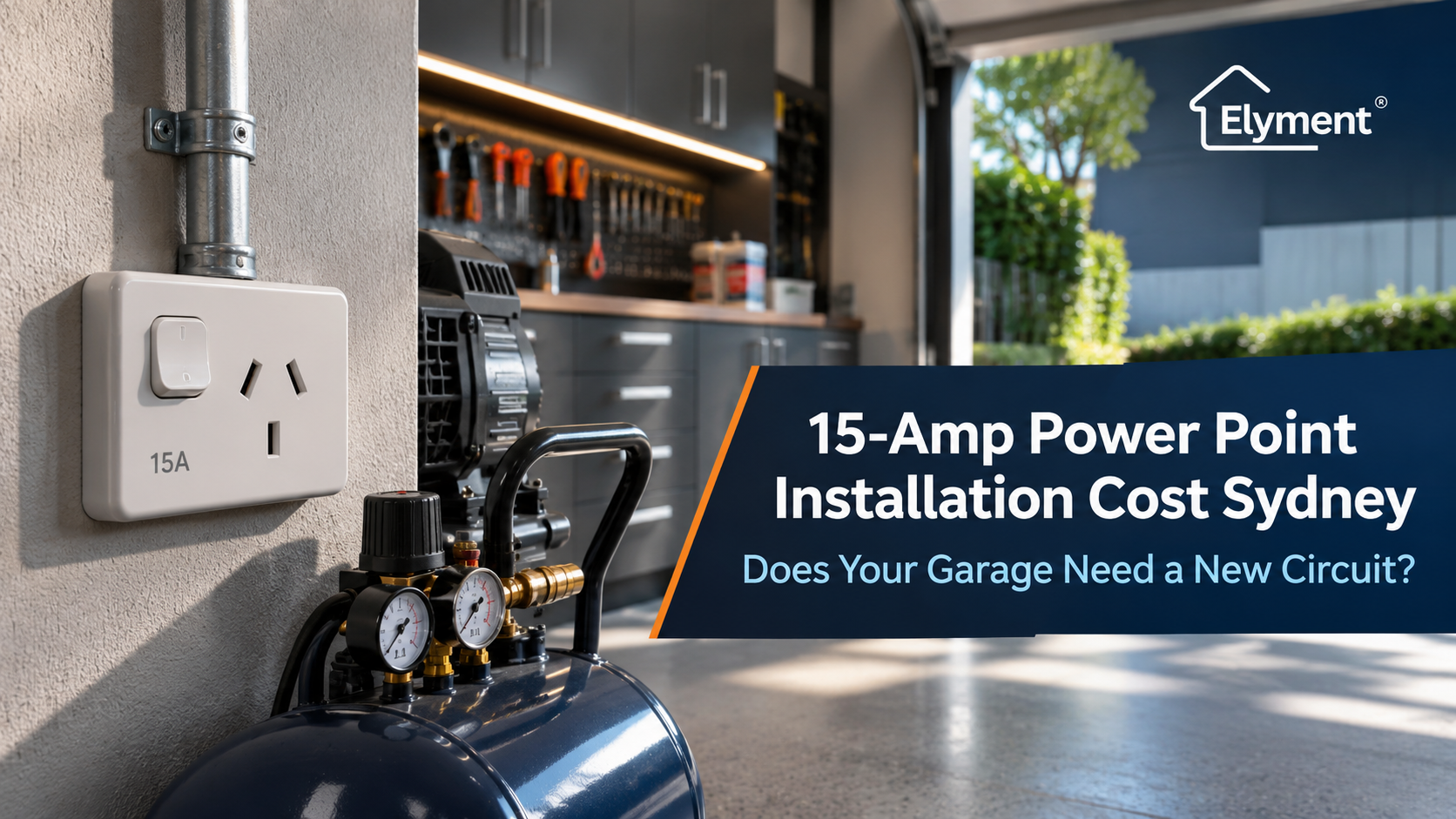
A 15-amp power point installation in Sydney does not automatically require a new dedicated circuit, but replacing a standard 10-amp socket alone may be unsafe or non-compliant. A licensed NSW electrician must assess the appliance's electrical requirements, existing circuit capacity, cable suitability, protective devices and switchboard condition. Installation costs depend on whether the existing supply is suitable or additional wiring, circuit protection and switchboard work are necessary.
ELYMENT Insights | Renovations & Property Operations | Sydney, NSW | 3 November 2026
The Garage Upgrade That Begins With an Appliance, Not an Electrician
A Sydney homeowner purchases a larger air compressor for the garage. The equipment arrives with a 15-amp plug, but the existing wall outlets accept only standard 10-amp plugs.
At first, the problem appears straightforward. Replace one power point with a 15-amp outlet and connect the machine.
However, the difference between a 10-amp and a 15-amp outlet is not simply the shape of the socket.
The electrical installation behind the wall must also be capable of supplying the intended equipment safely.
An existing garage power circuit may already supply a refrigerator, lighting, workshop equipment or outlets elsewhere in the house. The available wiring and protective devices may not be suitable for the proposed higher-current connection.
For homeowners, the central cost question is therefore not how much a 15-amp socket costs.
It is whether the existing electrical installation can safely accommodate the equipment or whether the project requires a new circuit from the switchboard.
This distinction is especially relevant to Sydney garages being converted into workshops, equipment storage areas and more functional home improvement spaces.
A 15-Amp Socket Does Not Create Additional Electrical Capacity
Standard Australian household power points are commonly rated at 10 amps.
A 15-amp outlet is designed for compatible higher-current equipment and uses a different socket configuration.
Under the Australian plug and socket arrangement, a conventional 15-amp plug has a wider earth pin than a standard 10-amp plug.
This physical difference is intentional. It prevents a 15-amp plug from fitting into an ordinary 10-amp socket.
Equipment that may require a 15-amp connection includes certain:
- Workshop air compressors.
- Welding machines.
- Stationary woodworking equipment.
- Professional concrete grinders.
- Commercial cleaning and extraction equipment.
- Other appliances specified by their manufacturers for 15-amp single-phase operation.
Not every appliance in these categories requires a 15-amp supply. The manufacturer's rating plate, installation instructions and plug configuration determine the actual electrical requirements.
Importantly, replacing the socket does not increase the capacity of the cables, circuit protection or upstream electrical installation.
A 15-amp outlet must form part of an electrical arrangement suitable for the connected equipment and compliant with the applicable wiring requirements.
Owners should not modify the earth pin of a 15-amp plug, use improvised adaptors or attempt to change electrical fittings themselves.
The correct solution must be determined by an appropriately licensed electrician.
What an Electrician Needs to Establish Before Quoting
A competent assessment begins with the intended electrical load and the installation already serving the garage.
Four separate questions determine whether an existing circuit may be suitable.
1. What Does the Equipment Actually Require?
The electrician needs to identify the equipment's voltage, current rating, plug configuration and manufacturer-specified installation requirements.
For motor-driven workshop equipment, starting current and operating characteristics may also matter.
A compressor, for example, can place a different demand on an electrical circuit during motor starting than during steady operation.
Where equipment incorporates variable-speed drives, electronic controls or other specialised components, the manufacturer may specify additional electrical protection or installation requirements.
The purchase price or physical size of a machine does not reliably indicate its electrical demand.
2. What Else Uses the Existing Circuit?
Two outlets positioned beside each other may be connected to the same electrical circuit.
Similarly, a garage outlet may share a circuit with power points in adjoining rooms.
An electrician must establish how the existing supply is arranged and whether its conductors, circuit protection and available capacity are suitable for the proposed installation.
Possible shared loads include refrigerators, freezers, power tools and other household appliances.
The number of visible power points is not a reliable measure of available circuit capacity.
3. Is the Existing Wiring Suitable?
The relevant assessment includes conductor suitability, installation conditions, circuit protection, cable routing and the demands of the proposed load.
Existing cables cannot automatically be assumed suitable simply because a new outlet can be physically connected.
Likewise, installing a higher-rated circuit breaker is not a substitute for verifying that the wiring and complete electrical installation are appropriate.
Any alteration must be designed and carried out in accordance with the applicable Australian and New Zealand Wiring Rules.
4. Can the Switchboard Accommodate the Proposed Work?
Where a new circuit is required, the electrician must assess the switchboard and available electrical infrastructure.
The work may involve a new protective device, a suitable cable run, alterations to the switchboard or additional investigation of an older installation.
Not every new garage circuit requires a complete switchboard replacement.
Equally, an ageing or unsuitable switchboard may create additional work that was not apparent when the homeowner first requested a power point.
The electrician must distinguish between work required for the proposed circuit and broader electrical upgrades that may be recommended or necessary.
When Does a Sydney Garage Need a Dedicated Circuit?
A dedicated circuit supplies a nominated electrical load or installation independently of other general-purpose power circuits.
For some workshop equipment, a separate circuit provides a practical way to manage electrical demand and reduce interference from unrelated household appliances.
However, the presence of a 15-amp plug does not establish a universal requirement for a dedicated circuit in every installation.
The decision depends on the equipment, existing installation, applicable standards and the electrician's assessment.
Garage Electrical Requirements and Possible Installation Outcomes
1. One 15A Appliance Used Occasionally
- Electrical consideration: Existing wiring, available capacity and manufacturer requirements.
- Possible installation outcome: An existing circuit may be suitable if the electrician verifies compliance and capacity.
2. Large Compressor Used Regularly
- Electrical consideration: Running current, motor starting demand and other connected loads.
- Possible installation outcome: A dedicated circuit may be appropriate or necessary.
3. Several Workshop Machines
- Electrical consideration: Equipment ratings and whether machines operate simultaneously.
- Possible installation outcome: Separate circuits or a broader workshop electrical design may be required.
4. Detached Garage
- Electrical consideration: Existing supply, cable route, distance and installation method.
- Possible installation outcome: New cabling, suitable protection or distribution arrangements may be required.
5. Older Garage With Limited Electrical Infrastructure
- Electrical consideration: Switchboard condition, existing circuit configuration and protective devices.
- Possible installation outcome: Electrical alterations or switchboard work may be necessary.
These outcomes are illustrative, not installation approvals. The correct arrangement must be established for the individual property.
What Does 15-Amp Power Point Installation Cost in Sydney?
Published electrician pricing demonstrates why homeowners need to distinguish between the cost of installing a 15-amp outlet and the cost of providing a suitable new electrical circuit.
Saunders Electrical Group's Hills District and Hawkesbury installation guide advertises the following starting prices:
Published 15-Amp Power Point Installation Prices
1. 15A Power Point Installation
- Advertised starting price: From $180 + GST.
2. New Circuit and Power Point
- Advertised starting price: From $350 + GST.
These are one Sydney contractor's advertised starting prices, not guaranteed quotations, regulated prices or independently established Sydney market averages.
They should not be interpreted as confirmation that a particular garage installation can be completed for those amounts.
The contractor identifies cable length, accessibility and the need for a new circuit as factors affecting the final quotation.
More extensive installations may involve additional electrical components, labour and building work beyond an advertised entry-level service.
The important commercial distinction is between two different scopes.
Scenario A: An Existing Suitable Circuit
Where the electrician confirms that the existing circuit and associated wiring can safely and compliantly supply the intended equipment, the work may be relatively limited.
The quotation may primarily concern the outlet, associated installation work, any necessary circuit alterations, testing and compliance documentation.
However, the electrician must establish suitability before the work proceeds.
Scenario B: A New Circuit Is Required
If the existing electrical arrangement cannot support the required installation, the quotation may need to include a new cable run and appropriate protective devices.
Depending on the site, additional work may involve switchboard modifications, conduit, wall penetrations, difficult access or making good disturbed finishes.
The installed cost can therefore be substantially different from the advertised price of a single power point.
A sensible budget should be based on the assessed electrical scope, not the retail price of the socket.
The Equipment Layout Can Determine the Electrical Installation
For a garage workshop, the proposed machinery layout deserves attention before the electrician finalises the electrical design.
Consider a hypothetical homeowner in Sydney's Hills District planning to install:
- A 15-amp air compressor beside the rear wall.
- A table saw on the opposite side of the garage.
- A dust extractor used alongside woodworking equipment.
- Additional general-purpose outlets for smaller tools.
Installing one 15-amp outlet beside the compressor may solve the immediate plug-compatibility issue.
It may not address the electrical demand of the complete workshop.
If the saw and dust extractor operate together, their combined load and circuit arrangements need consideration independently of the compressor.
The electrician should establish which machines can operate simultaneously, which require separate supplies and whether the garage's existing infrastructure can accommodate the intended use.
This is particularly important where a homeowner plans to purchase additional equipment over time.
Planning the intended workshop use before installation can reduce the likelihood of repeated electrical alterations.
Cable Routes and Switchboard Work: Where Installation Costs Change
A new circuit requires a suitable electrical connection between the switchboard and the proposed outlet.
The physical conditions of the property determine how straightforward that work may be.
In a Sydney brick garage attached to a house, an electrician may be able to identify an accessible cable route through an existing ceiling cavity or another appropriate service path.
In another property, the intended outlet may be located in a detached garage, behind finished wall linings or some distance from the main switchboard.
Potential cost considerations include:
- Cable installation: The actual route, cable requirements, installation conditions and labour involved.
- Physical access: Whether roof spaces, wall cavities or other suitable routes are accessible.
- Surface-mounted containment: Whether conduit or other cable protection is required.
- Switchboard alterations: Any necessary protective devices, circuit connections or associated changes.
- Detached structures: Additional cable routing, underground installation or other electrical infrastructure where required.
- Building reinstatement: Repairs to wall linings, finishes or other surfaces affected by the work.
The most direct physical route is not necessarily a permissible or technically suitable wiring route.
The electrician must determine the installation method and comply with the applicable standards.
Where a garage refurbishment also involves painting, new flooring or fixed workshop equipment, electrical access should be considered before the relevant surfaces are completed.
Elyment has separately examined how fixed workshop benches interact with epoxy flooring installation.
The broader project consideration is that permanently installed equipment, electrical services and finished floor surfaces should be coordinated rather than treated as unrelated decisions.
NSW Licensing and Electrical Compliance Are Not Optional
Electrical wiring work in NSW must be performed by, or under the supervision of, appropriately licensed electrical personnel.
The NSW Government's electrical licensing requirements apply regardless of the value of the work and whether the installation is residential, commercial or industrial.
Installing or altering a garage power point is not a suitable task for an unlicensed handyman or homeowner.
Changing the Circuit Is an Electrical Alteration
In October 2026, Building Commission NSW issued further guidance distinguishing electrical alterations from repairs.
According to its advisory on alterations to electrical installations, work that changes circuit protection, conductor sizing or the arrangement of a circuit is classified as an alteration.
The affected installation must satisfy the applicable requirements of AS/NZS 3000:2018, and the electrician must ensure the work does not adversely affect the safety of the existing installation.
Required residual current device protection must also be considered.
Building Commission NSW has additionally confirmed that Type AC residual current devices are no longer permitted for new electrical installations.
The correct protective equipment depends on the installation and applicable technical requirements.
Electrical Testing and the Certificate of Compliance
Applicable electrical work must be tested and documented through a Certificate of Compliance for Electrical Work, or CCEW.
From 1 July 2026, NSW requires CCEWs to be submitted through the BCNSW eCert system.
Under the NSW electrical compliance requirements, the certificate must be submitted as soon as practicable and no later than seven days after the relevant electrical test.
Property owners should request a copy of the relevant documentation and retain it with their property records.
Electrical testing and compliance documentation are part of completing the installation correctly, not optional extras that can be removed from the scope to reduce the price.
What a Complete Workshop Electrical Quote Should Establish
For a homeowner comparing installation proposals, the quotation should explain the electrical work being supplied and the assumptions on which it is based.
The most important information includes:
- Intended equipment: The appliances and electrical loads considered in the assessment.
- Circuit arrangement: Whether an existing suitable circuit will be used or a new circuit is included.
- Outlet specification: The proposed 15-amp socket, mounting location and any relevant environmental requirements.
- Wiring scope: The proposed cable route and any installation or access assumptions.
- Switchboard work: The protective devices, modifications or upgrades included in the price.
- Building work: Responsibility for penetrations, access, surface repairs and reinstatement.
- Testing and certification: Completion testing and the required NSW compliance documentation.
- Commercial conditions: GST, exclusions, potential variations and any additional investigation required.
A quotation described only as "install 15A power point" may not establish whether the existing circuit has been assessed or whether additional electrical work is included.
Owners should seek clarification before accepting the proposal.
For larger garage renovation projects, the electrician's findings should also be communicated to contractors undertaking related building work.
Electrical modifications can affect where equipment is positioned, whether wall linings need to be opened and how other renovation activities are scheduled.
Elyment's wider property and renovation services address the importance of defining physical work scopes and coordinating the practical requirements of property improvements.
Where professional concrete grinding is involved, a separate assessment of equipment power may also be necessary.
Elyment's earlier guide to power requirements for professional concrete grinding equipment explores this distinction in a different renovation environment.
Common Questions About 15-Amp Garage Power Points
Can I Replace a 10-Amp Power Point With a 15-Amp Power Point?
Not without an appropriately licensed electrician assessing the installation.
The existing wiring, circuit protection and electrical capacity must be suitable for the proposed 15-amp outlet and intended equipment.
A socket replacement alone does not establish compliance.
Does Every 15-Amp Power Point Need a Dedicated Circuit?
Not automatically.
Whether a dedicated circuit is required depends on the appliance specifications, existing circuit design, wiring suitability, electrical demand and applicable standards.
A licensed electrician must determine the correct arrangement for the property.
Can a Standard 10-Amp Plug Be Used in a 15-Amp Socket?
A standard Australian 10-amp plug is generally compatible with the corresponding 15-amp socket design.
The reverse is not true.
A 15-amp plug is intentionally prevented from fitting into a standard 10-amp outlet.
Will Installing a 15-Amp Outlet Stop My Circuit Breaker From Tripping?
Not necessarily.
Circuit breakers and safety switches can operate for different reasons, including overload, electrical faults and residual-current leakage.
Changing the outlet does not resolve an underlying electrical fault or inadequate circuit capacity.
A licensed electrician should investigate the cause.
Can a Workshop Use Several 15-Amp Machines?
Potentially, but the installation must be designed for the actual equipment and expected operating conditions.
The electrician should consider simultaneous loads, circuit arrangements, protective devices and manufacturer requirements.
Multiple 15-amp sockets do not automatically provide multiple independent supplies.
Is a Garage 15-Amp Outlet Suitable for an Electric Vehicle Charger?
Only where the particular charger, electrical installation and operating arrangement are suitable and compliant.
A garage 15-amp outlet should not automatically be treated as a substitute for a properly assessed EV charging installation.
Charging equipment may introduce additional circuit, protection and continuous-load considerations.
Elyment has separately covered outdoor power point installation costs in Sydney, where exposure and weather protection introduce different installation considerations.
The Practical Decision: Assess the Machine Before Altering the Garage
The most economical compliant installation is not necessarily the one involving the least electrical work.
A simple outlet replacement may be appropriate where the existing installation has been assessed and confirmed suitable.
Where the equipment requires additional capacity, a properly designed new circuit may be the more appropriate solution.
Conversely, commissioning extensive electrical upgrades without first confirming the appliance requirements can create unnecessary expenditure.
The decision should begin with the equipment specification and an assessment of the existing electrical installation.
For Sydney homeowners converting garages into practical workshops, that assessment provides the basis for a realistic quotation and a suitable installation design.
Planning a Garage or Workshop Renovation?
Review the project scope, electrical requirements and renovation sequence before work begins.
Elyment can assist with renovation planning and operational coordination, with electrical installation and compliance work to be undertaken by appropriately licensed electrical professionals.
Final Assessment: The Socket Is Only One Part of the Electrical Installation
A 15-amp power point may appear to be a minor component of a garage renovation, but its suitability depends on the electrical infrastructure serving the property.
The equipment requirements, existing circuit capacity, cable installation conditions, protective devices and switchboard arrangement all influence the work required.
A new circuit is not mandatory in every situation. However, a new socket cannot make an unsuitable electrical installation safe.
For property owners, the strongest approach is to obtain a licensed electrical assessment, confirm the complete scope and compare installation quotations on the same basis.
The objective is not simply to make a larger plug fit.
It is to provide a suitable, tested and compliant electrical supply for the equipment the garage is intended to accommodate.
Editorial note: Published installation prices referenced in this article are indicative starting prices from a Sydney electrical contractor, accessed in November 2026. They are not Elyment quotations or guaranteed market rates. Electrical design and installation decisions must be made by appropriately licensed electrical professionals.
Sources and References
Regulatory and Electrical Compliance Sources
1. NSW Government – Electrical Licensing Requirements
Information about licensing requirements for electrical wiring work in NSW.
NSW Electrical Licensing and Registration Requirements
2. Building Commission NSW – Alterations to Electrical Installations
Guidance on electrical alterations, applicable wiring standards and requirements affecting existing installations.
Alterations to Electrical Installations
3. NSW Government – Electrical Compliance Requirements
Information about electrical testing, Certificates of Compliance for Electrical Work and the BCNSW eCert system.
Electrical Compliance Requirements in NSW
Sydney Installation Pricing Reference
4. Saunders Electrical Group – Power Point Installation in the Hills District and Hawkesbury
Published contractor starting prices for 15-amp power point installation and new circuit installation.
Power Point Installation – Hills District and Hawkesbury
Pricing reference: From $180 + GST for a 15A power point installation and from $350 + GST for a new circuit and power point, as stated in the supplied article. These figures are indicative advertised starting prices, not guaranteed installation costs.
Related Elyment Insights
1. Epoxy Flooring Sydney for Home Workshops: Should Heavy Benches Be Bolted Down Before or After the Coating?
Considerations for coordinating workshop equipment installation with epoxy floor preparation and finishing.
Read the Home Workshop Epoxy Flooring Guide
2. Concrete Grinding Sydney in Apartments: Will a Standard Power Point Run the Equipment?
An examination of electrical supply requirements for professional concrete grinding equipment.
Read the Concrete Grinding Power Requirements Guide
3. Outdoor Power Point Installation Cost Sydney
Installation considerations for outdoor electrical outlets, including environmental exposure and weather protection.
Read the Outdoor Power Point Installation Cost Guide
Elyment Services and Project Enquiries
Property and Renovation Services
Garage and Workshop Renovation Enquiries
Planning a Garage or Workshop Renovation?
Review the project scope, electrical requirements and renovation sequence before work begins. Elyment can assist with renovation planning and operational coordination, with electrical installation and compliance work to be undertaken by appropriately licensed electrical professionals.
Discuss Your Project