Outdoor Power Point Installation Sydney: Quote Cost Factors
Outdoor power point installation costs in Sydney can rise with cable runs, access issues and weatherproof fittings. See what to check in an electrician's quote.
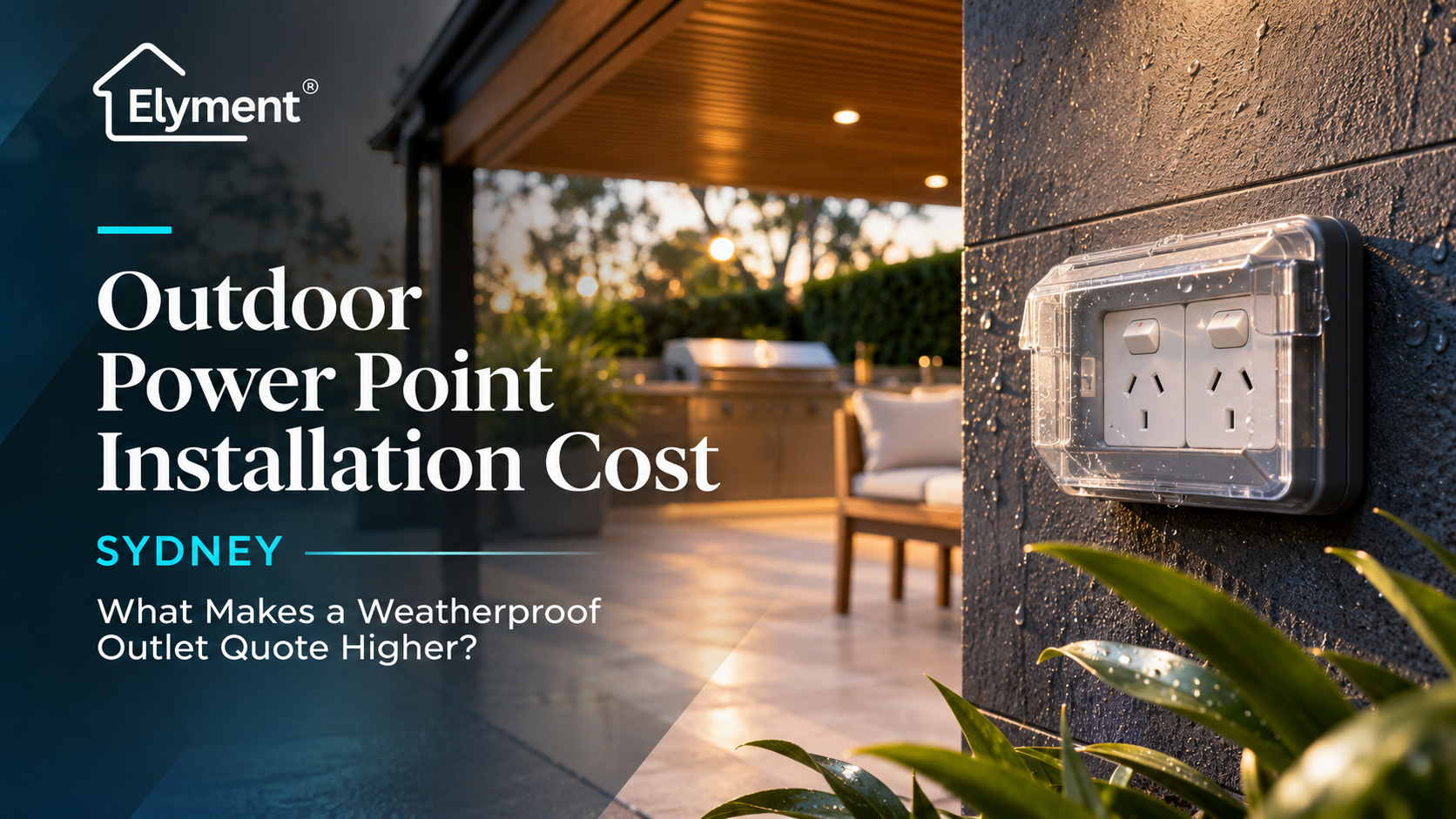
Outdoor power point installation in Sydney generally costs more when an electrician must run longer cables, penetrate masonry, assess circuit capacity or provide additional protection against weather exposure. A complete quote covers more than the weatherproof outlet itself. It should account for cabling, mounting, appropriate electrical protection, testing and NSW compliance requirements. Comparing quotations requires checking the installation location, access conditions, equipment specifications and exclusions rather than choosing on hardware price alone.
The Outdoor Power Point Is Often the Cheapest Part of the Installation
A weatherproof electrical outlet is a relatively small component of a residential renovation. Yet the cost of installing one can vary significantly between two Sydney properties, even when both owners select similar equipment.
The explanation lies behind the wall.
An alfresco outlet installed beside an accessible existing electrical supply may involve limited building work. An apparently identical outlet positioned across a courtyard, behind double-brick construction or on a detached structure may require substantially more labour, cabling and installation planning.
There is also the question of exposure.
A socket sheltered beneath a substantial roof is not necessarily exposed to the same conditions as one facing driving rain, coastal spray, irrigation equipment or frequent washdowns.
The electrician must consider how the outlet will be used, where it will be mounted and whether the selected product is suitable for those conditions.
These differences explain why a weatherproof power point cost should be assessed as a complete installation rather than a comparison between products displayed on a hardware supplier's website.
What Does Outdoor Power Point Installation Cost in Sydney?
Published Sydney electrician pricing provides a useful indication of the market, although individual quotations depend on the property.
Fox Electricians' 2026 Sydney pricing guide places general outdoor power point installations at approximately $175 to $500 or more, depending on outlet configuration, access, protection requirements and whether additional electrical work is necessary.
Another Sydney installer, HD Level 2 Electricians, indicates approximately $250 to $450 for a relatively straightforward installation using an existing suitable circuit, with more complex cabling work commonly quoted at $400 to $700 or above.
These are published installer estimates, not regulated NSW prices or verified market averages. They are not directly interchangeable because their underlying scopes may differ.
The practical distinction is between three broad installation conditions:
- Accessible installation: An appropriately protected outlet installed near a suitable electrical supply with straightforward mounting and cable access.
- Moderate installation: Additional cable routing, masonry penetration, surface conduit, difficult access or more extensive mounting requirements.
- Complex installation: A new circuit, significant switchboard work, detached structures, underground cabling, challenging building penetrations or other specialist construction requirements.
A relatively inexpensive outlet can therefore form part of an installation costing several times the hardware price.
The advertised starting price is useful for budgeting, but it cannot establish the final amount without understanding what work is included.
The Cable Route Is More Important Than the Distance Between Two Walls
Wiring distance is one of the most consequential factors in outdoor power point installation Sydney quotations.
However, the relevant distance is the actual cable installation route, not simply the straight-line distance between the existing switchboard and the proposed outlet.
Consider an older terrace renovation in Sydney's Inner West.
The owner wants an outdoor double power point beside a newly constructed barbecue area. The proposed position may be only a few metres from the rear living room.
Nevertheless, the installation may require:
- Identification and assessment of a suitable existing electrical circuit.
- Access through an internal wall, ceiling cavity or another permissible cable route.
- Penetration through double-brick masonry.
- Appropriate cable protection and containment.
- Weather-resistant sealing of the external penetration.
- Careful positioning around existing plumbing, doors and joinery.
- Repair of disturbed finishes where reinstatement is included.
The installation complexity can increase further where the building contains inaccessible cavities, concealed services or heritage-sensitive construction.
A contractor may also need to avoid newly completed waterproofing, decorative wall finishes or expensive external cladding.
These are construction interfaces, not merely electrical material costs.
For renovation projects involving potentially concealed services, Elyment has previously examined the importance of identifying hidden electrical conduits before intrusive renovation work.
The same principle applies to new electrical installations: establish an appropriate route before drilling, cutting or concealing new infrastructure.
A Weatherproof Rating Does Not Tell the Whole Story
Outdoor outlets are commonly marketed using an ingress protection rating, usually expressed as an IP code.
The first digit indicates a degree of protection against solid objects and dust. The second indicates protection against water ingress under specified test conditions.
Yet selecting an outdoor outlet by IP rating alone can be misleading.
Clipsal's Iconic Outdoor range, for example, includes socket outlets rated IP54, incorporating protective shutters and integrated seals.
Clipsal also supplies weather-protected products across other ranges, including equipment with different protection characteristics.
Importantly, the protection rating of a switch should not be confused with the rating of a socket outlet. Products from the same manufacturer or range may have different ratings.
The Difference Between an Outlet That Is Covered and One That Is Being Used
A particularly important detail is whether the outlet must remain exposed to moisture while an appliance is plugged in.
For some outdoor outlet products, the stated ingress protection rating does not necessarily establish equivalent protection under every plugged-in operating condition.
Clipsal's Iconic Outdoor technical information specifically addresses this distinction and recommends an appropriately sealed plug and socket arrangement for wet environments.
This matters for installations supplying equipment such as:
- Outdoor refrigerators that remain connected.
- Garden irrigation controllers.
- Permanent landscape lighting equipment.
- Outdoor entertainment equipment.
- Selected pool-related equipment, subject to the applicable electrical requirements.
- Other appliances used where rain, spray or regular washdown may occur.
The correct equipment depends on the intended operating conditions, relevant standards and the manufacturer's installation instructions.
There is no single IP rating that should automatically be specified for every outdoor power point in Sydney.
An electrician should assess the proposed location, exposure, installation arrangement and equipment requirements before selecting the outlet.
Why Two Alfresco Areas Can Require Different Electrical Specifications
Sydney's outdoor living spaces vary considerably in construction and environmental exposure.
A covered entertaining area in a suburban home may have substantial protection from direct rainfall.
A rooftop terrace or exposed coastal balcony may experience wind-driven rain, salt-laden air and stronger environmental exposure.
An outdoor kitchen may also introduce grease, cleaning water, heat-producing equipment and an increased likelihood of appliances remaining connected.
The installation specification should respond to these conditions rather than relying solely on the word "weatherproof".
Covered Residential Alfresco
- Key consideration: Accessible existing wiring, sheltered mounting position and intended appliance use.
- Potential quote impact: Potentially simpler installation where the existing electrical arrangement is suitable.
Exposed Garden Wall
- Key consideration: Rain direction, irrigation spray, cable protection and mounting conditions.
- Potential quote impact: Different product requirements and additional cable containment or mounting work.
Coastal Balcony
- Key consideration: Salt exposure, corrosion resistance, wind-driven rain and strata requirements.
- Potential quote impact: Potentially more demanding equipment selection and installation coordination.
Outdoor Kitchen
- Key consideration: Appliance demand, permanent connections, heat, cleaning methods and circuit suitability.
- Potential quote impact: Possible additional outlets, electrical assessment or circuit alterations.
Detached Pergola or Garden Structure
- Key consideration: Longer cable routes, structural access and suitable cable installation methods.
- Potential quote impact: Additional labour, containment, excavation or other building work.
These are installation considerations, not automatic requirements or fixed pricing categories.
For instance, an exposed coastal location does not necessarily require the same equipment as an industrial washdown environment. The actual exposure and product operating conditions must be assessed.
Existing Circuit Capacity Can Change the Scope
An additional power point does not automatically require a new electrical circuit.
Equally, the presence of an existing nearby power point does not prove that the circuit can safely support the proposed additional load.
The electrician must assess the existing installation, including relevant wiring, circuit protection and the intended equipment.
A modest outdoor outlet used occasionally for garden tools presents a different electrical demand from a group of permanently connected outdoor appliances.
Consider an alfresco renovation involving:
- A compact outdoor refrigerator.
- A television or entertainment system.
- An electric outdoor heater.
- Decorative lighting.
- Occasional cooking or cleaning equipment.
The combined electrical demand and expected simultaneous use may influence the circuit design.
The electrician may determine that an existing circuit is suitable, that additional protection or alterations are necessary, or that a separate circuit is appropriate.
Where required, the quotation may also include switchboard modifications and suitable residual current device protection.
These are electrical design decisions, not optional extras that should be omitted merely to reach an advertised starting price.
For owners dealing with existing electrical faults, Elyment's article on safety switches repeatedly tripping in NSW properties explains why the underlying cause should be identified rather than assumed to be a minor nuisance.
A tripping safety switch and insufficient circuit capacity are not the same problem. A licensed electrician must distinguish between electrical leakage, overload and other faults.
The Renovation Stage Can Determine Whether the Installation Is Straightforward or Expensive
One of the least visible cost drivers is the point at which the outdoor power point is added to the renovation programme.
During the early stages of an alfresco renovation, wall cavities may be accessible, external finishes unfinished and cable routes relatively easy to establish.
After construction is completed, the same outlet location may require opening finished surfaces, navigating installed joinery or arranging additional trades to restore the appearance of the property.
This is particularly relevant where the project includes:
- New external rendering or painting.
- Outdoor kitchen cabinetry.
- Waterproofing and tiled balcony surfaces.
- Concrete resurfacing or decorative coatings.
- Landscape construction.
- Timber decking or external cladding.
A late request for another power point can create an avoidable sequence of electrical work, surface repair and finishing trades.
A More Efficient Installation Sequence
- Confirm the intended appliances. Establish what equipment will use the outlets and whether it will remain connected.
- Select preliminary outlet locations. Consider accessibility, exposure, furniture placement and the final architectural layout.
- Arrange licensed electrical assessment. Confirm suitable routes, existing circuit capacity, protection requirements and product selection.
- Resolve approvals and interfaces. Address relevant strata permissions, structural limitations and waterproofing details before intrusive work.
- Complete authorised rough-in work. Schedule suitable electrical cabling work before finishes conceal accessible routes, where the project design permits.
- Finish surrounding construction. Coordinate rendering, painting, cabinetry, waterproofing and other surfaces with the approved electrical arrangement.
- Complete installation and testing. The electrician installs and verifies the completed electrical work and manages the required compliance documentation.
The precise sequence depends on the property, installation method and contracted responsibilities.
However, deciding where outdoor power will be needed before the final surfaces are installed can substantially reduce the risk of rework.
Sydney Apartments and Strata Balconies Bring an Additional Approval Question
Outdoor power point installation is not always a decision that an apartment owner can make independently.
In NSW strata buildings, external walls, balcony construction, certain electrical services and other building elements may form part of common property.
Installing an outlet may involve new wiring, penetrations through an external wall or alterations to building elements controlled by the owners corporation.
According to the NSW Government's strata renovation guidance, installing or replacing wiring, cabling and power points can fall within the minor-renovation framework.
However, works affecting a building's exterior, structural components, waterproofing or common property may require a different approval pathway.
The applicable approval process depends on the actual works, strata plan and scheme by-laws.
Before commissioning an electrician for a balcony installation, the owner or project coordinator should establish:
- Whether the proposed wall or mounting area is common property.
- Whether the installation changes the external appearance of the building.
- Whether drilling or cabling affects waterproofing or structural elements.
- Whether the proposed route crosses common-property areas.
- Whether strata consent or another approval is required before installation.
- Who is responsible for any affected finishes and future maintenance.
A relatively small electrical job can become expensive if contractors are mobilised before the required permissions and access arrangements are confirmed.
The approval question should be resolved before the installation date, not after a contractor arrives with the selected outlet.
Poolside Installations Need More Than a Weatherproof Cover
Outdoor power installations near swimming pools and spas introduce location-specific electrical safety requirements.
Water exposure is only one consideration.
The Australian and New Zealand Wiring Rules include requirements concerning electrical equipment locations and restricted zones around swimming pools and spas.
The selected socket outlet, protection arrangements and installation location must satisfy the applicable requirements.
A weatherproof product rating does not, by itself, establish that an outlet can legally or safely be installed at any distance from a swimming pool.
Where renovation work also affects surrounding concrete, reinforcement or conductive fittings, electrical bonding may need particular attention.
Elyment's earlier analysis of electrical bonding risks during poolside tile removal examines how physical renovation works can interact with electrical safety systems.
For poolside projects, the outlet position and electrical design should be confirmed with a licensed electrician before landscaping, tiling or structural work proceeds.
What Should a Complete Outdoor Power Point Quote Include?
Two quotations may appear substantially different because they describe different amounts of work.
One electrician may price a straightforward outlet addition based on an accessible circuit and existing suitable wiring.
Another may include a new cable run, additional protection, more complex mounting and restoration of disturbed surfaces.
Neither figure can be properly assessed without comparing the inclusions.
Outlet Specification
- What should be confirmed: Brand, model, number of sockets, current rating and suitability for the intended environment.
Installation Location
- What should be confirmed: Exact mounting position, height, accessibility and exposure conditions.
Electrical Supply
- What should be confirmed: Whether a suitable existing circuit can be used or additional electrical work is required.
Cable Route
- What should be confirmed: Proposed wiring path, containment, approximate length and access assumptions.
Wall Penetrations
- What should be confirmed: Required drilling, suitable sealing, mounting details and protection of existing services.
Switchboard Work
- What should be confirmed: Any required alterations, circuit protection or separately priced upgrade.
Building Reinstatement
- What should be confirmed: Whether making good render, paint, cladding or other disturbed finishes is included.
Testing and Compliance
- What should be confirmed: Completion testing, required certification and electrical handover documentation.
Commercial Exclusions
- What should be confirmed: GST, access assumptions, investigation allowances, variations and work by other trades.
The most useful quotation is not necessarily the most expensive or the most detailed.
It is the quotation that establishes what the contractor will deliver, which conditions have been assumed and what would constitute additional work.
NSW Electrical Compliance Is Part of the Installed Cost
Electrical wiring work in NSW must be undertaken by, or under the supervision of, an appropriately licensed electrician.
The NSW Government's electrical licensing guidance confirms that licensing requirements apply regardless of the value of the work.
Relevant electrical work must also comply with the applicable technical and safety requirements, including the Australian and New Zealand Wiring Rules, AS/NZS 3000.
Building Commission NSW requires a Certificate of Compliance for Electrical Work, commonly known as a CCEW, for applicable electrical installation work.
Since 1 July 2026, required CCEWs have been lodged through the BCNSW eCert system. The relevant testing and submission obligations must be completed within the prescribed timeframe, generally no later than seven days after the electrical test.
The NSW Government's September 2026 electrical compliance advisory clarifies that the requirements apply to electrical work involving installations, additions, alterations and relevant replacements.
For property owners, this makes electrical testing and compliance documentation part of the completed installation rather than an optional administrative service.
Where significant building work is involved, owners should also confirm which contractor is responsible for waterproofing integrity, surface repairs and other construction interfaces.
A licensed electrical contractor's completion of the electrical work does not automatically mean all unrelated building reinstatement is included in the quoted price.
Three Decisions That Can Prevent an Expensive Installation Variation
1. Finalise the Outlet Position Before the Finishes
Ask the electrician to assess the proposed position while the relevant wall or building area remains accessible.
Where possible, avoid leaving the location decision until after rendering, painting, tiling or expensive external finishes are completed.
2. Specify the Equipment That Will Actually Be Connected
A general-purpose garden outlet and an outlet intended for continuously connected equipment may require different planning.
Identify the intended appliances, electrical demand and exposure conditions before purchasing hardware.
3. Compare the Complete Delivered Installation
Request confirmation of the included electrical work, cable route, suitable protection, mounting, required testing and any restoration of disturbed surfaces.
Do not compare a hardware-only price with a complete installation price.
Likewise, do not assume that a lower quotation includes switchboard changes, additional wiring or construction reinstatement unless those items are clearly stated.
Outdoor Power Point Installation Sydney: Practical Questions
Can an Outdoor Power Point Be Connected to an Existing Circuit?
Potentially. A licensed electrician must assess whether the existing circuit, wiring, protection and available capacity are suitable for the proposed outlet and intended appliances. A new circuit is not automatically required for every installation.
Does Every Outdoor Power Point Need an IP66 Rating?
No universal IP66 requirement applies to every outdoor outlet location. The appropriate product must be selected according to the installation environment, applicable electrical standards, equipment specifications and intended use. A sheltered outlet and one exposed to frequent water spray may require different solutions.
Is Installing a Second Outdoor Outlet Cheaper?
It can be, particularly when two outlets are installed during the same visit and share accessible infrastructure. However, a second location may require additional cabling, circuit assessment or mounting work. The electrician must confirm the actual scope.
Does the Quote Include Repairing the Wall After Installation?
Not necessarily. Basic sealing associated with the electrical installation and cosmetic reinstatement of render, paint, tiles or other finishes should be identified separately in the quotation.
Who Can Install an Outdoor Electrical Outlet in NSW?
Electrical wiring work must be performed by, or under the supervision of, appropriately licensed electrical personnel. Property owners should verify the contractor's authorisation and ensure that required testing and compliance documentation are completed.
The Larger Cost Is Often the Work That Was Not Planned
Outdoor power points are a relatively small feature within a Sydney renovation, but their installation can interact with several parts of the building.
Walls may need to be penetrated. Wiring routes may cross finished construction. Outdoor exposure may change the equipment specification. Existing electrical infrastructure may require assessment or alteration.
In strata buildings, approvals and common-property responsibilities can introduce additional programme considerations.
These factors do not make every outdoor installation expensive. They explain why two apparently similar outlets can attract different quotations.
For property owners and builders, the more effective approach is to confirm electrical requirements early, identify physical access constraints and compare complete installed scopes.
The appropriate decision is not simply which weatherproof outlet costs less.
It is which installation arrangement provides suitable, compliant outdoor power without unnecessary building damage, repeated contractor attendance or avoidable renovation variations.
Plan Electrical Access Before the Finishes Go In
Sydney Renovation Project Planning
Review your renovation sequence, contractor responsibilities, site access and construction interfaces before outdoor electrical work creates avoidable delays or additional costs.
Request a Renovation Project Review
Final Assessment: Price the Installation, Not Just the Outlet
The cost of outdoor power point installation in Sydney depends on the existing electrical infrastructure, the available wiring route, building access, mounting conditions and the exposure requirements of the selected equipment.
The lowest-priced outlet does not necessarily produce the lowest total installation cost.
Equally, a premium weatherproof product cannot compensate for an unsuitable location, inadequate electrical design or poorly coordinated building work.
Before approving a quotation, owners should confirm what the electrician is installing, how the wiring will reach the outlet, which protective measures are required and who will complete any associated building repairs.
The strongest cost comparison is between two complete, site-specific and compliant installation proposals.
Editorial note: Indicative costs reference published Sydney installer guidance available in 2026 and are not Elyment quotations or guaranteed market rates. Product specifications and NSW requirements should be verified for the installation date. Electrical design, installation, testing and certification must be undertaken by appropriately authorised practitioners.
Sources and References
Sydney Installation Costs and Product Specifications
- Fox Electricians – How Much Does It Cost to Install Outdoor Power Points? (2026 Sydney Pricing Guide)
- https://foxelectricians.com.au/how-much-does-it-cost-to-install-outdoor-powerpoints/
- HD Level 2 Electricians Sydney – Outdoor Power Point Installation Cost Guide
- https://www.hdlevel2electriciansydney.com.au/resources/outdoor-power-point-installation-sydney-cost-guide
- Clipsal – Iconic Outdoor Range
- https://www.clipsal.com/products-and-solutions-overview/iconic-outdoor
NSW Government Regulations and Compliance
- NSW Government – Strata Renovations
- https://www.nsw.gov.au/housing-and-construction/strata/living/renovations
- NSW Government – Electrical Licensing Requirements
- https://www.nsw.gov.au/business-and-economy/licences-and-credentials/building-and-trade-licences-and-registrations/electrical
- NSW Government – When to Submit a Certificate of Compliance for Electrical Work (CCEW)
- https://www.nsw.gov.au/housing-and-construction/compliance-and-regulation/electricians/electrical-standards-rules-and-notes/when-to-submit-a-certificate-of-compliance-for-electrical-work-ccew
Elyment Related Articles and Services
- Elyment – Magnesite Removal Sydney: Hidden Electrical Conduit Risks
- https://elyment.com.au/blog/magnesite-removal-sydney-hidden-electrical-conduit-risks
- Elyment – Safety Switch Keeps Tripping in NSW
- https://elyment.com.au/blog/safety-switch-keeps-tripping-nsw
- Elyment – Poolside Tile Removal Sydney: Electrical Bonding Risks
- https://elyment.com.au/blog/poolside-tile-removal-sydney-electrical-bonding-risks
- Elyment – Contact and Renovation Project Review
- https://elyment.com.au/contact/
SYDNEY RENOVATION PROJECT PLANNING
Plan Electrical Access Before the Finishes Go In
Review your renovation sequence, contractor responsibilities, site access and construction interfaces before outdoor electrical work creates avoidable delays or additional costs.
Request a Renovation Project Review