Safety Switch Keeps Tripping NSW: Causes, Fixes & Electrician
A safety switch that keeps tripping in NSW may signal faulty appliances, wiring or moisture. Learn safe checks, possible fixes, and when to call an electrician.
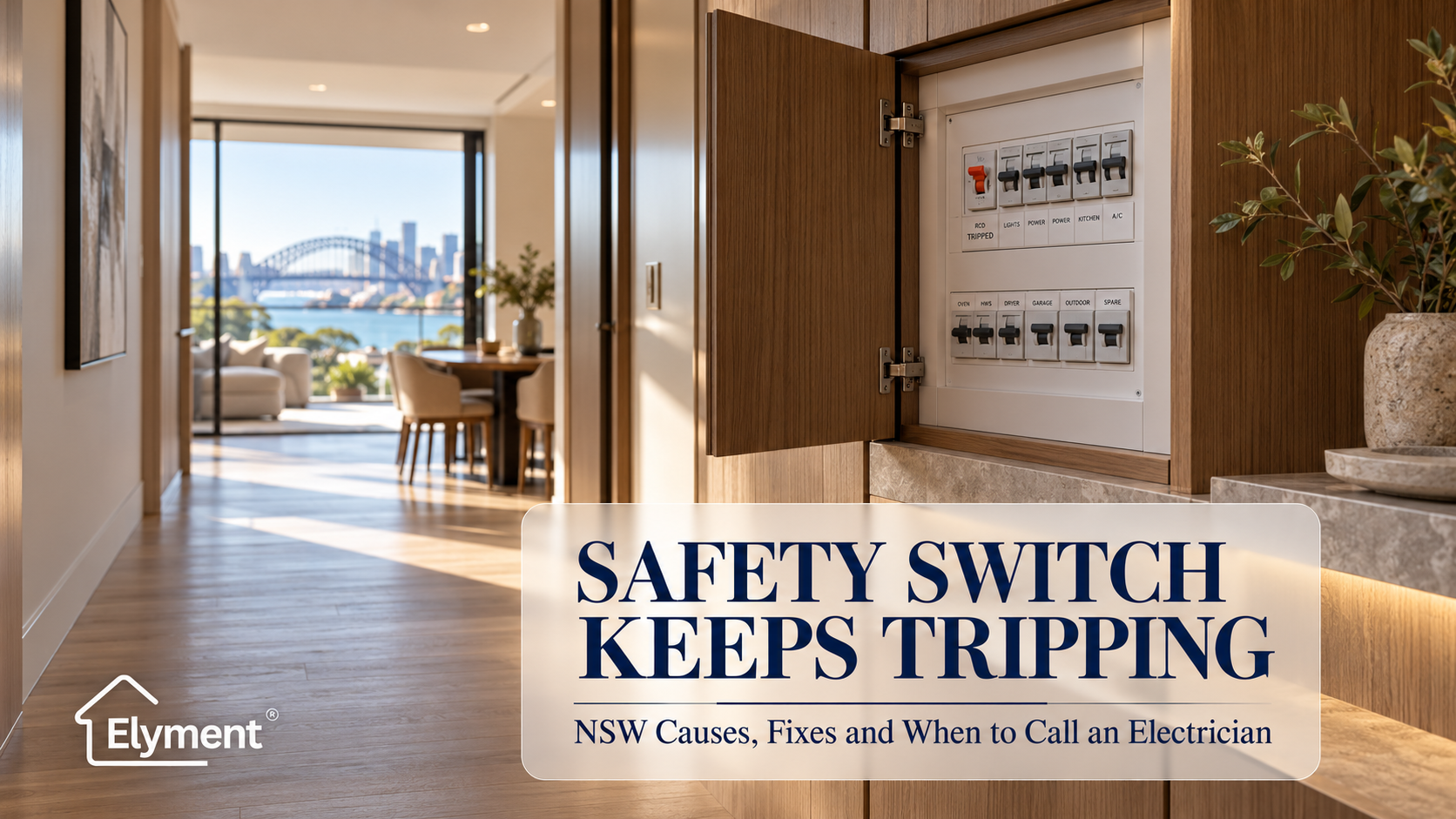
A safety switch that keeps tripping in NSW may indicate electrical leakage from an appliance, moisture, damaged wiring or a faulty electrical installation. Unlike an ordinary circuit breaker, a residual current device (RCD) responds to current leakage. Sydney homeowners should avoid repeatedly resetting a tripping switch, disconnect suspect appliances only when safe and arrange assessment by a licensed electrician when the cause is unclear or the fault continues.
ELYMENT Insights | Property Maintenance & Electrical Safety | Sydney, NSW | 29 October 2026
The Power Goes Out, but the Real Problem May Be Somewhere Else
A safety switch that repeatedly disconnects electricity can turn an ordinary day into an unexpected property maintenance problem.
The kitchen loses power. A laundry appliance stops working. Several rooms become unusable. In an apartment building, the affected electrical switchboard may not even be accessible from inside the residence.
For Sydney property owners, the immediate temptation is understandable: return to the switchboard, reset the device and hope the electricity stays on.
That approach can overlook the purpose of the safety switch.
A residual current device is designed to disconnect electricity when it detects an imbalance associated with electrical current leaking from its intended path.
The interruption is therefore potentially important evidence of an electrical fault.
The distinction matters particularly in older NSW homes, renovated apartments and properties containing several generations of electrical installations.
The problem may originate from one appliance, but the consequences can affect multiple rooms, essential services and planned property works.
Understanding what is actually tripping is the starting point for an effective response.
Safety Switch or Circuit Breaker? The Difference Changes the Diagnosis
Australian switchboards commonly contain several types of electrical protective devices.
Although occupants often describe every electrical interruption as a safety switch tripping, the devices do not necessarily respond to the same conditions.
Types of Electrical Protective Devices
1. Safety Switch (RCD)
- Primary function: Detects electrical current leakage and helps protect against electric shock.
- What may cause it to trip: Earth leakage associated with damaged equipment, moisture or wiring faults.
2. Circuit Breaker
- Primary function: Protects electrical circuits against excessive current.
- What may cause it to trip: Electrical overloads and short circuits.
3. RCBO
- Primary function: Combines residual-current and overcurrent protection.
- What may cause it to trip: Earth leakage, overloads or short circuits, depending on the fault.
This distinction explains why the assumption that a tripping safety switch simply means too many appliances are running can be misleading.
An overloaded circuit may operate a circuit breaker. A conventional RCD primarily responds to residual current, not the total electricity demand.
A combined RCBO can respond to both types of fault.
The NSW Government's residential electrical safety guidance also highlights another important consideration: one safety switch may protect several circuits, particularly in older properties.
That arrangement can make an apparently isolated fault responsible for a much larger interruption.
A licensed electrician can identify the installed protective devices and determine what caused them to operate.
Five Common Reasons a Safety Switch Keeps Tripping
1. A Faulty Appliance Is Leaking Electrical Current
Electrical appliances can develop insulation faults, internal component failures or moisture-related problems that allow current to leak towards earth.
Potential sources include washing machines, dishwashers, refrigerators, portable heaters and outdoor electrical equipment.
The timing of the interruption may provide useful information.
For example, a switch that trips when a dishwasher begins heating water may indicate a fault associated with that appliance or its electrical supply.
That observation is not a diagnosis. The appliance and installation may still require professional testing.
2. Moisture Has Entered Electrical Equipment
Sydney's coastal conditions, rain events and humid environments can expose outdoor electrical equipment to moisture.
Potential problem locations include:
- Outdoor power points and garden equipment connections.
- Exterior lighting installations.
- Garages and basement electrical fittings.
- Laundries and other moisture-prone areas.
- Electrical equipment affected by plumbing leaks.
Water entering an electrical fitting can create dangerous conditions even when the visible exterior appears relatively normal.
A circuit that begins tripping after heavy rain should not automatically be considered safe simply because the weather improves.
A licensed electrician should assess suspected water-affected fixed electrical equipment before reuse.
3. Damaged or Deteriorating Electrical Wiring
Electrical wiring may deteriorate through ageing, heat exposure, mechanical damage, unsuitable alterations or other installation defects.
The issue can become particularly relevant during renovations involving drilling, flooring removal, wall modifications or new electrical fittings.
Hidden electrical services are an important consideration when intrusive work is planned.
Elyment has separately examined hidden electrical conduit risks during Sydney magnesite removal, where the location of concealed services can affect how floor removal and substrate preparation proceed.
Electrical services should be identified and appropriately protected before work that could damage them begins.
4. Several Appliances Are Contributing to Leakage
A safety switch can sometimes operate even when no single appliance appears to be responsible for an obvious failure.
Multiple connected devices can contribute smaller amounts of leakage current.
When several circuits or appliances share one RCD, their combined leakage may contribute to unwanted tripping.
An electrician may need to assess the equipment, circuit arrangement and actual leakage measurements before recommending a solution.
Simply installing a different protective device without identifying the underlying conditions is not an appropriate shortcut.
5. The Safety Switch or Electrical Installation Has a Fault
Protective devices themselves can deteriorate, become damaged or develop operating problems.
However, a safety switch that trips frequently should not be assumed to be defective.
It may be responding correctly to a dangerous condition elsewhere in the installation.
The electrician's task is to establish whether the protective device is functioning correctly, whether the circuit contains a fault and whether the installation provides appropriate protection.
What Homeowners Can Safely Do Before Calling an Electrician
There is an important difference between observing an electrical problem and attempting to repair it.
Homeowners can collect useful information without opening electrical equipment, removing switchboard covers or interfering with wiring.
A Practical First-Response Process
- Check for immediate danger.
- If there is smoke, sparking, a burning smell, electric shock or suspected water contact, stay away from affected equipment.
- Do not attempt to reset the switch.
- Call emergency services on 000 if there is an immediate threat to life or fire emergency.
- Identify what lost power.
- Observe whether the interruption affects one outlet, several rooms or the entire property.
- Do not touch damaged equipment to investigate.
- Note what was operating.
- Record whether the interruption coincided with a particular appliance, rain event or recent renovation activity.
- Disconnect accessible plug-in appliances only if safe.
- Where equipment, plugs and surrounding conditions are dry and undamaged, appliances may be switched off and unplugged without interfering with wiring.
- Never handle equipment suspected of being electrically unsafe or water-affected.
- Do not repeatedly reset a tripping device.
- If the cause is unknown, the switch will not remain on, or the problem returns, leave the affected circuit off and contact a licensed electrician.
Do not remove switchboard covers, disconnect fixed wiring, bypass protective devices or attempt electrical fault testing.
An appliance that appears to be involved in the fault should remain disconnected until it has been appropriately assessed or repaired.
The Pattern of the Outage Can Help an Electrician Investigate
The most useful information is often not how frequently the electricity has failed, but the circumstances surrounding each interruption.
Common Safety Switch Tripping Patterns
1. Switch Trips Whenever a Particular Appliance Operates
- Possible explanation: Appliance leakage or a fault in its electrical supply.
- Appropriate next step: Stop using the appliance and arrange appropriate professional assessment.
2. Switch Trips After Heavy Rain
- Possible explanation: Possible moisture intrusion affecting outdoor equipment or wiring.
- Appropriate next step: Keep affected equipment out of service and contact a licensed electrician.
3. Switch Will Not Remain On
- Possible explanation: Potential ongoing fault involving fixed equipment, wiring or the protective device.
- Appropriate next step: Leave the affected circuit off and arrange electrical fault finding.
4. Several Rooms Lose Power Together
- Possible explanation: Multiple circuits may share one protective device.
- Appropriate next step: Have the electrician identify the affected circuits and protection arrangement.
5. Tripping Begins After Renovation Work
- Possible explanation: Possible damage, disturbance or alteration involving electrical services.
- Appropriate next step: Stop affected work, prevent access to the hazard and obtain electrical clearance.
6. Power Fails When Several High-Demand Appliances Operate
- Possible explanation: Possible circuit overload rather than an RCD leakage fault.
- Appropriate next step: Have the type of protective device and cause of operation confirmed.
These patterns help organise a professional investigation. They are not reliable enough to establish that a circuit is safe.
When an Electrician Is Necessary, and What They Should Investigate
A licensed electrician should be contacted when a safety switch repeatedly trips, cannot be reset, operates without an identifiable cause or is associated with signs of electrical damage.
Professional assessment may involve:
- Identifying the circuit and protective device involved.
- Testing the operation of the RCD or RCBO.
- Investigating electrical leakage and insulation faults.
- Checking relevant fixed wiring and connected equipment.
- Assessing moisture-related electrical damage.
- Reviewing earthing arrangements where relevant.
- Determining whether repairs or protective-device replacement are necessary.
- Verifying electrical safety before the affected installation returns to service.
The solution depends on the established cause.
A damaged appliance may need professional repair or replacement.
Defective wiring may require electrical repair. A faulty protective device may need replacement. An unsuitable circuit arrangement may require further electrical assessment.
These are different scopes of work, with different implications for cost and disruption.
Under NSW law, electrical wiring work must be undertaken by a licensed electrician.
The NSW Government's electrical safety requirements explain licensing obligations and the Certificate of Compliance for Electrical Work (CCEW) requirements associated with electrical installation work.
Property owners should verify the electrician's licence and request the applicable compliance documentation when electrical installation work has been completed.
The NSW Rental Property Issue: Electrical Faults Cannot Simply Be Deferred
A recurring safety-switch fault can create additional responsibilities when a property is occupied by tenants.
NSW Fair Trading identifies dangerous electrical faults and failures of electricity supply among the circumstances that may constitute urgent repairs.
Its guidance also identifies electrical faults in rental properties as urgent repair matters.
Tenants should notify the landlord or managing agent immediately.
For landlords and property managers, the response should focus on arranging appropriate investigation and repair, rather than repeatedly restoring power without establishing why it failed.
The NSW Fair Trading guidance on electrical safety in rental properties also explains the importance of working safety switches and electrical hazards in property condition reports.
An electrical interruption may therefore create both a safety problem and a tenancy-management obligation.
Strata Apartments Introduce Another Question: Who Controls the Switchboard?
In Sydney apartment buildings, the affected electrical equipment may not be located entirely within an individual residence.
Some apartments contain their own internal switchboard, while other electrical infrastructure may be located in shared meter rooms or common-property areas.
Responsibility for investigating and repairing an electrical fault can depend on the location and function of the affected infrastructure, the strata plan and applicable property arrangements.
The NSW Government's strata repairs and maintenance guidance explains the distinction between individual property maintenance and owners corporation responsibilities.
A practical response may require coordination between the resident, landlord, strata manager, owners corporation and electrician.
The immediate priority remains electrical safety.
Responsibility for paying for the eventual repair should be established through the relevant strata and ownership arrangements, rather than assumed solely from where the electrical interruption was noticed.
A Tripping Safety Switch Can Stop a Sydney Renovation
A recurring electrical fault can have consequences beyond an individual appliance.
Renovation projects depend on safe and reliable electrical arrangements for equipment, lighting, dust extraction and other site activities.
Consider a Sydney apartment where contractors are scheduled to remove old flooring, prepare a concrete substrate and install a new finish.
The planned works may require:
- Electrical supply for approved removal and preparation equipment.
- Suitable power arrangements for dust extraction.
- Safe equipment access through occupied or shared areas.
- Coordination with building management where required.
- Sequencing between electrical repairs and flooring work.
If the available power supply is found to be unsafe or repeatedly disconnects, the affected activities cannot simply continue as originally planned.
The project team may need to establish a safe alternative supply arrangement, resequence tasks or postpone electrical equipment use until the fault has been professionally resolved.
This is particularly relevant to Sydney floor levelling projects requiring early access and power planning.
A floor preparation contractor should not be expected to diagnose or rectify an unsafe electrical installation.
The appropriate division of responsibility is clear: electrical testing and repairs belong with qualified electrical trades, while renovation contractors coordinate their work around an electrically safe site.
Construction-Site Electrical Requirements Are Not the Same as Household Checks
There is another important distinction between electrical protection in an occupied home and electrical arrangements on a construction or demolition site.
SafeWork NSW identifies AS/NZS 3012:2019 as a relevant standard for electrical installations and equipment on construction and demolition sites.
Its guidance addresses matters including site switchboards, residual current devices, construction wiring, electrical equipment and inspection and testing requirements.
The SafeWork NSW construction and demolition electrical practices fact sheet sets out more detailed requirements.
A renovation involving construction or demolition activities may require site-specific electrical controls rather than relying on ordinary household arrangements.
For project managers, an unresolved electrical fault is therefore both a safety issue and a delivery risk.
Equipment cannot be regarded as safe merely because power can temporarily be restored.
What Determines the Cost of Fixing a Tripping Safety Switch?
There is no dependable repair price without knowing the cause of the fault.
The cost of replacing an individual protective device is different from the cost of investigating hidden wiring, repairing fixed equipment or upgrading an unsuitable switchboard.
The main variables include:
- The time required to locate the fault.
- The number of affected circuits.
- The accessibility of electrical equipment and wiring.
- Whether an appliance or the fixed installation is responsible.
- The condition and age of the switchboard.
- Whether replacement components or additional work are necessary.
- Strata access arrangements and permitted work hours.
- Whether the fault requires urgent attendance.
An effective electrical quotation should distinguish initial fault finding from any additional repair or replacement work.
Property owners should also understand whether further investigation may be required before a firm repair scope can be established.
For a renovation project, the full financial impact may include more than the electrician's invoice.
Interrupted site access, rescheduled contractors and delayed material installation can create additional project costs.
Safety Switch Testing Should Be Part of Routine Property Maintenance
Safety switches should be tested regularly, even when there is no obvious electrical problem.
The NSW Government's home safety-switch testing guidance recommends testing at least every six months.
Property owners should also follow relevant manufacturer instructions and professional advice.
The ordinary user test involves pressing the marked test button on an accessible safety switch, confirming that it operates, and restoring the switch after the test.
Occupants should be warned before planned testing because protected circuits will lose electricity.
A test button that fails to operate the safety switch requires assessment by a licensed electrician.
A successful push-button test is not a substitute for professional electrical inspection where faults or installation concerns exist.
Older Sydney properties may also benefit from an electrician reviewing whether all relevant circuits have suitable residual-current protection.
Where planned improvements include new fixtures or electrical equipment, the protection arrangements should be considered before installation.
For example, Elyment's article on ceiling fan installation in Sydney examines the electrical and physical considerations behind replacing an existing light fitting.
Safety Switch Problems Are Not the Same as Power Surge Problems
Electrical protection is not a single-device solution.
Safety switches, circuit breakers and surge-protection devices address different electrical risks.
A safety switch should not be assumed to protect electronic equipment against every voltage surge.
Similarly, installing surge protection does not resolve an underlying earth-leakage fault.
Elyment's separate analysis of surge protection and safety switches in Sydney examines this distinction in more detail.
For a property owner dealing with repeated disconnections, the immediate task is not to purchase additional electrical protection.
It is to identify why the existing protective device is operating.
Frequently Asked Questions
Why does my safety switch keep tripping when nothing is plugged in?
The problem may involve fixed electrical equipment, wiring, moisture, a shared circuit arrangement or the protective device itself.
Unplugging appliances does not isolate every possible electrical fault.
A licensed electrician should investigate a switch that continues to trip.
Can a faulty safety switch cause repeated power outages?
Yes. A defective protective device can contribute to interruptions, but repeated tripping can also indicate a genuine electrical fault.
Professional testing is necessary to distinguish between those possibilities.
Should I replace a safety switch myself?
No. Replacing a fixed switchboard safety switch involves electrical installation work and must be undertaken by an appropriately licensed electrician in NSW.
Can rain cause a safety switch to trip?
Yes. Moisture entering outdoor electrical equipment or wiring may cause leakage that operates an RCD.
Water-affected equipment should not be used until appropriately assessed.
Does a tripping safety switch mean the whole switchboard needs replacing?
Not necessarily. The cause may be confined to an appliance, circuit or individual protective device.
A switchboard replacement should be recommended only where the electrical assessment establishes that it is warranted.
Can renovation contractors continue working if the safety switch keeps tripping?
Affected electrical equipment and circuits should not be used until the hazard has been appropriately assessed and controlled.
Any unaffected activities can proceed only where the site can be maintained safely and relevant work requirements are satisfied.
The Best Repair Begins With Identifying the Actual Fault
Repeated safety-switch trips should not be treated as an inconvenience to be overcome by repeatedly restoring electricity.
They are a reason to investigate the condition of the electrical equipment, circuits and protective devices involved.
For Sydney homeowners, the priority is safe fault identification followed by appropriately licensed electrical repair.
For landlords and strata stakeholders, the issue also involves maintenance responsibilities and timely communication.
For renovation project teams, electrical reliability must be addressed before unsafe site conditions interrupt the wider programme.
The goal is not simply to restore power.
It is to establish that the affected electrical installation can be used safely.
Planning Property Works Across Sydney?
Elyment supports Sydney property owners, builders and property managers with renovation planning, flooring preparation, site logistics, contractor coordination and practical project delivery.
Where electrical investigations or repairs are required, those works must be undertaken by appropriately licensed electrical professionals.
Sources and References
Government and Regulatory References
- NSW Government: Residential Electrical Safety Guidance
- NSW Government: Electrical Safety Requirements and Consumer Rights
- NSW Fair Trading: Electrical Safety in Rental Properties
- NSW Government: Strata Repairs and Maintenance
- SafeWork NSW: Electrical Practices on Construction and Demolition Sites
- NSW Government: Safety Switches Protect You – Testing Guidance
Related Elyment Resources
- Magnesite Removal Sydney: Hidden Electrical Conduit Risks
- Why Did This Sydney Flooring Job Need Access Planning Before Floor Levelling Could Even Start?
- Ceiling Fan Installation Cost Sydney: Can a Fan Replace Your Existing Light?
- Surge Protection Sydney: Safety Switches vs Appliance Protection
- Contact Elyment Property Services
Relevant next actions
Explore the ELYMENT service most closely connected to this article.