Carpet Removal Sydney in an Occupied Office: Can the Job Be Staged After Hours Without Closing the Workplace?
See how carpet removal in an occupied Sydney office can be staged after hours reducing disruption while managing access, dust, noise and workplace safety risks.
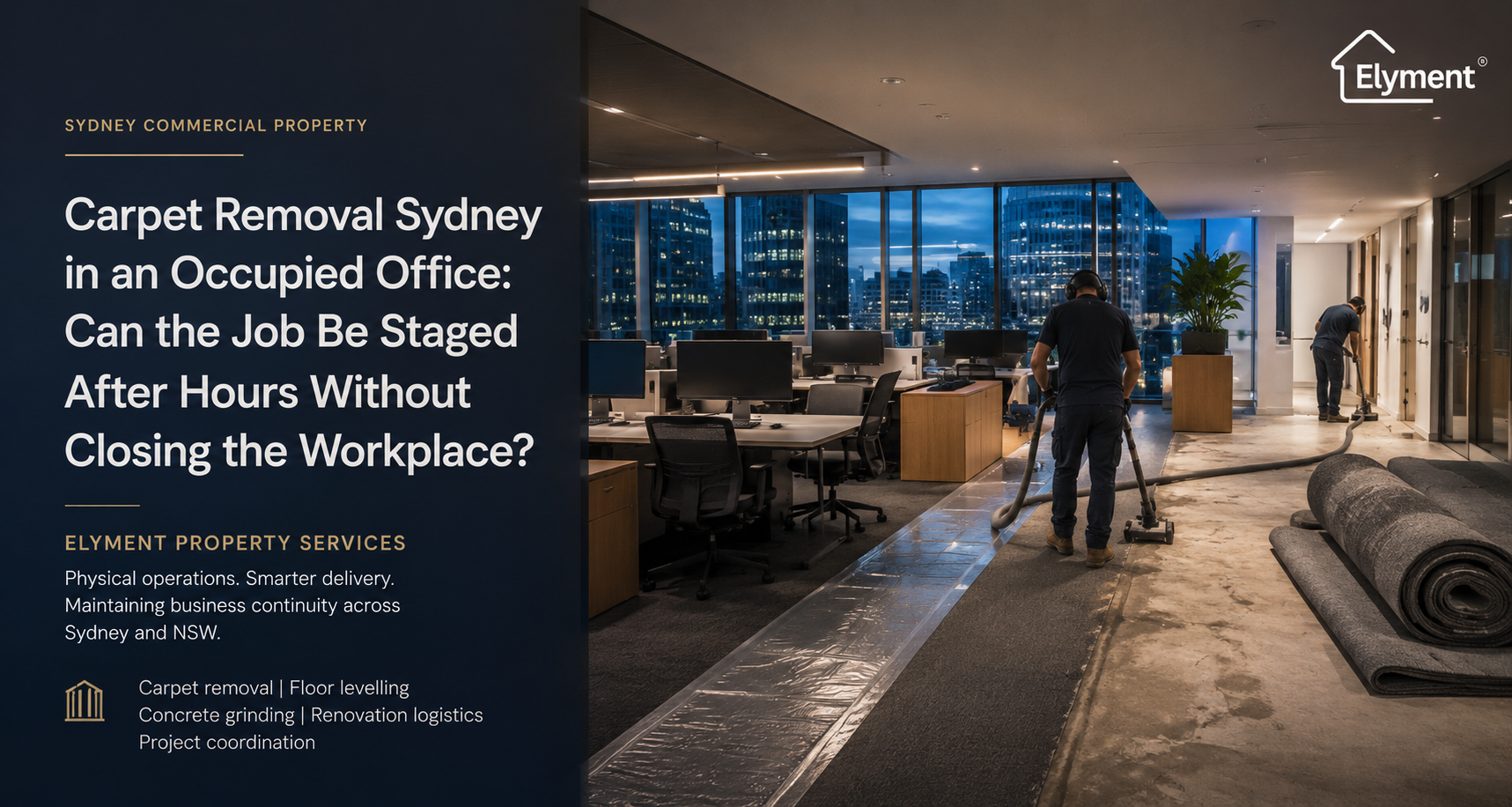
Yes, carpet removal in an occupied Sydney office can often be staged after hours without closing the entire workplace, provided each work zone can be safely isolated, completed, cleaned and released before staff return. The critical issue is not simply when the carpet is lifted. Furniture movement, dust, noise, exposed adhesive, floor transitions, waste removal, building access and unexpected substrate conditions can all determine whether next-morning occupation is realistic.
The commercial appeal of after-hours flooring work is obvious. A Sydney business may have hundreds of employees, client meetings, secure rooms, technology infrastructure and lease obligations operating across a floor that needs refurbishment. Closing the office for several days can create costs that extend far beyond the flooring contract.
That does not mean the alternative is to send a flooring crew in at 6 pm, remove whatever can be reached and leave before employees arrive.
In an occupied workplace, carpet removal becomes a business-continuity exercise. The project has to move through the tenancy without turning partially completed flooring work into tomorrow morning's operational problem.
Elyment's existing analysis of commercial carpet glue removal in NSW addresses why commercial substrates can require more demanding preparation than residential floors. The more consequential issue in a live office is how that preparation is sequenced around employees, furniture, technology, circulation and building management.
The Real Constraint Is Reoccupation, Not Removal Speed
A contractor may be physically capable of removing several hundred square metres of carpet during an evening shift. That production figure does not determine whether staff can safely occupy the same area at 8 am.
A better programme works backwards from a defined reoccupation time.
Before the next section is released, the project team needs to know whether:
- the nominated removal area is complete;
- loose carpet, underlay, smooth edge, staples and debris have been removed from circulation paths;
- the exposed substrate is stable enough for temporary occupation or has been covered appropriately;
- adhesive residue does not create a tacky or contaminated walking surface;
- temporary floor-height changes at the work-zone boundary are controlled;
- workstation power and data infrastructure remains protected and usable;
- doors, fire exits and normal circulation routes remain accessible;
- dust has been captured and the area cleaned rather than merely swept;
- waste has been taken through the approved building route;
- furniture has been returned only where the floor is ready to receive it; and
- nothing discovered during removal requires the area to remain isolated.
This distinction changes how an after-hours programme should be priced and managed. The nightly objective is not a number of square metres removed. It is a completed operational zone that can either be formally released or deliberately kept out of service.
Why Sydney Offices Make Staging More Complicated
Sydney commercial flooring projects are frequently constrained by the building surrounding the tenancy.
A CBD tower, North Sydney office, Parramatta commercial building or mixed-use development can add loading-dock bookings, lift protection, contractor induction, security access, noisy-work periods, waste movements and restrictions on work in shared corridors. Elyment's commercial floor levelling and preparation work in Sydney similarly reflects the importance of night and weekend work where daytime disruption needs to be reduced.
After-hours access therefore solves only one scheduling problem. It does not remove the need to coordinate the rest of the building.
A productive six-hour removal shift can become a much shorter working window once the crew has allowed time for:
- site access and inductions;
- furniture relocation;
- work-zone isolation;
- equipment movement from the loading dock;
- protection of lifts and common areas;
- carpet and underlay removal;
- floor-edge detailing;
- waste transfer;
- vacuuming and final cleaning;
- temporary transition treatment; and
- inspection before the tenancy is handed back.
In other words, the usable work window and the building-access window are not necessarily the same thing.
The Office Should Be Divided Into Operational Zones Before the First Night
The most reliable projects divide the tenancy according to how people actually use it, rather than simply drawing equal rectangles on a floor plan.
Reception, meeting rooms, executive areas, open-plan workstations, kitchens, printer zones, server or communications rooms and primary circulation paths have different operational consequences if they are unavailable the next morning.
A practical staging plan might therefore treat a 1,000-square-metre office as six operational zones rather than four equal 250-square-metre flooring areas.
- Reception and client areas
- Typical staging priority: Weekend or controlled single-stage work.
- Key constraint: Public presentation and access.
- Release consideration: Must be visually and physically safe before reopening.
- Open-plan workstations
- Typical staging priority: Nightly zones.
- Key constraint: Furniture, power and employee density.
- Release consideration: Complete workstation clusters rather than random strips.
- Meeting rooms
- Typical staging priority: Individual room staging.
- Key constraint: Bookings and acoustic separation.
- Release consideration: Can sometimes act as self-contained work zones.
- Main corridors
- Typical staging priority: High-control staging.
- Key constraint: Whole-floor circulation.
- Release consideration: Temporary transitions and uninterrupted access matter.
- Server or communications areas
- Typical staging priority: Special planning.
- Key constraint: Critical equipment and contamination sensitivity.
- Release consideration: May require complete exclusion from flooring works.
- Kitchen and breakout areas
- Typical staging priority: Night or weekend.
- Key constraint: Fixed joinery and plumbing interfaces.
- Release consideration: Check carpet boundaries beneath cabinetry and appliances.
This is why a workplace staging plan should involve the tenant or facilities representative before mobilisation. Contractors understand removal production. The tenant understands which 20 metres of floor can stop 200 people reaching their desks.
Furniture Can Become the Critical Path
Carpet removal is often quoted from a floor plan showing the area of floor covering. An occupied office presents something different: a floor almost entirely covered by the business itself.
Desks, task chairs, storage units, meeting tables, mobile pedestals, printers, plants, filing systems and loose technology all have to remain somewhere while the floor beneath them changes.
The staging strategy needs to establish whether furniture will be:
- moved to another part of the tenancy;
- shifted within the same work zone in controlled stages;
- temporarily stored elsewhere in the building;
- removed from site;
- handled by a specialist furniture contractor; or
- left in position because the carpet can be removed around a fixed installation.
Problems arise when a removal crew is expected to determine this after arriving on the first evening. Moving furniture can consume a significant part of a night shift and create additional handling, damage and workstation-reconnection risks.
The office should ideally enter each shift already prepared for the nominated flooring zone.
Carpet Construction Determines How Cleanly the Office Can Be Divided
Not every carpet system behaves equally well when a project is divided into nightly packages.
Carpet tile can offer convenient physical boundaries, particularly where sections can be removed without destabilising large adjoining areas. Broadloom carpet stretched over underlay creates different perimeter and seam conditions. Direct-stick carpet can expose adhesive across the entire work zone, while double-bond systems can require separate passes to remove both carpet and adhered underlay.
Elyment's guide to how glued, stretched and stapled carpet change a Sydney removal job explains why the fixing method can alter labour, equipment and substrate preparation.
In an occupied office, fixing method also affects the overnight programme.
A floor that releases cleanly may be vacuumed, inspected and temporarily reopened relatively quickly. A surface covered with stubborn adhesive or deteriorated backing can require scraping or mechanical preparation that was not part of the original nightly assumption.
The Most Important Hold Point Comes After the Carpet Is Lifted
Staged commercial projects need a deliberate inspection point immediately after the existing flooring is exposed.
The substrate may reveal:
- old adhesive;
- rubber or foam backing residue;
- previous levelling compound;
- cracked or weak patching material;
- unexpected floor-height changes;
- old vinyl or other concealed floor coverings;
- moisture staining;
- damaged concrete or screed;
- floor-box and service penetrations; or
- materials that should not be disturbed until they have been assessed.
That inspection has a direct impact on whether staff can return.
Elyment has separately examined what should happen when carpet removal exposes old vinyl tiles.
That issue becomes particularly important in a commercial workplace because SafeWork NSW states that where a workplace was built before 31 December 2003, or asbestos has been identified, the owner or manager must keep an asbestos register and make it available to people carrying out or intending to carry out work at the workplace.
SafeWork NSW also identifies flooring among the building locations where asbestos-containing materials may be encountered during renovation.
An after-hours programme should therefore contain a contingency for discovery. The deadline of "staff arrive at 8 am" cannot override a material-assessment or safety decision.
Grinding May Change the Entire Staging Strategy
Carpet uplift and concrete preparation should not automatically be treated as the same type of night work.
If direct-stick adhesive, old compounds or contamination need mechanical removal, the operation may introduce larger equipment, dust extraction, electrical requirements, greater noise and a longer cleaning period.
SafeWork NSW's construction guidance notes a workplace noise exposure standard of 85 dB(A) averaged over eight hours, with additional controls required for hazardous noise. SafeWork also recommends separating quieter work from noisy work through measures including designated low-noise areas, buffer zones and physical isolation.
Where floor preparation involves concrete grinding, the project also needs to address the applicable controls for respirable crystalline silica and dust-generating work rather than assuming an empty office at night eliminates exposure concerns.
This can lead to a hybrid programme:
- Complete straightforward carpet and underlay removal in smaller evening zones.
- Map areas requiring mechanical adhesive or substrate preparation.
- Consolidate the heavier preparation into a weekend or larger isolated work window.
- Inspect and prepare the slab for the specified replacement flooring.
- Reopen areas only after the required cleaning and floor conditions have been achieved.
This approach can be more efficient than mobilising grinding equipment for a small patch every night.
A Temporary Floor Is Still a Workplace Floor
One of the most underestimated risks in staged office refurbishment is the boundary between the completed area and the next work zone.
Staff may need to cross:
- new flooring to old carpet;
- carpet to exposed concrete;
- different underlay heights;
- doorway transitions;
- temporary protection systems; or
- areas where perimeter trims have not yet been reinstated.
SafeWork NSW identifies uneven flooring, changes between flooring types, contaminants, loose cords and poorly controlled walkways as common sources of slips and trips.
The project therefore cannot rely on the argument that a temporary edge will disappear in a few days. If employees are expected to use the space during the staged programme, temporary conditions need to be managed as real workplace conditions.
The Replacement Floor Determines How Much Carpet Can Be Removed Early
The question "Can we remove the carpet tonight?" should be followed immediately by "What happens to the floor tomorrow?"
If the replacement is carpet tile and the substrate requires little corrective work, removal and replacement may be able to follow one another closely.
If the office is changing to vinyl plank, engineered timber, epoxy, microcement or another finish that requires a more demanding substrate, the gap between demolition and installation can expand considerably.
The exposed slab may require:
- adhesive removal;
- concrete grinding;
- local repairs;
- moisture assessment;
- primer;
- floor levelling;
- curing or drying time; and
- a formal preparation handover to the installation team.
Elyment's analysis of carpet backing residue and self-levelling compound bonding illustrates why a floor that looks clean enough to walk across may still be unsuitable for the next bonded flooring system.
What a Realistic After-Hours Programme Looks Like
A controlled project can be structured around seven repeatable stages.
- Survey the whole tenancy before mobilisation.
- Confirm carpet construction, furniture, floor boxes, access routes, work hours, waste movements and the replacement flooring sequence.
- Divide the office into operational zones.
- Base boundaries on staff circulation and business functions as well as flooring geometry.
- Prepare the next zone during business hours where possible.
- Employees can pack personal items and technology teams can manage sensitive equipment before the flooring shift begins.
- Isolate and complete the nominated nightly scope.
- Avoid opening more floor than can be brought to an agreed hold point during the available work window.
- Inspect the exposed substrate.
- Decide whether the area can proceed, temporarily reopen or needs to remain isolated for additional preparation.
- Complete the reoccupation inspection.
- Review floor transitions, debris, dust, power leads, furniture, access paths and unresolved substrate conditions.
- Release the zone deliberately.
- The next morning's occupants should never be the first people to discover what the night shift left behind.
After-Hours Work Reduces Business Disruption, But It Can Increase Project Cost
Keeping an office operational has economic value, but staged delivery is not automatically the cheapest construction method.
Multiple night shifts can create repeated costs for mobilisation, supervision, security access, lift bookings, floor protection, cleaning, furniture movement and waste handling.
There can also be a productivity penalty. A crew that could process one continuous floor in a weekend may cover the same area more slowly when equipment has to be set up, cleaned down and removed each night.
The relevant comparison is therefore not simply:
Night work cost versus daytime work cost.
It is:
Staged construction cost versus the operational cost and disruption of shutting down the workplace.
For professional services firms, medical offices, corporate headquarters, customer-support environments and other high-occupancy workplaces, paying more for carefully staged delivery may still produce the better commercial outcome.
The Workplace Does Not Have to Close, But Some Zones May Need To
The most effective occupied-office projects avoid making an unrealistic promise that the entire tenancy will remain continuously usable.
A stronger plan distinguishes between keeping the business open and keeping every square metre open.
Individual workstation clusters, meeting rooms, corridors or departments may need temporary isolation even when the wider office remains operational.
The programme becomes more resilient when staff know in advance:
- which area will close each evening;
- when it is expected to reopen;
- where affected employees will work temporarily;
- which routes remain available;
- who approves the morning handback; and
- what happens if the substrate changes the planned sequence.
This is a project-coordination issue as much as a flooring issue.
OCCUPIED OFFICE FLOORING & PROJECT DELIVERY — Review the Staging Plan Before the First Night Shift
Review carpet removal zones, workplace access, substrate preparation, furniture movement, building requirements, compliance considerations and reoccupation sequencing before an occupied Sydney office refurbishment begins.
The Bottom Line for Sydney Office Refurbishments
Carpet removal does not necessarily require a Sydney office to shut down. In many tenancies, work can be divided into evening, overnight or weekend zones while employees continue using unaffected parts of the workplace.
The success of that strategy depends on controlling the interfaces between construction and occupation.
The floor has to be assessed before the first shift, the office divided according to operational needs, furniture and technology coordinated, concealed substrate conditions anticipated, dust and noise controlled, waste removed and every temporary transition made safe.
Most importantly, every shift needs a defined reoccupation gate.
If the floor is clean, stable, accessible and ready for its intended temporary or permanent use, the next zone can proceed. If removal reveals suspect material, difficult adhesive, damaged substrate or preparation work that cannot be completed safely within the available window, that particular area may need to remain closed.
For Sydney businesses, that is the more useful definition of successful after-hours carpet removal: not that nobody notices construction occurred, but that the workplace remains operational because the disruption has been deliberately designed around it.
Sources and References
- Elyment: Why Does Commercial Carpet Glue Removal Take Longer Than Residential Jobs in NSW?
- Elyment: Commercial Floor Levelling and Preparation Sydney
- Elyment: Carpet Removal Sydney Quote — How Glued, Stretched and Stapled Carpet Change the Job
- Elyment: Carpet Removal Sydney Uncovers Old Vinyl Tiles — When Should Work Stop for an Asbestos Check?
- Elyment: Carpet Removal Sydney — Rubber Backing Residue That Can Stop Self-Levelling Compound Bonding
- SafeWork NSW: Working Safely With Crystalline Silica
- Elyment: Contact
Review The Staging Plan Before The First Night Shift
Review carpet removal zones, workplace access, substrate preparation, furniture movement, building requirements, compliance considerations and reoccupation sequencing before an occupied Sydney office refurbishment begins.
Request A Project ReviewRelevant next actions
Explore the ELYMENT service most closely connected to this article.