Carpet Removal Sydney Uncovers Old Vinyl Tiles: When Should Work Stop for an Asbestos Check?
Old vinyl tiles found during carpet removal in Sydney may contain asbestos. Know when work should stop, testing is needed and removal can safely resume on site.
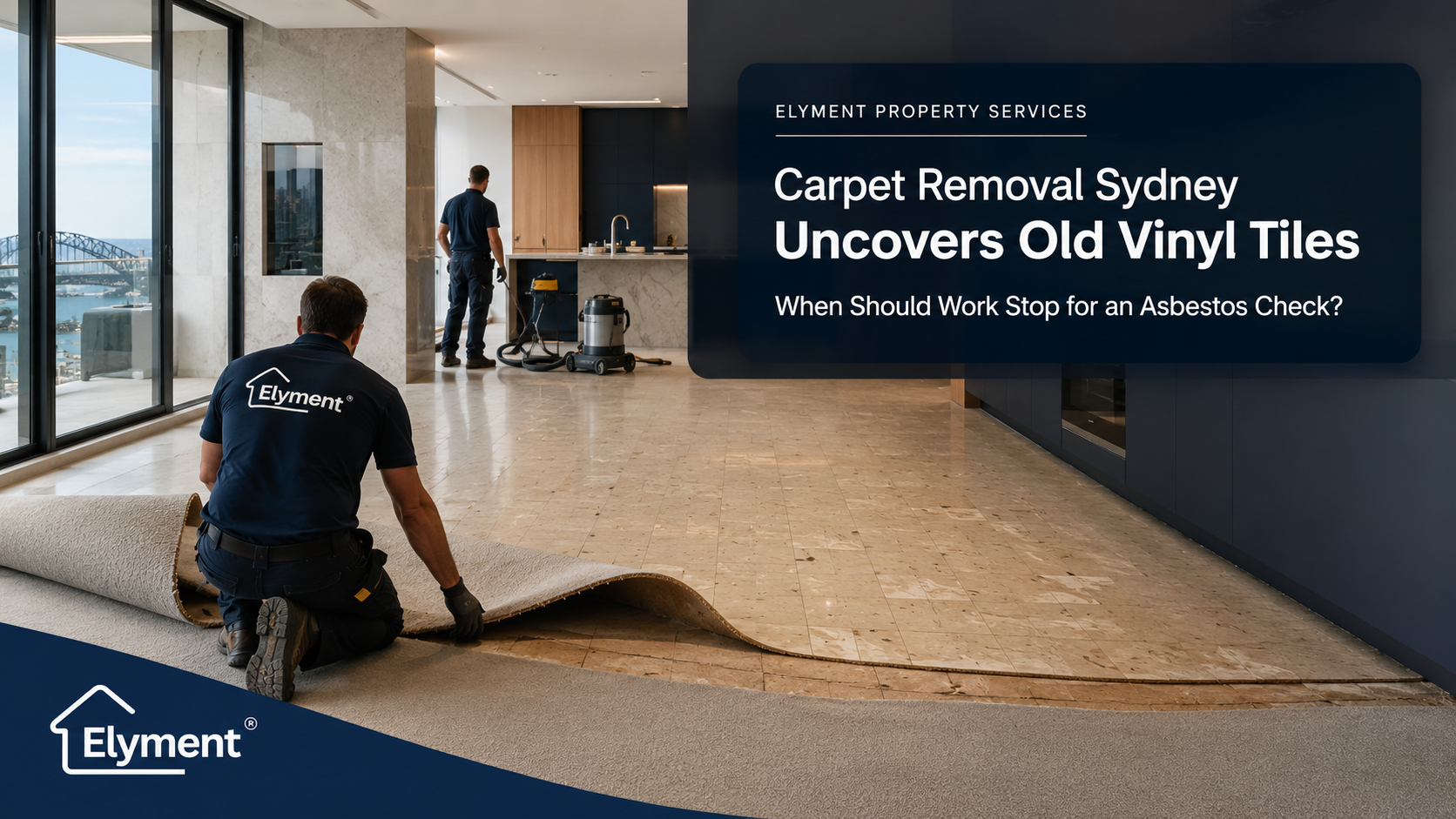
When carpet removal in a Sydney property exposes unidentified old vinyl tiles, backing or adhesive, further disturbance should stop where asbestos cannot reasonably be ruled out. NSW guidance recognises vinyl flooring and some flooring adhesives as potential asbestos-containing materials, particularly in older properties. The practical issue is not simply identifying the tile. It is preventing grinding, scraping or demolition from turning an uncertain material into a larger contamination and project-delay problem.
The Important Decision Happens Before the Grinder Comes Out
Carpet removal is usually one of the least complicated stages of a flooring project. The carpet is cut into manageable sections, the underlay is lifted, perimeter smooth edge is removed where required and the exposed substrate is assessed for the next finish.
That sequence changes when the carpet reveals another flooring system that nobody expected.
Across Sydney's older apartments, houses, commercial premises and previously refurbished buildings, crews can remove carpet and discover vinyl tiles, sheet flooring, remnants of backing material or old adhesive beneath it. Some of those products are entirely asbestos-free. Others may date from periods when asbestos-containing flooring materials were in circulation.
Asbestos NSW states that asbestos-containing vinyl flooring can be visually indistinguishable from vinyl flooring that does not contain asbestos. Its guidance identifies floor tiles, sheet vinyl and similar coverings among materials that may contain asbestos, particularly products manufactured before 1987. NSW guidance on asbestos in vinyl floor tiles and coverings is therefore relevant when an unidentified layer appears during renovation.
The consequence is operational rather than cosmetic. A flooring crew should not assume that because the newly exposed tiles are hard, intact or familiar-looking, they are automatically suitable for mechanical removal.
A Hidden Vinyl Layer Changes the Scope of the Project
The original scope may have been straightforward:
- Remove carpet and underlay.
- Remove smooth edge and staples.
- Mechanically prepare the concrete.
- Repair minor defects.
- Level the substrate where required.
- Install the new flooring system.
An unidentified vinyl layer inserts a new decision point between carpet removal and substrate preparation.
That matters because the next tools normally used on a flooring project can be substantially more aggressive than carpet removal. Floor scrapers, grinders, scarifiers and hand tools can fracture tiles, abrade backing material or grind through adhesive residues.
Once an uncertain material has been mechanically disturbed, the project may no longer be dealing with an intact suspected material. It may instead be dealing with broken flooring, dust, contaminated equipment and a wider work zone requiring assessment and controlled remediation.
This is why the most valuable asbestos control on some renovation projects is not specialist equipment. It is recognising the point at which ordinary flooring work should stop.
What Should Trigger a Stop-Work Decision?
Old vinyl beneath carpet does not automatically mean asbestos is present. Equally, appearance alone cannot reliably establish that it is absent.
A prudent stop-work decision becomes particularly relevant where one or more of the following conditions exists:
- the building or relevant flooring installation is known or suspected to be older;
- the vinyl layer was not identified in the original renovation scope;
- the tiles or sheet flooring cannot be confidently dated;
- there is an unidentified backing layer beneath the vinyl;
- black, dark or otherwise unidentified adhesive is exposed below the covering;
- tiles are already brittle, damaged or lifting;
- the proposed next operation involves grinding, scraping, sanding, drilling or aggressive mechanical removal;
- existing asbestos records do not clearly cover the newly exposed material;
- the project is in a workplace or managed property where asbestos documentation should be reviewed before refurbishment continues.
NSW Government asbestos guidance takes a conservative position where suspect material cannot be identified: if it might be asbestos, it should be treated accordingly until appropriate assessment resolves the uncertainty.
The Tile Is Only One Part of the Investigation
A common project-management mistake is to focus entirely on the visible vinyl tile.
The actual flooring assembly may contain several materials:
- CarpetWhat the renovation team may find: Modern or older textile flooring.
- Why it matters: Usually the layer that conceals the original flooring system.
- UnderlayWhat the renovation team may find: Foam, felt, rubber or older unidentified material.
- Why it matters: May require separate assessment depending on age and composition.
- Vinyl tile or sheetWhat the renovation team may find: Rigid tiles, patterned vinyl, lino-like material or sheet covering.
- Why it matters: Some historic products contained asbestos.
- BackingWhat the renovation team may find: Fibrous or felt-like backing beneath sheet flooring.
- Why it matters: Some older backing systems may present a different risk from the visible surface.
- AdhesiveWhat the renovation team may find: Black, brown, cream or other mastic and adhesive residues.
- Why it matters: Historic adhesives may themselves contain asbestos.
- SubstrateWhat the renovation team may find: Concrete, screed, timber sheet, magnesite or another floor base.
- Why it matters: Determines what preparation can occur after the asbestos question is resolved.
Asbestos NSW specifically identifies asphaltic cutback adhesive, commonly a black adhesive used beneath vinyl tiles and flooring, among historic adhesive products that may contain asbestos. It also documents asbestos-containing adhesive beneath vinyl and carpet.
The presence of black adhesive is not, by itself, proof of asbestos. The operational conclusion is narrower: an unidentified historic adhesive should not be mechanically ground merely because the vinyl above it has been removed or appears harmless.
Why Grinding Is Usually the Wrong Way to Investigate
Once carpet has been removed, flooring contractors naturally want to determine whether the exposed floor can be prepared for the next system.
Normally that assessment may involve scraping residue, testing bond strength, diamond grinding high spots or exposing clean substrate.
Those are appropriate floor-preparation methods only after the materials being disturbed are understood.
Grinding is particularly significant because it turns a surface layer into fine particulate material. A HEPA-filtered dust extractor is an important control for ordinary concrete and adhesive preparation, but dust extraction does not convert unidentified asbestos-containing material into conventional grinding work.
The correct sequence is identification first, mechanical preparation second.
Elyment's Sydney flooring and substrate preparation services treat removal, concrete preparation and levelling as connected stages. That sequencing becomes especially important when an unexpected material changes the risk profile before the substrate is reached.
A Better Site Response: Preserve the Evidence and Limit the Work Zone
When suspect vinyl is uncovered, crews gain little by lifting another ten square metres simply to understand what is underneath.
A more controlled response is to preserve the condition in which the material was found.
- Stop disturbing the unidentified layer.
- Do not continue pulling, breaking, grinding or scraping it merely to complete the original carpet-removal scope.
- Restrict unnecessary access.
- Keep other trades, residents, cleaners and building staff out of the affected work area while the material is being assessed.
- Do not dry sweep or use an ordinary vacuum cleaner.
- NSW asbestos guidance warns against activities that can redistribute suspected asbestos-containing dust.
- Record what has been uncovered without further disturbance.
- Photograph the location, transitions, approximate extent and relationship to adjoining rooms.
- Review available building information.
- Check renovation records, asbestos registers where applicable, strata documentation, previous flooring scopes and any earlier test reports.
- Arrange appropriate professional assessment.
- Where the material cannot be ruled out, obtain competent asbestos advice and testing rather than using demolition as a diagnostic method.
- Reissue the flooring programme after the result is known.
- Only then should removal, grinding, levelling and installation dates be reconfirmed.
SafeWork NSW advises that where asbestos is unexpectedly encountered or disturbed, work should stop, the material should be left undisturbed as far as possible and access should be controlled while competent asbestos advice is obtained.
Testing Is a Project Hold Point, Not an Administrative Delay
On fast-moving Sydney renovations, testing can initially appear to be a programme interruption.
In reality, it can prevent a considerably larger interruption.
Consider an apartment where 70 square metres of carpet is scheduled for removal on Monday, grinding on Tuesday and levelling on Wednesday before engineered timber installers arrive later in the week.
If an unidentified vinyl tile is discovered after the first bedroom is cleared, two choices exist.
The first is to keep removing because every trade has already been booked.
The second is to establish a controlled hold point before the tile, backing or adhesive is disturbed.
The second option may affect the programme immediately, but it protects the rest of the site. The first option risks turning a localised uncertainty into an apartment-wide remediation issue.
The scheduling lesson is important: when concealed floor layers are plausible, project managers should build contingency into the programme before demolition starts rather than treating every unexpected substrate as a same-day flooring decision.
Older Sydney Apartments Create a Particular Coordination Problem
The issue is especially relevant in strata buildings.
Many Sydney apartments have undergone several generations of floor finishes. A slab may have originally received vinyl or another resilient covering, later been carpeted and then be scheduled for timber or hybrid flooring decades afterwards.
The current owner may have no knowledge of the first installation.
The flooring contractor may therefore encounter a sequence such as:
carpet → underlay → old vinyl → historic adhesive → screed or concrete slab.
That discovery can affect more than the flooring subcontractor.
- The strata manager may need to be informed if the work methodology changes.
- Lift or loading arrangements may need to be rescheduled.
- An asbestos contractor may require different access and waste arrangements.
- Other trades may need to be kept away from the affected apartment.
- Grinding and levelling bookings may need to move.
- The flooring installer may lose its original installation window.
- Residents may need a revised access plan.
This is why Elyment's analysis of what a Sydney carpet-removal scope actually includes distinguishes carpet uplift from the condition and preparation of the substrate revealed underneath.
Commercial Properties Have an Additional Documentation Layer
In offices, shops, schools and other workplaces, the discovery has an additional compliance dimension.
SafeWork NSW states that workplaces built before 31 December 2003, or workplaces where asbestos has been identified, can be subject to asbestos-register obligations. Those records must be accessible to people carrying out or intending to carry out work at the workplace.
The current NSW Work Health and Safety Regulation also contains requirements relating to asbestos identification and refurbishment work. The operational implication for project teams is clear: existing asbestos information should be reviewed before intrusive work where the building age and proposed scope make concealed asbestos a realistic possibility.
A vinyl layer uncovered beneath carpet should therefore be checked against the existing asbestos documentation rather than assumed to fall outside it because it was concealed when the original inspection occurred.
Elyment's earlier examination of commercial vinyl removal and floor-preparation planning addresses the broader operational pressures around occupied premises, access control, adhesive removal, substrate readiness and business continuity.
What Happens After the Test Result?
The project separates into two very different pathways.
- No asbestos identified in the tested materialProject response: Confirm that the assessed layers correspond with the material to be disturbed.
- Flooring implication: Ordinary vinyl removal, adhesive preparation and substrate works may be rescheduled.
- Asbestos identifiedProject response: Engage the appropriate asbestos professionals and establish a compliant removal methodology.
- Flooring implication: Floor preparation waits until removal and any required clearance process is complete.
- Result does not adequately cover all materialsProject response: Resolve uncertainty in the remaining tile, backing, adhesive or adjacent flooring zones.
- Flooring implication: Do not assume one test result automatically clears every visually different layer.
This last scenario is easy to overlook.
A flooring assembly can contain different materials installed at different times. A negative result for one vinyl product does not logically establish the composition of another tile type, backing system or adhesive elsewhere in the property.
Asbestos Removal and Flooring Preparation Are Separate Work Packages
Where asbestos is confirmed, removal should be treated as its own controlled stage rather than bundled casually into ordinary carpet or vinyl demolition.
Asbestos NSW recommends using licensed asbestos professionals and notes that different licensing requirements apply to friable and non-friable asbestos removal. For paid tradespeople, more than 10 square metres of non-friable asbestos removal requires the appropriate licence, while friable asbestos requires licensed removal regardless of quantity.
After the asbestos work has been completed and the area is appropriately released for subsequent work, the flooring project can move back into its conventional sequence:
- Inspect the newly exposed substrate.
- Identify remaining non-asbestos adhesives or residues.
- Check cracks, screed condition and floor levels.
- Mechanically prepare suitable materials where required.
- Repair the substrate.
- Undertake floor levelling or self-levelling compound work where the final flooring system requires it.
- Confirm moisture, flatness and finish requirements.
- Install the new floor.
The key is maintaining a hard boundary between asbestos-related work and conventional flooring preparation.
Why the Cheapest Immediate Decision Can Become the Most Expensive Project Decision
Stopping work has a visible cost.
A crew may need to demobilise. Another contractor may lose its booking. Furniture may remain displaced. The installation date may move.
Continuing without resolving the material can create costs that are much harder to contain.
- additional contaminated floor area;
- specialist cleaning or remediation;
- equipment decontamination;
- lost access to occupied rooms;
- cancelled flooring installation;
- extended accommodation costs for residents;
- strata or building-management escalation;
- revised waste handling;
- regulatory consequences where workplace obligations apply.
Asbestos NSW similarly notes that improper removal can increase the eventual cost of dealing with asbestos.
For project managers, the financial question is therefore not whether testing creates delay. It is whether a short controlled delay is preferable to uncontrolled disturbance of a material whose composition is still unknown.
The Pre-Start Survey Should Look Below the Carpet Where Possible
The stronger operational strategy is to identify this risk before the demolition crew arrives.
For older Sydney properties, pre-start planning can include:
- asking when the building and major renovations were completed;
- reviewing existing asbestos reports or registers where relevant;
- checking previous flooring documentation;
- identifying whether historic resilient flooring may remain beneath carpet;
- examining accessible cupboard edges, transition strips or service penetrations without disturbing suspect material;
- allowing an asbestos-assessment contingency in the programme;
- avoiding back-to-back booking of demolition, grinding and installation where concealed layers are genuinely uncertain.
Australia's complete asbestos ban took effect on 31 December 2003, while asbestos-containing building products were used extensively much earlier. NSW Government guidance notes that asbestos materials remain common in many properties built or renovated during earlier decades.
Age should therefore inform the risk assessment, but age is not a substitute for identifying the actual material.
The Project-Control Principle Is Simple
A hidden floor is not automatically a hazardous floor.
But an unidentified historic floor should not be treated as ordinary demolition simply because the renovation programme is already running.
When carpet removal exposes old vinyl tiles in Sydney, the critical decision is whether the flooring assembly can be confidently cleared for the next operation. If it cannot, the sensible hold point is before the vinyl is fractured, before the adhesive is ground and before the uncertainty spreads into the rest of the project.
That distinction protects workers, occupants, contractors and the programme itself.
The best renovation sequence is not always the one that keeps every trade moving. Sometimes it is the one that knows exactly when a trade should stop.
Review the Hidden-Floor Risk Before the Next Trade Starts
Elyment supports Sydney property owners, builders, strata teams and project managers with renovation planning, removal sequencing, substrate assessment, compliance considerations and coordinated project delivery when concealed flooring conditions change the original scope.
Sources and References
- Asbestos NSW: Vinyl floor tiles and coverings and asbestos
- Elyment: Sydney flooring and substrate preparation services
- Elyment: What a Sydney carpet-removal scope actually includes
- Elyment: Commercial vinyl removal and floor-preparation planning
- Elyment: Floor levelling and self-levelling compound work
- Elyment: Contact
Unexpected Flooring Layer Uncovered?
Review the removal sequence, compliance considerations, substrate preparation and next-stage programme before further work proceeds.
Request a Project ReviewRelevant next actions
Explore the ELYMENT service most closely connected to this article.