Childcare Carpet Removal Sydney: Pre-Installation Checklist
Before new flooring goes down in a childcare centre, carpet, adhesive, debris and hazards must be cleared to prevent delays, defects and higher costs in Sydney.
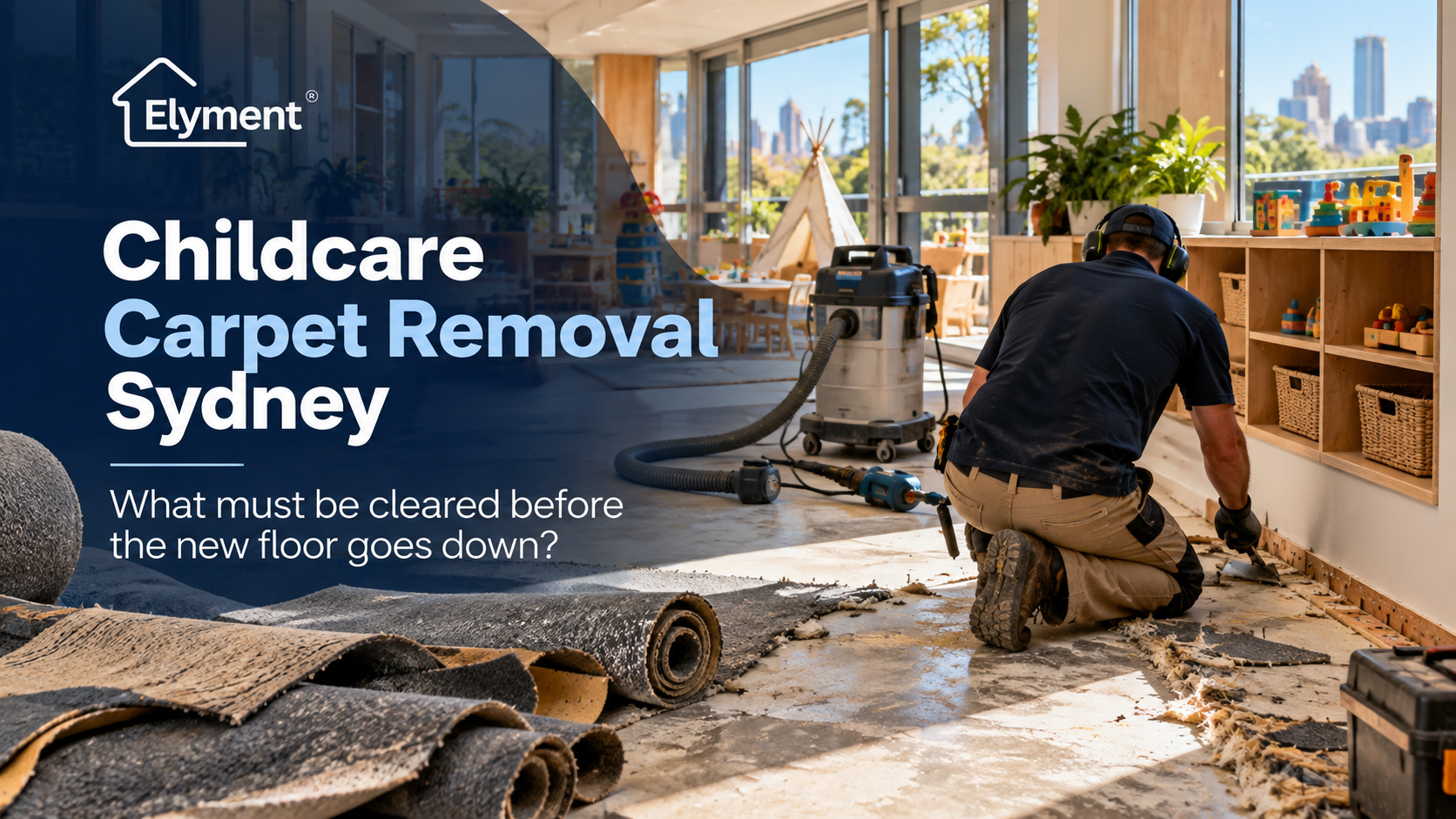
In Sydney childcare centres, carpet removal is not complete when the visible carpet is simply lifted. Before new flooring goes down, the work zone should be cleared of underlay, gripper strips, staples, adhesive, loose debris and unidentified legacy flooring, while the exposed substrate is checked for damage and readiness. The handover must also control dust, waste, access and separation from children, staff and operating areas.
In Childcare, “Carpet Removed” Is Not the Same as “Floor Ready”
A childcare flooring project has a different operational threshold from an empty residential renovation.
The room may contain low furniture, storage systems, soft-play equipment, activity stations, nap areas, joinery and multiple access points. The centre may also be trying to reopen the room quickly, move children temporarily to another space or complete the work during a weekend or shutdown window.
That changes the question from how quickly can the carpet come out? to what condition must the entire work zone reach before the flooring installer can safely and reliably take possession?
Elyment's existing guidance has examined individual carpet-removal problems such as underlay, smooth edge, staples, backing residue and old flooring discovered beneath carpet. The childcare environment introduces a different issue: the removal package has to become a controlled operational handover between an occupied education environment and the next construction trade.
That handover matters because the Australian Children's Education and Care Quality Authority's physical-environment framework requires education and care premises, furniture and equipment to be safe, clean and in good repair. Flooring work does not independently certify a childcare service as compliant, but the condition in which a renovated room is returned to the operator clearly matters to its wider safety and maintenance responsibilities.
The Clearance List Extends Below the Carpet
The visible carpet is only the first layer. A room should not automatically be released for new flooring simply because rolls of carpet have been carried out.
Carpet
- What needs to be established: Removed from the nominated installation area.
- Why it matters before installation: Exposes the underlying flooring system and substrate.
Underlay or backing
- What needs to be established: Removed where it is not part of the new specification.
- Why it matters before installation: Residual foam, rubber or fibre can interfere with preparation.
Gripper or smooth edge
- What needs to be established: Removed where required by the replacement floor.
- Why it matters before installation: Leaves fixing holes, perimeter damage and sharp components that may need treatment.
Staples and mechanical fixings
- What needs to be established: Removed or treated to the required handover standard.
- Why it matters before installation: Loose or projecting fixings can interfere with preparation and installation.
Adhesive
- What needs to be established: Assessed for bond, contamination and removal requirements.
- Why it matters before installation: The new adhesive, primer, levelling compound or coating needs a suitable substrate.
Legacy flooring
- What needs to be established: Identified before it is scraped, ground or disturbed.
- Why it matters before installation: Older vinyl, backing or adhesive can introduce asbestos or other legacy-material risks.
Loose waste
- What needs to be established: Removed from rooms, edges, thresholds and access routes.
- Why it matters before installation: Prevents the next trade inheriting a demolition work zone.
Concrete or subfloor
- What needs to be established: Inspected once fully exposed.
- Why it matters before installation: Damage, cracks, low areas or contamination may alter the installation scope.
This distinction is important in procurement. A quote for lifting carpet is not necessarily a quote for delivering an installation-ready substrate. Elyment has previously outlined the distinction in its guide to carpet removal inclusions such as underlay, smooth edge, staples and disposal.
For a childcare project, the scope should go one step further and define who owns the floor between demolition and installation.
The Room Has to Be Cleared Before the Floor Can Be Cleared
One of the easiest programme mistakes is to schedule the flooring crew for a nominated start time while furniture, play equipment and storage items are still being relocated.
A childcare room can contain far more movable objects per square metre than a typical office or living room. A small amount of remaining furniture can force carpet removal into several fragmented stages, create additional handling and leave inaccessible strips of old flooring around walls or cabinetry.
Before mobilisation, the project team should establish whether the work area requires:
- Tables, chairs and movable shelving to be relocated.
- Soft-play equipment and mattresses to be removed from the work zone.
- Portable storage tubs and teaching materials to be cleared.
- Temporary relocation of electronic or administrative equipment.
- Access to wall edges, doorways and transition strips.
- Protection of fixed joinery that is remaining in place.
- A nominated clean storage area so removed items do not obstruct waste routes.
- A defined point at which the centre formally hands the room to the construction team.
This is less about demolition technique than programme ownership. If furniture relocation begins after the flooring crew arrives, the site's limited shutdown window starts being consumed before productive removal work begins.
What Is Under the Carpet Can Change the Project in Minutes
The most important inspection often happens after the room appears empty.
Once carpet and underlay are lifted, the exposed floor may reveal pressure-sensitive adhesive, rubber backing, old patching compound, fixing damage, cracks, vinyl flooring, previous levelling material or multiple generations of renovation.
The correct response is not automatically to bring in a grinder.
SafeWork NSW identifies flooring materials, including some vinyl floor tiles and adhesives, among locations where asbestos-containing material may be encountered in older buildings. If an unidentified legacy material is exposed and asbestos cannot reasonably be ruled out, the material should be assessed before aggressive scraping or grinding proceeds.
Elyment has examined this specific stop-work issue in carpet removal that exposes old vinyl flooring requiring an asbestos check.
That risk has particular programme consequences for a childcare operator. A discovery made late on Sunday afternoon can prevent a room being returned on Monday morning. The sensible project approach is therefore to identify the age and flooring history of the building early where possible and preserve contingency in the programme for hidden conditions.
Adhesive Removal Is a Handover Decision, Not a Cosmetic One
A floor can look relatively clean while remaining unsuitable for the system going down next.
Whether adhesive must be scraped, mechanically ground, chemically managed or left under an approved system depends on what the flooring manufacturer and installer require. The target condition for sheet vinyl may differ from the condition required for carpet tile, hybrid flooring, timber, epoxy or another finish.
This is why the new flooring specification should be available before the removal scope is finalised.
The installer should be able to answer practical questions such as:
- How much residual adhesive is acceptable?
- Does the floor require mechanical preparation?
- Is a primer required?
- What flatness or smoothness condition is required?
- Will residual holes or perimeter damage telegraph through the finished floor?
- Is a levelling or patching layer required?
- Are moisture checks required before installation?
Where correction is necessary, Elyment's Sydney floor levelling and substrate preparation service addresses the stage between demolition and final floor installation rather than treating removal as an isolated activity.
Grinding Inside a Childcare Facility Changes the Dust-Control Standard
Mechanical preparation can be necessary when adhesive, laitance, high points or surface contamination remain on concrete. It also changes the risk profile of the job.
SafeWork NSW notes that concrete can contain crystalline silica and that cutting, grinding and similar processes can generate respirable crystalline silica dust. Appropriate controls can include on-tool dust capture, suitable extraction, controlled work methods and other measures determined by the risk assessment.
In a childcare environment, those controls need to be considered together with site isolation.
The practical objective is not simply keeping the grinding operator protected. It is preventing demolition dust and debris from migrating into adjacent learning rooms, kitchens, storage areas, ventilation pathways, reception spaces or circulation areas that are being returned to normal operation.
A project plan may therefore include:
- Physical separation of the work zone.
- Controlled entry and exit points.
- HEPA-filtered dust extraction appropriate to the equipment and task.
- Sealed or managed waste movement.
- Planned cleaning before barriers are removed.
- Inspection of adjoining areas before reopening.
- After-hours or shutdown scheduling where separation cannot be achieved during normal operation.
These measures also reduce the likelihood of the next flooring trade arriving to find fine dust sitting on a substrate that is supposed to receive primer or adhesive.
A Childcare Centre Needs a Waste Route, Not Just a Waste Pile
Floor removal produces bulky material quickly.
Carpet rolls, underlay, timber grippers, adhesive-contaminated waste and packaging can fill a small room before the removal work is finished. In a centre with narrow corridors, secure gates and controlled entrances, waste logistics can become the critical path.
The project team should identify the waste route before demolition begins. That means deciding where removed material travels, where it can be staged temporarily, how it exits the building and whether that route conflicts with staff access, emergency circulation or areas still being used by the centre.
For multi-room projects, repeatedly carrying demolition waste through freshly cleaned or completed areas can also undermine the programme. The sequence should ideally move dirty activities out of the building before finished-floor installation progresses into the same route.
The Exposed Slab Creates a Decision Gate
Once all removable flooring layers are out, the project gains information that was not available when the room was carpeted.
This is the appropriate point to inspect the substrate before the new finish is released.
The review may consider:
- Remaining adhesive and backing.
- Fixing holes and perimeter damage.
- Cracks or loose patches.
- Localised high and low areas.
- Old levelling compound.
- Moisture concerns relevant to the selected floor system.
- Door and threshold heights.
- Transitions into toilets, corridors or adjoining rooms.
- Whether the substrate meets the next manufacturer's installation requirements.
This is where a removal-only programme can become a preparation programme.
Elyment's wider flooring removal, grinding, levelling and substrate preparation pathway is structured around this transition from demolition to finish-ready handover.
The Most Reliable Programme Has a Formal Release Point
Childcare renovations are often compressed into evenings, weekends, holiday periods or staged room closures. That makes sequencing more important than simply adding additional labour.
- Operator clearance: Furniture, learning materials and movable equipment leave the nominated work area.
- Site isolation: The construction zone, access route and waste route are established.
- Floor removal: Carpet, underlay and nominated perimeter materials are removed.
- Hidden-condition inspection: Legacy flooring, adhesive and substrate conditions are reviewed before further disturbance.
- Mechanical preparation: Grinding, adhesive removal or patching proceeds using appropriate controls where required.
- Substrate correction: Local repairs or levelling are completed where part of the approved scope.
- Clean-down: Dust, loose material and demolition waste are removed.
- Floor-ready verification: The installer confirms the substrate condition against the selected flooring system.
- New flooring: Installation proceeds only after the preparation stage is released.
- Return to service: The room reopens after product-specific curing, cleaning and the centre's own operational checks are complete.
The strength of this sequence is that it creates a hold point between removal and installation. Hidden conditions can be priced, photographed and resolved before they disappear beneath the new floor.
NSW Childcare Requirements Make the Final Condition More Important
Under the National Quality Framework, Quality Area 3 addresses the physical environment of education and care services. ACECQA's guidance for Element 3.1.2 states that premises, furniture and equipment are to be safe, clean and well maintained, reflecting Regulation 103 of the Education and Care Services National Regulations.
This does not mean that Regulation 103 prescribes one particular carpet-removal method or flooring product. It means the renovation needs to sit within the provider's broader responsibility for maintaining an appropriate physical environment.
ACECQA has also emphasised the role of building design and maintenance in facilitating supervision of children under Regulation 115. Where temporary renovation barriers, furniture relocation or changed circulation arrangements affect an operating centre, project planning should therefore be coordinated with the service operator rather than treated as an isolated flooring decision.
For larger alterations, centres should also confirm whether council, certifier, landlord or other project approvals are relevant to the wider works. A floor replacement can be straightforward while the broader renovation package is not.
Why Sydney Childcare Carpet Removal Costs Can Diverge Quickly
Two childcare centres with the same carpeted floor area can require materially different programmes.
The cost difference is usually created by conditions around the carpet rather than the carpet itself.
Glue-down versus stretch-in carpet
- Potential impact: Changes removal speed and adhesive preparation.
Amount of furniture and equipment
- Potential impact: Can add relocation, staging and return-to-room labour.
Operating centre versus full shutdown
- Potential impact: May require additional isolation and staged access.
Legacy flooring beneath carpet
- Potential impact: Can introduce testing, specialist removal or programme delay.
Concrete grinding
- Potential impact: Adds equipment, dust controls and preparation time.
Substrate levelling
- Potential impact: Adds material, labour and cure sequencing.
After-hours or weekend access
- Potential impact: Changes labour and logistics planning.
Restricted waste route
- Potential impact: Can slow removal and increase manual handling.
Multiple rooms
- Potential impact: Requires more detailed sequencing to preserve usable areas.
For operators comparing quotations, a single square-metre removal rate tells only part of the story. The more useful comparison is the promised handover condition.
What Should Be Confirmed Before the Removal Date?
A useful pre-start discussion between the operator, builder, removal contractor and flooring installer should establish:
- Which rooms are included.
- Who clears movable furniture and centre equipment.
- Whether carpet, underlay, grippers, staples and adhesive are all included.
- The expected substrate condition at handover.
- The specification of the replacement flooring.
- Who decides whether grinding or levelling is required.
- What happens if old vinyl or another unidentified material is exposed.
- How dust and waste will be controlled.
- Which access route contractors will use.
- When the flooring installer will inspect the exposed substrate.
- How scope variations will be approved.
- What conditions must be satisfied before the room is returned to the centre.
That discussion can prevent the most common programme failure: the new flooring crew arriving on schedule while the demolition stage is technically finished but the substrate is not ready.
The Better Definition of Completion Is “Ready for the Next Trade”
Childcare carpet removal in Sydney should be scoped around the next operational milestone, not the moment the final roll of carpet leaves the room.
The project is genuinely progressing when the work zone has been emptied, the carpet system has been removed to the agreed extent, unidentified materials have been dealt with appropriately, adhesive and substrate conditions have been assessed, dust and waste have been controlled and the installer understands what floor it is inheriting.
That distinction is particularly important where a centre has only a short shutdown period. Compressing the programme does not remove the need for inspection. It makes the handover between trades more consequential.
Review the Removal, Preparation and Reopening Sequence Before Works Begin
Coordinate carpet removal, substrate preparation, access, dust control, flooring handover and renovation logistics before the centre's shutdown window begins.
For childcare operators, builders and project managers, the objective is straightforward: the next floor should not be installed over unresolved demolition conditions simply because the reopening date is approaching.
Sources and References
- Elyment: Carpet Removal Sydney — Are Underlay, Smooth Edge, Staples and Disposal Included?
- Elyment: Carpet Removal Sydney Uncovers Old Vinyl Tiles — When Should Work Stop for an Asbestos Check?
- Elyment: Sydney Floor Levelling and Substrate Preparation
- Elyment: Flooring Removal, Grinding, Levelling and Substrate Preparation
- Australian Children's Education and Care Quality Authority (ACECQA): Quality Area 3, Element 3.1.2 and Regulations 103 and 115.
- SafeWork NSW: Guidance relating to asbestos-containing flooring materials and respirable crystalline silica generated during concrete grinding.
- Elyment: Contact
Review the Removal, Preparation and Reopening Sequence Before Works Begin
Coordinate carpet removal, substrate preparation, access, dust control, flooring handover and renovation logistics before the centre's shutdown window begins.
Plan Your ProjectRelevant next actions
Explore the ELYMENT service most closely connected to this article.