Commercial Carpet Removal Sydney: Overnight Retail Shutdown
Commercial carpet removal in Sydney retail stores may fit an overnight shutdown, but glue, access, waste and floor condition can extend works and costs on-site.
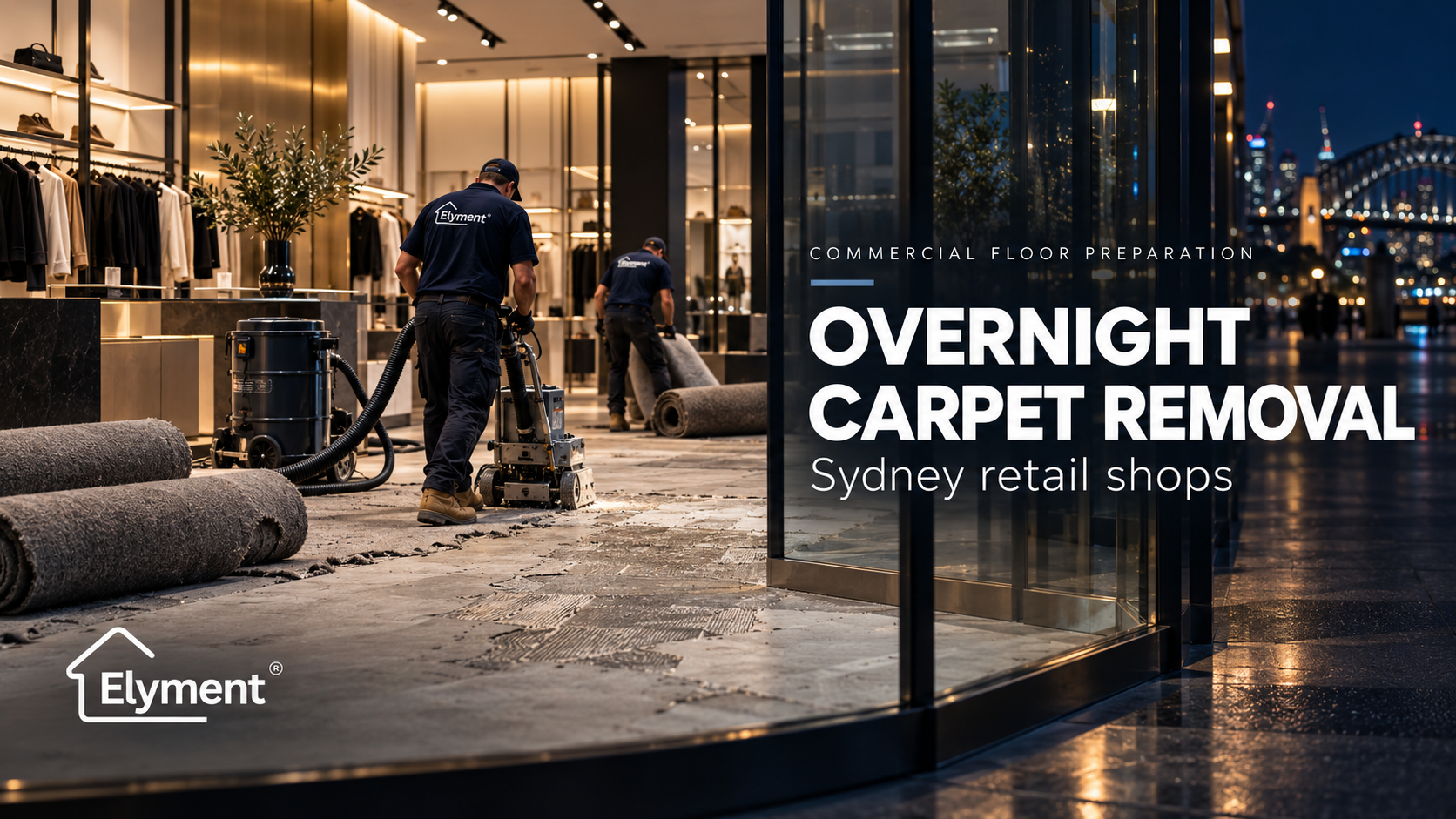
Usually yes for the carpet, and only conditionally for the glue. In a typical Sydney retail tenancy, carpet tiles laid on tackifier can be lifted, bagged and taken out within one overnight shutdown. Hard-set adhesive under glue-down broadloom is a different job. It often needs mechanical scraping or grinding, which brings dust controls and fire detector isolation into the plan. Whether one night is enough depends on the adhesive type, floor area, centre access hours, asbestos register status and the floor condition the next trade needs.
The Real Constraint Is the Clock, Not the Carpet
Most retail flooring conversations in Sydney start with a reasonable request from the retailer: close after trade, have the old floor gone by morning, open on time. The carpet is rarely the problem. The problem is that a shopping centre night shift is much shorter than it looks on paper, and adhesive removal does not compress well into short windows.
A centre that closes to the public at 9pm does not hand a tenancy to contractors at 9:01pm. Staff close out registers, security completes its sweep, and contractor sign-in usually opens later. At the other end, centre cleaners, early deliveries and staff arrivals mean the tenancy must be clean, safe and inspected well before doors open. When those buffers come off, the usable production window in a typical Sydney centre is often closer to five hours than ten.
That is the number every removal plan has to be tested against.
A realistic overnight time budget
Contractor sign-in, induction, permit check
Indicative duration: 20 to 40 minutes.
What drives it: Centre security procedures, first-time inductions.
Stock and fixture protection, dust barriers
Indicative duration: 30 to 60 minutes.
What drives it: Whether shelving stays in place or is moved.
Carpet lifting and bundling
Indicative duration: Variable.
What drives it: Carpet tile vs broadloom, adhesive grip, floor area.
Adhesive scraping or grinding
Indicative duration: Variable, often the longest stage.
What drives it: Adhesive type, thickness, target finish.
Waste transfer via loading dock
Indicative duration: 30 to 90 minutes, often in parallel.
What drives it: Dock booking, distance from tenancy, lift access.
Vacuum, detail clean, edge and threshold check
Indicative duration: 45 to 60 minutes.
What drives it: Residue level, H-class vacuum capacity.
Barrier removal, handover inspection
Indicative duration: 20 to 30 minutes.
What drives it: Whether centre management signs off on site.
These are planning ranges, not quotes. The point is structural: once fixed stages are subtracted, adhesive removal is competing for whatever time is left, and it is the stage least able to absorb a surprise.
Why Adhesive Type Decides the Answer
"Carpet and glue" covers very different site conditions. Before anyone commits to a single-night programme, the project team needs to know which of these it is dealing with.
- Carpet tiles on tackifier (pressure-sensitive adhesive). Common in newer retail fitouts. Tiles release cleanly and the residue is a thin, tacky film. Removal is fast. The floor may be ready for a new tile installation with light preparation, or may need a primer that is compatible with the residue. This is the scenario where one night is most achievable.
- Glue-down broadloom on permanent adhesive. The carpet often tears from its backing, leaving felt and hardened glue bonded to the slab. Elyment has covered this scenario in detail in its analysis of glue-down broadloom where the backing stays on the slab. In a retail overnight context, this is where programmes most often overrun.
- Layered history. Older Sydney strip shops and arcades frequently have carpet over previous vinyl, over earlier adhesive, sometimes over levelling compound. Each layer is a separate removal decision.
- Dark, bitumen-based or unidentified adhesives. These need to be treated as a stop point until their composition is confirmed, as covered in the compliance section below.
A 30-minute test patch, done on a prior night or during a site visit, is the most useful thing a retailer can pay for. It turns the removal rate from a guess into a measured number.
What "Cleared" Actually Means
Many disputes on retail overnight jobs come from a single word. The retailer hears "cleared" and imagines a floor ready for new flooring. The contractor may mean carpet out, bulk residue scraped, waste gone. The flooring installer arriving the next night may need something stricter again.
Level 1: Carpet removed
What it includes: Carpet and underlay lifted, bundled and removed from site. Adhesive left in place.
One night? Usually achievable.
Level 2: Bulk residue removed
What it includes: Level 1 plus scraping of backing and loose adhesive. Thin, well-bonded film may remain.
One night? Often achievable for small to mid tenancies.
Level 3: Install-ready substrate
What it includes: Adhesive mechanically removed to sound concrete, surface profiled and vacuumed to suit the new flooring system's requirements.
One night? Depends heavily on adhesive and area.
Level 4: Install-ready and new floor laid
What it includes: Level 3 plus any levelling, priming and installation of the new finish.
One night? Rarely achievable in one night unless the system and area suit it.
Writing the target level into the scope before the night starts is the single most effective protection against overruns, variations and arguments at 5am.
The Approvals That Must Exist Before the Shutdown
In a Sydney shopping centre, the contractor's capability is only half the question. The other half is whether centre management has approved the work in the form it will actually be done. Tenant works are generally governed by the lease and the centre's fitout or tenancy works guidelines. The NSW Small Business Commissioner publishes guidance for retail tenants on their lease obligations and on resolving disputes with landlords.
Typical items to have confirmed in writing:
- After-hours works permit covering the specific night, contractor names and scope.
- Certificates of currency for public liability and workers compensation, lodged with centre management in advance.
- Safe Work Method Statement and risk assessment that reflect grinding, if grinding is planned.
- Fire detector isolation where dust-generating work is planned near smoke detectors. This usually requires a booking through centre management and its fire services contractor, and is often not available on short notice.
- Loading dock and waste booking, including whether construction waste may use centre facilities at all. Many centres require contractors to remove their own waste off site.
- Noise conditions, particularly in mixed-use developments with apartments above retail. Strata by-laws and development consent conditions can restrict overnight grinding even where the centre permits it.
- Floor-plate interface rules, such as how the new floor must meet the centre's common-area finish at the shopfront line.
A permit that says "carpet removal" when the night will involve grinding is a common way for a programme to be halted part-way through by centre security.
The Compliance Considerations That Can Stop the Night
Asbestos in older adhesives and underlying layers
Under NSW work health and safety laws, workplaces built before 31 December 2003 must have an asbestos register, and asbestos-containing materials must be identified before work that could disturb them. SafeWork NSW's asbestos guidance sets out these duties. In older Sydney retail stock, black mastic adhesives and vinyl layers beneath carpet are the usual items of concern.
The practical consequence for overnight planning is simple. If the register is missing, out of date, or flags a suspect material in the floor build-up, the one-night programme should not proceed until the material is sampled and the result is known. Discovering a suspect layer at 1am leaves the retailer with a half-stripped floor and no lawful way to continue.
Respirable crystalline silica from grinding
Grinding adhesive off a concrete slab generates concrete dust, which contains crystalline silica. NSW requires controls such as on-tool extraction and appropriate vacuums when this work is done, and SafeWork NSW publishes guidance on managing silica exposure. In an enclosed retail tenancy with stock, fixtures and a centre air-handling system, dust containment is also a commercial issue: a fine coating across merchandise can cost more than the floor.
Reopening safety
Whatever state the floor is left in, it has to be safe for staff and customers at opening. That means no raised edges, no loose transition strips and no slippery residue films. For new finishes, the slip resistance expectations referenced through the National Construction Code and associated Australian Standards are relevant to the final floor selection, particularly at entrances.
A Worked Example: The 120 Square Metre Boutique
Consider an illustrative scenario: a 120 square metre fashion tenancy in a suburban Sydney shopping centre, trading seven days, with a new luxury vinyl plank floor planned. Centre access runs from 10pm to 6am.
Scenario A: carpet tiles on tackifier.
Tiles lift quickly. Residue is a thin film. With a crew of four, protection in place by 10:45pm, tiles out and waste moving to the dock by around 1am, residue treated and the floor vacuumed by 3am. A Level 2 or Level 3 handover is realistic. Installation the same night is possible only if the vinyl system accepts the prepared residue and the installer is ready on site.
Scenario B: glue-down broadloom on hard-set adhesive.
The carpet comes off, but felt backing and adhesive remain bonded. Scraping alone is slow. Grinding is the efficient option but requires a fire isolation booking and dust extraction. Realistically, the first night delivers Level 2. A second night is needed for grinding and preparation to Level 3, with installation on a third night or a planned closure day.
The retailer's real decision in Scenario B is whether to schedule two or three nights from the outset or to promise one night and discover the second at 4am.
Single Shutdown or Staged Programme?
Single overnight shutdown
Best suited to: Carpet tiles on tackifier, smaller tenancies, confirmed register, simple waste path.
Main risk: No buffer if the adhesive behaves differently from the test patch.
Two consecutive nights
Best suited to: Glue-down broadloom, mid-size tenancies, grinding required.
Main risk: Store trades for one day on a partially prepared floor.
Zone-by-zone over several nights
Best suited to: Larger stores, supermarkets, stores where fixtures can't all move in one night.
Main risk: Temporary transitions between old and new zones must be made safe each morning.
Planned closure day
Best suited to: Full removal, preparation and installation in one continuous window.
Main risk: Lost trading day, which the retailer must weigh against risk.
The Australian Bureau of Statistics retail trade series shows why the decision weighs so heavily on retailers: trading is concentrated, seasonal and sensitive to disruption. A lost Saturday in the weeks before Christmas costs far more than a lost Tuesday in February, and the flooring programme should be scheduled around that calendar rather than the contractor's availability alone.
What Project Teams Are Learning
Across Sydney retail refurbishments, a consistent set of lessons keeps coming up:
- The test patch pays for itself. Measured removal rates beat estimated ones every time.
- Waste is a production constraint. If the dock path is long or the lift is shared, waste transfer can limit output more than the removal crew does.
- Removal and preparation should be priced separately. Bundling them hides the variable component and leads to disputes when the adhesive turns out to be harder than expected.
- Fixtures need an owner. Who moves gondolas, wall bays and counters, and who reinstates them, must be settled before the night.
- The next trade should define the finish. The installer's substrate requirements, not the removal contractor's view, should set the handover standard.
- Old carpet tiles may not need to go to landfill. Depending on product and condition, some may qualify for manufacturer take-back programmes for commercial carpet tiles, which affects how tiles are lifted and stacked on the night.
A Practical Overnight Sequence
- Two to three weeks out: site inspection, asbestos register review, test patch, adhesive identification, measured removal rate.
- Two weeks out: lodge works permit, insurances and SWMS with centre management. Book fire detector isolation and loading dock time if grinding is planned.
- One week out: agree the written handover standard (Level 1 to 4) and the fallback plan if the night overruns.
- Day of shutdown: retailer clears or covers stock, removes small fixtures, confirms after-hours contacts.
- Night: sign-in, protection, removal, residue treatment, waste transfer, detail clean, threshold check.
- Before opening: joint walk-through with the store manager and, where required, centre management. Photograph the handover condition.
- Following night or day: next trade proceeds against the agreed substrate standard, whether that is concrete grinding and surface preparation, floor levelling or direct installation.
The Go or No-Go Test
A single overnight shutdown for carpet and glue is a sound plan when most of the following are true:
- The adhesive has been identified and a test patch has produced a measured rate.
- The asbestos register is current and the floor build-up is clear.
- The handover standard is written down and achievable within roughly five productive hours.
- Permits, fire isolation and dock bookings match the actual method of work.
- There is a documented fallback that leaves the store safe to trade if the night runs short.
Where two or more of those points are uncertain, the honest answer is that the job is a two-night programme, and it should be planned as one from the start. Retailers who accept that early usually trade without disruption. Those who don't are the ones re-opening on a half-finished floor.
For retailers planning a refit, Elyment's commercial flooring demolition and removal service covers removal, adhesive treatment, substrate preparation and the coordination around them. The company has also examined how removal planning differs across sectors in its analysis of commercial vinyl removal for shops, offices and schools.
Sources and Further Reading
- NSW Small Business Commissioner
- SafeWork NSW: Asbestos guidance
- Australian Building Codes Board: National Construction Code
- Australian Bureau of Statistics: Retail Trade, Australia
- Elyment: Glue-down broadloom where the backing stays on the slab
- Elyment: Manufacturer take-back programmes for commercial carpet tiles
- Elyment: Concrete grinding and surface preparation
- Elyment: Floor levelling
- Elyment: Commercial flooring demolition and removal
- Elyment: Commercial vinyl removal for shops, offices and schools
SYDNEY RETAIL FLOOR REMOVAL · OVERNIGHT PROJECT REVIEW
Confirm the Reopening Plan Before the Store Closes
Review carpet uplift, adhesive removal, loading access, waste movement, noise constraints, concrete preparation and the morning handover standard before committing the project to one overnight shutdown.
Request a Project ReviewRelevant next actions
Explore the ELYMENT service most closely connected to this article.