Carpet Removal Sydney for Glue-Down Broadloom: When the Carpet Lifts but the Backing Stays on the Slab
Carpet removal in Sydney can leave backing glued to the slab. Learn why this happens, the risks, removal costs and preparation needed before installing flooring
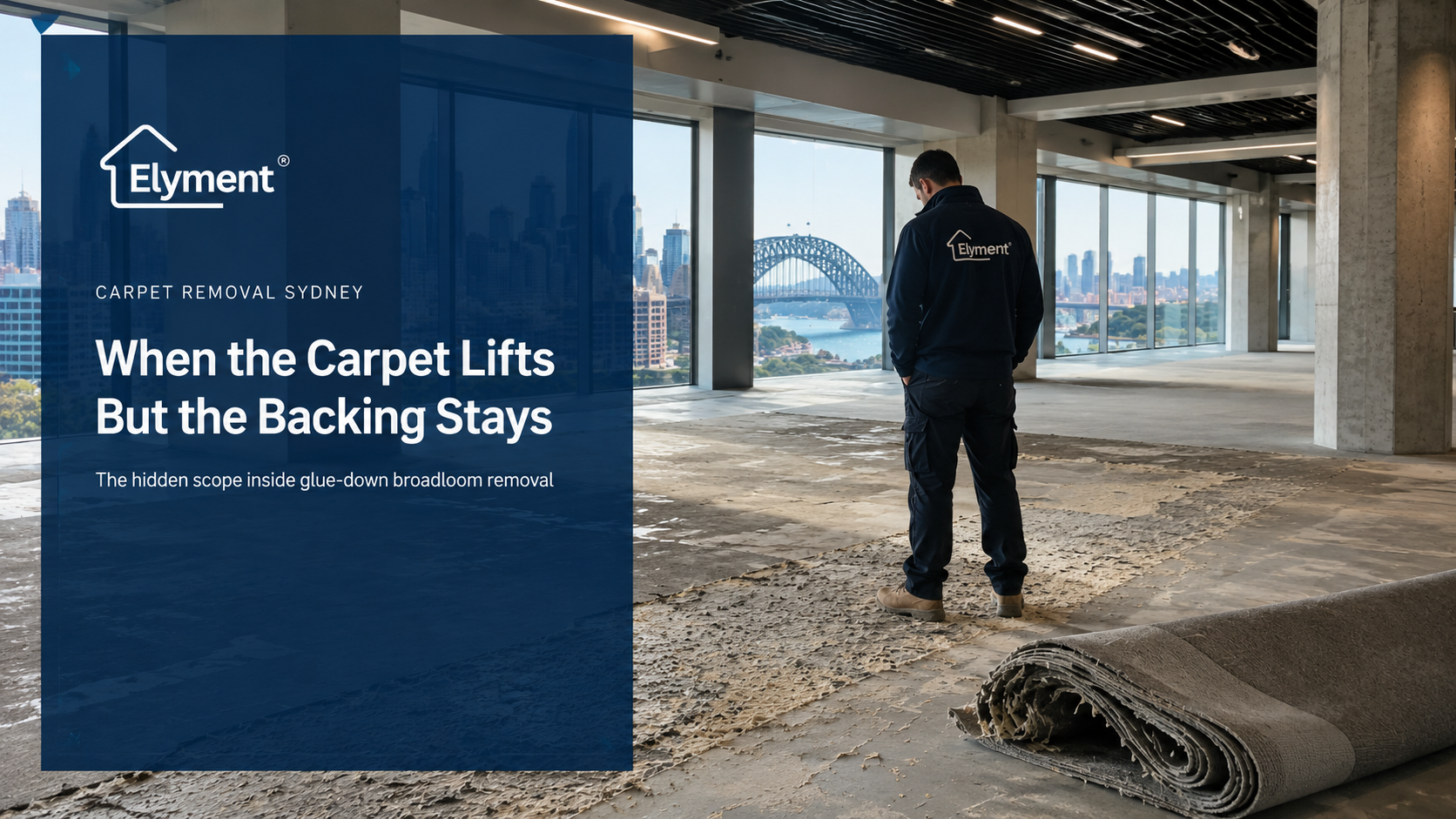
In Sydney, glue-down broadloom carpet can lift while part of its secondary backing remains bonded to the concrete slab. That means the visible carpet may be removed while substantial preparation work is still outstanding. Whether the remaining backing must be scraped, mechanically removed or followed by adhesive grinding depends on the next floor finish and the agreed handover standard. Those extra stages should be identified clearly in the carpet removal quote.
There is a deceptively convincing moment during commercial carpet removal when the old floor appears to be gone.
A strip of broadloom is pulled back. The pile, colour and visible wear disappear with it. Rolled carpet begins moving towards the loading dock and, from standing height, the tenancy looks stripped.
Then someone looks at the slab.
Instead of exposed concrete, sections of woven backing, latex-like material, fibres and adhesive remain across the floor. In some areas the carpet has separated cleanly. In others, the backing has split within its own construction and stayed attached to the substrate.
This is where a straightforward carpet removal Sydney scope can divide into several materially different jobs.
The first is removing the visible carpet. The second is removing the backing left behind. The third may be carpet glue removal or concrete grinding. A fourth may involve patching, levelling or other substrate preparation before the incoming flooring system can begin.
For Sydney owners, builders, facility managers and commercial project teams, the important distinction is therefore not simply whether the carpet has been removed. It is what condition the floor has been contracted to reach when the removal crew leaves.
The Carpet Can Be Gone While the Removal Job Is Only Half Finished
Glue-down broadloom is not necessarily removed as one clean assembly.
A typical carpet product can contain a face fibre structure and one or more backing components. Over time, the bond between those components can behave differently from the bond between the backing and the floor adhesive.
When the carpet is pulled, the weakest interface can release first.
Sometimes that is the adhesive-to-slab interface, producing a comparatively clean uplift. On another floor, the carpet itself separates and leaves substantial backing bonded to the concrete.
The result can look like:
- Broad sheets of backing still attached to the floor
- Irregular islands of woven or fibrous material
- Thin backing remnants embedded in adhesive
- Areas where backing and adhesive have effectively become one removal layer
- Clean concrete beside heavily contaminated sections
- Different release behaviour between perimeter zones, traffic paths and open areas
Elyment has previously examined how glued, stretched and stapled carpet change a Sydney removal quote. Glue-down broadloom creates a more specific estimating problem: even after the fixing method is known, the crew may not know how the carpet will physically separate until removal starts.
The Quote Needs a Handover Standard, Not Just a Square-Metre Rate
The phrase "remove carpet" can describe several different completion points.
A removal-only contractor may legitimately price the work differently from a contractor expected to deliver an installation-ready substrate. Comparing those figures without comparing the handover condition creates the appearance of a price difference where the real difference is scope.
Carpet uplift only
- What may be included: Cutting, lifting, rolling and removing the broadloom
- What may still remain: Backing, adhesive and substrate contamination
- Suitable where: Another contractor has specifically accepted the preparation work
Carpet and backing removed
- What may be included: Visible carpet plus secondary backing removal
- What may still remain: Adhesive film, old patching and slab irregularities
- Suitable where: The next trade has its own adhesive-removal methodology
Adhesive-prepared slab
- What may be included: Carpet, backing and nominated adhesive preparation
- What may still remain: Possible slab defects, cracks or level corrections
- Suitable where: A defined flooring system will follow
Finish-ready substrate
- What may be included: Removal plus the specified preparation required for the incoming finish
- What may still remain: Only items specifically excluded or identified as separate works
- Suitable where: The contractor is coordinating removal with the next flooring stage
None of these scopes is automatically wrong.
The problem arises when the customer believes they purchased the fourth outcome while the contractor priced the first or second.
Backing Removal Is a Separate Production Stage
Once broadloom has separated and left its backing behind, crews often need a second pass across the same floor area.
That matters commercially because the floor has already been measured once. Waste has already begun moving. Labour has already been allocated. Yet the crew may now have to traverse the same area with different equipment and a different production rate.
Depending on the material and substrate, this second stage can involve controlled hand scraping, powered scraping equipment, detailed edge work or other mechanical removal techniques.
The objective is not necessarily to make the concrete visually attractive. It is to remove the material that the agreed scope requires to be removed without unnecessarily damaging the substrate beneath it.
This distinction is particularly important in commercial carpet removal because hundreds of square metres of apparent carpet uplift can be completed relatively quickly, while stubborn backing across the same tenancy may become the slower part of the programme.
Then Comes the Adhesive Question
Removing the backing can expose another interface rather than clean concrete.
The slab may still carry:
- Thin adhesive film
- Heavier glue ridges
- Different adhesives from earlier flooring installations
- Old patching compounds beneath or within the adhesive
- Local areas where the adhesive releases with the backing
- Areas where the adhesive remains strongly attached to the substrate
This is the point at which glue-down carpet removal can transition into substrate preparation.
Elyment's analysis of carpet backing residue and levelling-system bond risk addresses what can happen when unsuitable residue is left beneath a later preparation layer. The commercial question in the present scenario comes one stage earlier: has removal been priced to stop at the backing, at the adhesive, or at a defined slab condition?
Grinding Should Not Be Used as a Generic Meaning of "Clean It Up"
Concrete grinding is often discussed as though it were simply the final cleaning stage after carpet removal.
It is more accurately treated as a separate mechanical preparation operation.
The required tooling and number of passes can change according to the adhesive, the concrete, existing patching and the surface condition required for what comes next.
A lightly contaminated slab being prepared for another carpet installation is not automatically the same scope as concrete that must accept direct-stick vinyl, engineered timber adhesive, epoxy, microcement or self-levelling compound.
Elyment's guide to concrete grinding and substrate bond readiness after floor removal explains why visual cleanliness should not be confused with preparation suitability.
For quoting purposes, "grind adhesive" should therefore be defined more carefully than a generic allowance to make the floor look cleaner.
The Incoming Finish Decides How Far Preparation Needs to Go
A useful way to scope glue-down broadloom removal is to work backwards from the next flooring system.
If new carpet is being installed, the preparation requirement may be comparatively tolerant in some circumstances, subject to the flooring manufacturer's system requirements and the actual substrate condition.
Direct-stick resilient flooring can expose much smaller surface irregularities. Glue-down timber introduces its own adhesive and substrate requirements. Epoxy, polished finishes and microcement can turn surface contamination and patching into highly visible or performance-critical issues.
Floor levelling adds another dependency because the levelling system needs an appropriately prepared substrate rather than a miscellaneous combination of backing fibres, old glue and loosely bonded material.
Replacement carpet
- Why leftover backing or glue matters: Residual build-up may affect installation method, seams or transition heights
- Potential additional preparation: Selective scraping, patching or adhesive treatment
Carpet tile
- Why leftover backing or glue matters: A consistent substrate may be needed for the nominated adhesive or tackifier system
- Potential additional preparation: Backing removal, adhesive preparation and local repairs
Vinyl plank or sheet
- Why leftover backing or glue matters: Fine imperfections can telegraph through the finished surface
- Potential additional preparation: More detailed grinding, patching or skim preparation
Glue-down engineered timber
- Why leftover backing or glue matters: The new adhesive system depends on an appropriate substrate
- Potential additional preparation: Mechanical preparation, moisture assessment and possible levelling
Floating timber, hybrid or laminate
- Why leftover backing or glue matters: Old residue may reveal or conceal flatness and height problems
- Potential additional preparation: Grinding of ridges, repairs and levelling assessment
Epoxy or microcement
- Why leftover backing or glue matters: The exposed substrate becomes part of a tightly controlled coating system
- Potential additional preparation: Specified mechanical preparation, repairs and compatible primer system
A Commercial Quote Should Separate Known Work From Concealed Work
One difficulty with glue-down broadloom is that a contractor may know the carpet is fully bonded without knowing exactly how much backing will remain.
That does not make meaningful quoting impossible.
It means the quotation should distinguish between what is visible and measurable before work starts and what can only be confirmed after a test area or initial uplift.
A practical scope can separate:
- Carpet uplift: Measured broadloom area, cutting, lifting, handling and disposal.
- Backing removal: Included in full, included to an agreed allowance, or treated as a concealed-condition item where its extent cannot reasonably be established.
- Adhesive preparation: Scraping, grinding or other nominated treatment defined separately from carpet uplift.
- Slab repairs: Gouges, cracks, previous patches and damaged levelling material reviewed after exposure.
- Floor levelling: Assessed after the substrate is sufficiently exposed to establish actual floor condition.
- Final installation readiness: Confirmed against the requirements of the selected replacement flooring system.
This structure gives project teams something more useful than an artificially precise rate for conditions nobody has yet seen.
The Test Patch Can Be More Valuable Than Another Round of Quote Negotiation
On larger commercial floors, a controlled trial area can provide information that drawings and photographs cannot.
It can show how readily the carpet releases, whether backing separation is widespread, how much adhesive remains and what equipment is likely to be appropriate.
An illustrative 500-square-metre office, for example, may look uniform before demolition. A small test zone might reveal that the broadloom lifts quickly but leaves dense secondary backing across most of the slab.
That changes the project discussion immediately.
The critical production rate is no longer how quickly the carpet can be rolled up. It is how efficiently the underlying material can be removed to the required standard.
A trial area can therefore assist with labour planning, machine selection, waste forecasts and scheduling before the full tenancy is committed to a narrow removal window.
Sydney Programmes Often Feel the Impact After Uplift, Not During It
The operational consequence becomes more significant where removal sits inside a fixed refurbishment programme.
Consider a Sydney CBD office where furniture has been cleared for the weekend, loading access has been booked and new flooring is scheduled immediately after removal.
If the programme assumes that visible carpet removal equals a finished substrate, widespread backing can consume the time allocated to adhesive grinding or floor preparation.
The result may affect:
- Building loading-dock bookings
- Goods-lift access
- Noise-restricted work periods
- Floor preparation crews
- Levelling and curing windows
- Flooring installers
- Joinery or partition programmes
- Cleaning and reoccupation dates
This is why Elyment's work on staging carpet removal inside occupied Sydney offices places an inspection hold point after the existing flooring is exposed. On glue-down broadloom, that hold point can determine whether the planned removal shift has actually completed the work required for the next shift.
Strata Projects Add Another Layer of Coordination
Sydney apartment work can combine difficult removal with lift bookings, common-area protection, working-hour restrictions and approval requirements for the replacement flooring.
NSW Government strata guidance identifies installing or replacing hard flooring, including removing carpets as part of that work, within the minor-renovation framework. Owners should therefore check the approvals relevant to their scheme rather than assume carpet removal and a change to hard flooring can be managed solely between the owner and flooring contractor.
See the NSW Government strata renovation guidance for current information.
The practical flooring issue remains the same: if backing removal extends the noisy mechanical-preparation period, building access and approved work windows may need to accommodate the real scope rather than the visible carpet area alone.
Safety Assessment Comes Before Aggressive Adhesive Grinding
Once work progresses from textile removal into mechanical preparation of concrete, the work method also changes.
SafeWork NSW identifies concrete among materials that can contain crystalline silica and states that processing silica-containing materials without appropriate controls can create serious health risks. Mechanical concrete preparation should therefore be undertaken using appropriate risk controls, equipment and dust-management procedures.
Project teams can review SafeWork NSW guidance on crystalline silica.
Older flooring assemblies require an additional caution.
NSW asbestos guidance notes that some historical carpet underlay and glues contained asbestos. Where an unidentified older fibrous backing, black adhesive or another suspicious legacy material is exposed, aggressive scraping or grinding should not be used simply to establish what the material is.
The safer project sequence is to identify or appropriately assess the material first and only proceed with ordinary mechanical preparation once the work method is suitable.
See the NSW Government's guidance on carpet underlay, glue and asbestos. Elyment has also examined the stop-work decision in Sydney carpet removal projects that expose unidentified historic flooring.
What Should Be Written Into a Glue-Down Broadloom Scope?
For a project where backing separation is possible, the scope should be explicit enough that the contractor, owner and incoming flooring installer understand where responsibility changes hands.
Useful items to define include:
- The measured broadloom areas
- Whether the carpet is believed to be fully bonded, double bonded or mixed
- Whether a test patch has been completed
- Whether backing removal is included
- How concealed or unusually stubborn backing will be managed
- Whether adhesive scraping is included
- Whether concrete grinding is included and for what intended outcome
- Whether floor levelling is included or assessed later
- Whether waste removal and disposal are included
- Access, lift, loading and working-hour constraints
- How unidentified legacy materials will be handled
- The condition in which the substrate must be handed to the next trade
The last item is the most important.
"Carpet removed" describes an activity.
"Concrete substrate prepared to the agreed condition for the nominated replacement flooring system" describes an outcome.
Those are not interchangeable scopes.
The Best Completion Test Is Whether the Next Stage Can Actually Start
Glue-down broadloom exposes a recurring weakness in renovation procurement: demolition is often priced according to what is being taken away, while the success of the project depends on what is left behind.
Carpet rolls leaving the site are visible progress. Backing fibres, old glue, damaged patching and an unsuitable substrate are less visible until another contractor arrives and refuses to install over them.
For Sydney project teams, the stronger approach is to define the required end condition before comparing prices.
If only carpet uplift is required, say so.
If backing must also be removed, include it.
If the project requires adhesive grinding, specify the intended preparation outcome.
If the new floor requires levelling, patching or a particular substrate condition, connect those stages to the removal programme rather than assuming they will resolve themselves after demolition.
That is how a carpet removal quote becomes a project-delivery document rather than simply a square-metre demolition rate.
CARPET REMOVAL, SUBSTRATE PREPARATION & PROJECT DELIVERY
Does Your Quote End When the Carpet Comes Up?
Elyment can review glue-down carpet removal, backing and adhesive conditions, concrete preparation, renovation sequencing and the handover standard required for your next flooring system.
Sources and References
- Elyment: How Glued, Stretched and Stapled Carpet Change a Sydney Removal Quote
- Elyment: Carpet Backing Residue and Levelling-System Bond Risk
- Elyment: Concrete Grinding and Substrate Bond Readiness After Floor Removal
- Elyment: Staging Carpet Removal Inside Occupied Sydney Offices
- NSW Government: Strata Renovation Guidance
- SafeWork NSW: Crystalline Silica
- NSW Government: Carpet Underlay, Glue and Asbestos
- Elyment: Sydney Carpet Removal Projects That Expose Unidentified Historic Flooring
- Elyment: Request a Project Review
Does Your Quote End When the Carpet Comes Up?
Review glue-down carpet removal, backing and adhesive conditions, concrete preparation, renovation sequencing and the handover standard required for your next flooring system.
Request a Project ReviewRelevant next actions
Explore the ELYMENT service most closely connected to this article.