Concrete Driveway Sealing Sydney: When Can You Park Again?
Resealing an existing Sydney driveway? Compare walking, driving and overnight parking times, plus weather delays and the handover checks to confirm before use.
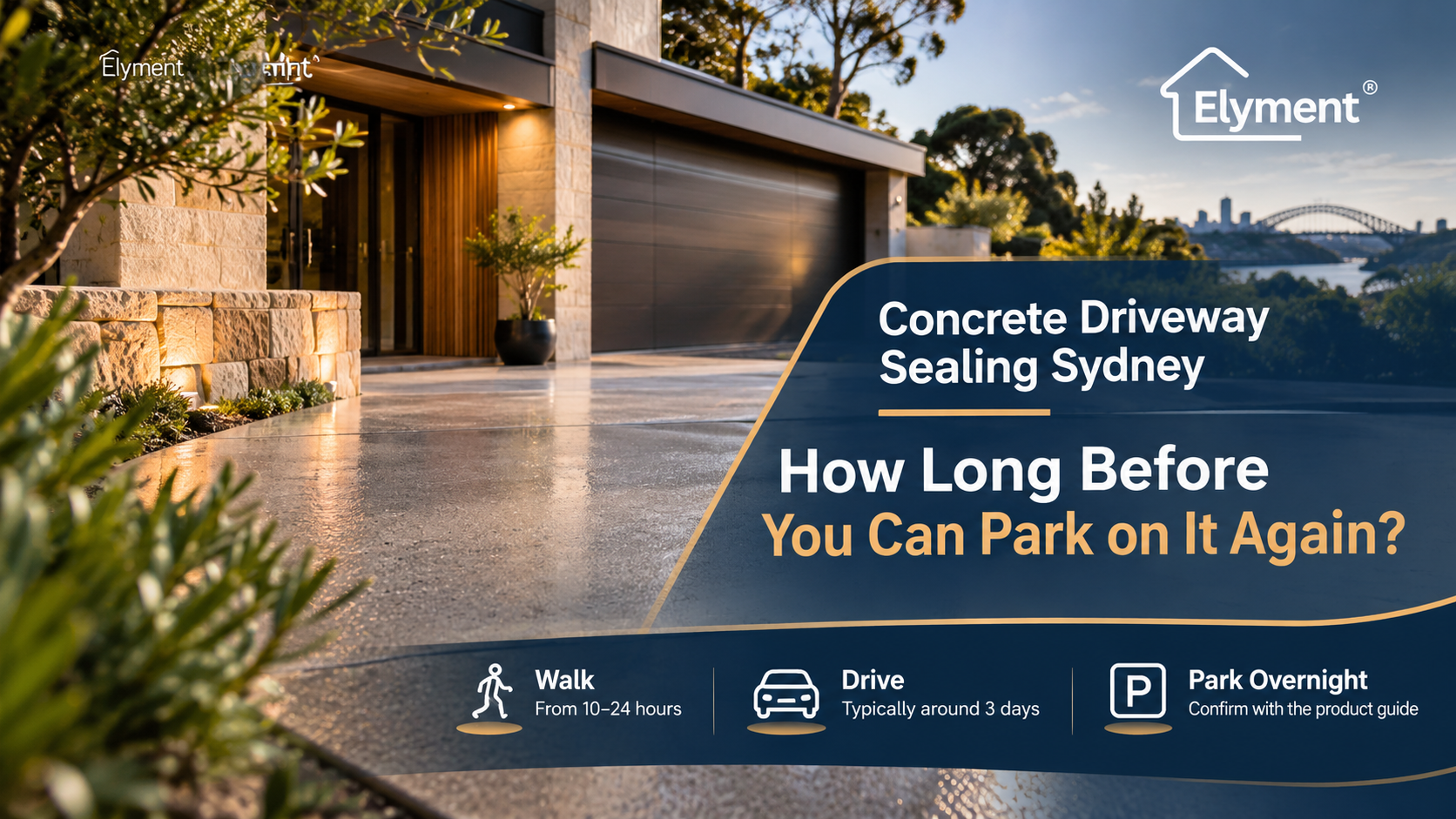
For an existing concrete driveway in Sydney, the return-to-use clock starts after the final sealer coat, not when cleaning begins. One Australian supplier advises waiting at least 24 hours to walk and three days to drive over its product; another lists light foot traffic after 10–12 hours but does not specify vehicle access. Overnight parking needs separate confirmation because stationary hot tyres, turning wheels, rain and cool weather can affect the finish.
ELYMENT Insights | Concrete Sealing & Property Maintenance | Sydney, NSW | 13 November 2026
The Driveway Is Finished. The Parking Problem Is Not.
Resealing an existing concrete driveway appears to be a relatively straightforward property maintenance exercise. The contractor cleans the surface, addresses any necessary preparation and applies the specified protective treatment.
The more consequential decision often arrives immediately afterwards: when can the owner put the car back?
For households across Sydney, including the Northern Beaches, Inner West, Eastern Suburbs and Hills District, a driveway is not simply an architectural surface. It may provide the property's only off-street parking, vehicle charging access, garage entry or space for deliveries.
Taking it out of service affects the household's daily operations. Restoring access too early may damage a coating that otherwise appeared properly installed.
These are two separate questions:
- Has the applied sealer dried sufficiently for a particular type of traffic?
- Has the coating developed enough resistance for the vehicle movements and parking conditions expected?
The answer depends on the specific product, the completed application and the conditions at the site. A surface that looks dry is not necessarily ready for vehicle tyres.
Walking, Driving and Overnight Parking Are Three Different Handover Decisions
The phrase "driveway sealer cure time" is frequently reduced to a single number. Manufacturer specifications show why that approach can be misleading.
Australian supplier Con-Treat's published concrete sealer installation guide states that users should avoid walking on the surface for a minimum of 24 hours and allow three days before driving over it.
By comparison, the January 2026 Crommelin DiamondTough Concrete & Paving Sealer Gloss technical data sheet identifies light foot traffic after 10–12 hours and full cure after seven days. The cited document does not provide a separate explicit time for vehicle traffic.
Neither set of figures should be treated as a universal rule for every driveway sealer.
Published Return-to-Use Information for Two Australian Driveway Sealing Systems
Recoat timing
- Crommelin DiamondTough Gloss: 2–4 hours.
- Con-Treat Hard Seal guidance: Typically 6–12 hours between coats in the installation guide, depending on weather.
Light foot traffic
- Crommelin DiamondTough Gloss: 10–12 hours.
- Con-Treat Hard Seal guidance: Minimum 24 hours before walking.
Driving across
- Crommelin DiamondTough Gloss: No explicit vehicle-release interval in the cited data sheet; obtain written guidance.
- Con-Treat Hard Seal guidance: Allow three days before driving over.
Overnight parking
- Crommelin DiamondTough Gloss: Confirm separately against the product specification and site conditions.
- Con-Treat Hard Seal guidance: Confirm whether the three-day drive-over clearance also permits prolonged stationary parking.
Full cure
- Crommelin DiamondTough Gloss: Seven days.
- Con-Treat Hard Seal guidance: No universal full-cure interval stated in the cited installation guide.
Manufacturer figures are product-specific and assume appropriate preparation and application conditions. Times should be calculated from completion of the final coat unless the manufacturer directs otherwise. The applicable current product documentation and contractor's written release instructions take precedence.
The significant distinction is between permission to cross a driveway and permission to leave a vehicle stationary on it.
A vehicle moving slowly across a sealed surface creates a different loading pattern from one remaining parked in the same position overnight. Tyre temperature, wheel movement and surface condition must also be considered.
Owners should therefore request an actual parking-release time rather than interpreting a foot-traffic or surface-dry figure as permission to resume normal use.
The Clock Starts With the Final Coat, Not the Contractor's Arrival
Consider a hypothetical driveway resealing project in Ryde.
The contractor arrives on Monday morning to wash, prepare and inspect the surface. The first coat is applied that afternoon. A second coat is completed on Tuesday at 11 am.
If the approved product system requires three days before vehicle access, the relevant 72-hour period would ordinarily be counted from the completed final application, subject to the manufacturer's directions and confirmation that curing conditions were acceptable.
That would place the earliest possible vehicle movement at 11 am on Friday, not Thursday morning simply because the contractor started work on Monday.
This example is a scheduling illustration, not a guaranteed release time for a particular site.
It exposes a common weakness in driveway maintenance quotations: the application date is recorded, but the actual return-to-service date is not.
For a household with two vehicles, restricted kerbside parking or an electrically operated gate, that omission can become more disruptive than the sealing work itself.
A Practical Timeline for Driveway Access
- Preparation and cleaning: The driveway remains unavailable while cleaning, drying, repairs and any required surface preparation are completed.
- Coating application: Record the exact product, application sequence and completion time of the final coat.
- Pedestrian release: Permit only the level of foot traffic expressly allowed by the selected system.
- Vehicle crossing: Resume movement only after the specified vehicle-access period and any required site checks.
- Normal parking: Confirm that stationary parking, hot tyres and wheel movements are permitted, particularly where the product has not reached full cure.
- Ongoing protection: Observe any remaining restrictions on washing, heavy loading, spills or aggressive tyre turning.
Why Hot Tyres and Steering Movements Matter
Vehicle tyres introduce a combination of pressure, friction and temperature that ordinary pedestrian use does not.
Both Crommelin DiamondTough and Con-Treat Hard Seal describe formulations designed to resist hot tyre marking or pick-up. That is an intended performance characteristic of the properly applied product, not a waiver of its drying and curing instructions.
Three operational conditions deserve particular attention.
1. Stationary Tyres
When a vehicle remains in one location, the load is concentrated at its tyre contact patches. Where a coating is insufficiently cured, prolonged contact may increase the risk of marking or surface disturbance.
2. Turning Wheels Without Moving
Dry steering, where the wheels turn while the vehicle is stationary, introduces substantial localised friction. It can place additional stress on a fresh film-forming finish.
Owners may need to avoid tight manoeuvres or steering while stationary during any manufacturer-specified early-use restriction period.
3. Repeated Entry and Exit
A household that crosses the driveway several times daily imposes a different traffic pattern from a property where a vehicle is parked once and remains undisturbed.
Garages approached by steep or curved driveways can also concentrate tyre forces at particular points.
The appropriate release decision needs to reflect how the driveway will actually be used, not merely whether a car can physically cross it.
Sydney Weather Can Move the Handover Date
The manufacturer's stated drying times are not independent of weather.
External driveway surfaces experience changing temperature, humidity, wind, sunlight, rain and overnight moisture. These conditions can vary considerably between exposed western Sydney properties, shaded North Shore driveways and coastal locations.
Crommelin's January 2026 DiamondTough Gloss specification recommends an application temperature range of 5°C to 35°C, a maximum relative humidity of 85% during application and initial curing, and no application where rain is expected within 72 hours.
Con-Treat's installation guide gives a different application window, recommending temperatures between 15°C and 28°C and advising against application where rain is imminent within 24 hours.
Those figures are not interchangeable requirements. Each applies to its own documented system.
Site Conditions and Practical Responses
Rain forecast
- Why it matters: Premature moisture exposure can interfere with coating formation or appearance.
- Practical response: Check the selected product's rain-free application and initial cure window.
Cool, shaded concrete
- Why it matters: Lower surface temperatures can slow drying.
- Practical response: Check substrate temperature and allow for revised release times.
High humidity
- Why it matters: Moisture conditions can affect drying and film development.
- Practical response: Confirm the manufacturer's humidity limits before application.
Strong afternoon sun
- Why it matters: Excessive surface heat can create application and finish defects.
- Practical response: Schedule work within the permitted temperature range and avoid unsuitable direct sunlight.
Overnight dew or condensation
- Why it matters: A surface may become damp even without rainfall.
- Practical response: Check the surface condition and seek a revised release instruction where moisture exposure is suspected.
For Sydney property owners, the Bureau of Meteorology's Sydney forecast provides useful planning information, but a forecast does not replace checking the actual concrete surface.
Where conditions fall outside the manufacturer's requirements, the prudent response may be to postpone application or extend the closure. A contractor should not simply guarantee the same return-to-use time regardless of the weather encountered.
Resealing an Old Driveway Requires a Surface Assessment Before the Access Countdown
An existing driveway carries the history of previous coatings, tyre contamination, weathering, repairs and ongoing vehicle use.
Applying another coat does not automatically reset that history.
Before resealing, the project should establish whether the existing treatment remains compatible with the proposed sealer and whether the concrete has the required soundness, cleanliness, dryness and porosity.
Crommelin's DiamondTough specification requires the surface to be dry and sound, and instructs users to confirm compatibility where a driveway has previously been sealed.
Con-Treat's Hard Seal technical information identifies water blasting or grinding as preparation methods where needed to establish an appropriate surface profile.
This does not mean every driveway requires grinding. It means the preparation scope must be established from the actual substrate and the selected sealer.
Where an old film is incompatible, mechanically unstable or contaminated, additional preparation may be necessary. Elyment's concrete grinding and coating preparation services in Sydney illustrate the wider preparation considerations involved in removing residual coatings and establishing a suitable substrate profile.
Any concrete grinding also requires appropriate protection against respirable crystalline silica. SafeWork NSW's crystalline silica guidance outlines risk controls, including suitable dust extraction, suppression methods and exposure management.
The relevance to driveway handover is straightforward: if additional preparation or drying is required, the application date may shift. The household's parking plan needs to shift with it.
Owners dealing with an existing coating that has already become cloudy or unstable can also review Elyment's separate analysis of when a whitening concrete sealer needs recoating or removal.
The Hidden Cost of Closing a Driveway Is Often the Alternative Parking Arrangement
For a detached home with ample street parking, a temporary driveway closure may be a modest inconvenience.
For a terrace house with restricted kerbside spaces, a battle-axe property, a duplex with shared access or a business that relies on driveway deliveries, the same closure can have greater consequences.
Consider three different Sydney operating environments.
A Northern Beaches Home With a Steep Driveway
A sloping entrance may require careful consideration of traction, tyre loading and the precise conditions for returning vehicles. The finish specification should also address slip performance where appropriate.
An Inner West Property With Limited Street Parking
The owner may need alternative parking arrangements before work begins. Parking restrictions, access to waste bins and scheduled deliveries should be checked rather than treated as problems to solve after application.
A Shared Driveway Serving Two Dwellings
Both households may need uninterrupted access for separate vehicles. The scope should define whether temporary closure affects the complete driveway, whether a staged application is technically permissible and who will communicate the reopening decision.
Staging a shared accessway must not be assumed feasible. Coat continuity, safe access, the location of joins and manufacturer requirements may make a full closure more appropriate.
Where the driveway is part of a strata scheme or another shared property arrangement, relevant by-laws, ownership, permissions and access requirements should be established before work begins.
A cheaper sealing quotation is not necessarily the more economical option if it excludes the scheduling, preparation or access arrangements that the property actually requires.
What Owners Should Demand at Handover
The most useful completion document for an existing sealed driveway is a clear release-to-use record.
It does not need to be complicated. It does need to distinguish what is confirmed from what remains subject to curing conditions.
Existing Driveway Resealing Handover Checklist
- Product identification: Record the manufacturer, exact sealer, colour or finish where applicable, and relevant data-sheet version.
- Existing surface: Confirm the preparation and repairs completed, including any old-coating compatibility assessment.
- Application details: Record the number of coats and the date and time the final coat was completed.
- Weather record: Note material weather or surface conditions relevant to application and initial curing.
- Pedestrian release: State the earliest permitted time for light walking.
- Vehicle crossing: State the earliest permitted time for driving across the surface.
- Overnight parking: State whether stationary parking is permitted and whether any additional restriction applies.
- Early-use precautions: Identify any restrictions on steering movements, hot tyres, heavy loads, cleaning or moisture exposure.
- Surface performance: Record any agreed sample results and relevant traction or slip-resistance considerations.
- Maintenance: Supply cleaning instructions, inspection recommendations and contact details for reporting early defects.
Where the manufacturer does not publish an explicit vehicle-access time, the installer should obtain product-specific technical advice rather than inventing a date from another sealer's specification.
The owner should also understand who will inspect the surface and authorise reopening if it rains or another adverse condition arises during the initial cure period.
Four Questions to Ask Before Accepting a Driveway Sealing Quote
- Which exact sealer is being proposed? A quote that says only "two coats of concrete sealer" provides insufficient information to establish the correct traffic restrictions.
- What preparation is included? Clarify cleaning, degreasing, repairs, removal of incompatible coatings, surface testing and any necessary grinding.
- When will the driveway actually reopen? Ask for separate times for walking, vehicle crossing and regular overnight parking, counted from the relevant application milestone.
- What happens if Sydney weather prevents the intended application or cure? Establish how delays, return visits, additional preparation and access arrangements will be handled.
These questions allow owners to compare completed project outcomes rather than simply comparing the price of coating materials.
Where the property owner is also considering the appearance of the finished surface, Elyment's guide to matte and natural-look concrete sealing addresses a separate but relevant specification decision.
The Successful Project Is the One That Returns the Driveway to Service Properly
A newly resealed driveway can appear complete well before the manufacturer permits normal use.
That difference should be incorporated into the job from the quotation stage, particularly where a Sydney household depends on its driveway for routine access.
The available manufacturer information demonstrates why there is no responsible universal answer to when a vehicle can return. One system expressly requires three days before driving. Another publishes pedestrian and full-cure milestones without separately specifying vehicle release.
Neither justifies assuming that every sealed driveway can accept a parked car after 24 hours, nor that every product must remain entirely unused for seven days.
For existing concrete driveway sealing in Sydney, the practical benchmark is not simply a dry-looking finish. It is a documented handover that identifies the actual sealer, the completed application, the weather conditions and the specific point at which the owner can safely resume each type of use.
Plan the Work Around the Access Your Property Needs
SYDNEY PROPERTY & RENOVATION SUPPORT
Review existing concrete conditions, preparation requirements, access restrictions and renovation sequencing before committing to a coating programme.
Editorial Note
This article concerns resealing existing concrete driveways. It does not address the curing of newly poured slabs or the separate requirements of epoxy garage floor systems. Manufacturer information was reviewed in November 2026. Product instructions, technical approval and actual site conditions must be verified before application and traffic release. Hypothetical property examples are illustrative, not reports of actual Elyment projects.
Sources and References
Manufacturer and Technical References
- Con-Treat — Concrete Sealer Installation Guide
- Crommelin — DiamondTough Concrete & Paving Sealer Gloss Technical Data Sheet, January 2026
Government and Safety References
- Bureau of Meteorology — Sydney Weather Forecast
- SafeWork NSW — Working Safely With Crystalline Silica
Related Elyment Guides
- Concrete Grinding and Coating Preparation Services in Sydney
- Concrete Sealer Turning White in Sydney: Recoat It or Remove It First?
- Concrete Sealing Sydney: Matte and Natural-Look Finish Guide
SYDNEY PROPERTY & RENOVATION SUPPORT
Plan the Work Around Your Property's Access Needs
Review existing concrete conditions, preparation requirements, access restrictions and renovation sequencing before committing to a coating programme.
Request a ReviewRelevant next actions
Explore the ELYMENT service most closely connected to this article.