Concrete Grinding Sydney After Curing Compounds: Can Primer Bond Without Removing the Sealer?
Concrete grinding in Sydney may be needed after curing compounds. Learn if primer will bond over sealer or if removal is required for lasting flooring adhesion.
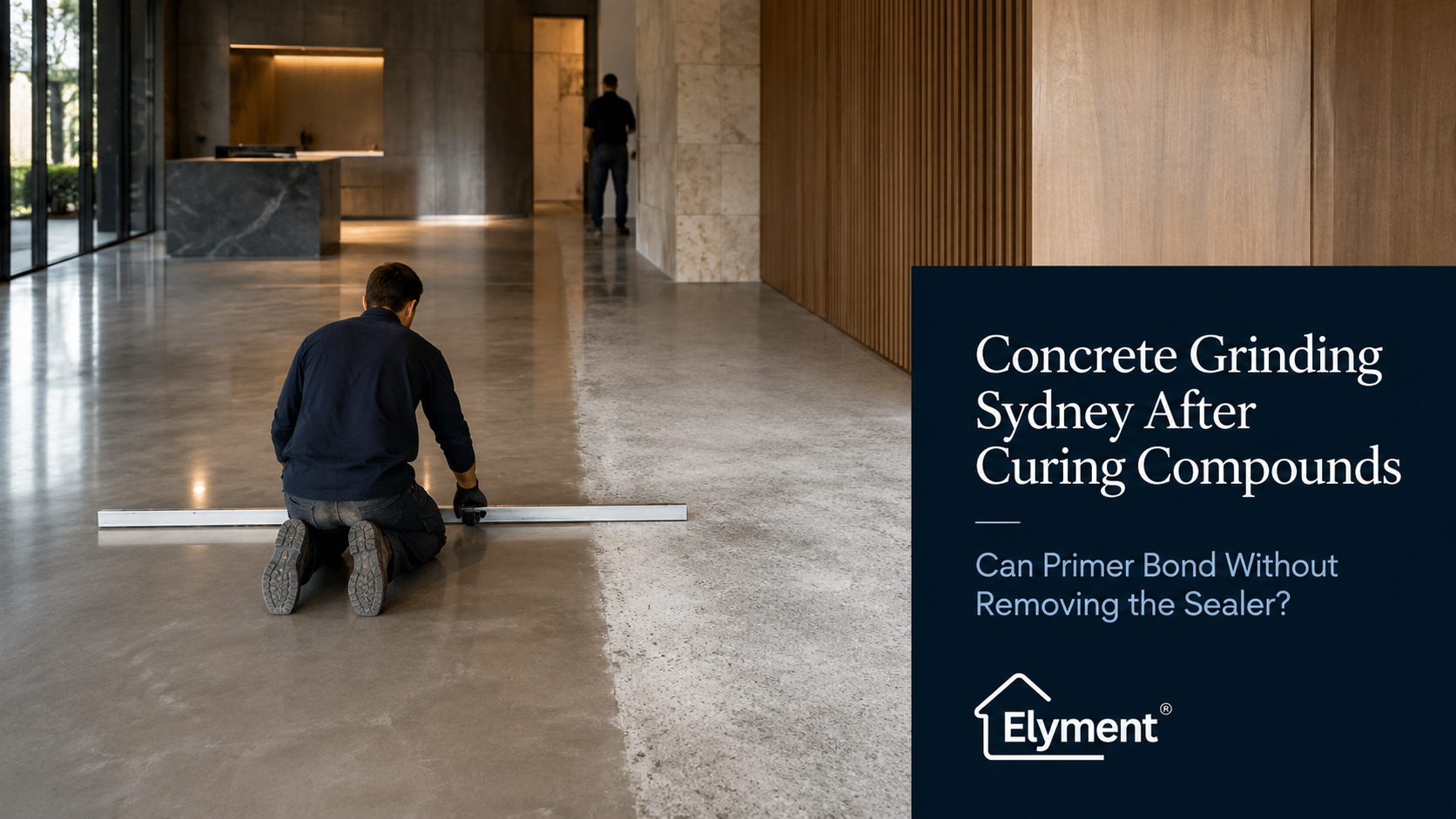
Primer should not be assumed to bond reliably over a concrete curing compound or sealer simply because the slab looks clean. On Sydney and NSW flooring projects, many levelling and preparation systems require curing compounds, sealers and other bond-breaking contaminants to be mechanically removed before priming. The critical project decision is not whether the concrete has cured, but whether the surface that remains is clean, sound, porous and compatible with the specified primer and flooring system.
A newly exposed concrete floor can create a misleading sense of readiness. The slab may be hard, dry to the touch and free from adhesive, paint or construction debris, yet still carry a curing membrane or sealer that changes how the next material interacts with the concrete.
That matters because the floor-preparation sequence is usually relying on a chain of adhesion: concrete to primer, primer to levelling compound or coating, then the prepared substrate to the finished flooring system. A weak interface at the bottom of that chain can compromise everything placed above it.
This is a different issue from whether new concrete has reached a particular age. Elyment has previously examined the separate question of whether floor preparation can start before or around the conventional 28-day concrete curing milestone. Curing compounds introduce another decision entirely: what was put on the surface, whether it remains, and whether the flooring specification allows anything to be installed over it.
The Surface Can Look Finished Before It Is Flooring-Ready
Curing compounds are applied for a legitimate construction purpose. Some products form a membrane that helps control moisture loss from fresh concrete during curing. Other slabs may subsequently receive sealers, hardeners or treatments for protection, appearance or construction-stage use.
The problem begins when a later flooring package assumes it is dealing directly with absorbent concrete.
A primer designed for porous mineral substrates may behave very differently when the actual surface is a film-forming compound. Instead of penetrating or wetting the concrete as intended, it may remain on top of the treatment beneath it. The floor can therefore appear successfully primed while the underlying bond remains dependent on an interface that was never approved as part of the flooring system.
Australian flooring manufacturer ARDEX, for example, specifies for products including ARDEX K 12 that concrete must be free from curing and sealing compounds and other surface contaminants, with mechanical preparation used to produce a clean, sound and open-pored substrate.
That does not mean every primer from every manufacturer has identical requirements. It means project teams should not convert a general assumption such as "primer sticks to concrete" into permission to coat an unidentified sealer.
The Question Is Not Simply: Has It Been Ground?
Concrete grinding is often written into renovation scopes as though it were a binary activity: grind the floor, vacuum it and move to levelling.
Curing compounds make that wording too vague.
A grinding pass can remove contaminants, expose the concrete and create an appropriate surface profile, but only if the process actually removes the unwanted layer across the required area. A quick cosmetic pass that changes the appearance of the slab is not automatically evidence that a membrane-forming compound has been eliminated.
The operational objective should therefore be defined more precisely:
- identify whether a curing compound, sealer or other treatment may be present;
- determine what the specified flooring or levelling system requires;
- mechanically prepare the floor to the condition required by that system;
- remove grinding dust and loose material thoroughly;
- inspect the prepared substrate before primer is released for application; and
- record any areas that require further preparation or technical review.
This shifts grinding from a generic trade task into a measurable substrate handover.
Why Sydney Projects Are Vulnerable to the Handover Gap
The issue becomes particularly important where responsibility for the slab moves through several contractors.
A typical Sydney apartment, commercial fit-out or new-build flooring sequence may involve a concrete contractor, builder, demolition contractor, flooring-removal crew, grinding contractor, levelling contractor and final flooring installer.
None of those parties necessarily selected the original curing treatment.
Months after the slab was poured, the flooring team may arrive without a curing-compound product name, technical data sheet or clear record of whether a sealer was subsequently applied. The result is often an information problem before it becomes a grinding problem.
This is where a substrate hold point becomes commercially valuable.
A Practical Hold-Point Sequence
- Review construction information.
- Check slab records, builder information, specifications and available product data for curing compounds, sealers or treatments.
- Inspect the exposed slab.
- Look for differences in sheen, absorption, contamination, weak laitance, existing coatings and areas where previous finishes may have protected or disturbed the original surface.
- Confirm the next flooring system.
- The preparation method must be driven by the primer, levelling compound, adhesive or coating that will actually be installed.
- Define the mechanical preparation scope.
- Specify whether grinding, shot blasting, scarifying or another approved preparation method is required rather than using the generic instruction "prepare concrete".
- Prepare and clean the substrate.
- Remove incompatible surface material and control the dust generated during the work.
- Inspect before priming.
- Primer application becomes a release point rather than the automatic next task on the programme.
Why Adding More Primer Is Not the Solution
When a substrate appears unusually non-absorbent, the temptation can be to compensate by applying more primer.
That can misunderstand the purpose of the product.
A primer is part of a specified installation system. It is not a universal adhesive intended to make every unknown surface acceptable. Applying a thicker coat does not prove compatibility with the curing compound beneath it, and excessive product can itself move the installation outside the manufacturer's specified method.
Some specialised epoxy or moisture-management systems are deliberately designed to form non-porous layers before subsequent flooring preparation. Those are engineered assemblies with defined primers, broadcast sands, curing periods or follow-on products. They should not be confused with leaving an unidentified construction sealer in place and hoping the next primer bonds to it.
ARDEX's Australian technical guidance illustrates this distinction. Its flooring systems include specific epoxy and moisture-management pathways for particular conditions, while its standard substrate-preparation guidance separately requires contaminants and curing compounds to be removed and the concrete pores opened before conventional preparation proceeds.
The Cost Usually Appears One Trade Later
Insufficient preparation can be difficult to see immediately after priming. The commercial consequences may emerge only after levelling compound, adhesive or a coating has been installed.
- Curing membrane remains beneath primer
- Possible project consequence: Weak interfacial bond or local delamination.
- When it may become visible: During levelling, flooring installation or later service.
- Grinding removes treatment unevenly
- Possible project consequence: Different absorption and primer behaviour across the same room.
- When it may become visible: During priming or levelling.
- Dust remains after grinding
- Possible project consequence: Primer adheres to loose dust rather than a sound substrate.
- When it may become visible: During application or subsequent pull-off.
- Unknown sealer is accepted without verification
- Possible project consequence: Installer warranty or manufacturer compliance may become disputed.
- When it may become visible: At handover or after a flooring defect.
- Additional grinding discovered after mobilisation
- Possible project consequence: Programme delay, access rebooking and additional labour.
- When it may become visible: Immediately before the next flooring trade.
This is why the cheapest apparent option can be to stop before primer rather than continue through an unresolved substrate condition.
Grinding Also Creates a NSW Work Health and Safety Issue
Mechanical preparation of concrete is not only a flooring-quality question. Concrete contains crystalline silica, and grinding can generate respirable silica dust if appropriate controls are not used.
SafeWork NSW guidance on crystalline silica identifies measures including water suppression and on-tool dust capture as effective controls for concrete-processing work.
For Sydney apartments and occupied commercial buildings, this affects more than the grinding operator. Project planning may need to address:
- dust extraction and equipment selection;
- work-zone isolation;
- worker respiratory protection where required;
- clean-up methods;
- building-manager requirements;
- noise windows and strata working hours;
- lift and loading-zone bookings; and
- the timing of other trades entering the prepared area.
Elyment has examined these operational issues separately in its analysis of concrete grinding quotes, silica controls and preparation documentation in Sydney.
New Apartments and Commercial Fit-Outs Can Be More Complicated Than Renovations
Older renovation projects usually make contamination risk obvious. Carpet adhesive, tile bedding, paint, old coating systems or construction residue visibly signal that the slab requires preparation.
A relatively new slab can create the opposite problem. Because it has never carried an old floor finish, stakeholders may assume it requires less preparation.
In reality, the absence of demolition residue does not prove the surface is untreated.
This can become important in new Sydney apartment developments, retail tenancies and commercial fit-outs where the base-build contractor hands a slab to a separate fit-out team. The downstream flooring contractor needs to know what the actual substrate is, not merely when it was poured.
The programme should therefore carry substrate information through the handover in the same way it carries floor levels, penetrations and service locations.
What the Flooring Specification Should Clarify Before Mobilisation
The most useful flooring scopes define the required outcome rather than assuming every slab can be treated in the same way.
Before scheduling grinding and priming, project teams should establish:
- the intended finished flooring system;
- the selected levelling compound, adhesive or coating where already known;
- the manufacturer's substrate-preparation requirements;
- whether curing compounds, sealers or hardeners were used;
- whether moisture testing or moisture-management measures are required;
- the floor flatness or level correction required after preparation;
- threshold, door, joinery and lift-sill height constraints;
- the required grinding and dust-control methodology; and
- who has authority to release the substrate for priming.
Where levelling is also required, the preparation decision should be integrated with the wider apartment floor levelling and substrate-preparation sequence rather than treated as an isolated grinding operation.
A Small Test Area Can Prevent a Large Rework Scope
Where the history of the slab is uncertain, blindly committing the entire floor to one preparation assumption creates avoidable risk.
A controlled initial area can help the project team understand what mechanical preparation reveals before the whole site is processed. The appropriate verification method depends on the flooring system and manufacturer requirements, so a test area should not be treated as a substitute for the specification. Its value is operational: it can expose unexpected surface treatments, excessive hardness, weak layers or inconsistent preparation while the scope is still adjustable.
This is particularly useful where a Sydney project has expensive mobilisation constraints such as after-hours access, loading-dock bookings, lift protection or a narrow fit-out programme.
The Better Handover Is "Ready for This System"
The phrase "floor has been ground" provides surprisingly little information to the next contractor.
A better handover identifies what the slab has been prepared to receive.
That distinction matters because the required preparation can change depending on whether the next layer is a cementitious levelling compound, epoxy coating, polyurethane system, resilient-flooring adhesive, timber-floor adhesive or another specified finish.
Elyment's earlier analysis of concrete surface profile before epoxy and microcement addresses a related issue: preparation should be matched to the finish rather than judged purely by how the slab looks.
Confirm What Is On The Concrete Before Primer Locks The Sequence In
Review curing compounds, sealers, grinding requirements, primer compatibility, floor levelling, silica controls and trade sequencing before the substrate is released for the next flooring system.
The Final Decision Belongs to the Complete Flooring System
There is no useful universal rule that every visible sealer can stay or that every concrete floor must receive the same depth of grinding.
The defensible approach is more specific. Identify what is on the slab, check the requirements of the products that will be installed, mechanically remove incompatible material where required, clean and inspect the prepared concrete, and only then release the floor for primer.
On Sydney projects, that decision can protect more than adhesion. It can prevent a flooring defect from becoming a programme problem involving regrinding, material removal, lift rebookings, delayed installers and disputed responsibility between trades.
The critical question is therefore not whether primer can physically dry on top of a curing compound. It is whether the complete flooring system has been specified and installed over a substrate that the manufacturer accepts.
Confirm What Is On The Concrete Before Primer Locks The Sequence In
Review curing compounds, sealers, grinding requirements, primer compatibility, floor levelling, silica controls and trade sequencing before the substrate is released for the next flooring system.
Book a Project ReviewRelevant next actions
Explore the ELYMENT service most closely connected to this article.