Concrete Grinding Sydney: Steel-Fibre Slab Preparation
Concrete grinding in Sydney prepares steel-fibre slabs for flooring, reducing surface defects, bonding failures, delays, and costly rework on site in projects.
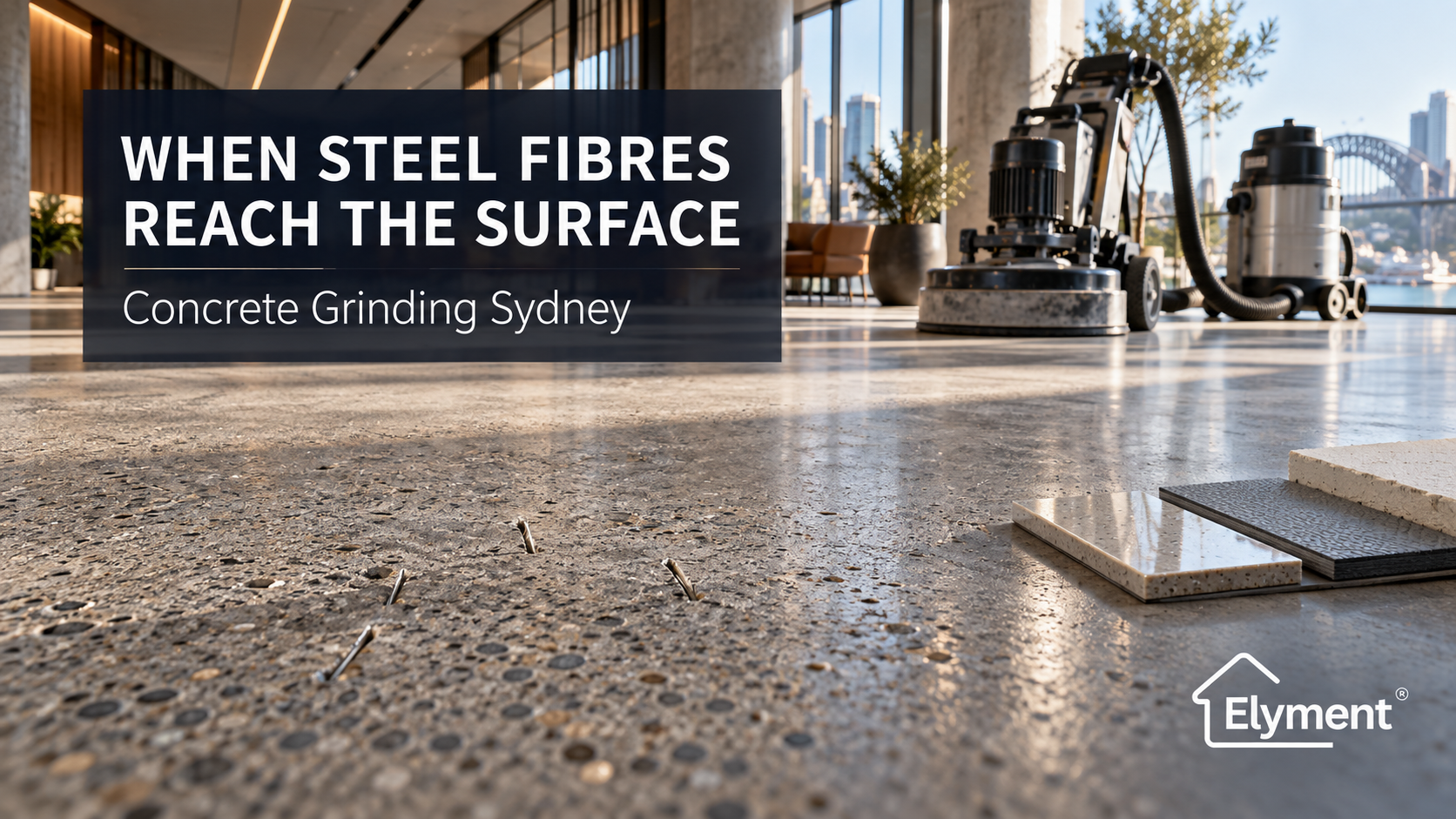
Grinding a steel-fibre concrete slab can expose, flatten, cut or occasionally loosen fibres close to the surface. On Sydney commercial projects, this does not automatically mean the slab has failed, but it changes the preparation decision. Sharp or unstable fibres, grinding depth, surface profile and the proposed flooring system should be reviewed before primer, levelling compound, coatings or thin floor finishes are allowed to proceed.
Steel-fibre reinforced concrete is common in industrial and commercial construction because fibres can contribute to toughness, crack control, impact resistance and structural performance. The Cement Concrete & Aggregates Australia Guide to Concrete Construction identifies industrial pavements among the Australian applications for fibre-reinforced concrete.
That reinforcement becomes a different operational issue years later when an old coating, adhesive, screed or floor finish is removed and the slab requires mechanical preparation.
A grinder may initially be working through adhesive residue, laitance or a superficial high spot. After another pass, bright metallic points or short lengths of wire may begin appearing across the floor. The project then has a question that cannot be answered by simply increasing machine time: is the preparation still removing expendable surface material, or has it reached a depth where the reinforced slab itself needs to be treated as part of the design decision?
The First Exposed Fibre Changes the Question
Steel fibres are distributed through the concrete rather than installed as one neatly defined layer. A fibre may sit deeper within one part of the slab and lie close to the finished surface somewhere else.
Industry guidance recognises that individual steel fibres can sometimes occur near concrete surfaces even where placement and finishing have been properly controlled. Grinding can reveal additional fibres because the operation deliberately removes cement paste and aggregate from the upper surface.
What appears after grinding can include:
- Small metallic points finishing approximately flush with the concrete.
- Short fibre ends newly exposed by removal of the surrounding paste.
- Fibres partially cut by diamond tooling.
- Fibres folded or burnished into the prepared surface.
- Occasional protruding fibres capable of creating a sharp point.
- Small voids where a poorly anchored surface fibre has released.
- Local metallic staining where exposed steel later encounters moisture.
Those conditions do not have identical consequences. A stable fibre that finishes flush with a substrate later receiving a substantial cementitious build-up presents a different preparation problem from a sharp fibre protruding beneath a thin waterproofing membrane, resin coating or decorative finish.
This is why a steel-fibre slab should not be judged simply as fibres visible or fibres not visible. The project team needs to understand the condition, quantity, preparation depth and next floor system.
Visible Steel Is Not Automatically a Grinding Defect
A common site reaction is to treat every visible piece of metal as something that should immediately be pulled from the slab. That can be the wrong starting point.
Steel fibres form part of the concrete matrix. Surface exposure may arise because of original placement and finishing, subsequent wear, previous construction work or the depth reached during the new grinding operation. Appearance alone does not establish whether the fibre is structurally significant or whether its removal is acceptable.
The more useful questions are:
- How much concrete has already been removed?
- Are fibres isolated or appearing across a substantial area?
- Are they flush, firmly embedded, loose or projecting?
- Is the slab ground-supported, suspended or otherwise structurally sensitive?
- Was the grinding scope intended only for contamination removal or also for level correction?
- What floor system will cover the concrete?
- Does that system tolerate isolated metallic exposure?
- Is further grinding likely to expose materially more reinforcement?
Where exposure becomes widespread, grinding depth is increasing or the work moves beyond ordinary superficial preparation, the appropriate response may be to stop and confirm the permissible preparation depth with the builder, superintendent, slab designer or structural engineer rather than allowing surface preparation to become uncontrolled concrete removal.
The Next Floor Finish Determines How Serious the Surface Condition Is
The end use matters more than the appearance of the freshly ground concrete. Elyment has previously examined why surface profile must be matched to epoxy, microcement and other downstream finishes. Steel-fibre exposure adds another layer to that handover decision.
Epoxy or polyurethane coating
Why exposed fibres matter: Protruding fibres, pinpoints and local voids may affect coating continuity, appearance or subsequent corrosion staining.
Preparation decision: Remove unsafe projections appropriately, repair voids where required and confirm profile and coating-system requirements.
Self-levelling compound
Why exposed fibres matter: The issue is whether the surface is sound, stable and capable of receiving the nominated primer and levelling build-up.
Preparation decision: Confirm fibre condition, required coverage, primer compatibility and whether further concrete removal is necessary.
Vinyl, LVT or other thin resilient flooring
Why exposed fibres matter: Thin finishes place greater emphasis on smoothness and can reveal defects in the preparation layers beneath them.
Preparation decision: Make the steel-fibre surface part of the smoothing and levelling specification rather than relying on the floor covering to hide it.
Microcement or thin decorative system
Why exposed fibres matter: Local surface variation, repairs and metallic points may become visually important beneath a thin continuous finish.
Preparation decision: Establish an agreed substrate standard before decorative work begins.
Polished or exposed concrete
Why exposed fibres matter: Grinding may intentionally reveal fibres and aggregate, making the appearance part of the final architectural outcome.
Preparation decision: Confirm whether exposed fibres are acceptable within the specified visual finish before continuing across the full floor.
Tiles or thicker flooring build-up
Why exposed fibres matter: Individual flush fibres may be less visually significant, but loose metal, sharp projections and weak surrounding concrete still require attention.
Preparation decision: Prepare a clean, sound substrate that meets the requirements of the adhesive, screed or underlayment system.
The Important Distinction Is Exposure Versus Projection
A metallic point visible within the concrete surface is not the same as a fibre standing proud of the floor.
Protruding fibres create a more immediate downstream concern because they can interfere with membranes and thin finishes. International fibre-concrete technical guidance from Sika specifically notes that protruding steel fibres can create an injury risk and may damage waterproofing membranes.
On a commercial concrete grinding Sydney project, the surface inspection should therefore identify not only whether steel is visible, but whether the fibre is:
- Flush and firmly locked into sound concrete.
- Slightly proud but stable.
- Sharp enough to affect safe access or subsequent products.
- Loose or capable of being moved by hand.
- Surrounded by a small breakout or void.
- Part of widespread fibre exposure caused by deeper-than-expected grinding.
That record gives the next contractor something more useful than a photograph of an apparently clean slab.
Why Pulling Fibres Out Indiscriminately Can Create Another Problem
Removing a protruding hazard and systematically extracting fibres from the concrete are not the same operation.
Pulling a firmly embedded fibre can break concrete around the fibre and leave a local cavity that then requires repair. Repeated across a large commercial floor, a seemingly minor decision can turn into hundreds of small patching points and alter the consistency of the final substrate.
Conversely, leaving a loose or sharp fibre simply because it is technically reinforcement may also be inappropriate where the next system requires a continuous, smooth and defect-free substrate.
The sensible approach is outcome-based: identify the surface condition, confirm what the next system requires, establish the treatment method and document any area where fibre exposure suggests that grinding is reaching beyond the intended preparation depth.
A Test Area Becomes More Valuable Once Steel Appears
Large Sydney warehouses, commercial refurbishments and industrial floors amplify small preparation assumptions. A technique that exposes only a few fibres in the first 10 square metres may behave very differently across another zone with a different finishing history or slab condition.
Elyment has previously examined how a representative test patch can improve commercial coating-removal planning. The same principle becomes valuable when steel fibres begin appearing.
A controlled trial area can establish:
- Removal productivity. Determine what the selected tooling removes before fibres become frequent.
- Fibre frequency. Record whether steel exposure is isolated or widespread.
- Surface response. Check whether fibres remain flush, protrude or release from the surface.
- Concrete condition. Identify breakout, weak paste, old repairs or previous surface treatments.
- Required profile. Compare the result with the primer, leveller, adhesive or coating specification.
- Programme impact. Decide whether additional repairs, technical review or drying time will be needed before the flooring contractor mobilises.
For a large floor, that early hold point can be more valuable than discovering halfway through the grinding programme that the original preparation specification cannot be repeated safely across the remaining area.
Grinding Depth Should Become a Recorded Project Variable
Commercial preparation scopes often describe area and outcome but say little about how much structural concrete may be removed.
That may be adequate where the machine is only cleaning adhesive haze or weak surface laitance. It becomes less adequate when grinding is being used to correct a meaningful high point, remove a deeply bonded coating or chase a surface until a particular visual result is achieved.
The appearance of increasing numbers of fibres can act as a practical warning that the project should reassess the correction strategy.
The alternative may not necessarily be more grinding. Depending on the geometry and specified finish, the project may instead consider:
- Retaining part of the existing high zone.
- Raising adjoining low areas with an approved levelling system.
- Changing the flooring build-up.
- Revising threshold or transition details.
- Repairing locally rather than continuing broad-area grinding.
- Obtaining engineering confirmation before deeper concrete removal.
That is a different decision from the usual grinding-versus-levelling calculation used to manage isolated high points. Steel-fibre exposure introduces a reinforcement and finish-handover question as well as a floor-height question.
Commercial Projects Need a Fibre Condition Map, Not Just a Clean-Floor Photo
On a small renovation, the preparation contractor and flooring installer may inspect the floor together. On a warehouse, supermarket, medical fit-out, office refurbishment or industrial project, the two contractors may attend days apart and under separate scopes.
A useful handover can record areas as:
- Zone A: Normal prepared concrete with no meaningful fibre exposure.
- Zone B: Isolated flush fibres, stable and photographed.
- Zone C: Protruding fibres requiring agreed treatment.
- Zone D: Local fibre release or concrete breakout requiring repair.
- Zone E: Widespread exposure where further grinding is placed on hold.
This does not need to become an elaborate engineering drawing. A marked-up floor plan and representative photographs can prevent the incoming installer from having to rediscover the condition after primer, smoothing compound or flooring materials have already arrived.
The Installer Should Be Involved Before the Grinder Leaves
One of the most expensive commercial flooring failures is a technically completed preparation scope that the next contractor will not accept.
The grinding contractor may say that adhesive and high spots have been removed. The flooring installer may say that projecting fibres, repairs or surface texture fall outside the requirements of its product system. Meanwhile, the builder may already have booked deliveries, joinery, line marking or reopening.
The practical solution is a controlled handover before demobilisation.
That process should confirm:
- The final floor system and its preparation requirements.
- Areas where steel fibres are visible.
- Areas where fibres have been treated or local concrete repairs completed.
- Whether further grinding has been stopped because of depth or fibre frequency.
- The agreed cleaning and dust-removal standard.
- Any primer, levelling or repair system still required.
- Who accepts the substrate before the next application begins.
This fits the broader sequencing principle described in Elyment's guidance on coordinating removal, grinding, levelling and flooring installation on busy Sydney sites.
Silica Controls Still Apply When Metal Becomes Visible
Steel appearing at the surface does not remove the principal dust hazard created by processing the surrounding concrete.
SafeWork NSW's code of practice for cutting, drilling and grinding concrete and masonry products identifies respirable crystalline silica among the hazards associated with grinding concrete and sets out the need to manage risks through appropriate systems, equipment and controls.
For Sydney commercial projects, that has direct programming consequences. Grinding zones may require isolation, effective extraction or other appropriate dust controls, controlled clean-up and restrictions on adjacent trades. The appearance of steel fibres should not encourage improvised dry cutting, uncontrolled abrasive work or manual treatment that bypasses the site's existing safety controls.
Steel Fibres Can Change Cost Without Changing the Floor Area
Fibre exposure is a useful example of why square metres alone do not fully describe commercial concrete preparation.
A 1,000-square-metre floor remains 1,000 square metres whether the first grinding pass exposes ten fibres or several thousand. The labour and programme implications can be materially different.
Occasional flush fibres
Potential project consequence: May require recording and confirmation rather than major scope change.
Numerous projecting fibres
Potential project consequence: Additional treatment and inspection before a thin flooring system proceeds.
Fibres releasing with local concrete
Potential project consequence: Repair material, labour and curing or drying time may need to be added.
Rapid increase in exposed fibres
Potential project consequence: Grinding depth may need review before further concrete is removed.
Change from coating to polished concrete
Potential project consequence: The visible steel may become an architectural acceptance issue rather than a hidden substrate issue.
Installer rejects prepared zone
Potential project consequence: Rework, remobilisation and programme delay can exceed the cost of the original local treatment.
A Better Sydney Commercial Preparation Sequence
For steel-fibre concrete, the strongest preparation programme is not simply grind until clean.
- Confirm the next floor finish. Obtain the flooring, coating, levelling or membrane requirements before selecting the final grinding outcome.
- Review available slab information. Determine whether the concrete is known to contain steel fibres and whether structural or project documentation imposes limits on modification.
- Expose a representative test area. Establish how the slab, old coating and fibres respond to the proposed tooling.
- Record fibre exposure. Separate isolated flush fibres from projecting, loose or widespread conditions.
- Create a hold point where necessary. Do not continue deeper merely because another grinding pass is technically possible.
- Treat and repair to an agreed standard. Match the preparation to the nominated downstream system.
- Complete a joint handover. Have the builder, preparation contractor or flooring installer accept the substrate before primer or finish installation locks the condition out of sight.
The Commercial Lesson Is About Restraint, Not More Grinding
Steel fibres appearing during concrete grinding are not automatically proof that the slab is defective and they are not automatically permission to keep grinding until every metallic point disappears.
Their real value is diagnostic.
They tell the project team that mechanical preparation is interacting with the reinforced concrete itself. At that point, surface profile, preparation depth, the next finish, worker safety, repair strategy and responsibility between contractors all become part of the same decision.
For commercial concrete grinding in Sydney, the most defensible approach is therefore to establish the flooring outcome first, use representative test areas, record what the slab reveals and stop for technical review when the preparation moves beyond the intended surface zone.
The objective is not to produce the most aggressively ground slab. It is to deliver a concrete surface that the next flooring system can accept without creating a structural, aesthetic or programme problem somewhere else.
Sydney & NSW | Commercial Floor Preparation
Review the Slab Before Another Grinding Pass Changes the Scope
Assess steel-fibre exposure, grinding depth, substrate condition, levelling requirements, finish compatibility and project sequencing before the next flooring system is installed.
Request a Project Review → /contact/
Sources and References
- Cement Concrete & Aggregates Australia: Guide to Concrete Construction
- SafeWork NSW: Code of Practice for Cutting, Drilling and Grinding Concrete and Masonry Products
- Sika technical guidance on steel-fibre reinforced concrete and protruding steel fibres.
- Elyment: Surface Profile Before Epoxy or Microcement
- Elyment: Test Patches for Commercial Coating Removal
- Elyment: Concrete Grinding Versus Floor Levelling
- Elyment: Sequencing Removal, Grinding, Levelling and Installation
Review the Slab Before Another Grinding Pass Changes the Scope
Assess steel-fibre exposure, grinding depth, substrate condition, levelling requirements, finish compatibility and project sequencing before the next flooring system is installed.
Request a Project Review →Relevant next actions
Explore the ELYMENT service most closely connected to this article.