Concrete Sealer Roller Marks: Repair Options in Sydney
Roller lines after concrete sealing in Sydney might not require full stripping. Learn when local repairs work and what affects the finish, costs and durability.
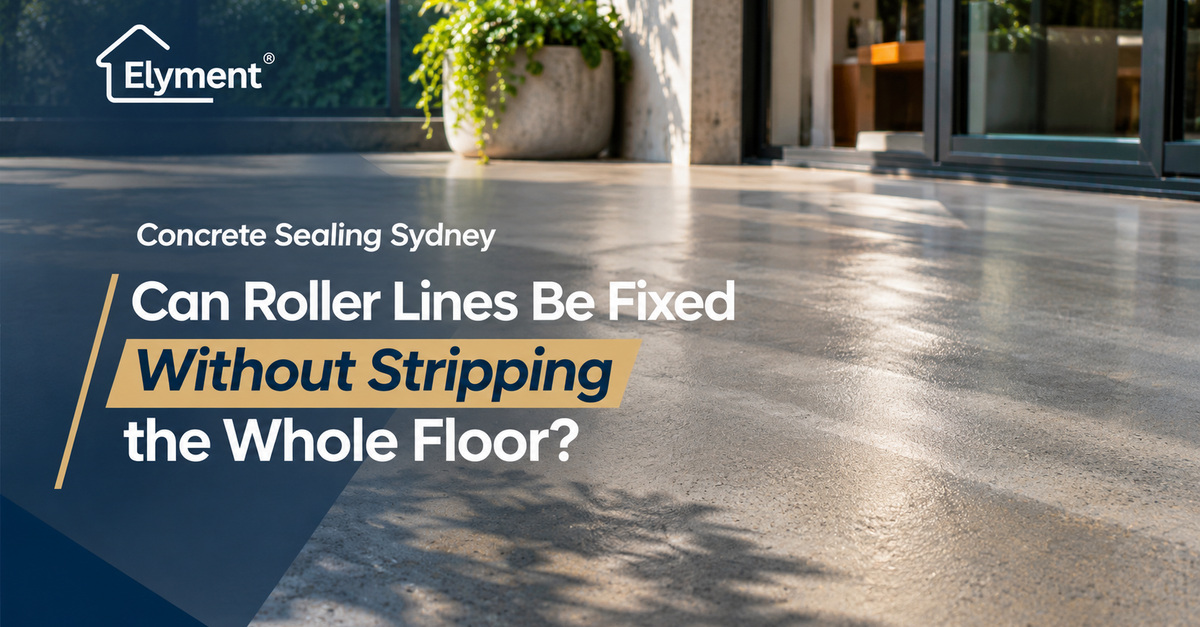
Concrete sealer roller marks in Sydney do not automatically mean the whole floor needs stripping. Regular overlap bands on an otherwise sound, clear film may be repairable through a product-approved blending, abrasion or recoating process. Whitening, lifting or flaking can indicate a different failure. Before quoting, identify the existing sealer, review its technical data and test a discreet area to confirm compatibility, appearance and adhesion.
The Line Across the Floor May Be an Application Defect, Not a Failed Coating
A newly sealed concrete driveway or courtyard can look different once the surface dries and natural light begins reflecting across it.
Long parallel bands, darker strips and visible changes in gloss can appear across an otherwise attractive finish. In some cases, these marks are caused by the way the sealer was applied rather than a failure of the concrete or the entire coating system.
For Sydney property owners, the distinction matters commercially. A localised application defect may require controlled surface preparation and a compatible additional treatment. A coating that has lost adhesion may require a much larger removal process.
The two conditions can look similar in photographs, but they do not necessarily require the same equipment, labour, materials or project duration.
Why Concrete Sealer Develops Roller and Lap Marks
Roller marks commonly develop when the application process produces an uneven distribution of material across the concrete.
One recognised cause is the loss of a wet edge. During application, the next pass should overlap the previous pass while the material is still within its permitted working time. If the earlier section begins curing before the next pass reaches it, the overlap can remain visible as a distinct line.
Other contributing factors can include:
- Using an applicator that is unsuitable for the selected sealer.
- Applying inconsistent quantities of material.
- Working across large sections without maintaining a consistent application sequence.
- Overworking the coating after it has started setting.
- Changes in temperature, wind and surface conditions.
- Incorrect mixing or inadequate preparation of the product.
The applicator itself also matters. Concrete Network distinguishes between application methods for different coating types, including solvent-based acrylics, water-based acrylics and heavier polyurethane or epoxy systems.
Its technical discussion of concrete sealer roller marks and lap lines explains why application technique and coating chemistry must be considered together.
How to Distinguish Roller Lines From Whitening and Peeling
Before considering repairs, the visible defect needs to be classified. A regular line across a sealed floor is not automatically evidence of delamination, while a cloudy surface should not automatically be treated as a simple roller application issue.
Common Concrete Sealer Conditions
1. Parallel or Overlapping Bands
- Possible explanation: Application overlap, inconsistent film thickness or roller marks.
- What needs checking: Whether the coating remains intact and securely bonded.
2. Milky or Cloudy Patches
- Possible explanation: Moisture-related whitening, coating incompatibility or loss of adhesion.
- What needs checking: Coating condition, moisture history and adhesion.
3. Flaking or Peeling Edges
- Possible explanation: Possible delamination or failure of the coating system.
- What needs checking: How far the unsound material extends.
4. Powdery White Deposits
- Possible explanation: Possible efflorescence or surface contamination.
- What needs checking: Whether the material is on top of the coating or within the coating system.
Application overlap: Lines often follow the direction and width of the applicator. The film may remain physically intact, with the defect mainly visible through differences in gloss, colour or surface texture.
Whitening: A cloudy or milky appearance may indicate moisture-related problems or a change within the coating. It requires further investigation rather than an automatic assumption that another coat will solve the problem.
Peeling: Raised edges, loose flakes, blisters and visible separation suggest that the coating may no longer be properly bonded. Applying fresh sealer over an unstable layer does not restore the original adhesion.
Efflorescence is another possible source of white surface deposits. It should be distinguished from whitening within a film-forming coating because the underlying causes and treatment requirements differ.
For a broader discussion of white and cloudy concrete sealer failures, see ELYMENT's separate guide: Concrete Sealer Turning White in Sydney: Recoat It or Remove It First?
Why Identifying the Existing Sealer Comes Before Repair
One of the biggest problems in remedial concrete sealing is being asked to repair a coating without knowing what was originally applied.
Owners may know that the driveway was sealed several years ago, but that does not establish whether the existing material is acrylic, polyurethane, epoxy or a penetrating treatment.
These products do not necessarily behave in the same way. Their curing processes, film characteristics, preparation requirements and compatibility with additional coatings can differ substantially.
Film-Forming Sealers
Some sealers create a protective film at or above the concrete surface. Their appearance and condition can be affected by application thickness, adhesion, previous coating layers and surface preparation.
Penetrating Sealers
Other products are designed to penetrate the concrete rather than create the same type of continuous surface film.
This distinction matters because a visible application mark on one system may not have the same explanation or repair pathway on another.
Previous Coatings and Maintenance Treatments
A floor may also have received several applications over time. A later contractor might be dealing with a combination of original sealer, maintenance coating and subsequent repair material rather than one identifiable product.
Before selecting a repair process, request:
- The original product name and manufacturer.
- Previous application invoices or contractor records.
- Technical data sheets and safety data sheets where available.
- The approximate application date.
- Information about previous resealing or maintenance treatments.
- Details of cleaning chemicals or treatments used since application.
Dulux Avista's concrete sealer technical information library provides an example of why product-specific documentation matters. Different products have their own technical data and application requirements.
Where the original material cannot be identified, the repair should remain subject to further inspection and testing rather than being priced on an assumed coating type.
The Test Patch: A Small Step That Can Change the Entire Quote
When the coating type or repair method is uncertain, a controlled test area is often more useful than immediately preparing the entire floor.
The objective is not simply to make one small section look better. It is to establish whether the proposed repair process can produce a consistent and reliable result on the existing surface.
A suitable assessment should consider the following stages:
- Record the existing condition: Photograph the affected area and an unaffected section under consistent lighting.
- Identify the coating: Review available product records and consult the manufacturer where necessary.
- Inspect the existing film: Check for lifting, flaking, bubbles, contamination and signs of poor adhesion.
- Select an approved test method: Determine whether the proposed treatment involves controlled abrasion, a compatible reactivation process or another manufacturer-approved method.
- Prepare a discreet test section: Keep the trial area small enough to limit unnecessary disturbance while allowing the proposed repair to be assessed.
- Apply the proposed repair system: Follow the relevant manufacturer's preparation, application and curing requirements.
- Assess the cured result: Check colour, gloss, surface uniformity and adhesion after the specified curing period.
A test patch can reveal problems that a quick visual inspection will not. The new material may fail to bond, produce a different sheen or leave a visible transition between the treated and untreated sections.
Importantly, a successful small patch does not automatically guarantee that every part of a large floor will behave identically. Surface porosity, previous repairs and localised contamination can vary across the slab.
The trial should therefore establish a defensible repair method and acceptance standard before the full scope is confirmed.
Can Roller Marks Be Repaired Without Stripping the Entire Floor?
In some situations, yes. The correct method depends on the condition of the existing coating and the result of the test area.
Scenario 1: Localised Lap Lines on a Stable Coating
Where the coating remains intact and the defect is limited to application overlap, a product-approved blending, controlled abrasion or compatible recoating process may be sufficient.
However, localised treatment does not always produce a visually seamless result. Differences in gloss, colour and weathering can make a repaired patch noticeable.
Scenario 2: Roller Marks Across a Larger Continuous Section
Where the film remains sound but the application marks extend across a substantial area, treating individual lines may create further inconsistencies.
A more uniform preparation and recoating process across the affected visual section may provide a better result than multiple small repairs.
Scenario 3: Whitening Accompanied by Poor Adhesion
Where investigation identifies lifting, flaking or widespread adhesion failure, a cosmetic repair is unlikely to provide a dependable long-term outcome.
Unsound material may need to be removed back to a suitable, stable surface before a replacement coating is considered. Whether this involves localised removal or the whole floor depends on the extent of the failure.
Scenario 4: Unknown Coating or Incompatible Previous Treatments
Where the existing product cannot be established, applying another sealer introduces unnecessary uncertainty.
The better approach is to pause the full repair scope, investigate the existing system and establish a compatible treatment through manufacturer guidance and controlled testing.
Why the Repair Method Changes the Sydney Project Quote
Two concrete surfaces measuring the same area can require very different repair scopes.
For example, consider a hypothetical 55-square-metre sealed courtyard in Sydney.
One surface has visible roller overlap marks, but the existing coating remains intact. The other has similar-looking bands alongside cloudy sections and peeling edges.
Although both owners may request a quote for roller mark removal, the actual work could be materially different.
Repair Scope Comparison: Stable Coating vs Failed Coating
1. Initial Inspection
- Stable coating: Required.
- Failed coating: Required.
2. Product Identification
- Stable coating: Required.
- Failed coating: Required.
3. Test Patch
- Stable coating: Repair compatibility.
- Failed coating: Removal and replacement assessment.
4. Surface Preparation
- Stable coating: Potentially localised or uniform abrasion.
- Failed coating: Removal of unsound coating and further preparation.
5. New Application
- Stable coating: Compatible repair or recoat.
- Failed coating: Replacement system after suitable preparation.
The quotation should distinguish between inspection, testing, preparation, coating application and any additional removal work.
Other variables can influence the final scope:
- Total floor area and the number of affected sections.
- Indoor or outdoor exposure.
- Concrete porosity and existing surface condition.
- Number and type of previous coating layers.
- Access restrictions and protection of surrounding surfaces.
- Required working hours and property occupancy.
- Waste management and mechanical preparation requirements.
A price based only on square metres may overlook the investigation and preparation needed to achieve a consistent finish.
Mechanical Preparation Requires More Than a Cosmetic Assessment
If the selected repair requires mechanical abrasion or concrete grinding, the scope changes from a simple coating treatment to a surface preparation activity.
Grinding concrete can generate respirable crystalline silica. SafeWork NSW identifies concrete processing as a relevant exposure risk and requires appropriate controls for applicable work activities.
Depending on the process, the work may require suitable on-tool dust extraction, wet suppression, local exhaust ventilation, isolation and appropriate respiratory protection.
Read SafeWork NSW's guidance on working safely with crystalline silica before specifying mechanical preparation.
For projects requiring concrete grinding, ELYMENT provides concrete grinding and coating preparation services in Sydney.
The proposed preparation method should also protect adjoining finishes, drains, landscaping, thresholds and other surfaces that are not part of the repair.
What Sydney Property Owners Should Send Before Requesting a Quote
Photographs and basic product information can help establish whether a site inspection and test patch are necessary.
For an initial project review, prepare:
- Wide photographs showing the entire sealed floor.
- Close-up photographs of the roller lines or affected sections.
- Photographs showing any whitening, peeling or flaking.
- The approximate floor area in square metres.
- The original sealer product name, if known.
- The approximate date of the last application.
- Details of previous resealing, cleaning or repair work.
- The property's suburb and whether the floor is indoors or outdoors.
Photographs should ideally be taken in natural light from more than one angle. Low-angle images can help reveal differences in surface sheen and the direction of application marks.
Where the coating history is uncertain, the initial quotation should clearly identify which parts of the proposed scope remain subject to site inspection or product testing.
The Better Repair Decision Starts With Evidence
Concrete sealer roller marks are not always a sign that the entire floor needs to be stripped.
Where the existing coating is stable, the application defect is understood and a compatible repair passes a test area, a more limited treatment may be possible.
Where whitening, peeling or adhesion failure is present, the correct response may involve more extensive preparation and replacement of the coating.
For Sydney homeowners, builders, property managers and strata stakeholders, the commercial priority is to establish the actual condition before committing to a repair price.
Identifying the existing sealer, testing a proposed treatment and defining the required finish can prevent unnecessary removal, repeated applications and avoidable contractor variations.
Review Your Concrete Sealing Project Before Work Begins
Discuss the existing coating, test requirements, preparation scope and repair options before committing to another application.
Further Reading
- Concrete Sealing Sydney: Matte and Natural-Look Finish Guide
- Concrete Grinding Sydney: Does a Densified Concrete Floor Need Different Preparation?
- Concrete Sealing Sydney: Can You Seal Before 28 Days?
Technical References
- Concrete Network: How to Fix Blotchy, Hazy or Spotty Concrete Sealer
- Dulux Avista: Concrete Sealers Technical Information
- SafeWork NSW: Working Safely With Crystalline Silica
Editorial Disclaimer
This article provides general information about concrete sealing and remedial preparation. Actual repair methods, product compatibility, safety requirements and project costs depend on the existing coating, substrate condition and relevant manufacturer instructions.
ELYMENT | SYDNEY PROPERTY & RENOVATION SERVICES
Physical Operations | Professional Services | Technology & Digital Solutions
Review Your Concrete Sealing Project
Understand your existing coating, repair requirements and preparation options before committing to another application.
Request a Project ReviewRelevant next actions
Explore the ELYMENT service most closely connected to this article.