Epoxy Floor Repairs Sydney: Recoat Over Old Epoxy or Strip It Back?
Recoating over old epoxy can save days or repeat a failure. How Sydney owners choose between an overcoat, a patch repair and a full strip back to concrete.
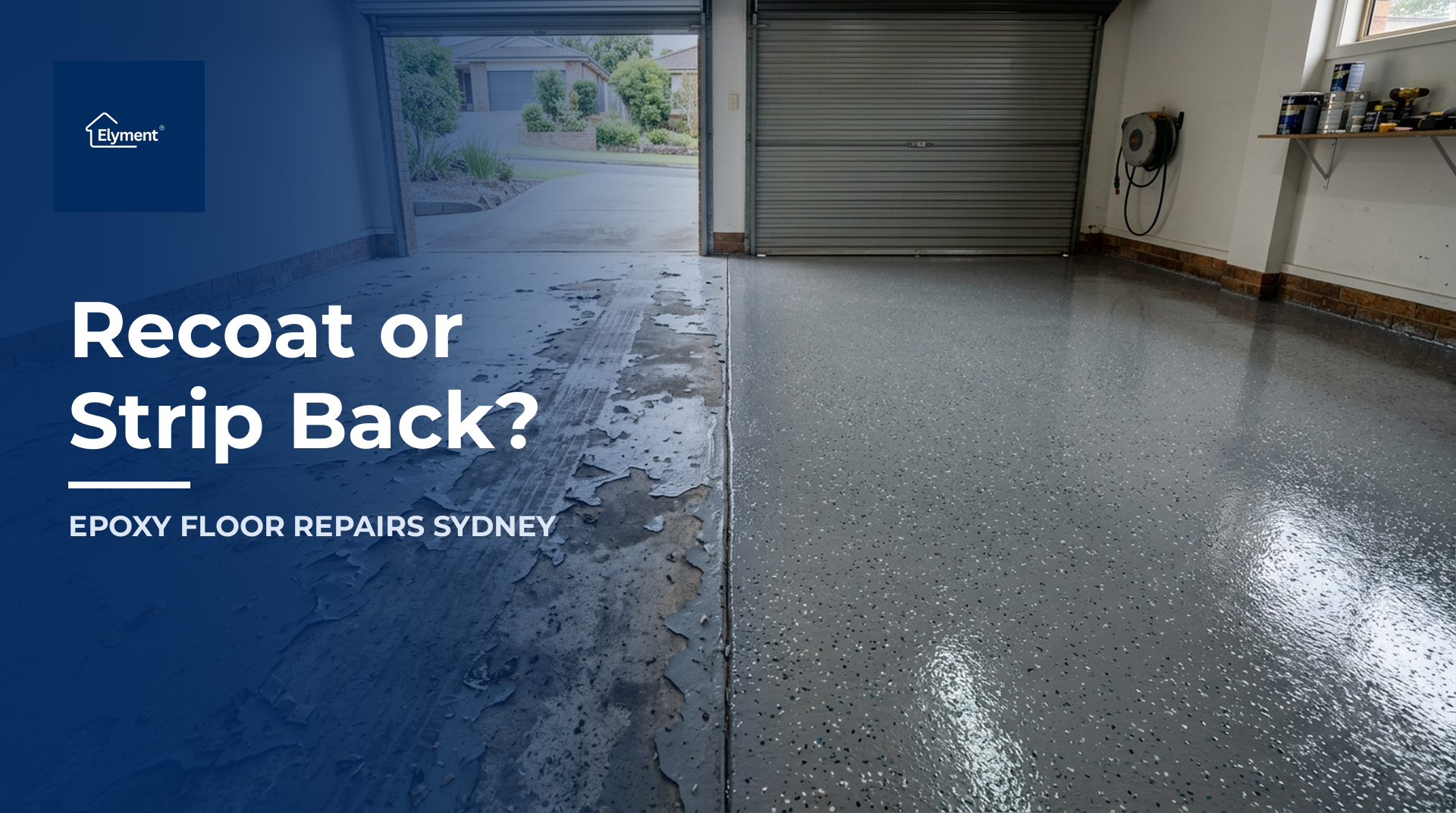
Recoat old epoxy only when the retained coating is sound, well bonded, compatible with the new system and can be mechanically prepared to the manufacturer's requirements. In Sydney repairs, isolated cosmetic wear may justify recoating, while widespread peeling, unknown coating history, contamination or bond failure usually points toward selective or full strip-back. The key decision is not appearance. It is whether the existing epoxy can safely become part of the new floor system.
An ageing epoxy floor creates an apparently simple choice: roughen the surface and apply another coat, or remove everything and start again.
On Sydney renovation, strata, warehouse, garage and commercial projects, that binary framing can be misleading. There is often a third pathway between the two: remove the failed zones, retain coating that can be demonstrated to be sound, prepare the repair interfaces correctly and rebuild the system across a controlled boundary.
The difficult part is deciding which parts of the existing floor deserve to remain. Once a new coating is applied over old epoxy, the retained material is no longer merely an old finish. It becomes one of the layers supporting the new floor.
That changes the question from "Can epoxy stick to epoxy?" to something more consequential: is the project team prepared to rely on the adhesion, condition and history of the old coating for the service life expected from the repair?
The Existing Epoxy Becomes Part of the New Specification
Recoating can be technically appropriate. Manufacturers of professional resin systems commonly provide pathways for overcoating sound existing finishes, subject to conditions such as adhesion, cleanliness, compatibility, abrasion, recoat windows and preparation.
The important word is sound.
A new resin layer cannot strengthen a poorly bonded layer underneath it. If the old coating is separating from the concrete, a fresh topcoat may initially bridge the area and improve its appearance, but the weakest interface remains buried inside the system.
Dulux Protective Coatings, for example, instructs users of relevant epoxy systems to assess existing coating adhesion and remove coating that fails the required assessment. Sika similarly requires sound, clean substrates and advises project teams to obtain system-specific direction where new resin flooring is proposed over an existing resin finish.
For Sydney asset owners, this makes the old floor a project input that should be investigated rather than assumed.
Start With a Failure Map, Not a Colour Selection
Before choosing a new grey, flake blend or gloss level, the existing floor should be divided conceptually into different condition zones.
A warehouse can contain sound epoxy beside forklift-worn traffic lanes. A garage may have intact perimeter coating but localised peeling beneath vehicle positions. A retail tenancy may contain several generations of coating, patch repairs and former partition lines.
Treating every square metre as though it has the same condition can lead either to unnecessary full removal or an under-scoped recoat.
- Loss of sheen, scratches and superficial wear
- What it may indicate: The coating may still be bonded but the wearing surface is exhausted.
- Repair implication: Recoating may remain feasible after system-specific inspection and preparation.
- Small isolated peeling zones
- What it may indicate: Local contamination, impact damage or an isolated bond problem may exist.
- Repair implication: Selective removal may be possible if the surrounding coating is demonstrably sound.
- Peeling appearing across unrelated areas
- What it may indicate: The failure may be systemic rather than local.
- Repair implication: Keeping large areas of the original coating becomes increasingly difficult to justify.
- Blistering or unexplained bubbles
- What it may indicate: Moisture, contamination, trapped material or intercoat failure may require investigation.
- Repair implication: Do not assume another coat will resolve the cause.
- Unknown layers beneath the visible finish
- What it may indicate: The floor may contain multiple coatings, skim coats or previous repairs.
- Repair implication: Test areas and layer identification become important before scope approval.
- Oil, grease or chemical exposure
- What it may indicate: Contamination may affect the old coating, concrete or both.
- Repair implication: Contamination assessment should occur before deciding how much material can remain.
- Cracking through the coating
- What it may indicate: Movement or cracking may originate below the resin layer.
- Repair implication: The underlying condition should be assessed before cosmetic recoating.
Elyment has separately examined oil stains and paint contamination that can compromise epoxy adhesion.
In a repair project, the important extension is to determine whether that problem exists only in an exposed defect or continues beneath epoxy that still appears sound.
When Recoating Over Old Epoxy Can Make Operational Sense
Recoating is most defensible where the existing system is performing as a stable base and the project is renewing its wearing surface rather than trying to conceal widespread failure.
A project team would normally want confidence in several conditions before relying on the existing coating:
- the old coating remains firmly bonded across the area being retained;
- loose, hollow, peeling or otherwise unsound sections have been identified;
- the new coating system is compatible with the retained material;
- oil, grease, silicone, chemicals, waxes and cleaning residues are controlled;
- the surface can be mechanically abraded or otherwise prepared as required by the nominated system;
- cracks, joints and damaged concrete are assessed independently of the cosmetic finish;
- the required slip, texture, traffic and cleaning performance is known;
- the coating manufacturer's recoat and preparation requirements are followed;
- the project team accepts the visual limitations of coating over an older repaired base.
Recoating can reduce demolition, waste movements and exposure of the concrete substrate. It may also shorten the period during which a garage, workshop, plant room or tenancy is unavailable.
That does not make it automatically cheaper in risk terms. Investigation and preparation still matter because the project is retaining an existing layer whose performance will influence the new work.
Selective Strip-Back Is the Missing Middle Option
Many repair discussions jump directly from "recoat everything" to "grind everything back to concrete".
Selective removal can sometimes provide a more proportionate response.
Consider a commercial floor where one loading zone has delaminated after years of impacts but adjacent areas remain strongly bonded. If testing and system guidance support retention, the failed zone may be stripped while the surrounding coating is prepared for incorporation into the rebuilt system.
The repair boundary then becomes critical.
It should not simply be the point where the visible peeling stops. The edge needs to terminate in coating that is genuinely sound. Depending on the specified product, preparation may involve controlled abrasion, scarification, feathering, cleaning, dust removal and rebuilding the system through the interface.
This is where manufacturer instructions matter. For some professional epoxy systems, repair guidance expressly requires sound retained coating to be scarified or abraded beyond the repair edge before the new material overlaps it.
Poorly controlled transitions can create their own defects:
- a visible ridge around the repaired area;
- different texture between old and new zones;
- weak feather edges;
- an adhesion break at the perimeter of the repair;
- telegraphing of the old patch through a uniform topcoat;
- premature wear where traffic repeatedly crosses the interface.
The smallest possible repair is therefore not always the best repair. The correct boundary is the one that can be prepared, coated and handed over as a coherent system.
When Full Strip-Back Becomes the Safer Project Decision
Full removal becomes more compelling when the uncertainty underneath the existing epoxy is greater than the value of keeping it.
That can occur where:
- delamination is widespread or continues to grow;
- adhesion varies unpredictably across the floor;
- multiple unidentified coating generations are present;
- the existing system is incompatible with the proposed replacement;
- contamination is suspected beneath apparently intact coating;
- the substrate requires crack, spall or levelling repairs that cannot be properly accessed while the old coating remains;
- the asset owner requires a new coating warranty that depends on a fully prepared substrate;
- the finished floor requires a uniform build, texture or appearance that local patching is unlikely to achieve;
- previous repair campaigns have created a patchwork of unreliable interfaces.
Elyment's analysis of test patches before large-scale coating removal addresses what stripping can reveal about old floor build-ups.
The repair decision adds a different consideration: whether the project needs that visibility badly enough to expose the entire slab.
Full strip-back costs more in mechanical preparation and usually creates more waste, dust-control requirements and shutdown time. Its advantage is certainty. Once the coating has been removed to the specified benchmark, the project team can inspect the substrate rather than relying on what may be hidden beneath the old resin.
A Repair Boundary Is Also a Business-Continuity Decision
The technical floor decision cannot be separated from how the property operates.
A residential garage may tolerate several days without vehicle access. A strata basement may not be able to close every parking bay simultaneously. A warehouse may need forklift corridors preserved. A workshop may need one half of the floor operational while the other half is prepared and coated.
In those environments, partial strip-back can look attractive because it appears easier to stage.
Sometimes it is. Sometimes repeated small repairs create more operational disruption than one properly planned shutdown.
The comparison should consider the whole programme:
- removal and grinding duration;
- edge and detail preparation;
- repairs to concrete, cracks or joints;
- cleaning and inspection;
- primer and coating application windows;
- curing before foot, trolley, vehicle or forklift traffic returns;
- temporary access routes;
- ventilation and exclusion zones;
- protection from other trades;
- line marking or operational signage reinstatement.
Elyment's earlier analysis of floor-preparation sequencing and tenant downtime is particularly relevant here.
A repair methodology that looks faster as an isolated flooring task can still be slower for the overall project if it requires repeated mobilisations, closures and cure periods.
Six Decision Gates Before the Repair Scope Is Approved
- Identify the failure mode.
- Determine whether the issue is wear, intercoat separation, loss of bond to the substrate, contamination, cracking, impact damage or another condition.
- Map the extent.
- Separate visibly damaged areas from apparently sound areas and investigate whether failure continues beyond the obvious perimeter.
- Establish what the old coating actually is.
- Product records, previous invoices, maintenance documents and test areas may help determine the build-up. Unknown material increases compatibility uncertainty.
- Define what the replacement floor must do.
- Vehicle traffic, forklifts, chemicals, cleaning, slip requirements, visual standards and return-to-service expectations influence the appropriate system.
- Choose the retained-coating strategy.
- Decide explicitly whether the scope is full recoat, selective removal or full strip-back. Do not leave that choice to be made informally after mobilisation.
- Document the approval and handover benchmark.
- Record what must be removed, what may remain, how edges are treated and what condition is required before the coating installer proceeds.
Grinding the Repair Changes the Safety Scope
Strip-back is not simply a pricing decision.
Where removal exposes or mechanically processes concrete, dust and silica controls become part of the work methodology. SafeWork NSW identifies grinding and other mechanical processing of concrete and masonry products as activities that can expose workers to respirable crystalline silica.
Suitable controls need to be determined for the work being performed. On flooring projects this can affect equipment selection, HEPA-filtered or suitable dust extraction, exclusion areas, cleaning methods, personal protective equipment and the way adjacent occupied spaces are isolated.
The practical consequence is that "strip it all back" should not be added casually to a repair scope without accounting for how that removal will actually be delivered.
Surface Profile Still Matters After the Old Coating Is Gone
Removing failed epoxy does not automatically create a coating-ready slab.
The concrete still needs to meet the requirements of the specified replacement system. Mechanical preparation must leave a surface that is sound, clean and appropriately profiled rather than merely visually bare.
Elyment has previously examined concrete surface profile before epoxy and microcement.
That distinction becomes particularly important in rectification work because aggressive removal can leave some zones more open or deeply cut than others.
The project may therefore require a finishing preparation pass after bulk coating removal so the final substrate condition matches the new resin specification.
What a Sydney Epoxy Repair Quote Should Make Clear
Two quotations can describe "epoxy floor repairs" while pricing materially different outcomes.
A useful scope should identify the assumptions that determine whether old coating stays or goes.
- Area and condition inspected
- Why it matters: Clarifies whether the quote is based on representative inspection or limited visibility.
- Existing coating to be retained
- Why it matters: Defines which old material becomes part of the new system.
- Failed coating removal benchmark
- Why it matters: Distinguishes loose-coating removal from complete strip-back to concrete.
- Concrete grinding and surface preparation
- Why it matters: Establishes what condition will be delivered to the coating stage.
- Cracks, spalls and substrate repairs
- Why it matters: Prevents structural or substrate defects from being mistaken for coating defects.
- Oil or chemical contamination
- Why it matters: Identifies whether additional treatment falls inside or outside the base scope.
- Repair-edge treatment
- Why it matters: Controls how retained coating transitions into stripped areas.
- Coating system and preparation requirements
- Why it matters: Connects the repair method with the material that will actually be installed.
- Return-to-service window
- Why it matters: Allows the owner to plan vehicle, customer, staff or equipment access.
- Variations triggered by concealed conditions
- Why it matters: Explains what happens if wider failure appears once preparation begins.
The Cheapest Repair Is Not Always the One With the Least Grinding
Recoating usually involves less removal than full strip-back, but floor-repair economics should be assessed over the life of the rectification rather than by machine hours alone.
Keeping sound epoxy can avoid unnecessary demolition. Keeping questionable epoxy can preserve the very interface that caused the problem.
Full removal has the opposite trade-off. It increases immediate preparation, waste handling and programme requirements, but it can remove uncertainty and give the replacement system a clearly defined starting point.
Selective strip-back sits between those positions. Done well, it concentrates removal where the risk exists. Done poorly, it creates a patchwork of interfaces whose long-term performance becomes difficult to separate.
That is why the repair methodology should be agreed before the floor is cosmetically renewed.
For Sydney Owners, the Real Decision Is What Risk Can Stay Beneath the New Floor
An old epoxy floor does not need to be stripped merely because it is old. Nor should it be recoated merely because most of it still looks intact.
The defensible approach is to determine which layers remain sound, identify the cause and extent of failure, confirm compatibility with the replacement system, establish a repair boundary and then coordinate removal, preparation, coating, cure and return to service around the property being operated.
In practical terms, the project has three possible pathways:
- Recoat: where the existing epoxy is a verified, suitable base.
- Selective strip-back: where failure is genuinely localised and the retained system remains defensible.
- Full strip-back: where widespread failure, uncertainty or substrate work makes retention the greater risk.
The objective is not to remove as little material as possible or as much as possible. It is to leave only the layers that the repaired floor can responsibly rely on.
Decide the Repair Boundary Before the Floor Is Recoated
Review coating condition, strip-back requirements, substrate preparation, shutdown windows and project sequencing before locking in a Sydney epoxy rectification scope.
Request an Epoxy Repair Review
Sources and Technical References
- SafeWork NSW: Working safely when cutting, drilling and grinding concrete and masonry products
- Sika Australia: Sikafloor MultiDur ES-24 substrate and preparation guidance
- Dulux Protective Coatings: Luxepoxy and EnviroPoxy technical guidance on recoating, adhesion assessment and preparation of existing coating systems
- Elyment Insights: Sydney coating removal, concrete preparation, contamination and project-sequencing articles referenced throughout this feature
Peeling, worn or blistered epoxy?
Get a slab assessment before you pay for a recoat. We will tell you whether an overcoat, a patch or a full strip back is the right fix.
Book a Floor AssessmentRelevant next actions
Explore the ELYMENT service most closely connected to this article.