Epoxy Flooring Sydney: Will It Survive Oil, Fuel and Chemical Spills?
Can epoxy flooring in Sydney handle oil, fuel and chemical spills? See how coating types, surface preparation and spill clean-up affect damage and repair costs.
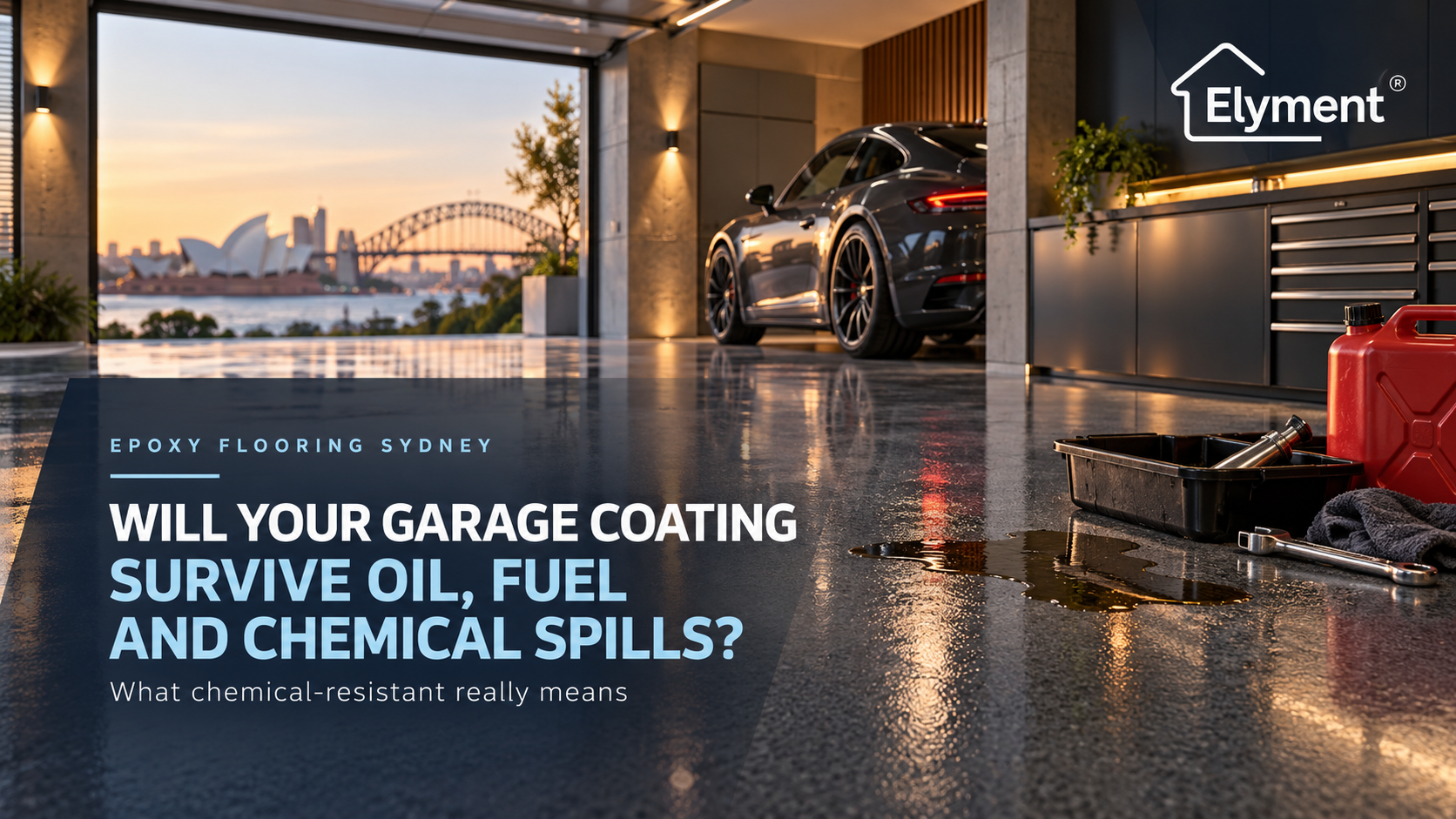
An epoxy garage floor in Sydney can tolerate some oil, fuel and cleaning-product spills, but resistance depends on the coating formulation, chemical concentration, contact time, temperature and cleaning procedure. Chemical-resistant does not mean chemical-proof. Before approving a quote, NSW homeowners and workshop operators should request product-specific resistance data, defined exposure conditions, preparation requirements, curing restrictions and a written spill-cleaning procedure.
ELYMENT Insights | Flooring & Property Operations | 22 October 2026
The Garage Floor Has Become a Chemical Exposure Decision
A Sydney homeowner commissions a new epoxy garage floor. The finished surface looks immaculate, reflects the architectural lighting and appears considerably easier to clean than the original concrete.
Several months later, a vehicle develops a fluid leak. The liquid remains beneath the car overnight. When the owner removes it, the floor has developed a visible mark.
The immediate question is whether the coating has failed. The more important question is whether that particular chemical, at that concentration and for that duration, was ever covered by the original specification.
This distinction matters across Sydney, where residential garages increasingly serve several purposes. A garage may accommodate vehicles, hobby equipment, cleaning chemicals, power tools and occasional mechanical maintenance.
The same issue applies more seriously to commercial workshops, industrial units and vehicle-service facilities, where chemical exposure may be routine rather than accidental.
A coating selected primarily for colour, texture and installation cost may be entirely suitable for ordinary parking but unsuitable for prolonged exposure to the chemicals actually used on the premises.
Why Chemical Resistance Is Not a Universal Product Claim
Epoxy is a category of coating technology, not a single formulation with identical performance across every manufacturer and product.
Two products described as epoxy flooring may differ substantially in their resin chemistry, curing system, dry film thickness and resistance to solvents, fuels, acids or cleaning agents.
Some specialised coatings are formulated for demanding industrial exposure. Others are intended mainly for decorative protection, abrasion resistance and routine cleaning.
Manufacturers commonly assess chemical resistance using specified test conditions. The result may change according to:
- Chemical identity: Petrol, diesel, engine oil, brake fluid, coolant and degreasers have different compositions.
- Concentration: A diluted cleaning solution may behave differently from its concentrate.
- Contact duration: A short spill is not equivalent to liquid pooling overnight.
- Temperature: Chemical exposure at elevated temperatures can produce different results.
- Cleaning frequency: Repeated chemical washing creates a different exposure pattern from occasional accidental spills.
- Coating condition: Cracks, worn areas, joints and damaged edges may become vulnerable points.
Australian coating manufacturer ALKA publishes product-specific resistance information rather than treating chemical resistance as one universal rating. Its chemical-resistant flooring guidance illustrates why the exact product and substance must be checked together.
A supplier's statement that a floor is resistant to chemicals therefore needs an accompanying explanation of which chemicals, under what conditions and for how long.
Oil, Petrol, Brake Fluid and Solvents Pose Different Questions
Not every garage liquid presents the same performance challenge. The relevant risk is determined by the complete coating system and the anticipated exposure.
Engine oil
- Specification concern: Repeated drips, staining and extended contact.
- What to verify: Oil resistance, allowable contact time and cleaning method.
Petrol
- Specification concern: Hydrocarbon exposure, volatility and fire risk.
- What to verify: Petrol-specific resistance and safe spill procedures.
Diesel
- Specification concern: Oily residue and potential prolonged exposure.
- What to verify: Diesel compatibility and approved degreasing procedure.
Brake fluid
- Specification concern: Compatibility varies with fluid chemistry.
- What to verify: Resistance to the actual brake-fluid specification.
Coolant
- Specification concern: Glycol-containing mixtures, dyes and additives.
- What to verify: Compatibility with the relevant coolant formulation.
Solvents and thinners
- Specification concern: Potential softening, staining or coating degradation.
- What to verify: Solvent-specific data and prohibited exposure conditions.
Degreasers
- Specification concern: Repeated cleaning, alkalinity and chemical concentration.
- What to verify: Approved products, dilutions and cleaning frequency.
These are specification questions, not universal resistance ratings. Suitability must be verified against the selected manufacturer's technical data.
For example, an epoxy product may perform acceptably during brief exposure to motor oil while having limitations involving certain strong solvents. Another system may offer broader chemical resistance but carry different requirements for application, curing and maintenance.
The buyer should not assume that a coating suitable for parking vehicles is automatically suitable for a workshop where solvents are regularly handled.
The Overlooked Variable Is How Long a Spill Remains
Exposure time can be more commercially significant than the amount of liquid initially spilled.
Consider three hypothetical operating conditions.
- Residential garage: A few drops of engine oil are noticed and promptly removed.
- Hobby workshop: A coolant leak remains beneath stored equipment overnight.
- Commercial workshop: Repeated fuel, oil and cleaning-product exposure occurs across the same working area.
These situations should not automatically receive identical coating specifications.
The first involves brief, incidental exposure. The second requires consideration of longer contact times. The third may justify a more demanding system, additional containment measures and a documented cleaning regime.
A chemical-resistance chart should be reviewed for the relevant exposure type, including whether the manufacturer's information covers intermittent splashes, prolonged contact or immersion.
If the proposed operating conditions fall outside the published data, written manufacturer advice or appropriate testing may be necessary before the product is approved.
Why the Cleaning Routine Belongs in the Flooring Specification
Chemical resistance is partly a question of product selection and partly a question of how the completed floor will be operated.
A suitable maintenance procedure should identify which cleaning agents can be used, their permitted dilution, the cleaning equipment and the expected response to different spills.
Property owners should establish:
- Who is responsible for identifying and managing spills.
- Which substances require immediate isolation or specialist response.
- Which absorbents and cleaning products are approved.
- Whether mechanical scrubbing is suitable for the finish.
- How contaminated cleaning materials and wastewater will be managed.
- When visible deterioration requires inspection or repair.
For NSW workplaces, the flooring maintenance procedure must sit alongside broader hazardous-chemical controls. A floor coating is not a substitute for safe chemical storage, ventilation, spill containment or fire-risk management.
SafeWork NSW's guidance on flammable substances identifies the fire and explosion hazards associated with common liquids including petrol and solvents.
Likewise, the NSW EPA's stormwater management guidance makes clear that oils, chemicals and contaminated wash water must not be allowed to pollute stormwater systems.
A glossy surface that is easy to hose down is not permission to wash hazardous liquids into a driveway drain.
The Quote Should Name the Coating, Not Simply Promise Epoxy
One of the most useful improvements a Sydney homeowner or facility manager can make is to request a performance-based quotation.
A quote describing only the floor area, colour and price does not establish what level of chemical resistance will be delivered.
A more complete chemical-resistant garage flooring specification should address the following items.
Product identification
- Required detail: Manufacturer, system name, primer, coating and topcoat where applicable.
Chemical schedule
- Required detail: Specific oils, fuels, solvents and cleaning agents expected on site.
Exposure limits
- Required detail: Concentration, temperature, contact time and any excluded chemicals.
Coating build
- Required detail: Number of coats and manufacturer's specified dry film thickness.
Substrate preparation
- Required detail: Contamination assessment, concrete grinding, repairs and moisture checks.
Joint detailing
- Required detail: How movement joints, cracks, drainage edges and transitions will be treated.
Slip resistance
- Required detail: Required surface performance for expected wet and oily conditions.
Curing and handover
- Required detail: Minimum periods before pedestrian use, vehicle traffic and chemical exposure.
Maintenance requirements
- Required detail: Approved cleaning agents, spill procedures and inspection requirements.
Warranty exclusions
- Required detail: Limits relating to chemicals, standing liquids, misuse and maintenance.
The dry film thickness and application system should follow the product manufacturer's requirements rather than an arbitrary figure applied across every job.
Similarly, chemical resistance should be confirmed using the complete proposed system, particularly where primer, body coat and topcoat products are combined.
A written schedule of substances and exposure conditions can reduce disputes by establishing what the contractor is being asked to supply.
When Surface Preparation Changes the Financial Decision
A stronger chemical-resistant coating cannot compensate for every defect in the concrete beneath it.
Existing contamination, unsuitable coatings, weak surface material, moisture problems and unresolved concrete damage can undermine the performance of an otherwise appropriate system.
The necessary preparation may involve selective coating removal, concrete grinding, cleaning, repair and specialist assessment before application.
Elyment's earlier examination of oil contamination and concrete grinding before epoxy flooring addresses the separate issue of achieving a reliable bond to the existing slab.
The current specification question begins after that assessment: which coating will withstand the actual service environment once it has been correctly installed?
This separation is important for project delivery. The preparation contractor must understand the coating manufacturer's substrate requirements, while the coating installer must confirm that the completed system matches the owner's anticipated exposure conditions.
Epoxy Flooring Cost Sydney: Why the Lowest Square-Metre Price Can Mislead
Sydney epoxy flooring quotations can vary considerably because different projects are purchasing different levels of preparation, coating build and performance.
The cost of a decorative garage floor is not directly comparable with a chemically demanding workshop system without understanding the inclusions.
Important cost drivers may include:
- Condition and contamination of the existing slab.
- Removal of previous paint or coating systems.
- Grinding, profiling, crack repairs and moisture treatment.
- Specialist chemical-resistant resin selection.
- Coating thickness, number of layers and surface texture.
- Manufacturer consultation or additional performance testing.
- Ventilation, site isolation and work-area access.
- Curing time before the garage or workshop can resume operations.
For a small residential garage, an upgraded industrial system may offer little economic value if chemical exposure is rare and controlled through routine maintenance.
Conversely, for a workshop where chemical contact is foreseeable, selecting the cheapest visually acceptable coating may create an avoidable replacement and downtime risk.
The meaningful comparison is the complete installed and maintained system, not merely its initial cost per square metre.
What Sydney Workshops Must Consider Beyond the Coating
Commercial workshops require a broader operating assessment than private garages.
Chemical-resistant flooring may be only one element of a safe working environment. Depending on the chemicals and activities, facilities may also require appropriate storage, spill kits, drainage controls, bunding, ventilation and emergency procedures.
SafeWork NSW's Managing Risks of Hazardous Chemicals in the Workplace Code of Practice provides a framework for identifying chemical hazards and assessing appropriate controls.
A coating's resistance to accidental chemical contact does not establish that the finished floor is suitable as a chemical containment system or that it meets every workplace safety requirement.
In facilities with frequent spills, project teams should also consider whether the chosen texture provides suitable slip performance when exposed to oils, water or cleaning solutions.
Chemical resistance, slip resistance and cleanability must be considered together. Improving one characteristic should not inadvertently compromise another.
The Handover Test Is More Than Whether Cars Can Return
A recently applied coating may be ready for limited access before it has achieved the full cure required for its intended chemical service.
These dates are not necessarily interchangeable.
A complete handover should distinguish between permission for pedestrian traffic, vehicle parking, cleaning and chemical exposure.
The exact timing must follow the selected manufacturer's recommendations and actual site conditions, including temperature and humidity.
Garages shared by multiple occupants can introduce additional access and scheduling complications. Elyment has separately examined the operational requirements for epoxy coating within shared Sydney strata garages.
For an active workshop, the handover plan should identify precisely when vehicles, equipment, chemical storage and cleaning operations may resume.
Five Questions to Resolve Before Signing
- What chemicals will reach this floor? List actual products rather than broad terms such as automotive fluids.
- How long could they remain? Describe realistic spill detection and clean-up intervals.
- What evidence supports the proposed system? Request the relevant manufacturer resistance information and written clarification where required.
- What is included in the installation? Confirm substrate preparation, repairs, coating build and cure requirements.
- How will the floor be maintained? Establish cleaning methods, prohibited chemicals, inspection arrangements and warranty conditions.
These questions make it possible to compare competing proposals on performance rather than appearance alone.
ELYMENT | PROPERTY & RENOVATION OPERATIONS
Review Your Garage or Workshop Flooring Scope
Plan substrate preparation, coating specifications, chemical exposure requirements and project delivery before committing to installation.
Request a Flooring Project Review →
The Bottom Line: Specify the Exposure Before the Finish
Epoxy flooring can be a practical investment for Sydney garages and workshops, but the phrase chemical-resistant has limited value without a defined operating environment.
Engine oil, petrol, coolant, brake fluid and cleaning solvents cannot be treated as interchangeable substances. Nor can a spill removed promptly be treated as equivalent to liquid left standing for hours.
The most defensible flooring decision is one supported by product-specific data, realistic exposure assumptions, adequate surface preparation and clear maintenance responsibilities.
A properly specified system gives owners, contractors and facility managers a common understanding of what the finished floor is expected to withstand, and what falls outside that expectation.
Sources and References
Industry and manufacturer guidance
- ALKA Coatings: Chemical-Resistant Flooring
- SafeWork NSW: Flammable Substances
- NSW EPA: The Drain Is Just for Rain
- SafeWork NSW: Managing Risks of Hazardous Chemicals in the Workplace — Code of Practice
Related Elyment articles
- Concrete Grinding Sydney: Oil Stains and Paint Marks That Can Break an Epoxy Floor Bond
- Epoxy Flooring Sydney in a Shared Strata Garage: Can One Parking Bay Be Coated Without Closing the Whole Basement?
Project enquiries
ELYMENT | PROPERTY & RENOVATION OPERATIONS
Review Your Garage or Workshop Flooring Scope
Plan substrate preparation, coating specifications, chemical exposure requirements and project delivery before committing to installation.
Get a Flooring ReviewRelevant next actions
Explore the ELYMENT service most closely connected to this article.