Floor Sanding Sydney: Can Dark Timber Stain Be Removed?
Can floor sanding restore dark-stained timber to a natural finish? Sydney owners should assess stain depth, timber condition and sanding limits before starting.
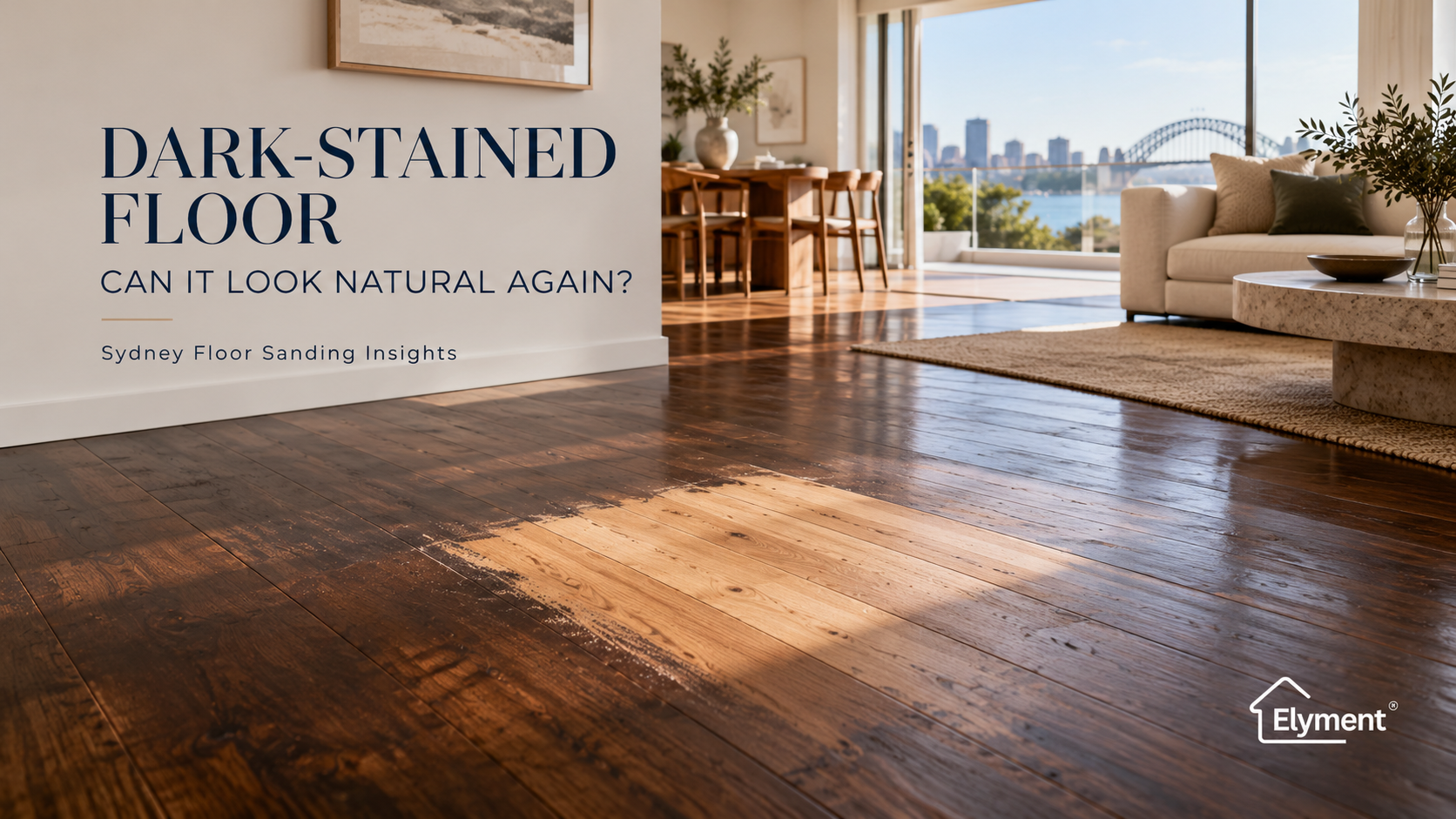
A dark-stained timber floor can sometimes return to a lighter, more natural appearance through professional sanding, but the result depends on stain penetration, timber species, previous sanding and remaining usable thickness. In Sydney and NSW, a controlled trial sanding area should establish the achievable colour before full restoration is approved. Deeply absorbed stain, thin engineered veneers and uneven boards may make selective replacement or complete flooring replacement more practical.
The Renovation Decision Hiding Beneath a Dark Timber Floor
Dark timber flooring once offered a straightforward interior design proposition: richness, contrast and a dramatic backdrop to pale walls and contemporary furniture.
In many Sydney properties, that preference is changing. Owners renovating established houses and apartments increasingly want the natural character of timber visible again, rather than a heavily stained surface concealing its grain and original colour.
The difficulty is that a dark floor is not necessarily a light floor waiting to be uncovered.
A black, walnut or espresso-coloured appearance might come primarily from a pigmented surface coating. It could also result from colourants absorbed into the timber, a factory treatment, previous refinishing or the natural pigmentation of the species itself.
These conditions can look similar before work begins, yet produce substantially different results under a sanding machine.
For owners planning timber floor restoration in Sydney, the first financial decision should therefore concern investigation rather than wholesale sanding.
Removing the Finish Is Not Always Removing the Stain
Sanding removes material from the surface of timber. It does not chemically reverse every colouring process previously applied to the wood.
Where most of the dark appearance comes from a surface coating, a carefully controlled sanding sequence may reveal substantially lighter timber.
Where pigment has entered the grain, vessels or porous sections of the timber, dark colour can remain after the original finish has disappeared.
Absorption may vary between individual boards, between heartwood and sapwood, and across different grain patterns. Previous repairs and changes in sanding technique may also produce uneven colour.
Three conditions are especially important:
- Surface-heavy colour: Much of the darkness sits in the original coating or close to the timber surface. A lighter result may be achievable without excessive material removal.
- Penetrating stain: Colour remains inside portions of the grain after initial sanding. Further sanding may improve the result, but complete removal cannot be assumed.
- Natural or chemically altered colour: The timber species, ageing, reactive treatment or other colour-changing process contributes to the appearance. Sanding may not produce the pale colour the owner expects.
This distinction matters particularly where owners are seeking the appearance of pale oak but have an existing Australian hardwood floor with a naturally warmer or darker character.
Sanding can expose natural timber. It cannot change the underlying species.
The Trial Sanding Area Should Decide the Project
A small trial area is one of the most useful expenditure controls available before committing to a full-floor restoration.
It allows the contractor and property owner to observe how the existing finish responds, how much colour remains and whether the proposed natural appearance is technically achievable.
Bona's Australian DriFast Stain technical guidance recommends evaluating a trial area where the floor's condition or final appearance is uncertain. It also identifies sanding preparation, timber properties and application technique as factors influencing final colour.
Although those instructions principally address applying new stain, they reinforce an important restoration principle: a colour specification should be tested on the actual timber rather than approved from a showroom photograph.
How a Professional Trial Should Be Structured
1. Identify the floor: Establish whether it is solid timber, engineered flooring, parquetry or another timber-based product. Check previous sanding and repair history.
2. Select a representative area: Choose a discreet location that reflects the main floor condition. Where colour varies, more than one trial location may be necessary.
3. Inspect the available timber: Confirm that the sanding trial can be completed without breaching the wear layer or damaging the board profile.
4. Remove the existing finish gradually: Use an appropriate professional abrasive sequence and assess the exposed grain without pursuing excessive depth merely to remove colour.
5. Inspect residual pigment: Record dark grain lines, colour patches, old repairs and differences between adjacent boards.
6. Apply proposed finish samples: Compare compatible clear, natural-look or appropriately toned finishes using the complete recommended coating system.
7. Approve or reject the appearance: Review the dry, completed sample in the property's normal lighting before agreeing to full production.
A trial should not become an excuse to continue sanding until a desired shade appears.
Its purpose is to establish the attainable result within a safe material-removal allowance. If the acceptable colour requires excessive timber removal, the trial has demonstrated a limitation rather than an invitation to keep cutting.
How Much Timber Can Be Removed Before Restoration Becomes Damage?
Remaining timber thickness determines how far a contractor can reasonably pursue an embedded stain.
Solid strip flooring may offer more scope for refinishing than a thin-veneer engineered board, but even solid timber has practical limits. The position of the tongue, nails, joints, previous sanding and existing unevenness all influence the remaining allowance.
Engineered timber adds another constraint: its visible hardwood layer may be only a small proportion of the board's total thickness.
A 14 mm engineered board, for example, does not contain 14 mm of sandable timber. The core, adhesive layers and wear surface must be considered separately.
Elyment has previously examined this issue in its guide to engineered timber wear-layer thickness and future sanding.
For dark-stain removal, the concern is more immediate. If the colour remains below the safely removable surface layer, the project may have reached its practical restoration limit even if the timber is otherwise sound.
That point should be documented before any additional sanding is authorised.
A Natural Finish Does Not Mean a Colourless Finish
The expression "natural timber finish" can create an expectation that clear coating will leave freshly sanded timber looking exactly as it does in its raw state.
In practice, clear sealers, oils, hard-wax oils and polyurethane systems can produce different degrees of warmth, grain contrast and sheen.
Some coatings enhance the timber's amber or golden undertones. Other compatible systems are designed to maintain a lighter, less-wetted appearance. The final result remains dependent on the timber species and the specified product combination.
Bona's wood-floor sanding guidance describes the progressive abrasive stages used to remove an existing finish and prepare the surface. Its Australian staining instructions also explain why sanding technique affects subsequent colour penetration.
This is particularly relevant for Australian hardwoods with different densities, tannin contents and natural colour variations.
A successful trial should answer several questions:
- Does the exposed timber retain dark pigment along the grain?
- Does the new coating make the timber visibly warmer or darker?
- Are repaired boards and old parquet blocks noticeably different in colour?
- Is the appearance acceptable in direct daylight and under evening interior lighting?
- Can the sample be reproduced consistently throughout the floor?
These are approval questions, not merely design preferences. They define the standard against which the completed work can reasonably be assessed.
The Restoration Versus Replacement Calculation
Retaining a sound timber floor can avoid the disruption of removing boards, disposing of material and reconstructing the floor system.
Nevertheless, restoration is not automatically the cheaper option, particularly where the owner requires an almost perfectly uniform pale finish from timber that has absorbed dark stain unevenly.
The following conditions can help determine whether restoration or replacement is more appropriate.
- Solid timber, sound boards, mostly surface-level colour
- Restoration assessment: Trial sanding may establish a viable lighter finish.
- Replacement assessment: May introduce avoidable demolition and reconstruction.
- Deep residual pigment with substantial tonal variation
- Restoration assessment: May require acceptance of a visibly varied finish.
- Replacement assessment: May offer more predictable colour and product selection.
- Thin engineered timber veneer
- Restoration assessment: Full sanding may be technically unsuitable or uneconomical.
- Replacement assessment: Can be preferable where the desired colour is essential.
- Stable flooring with a small number of damaged boards
- Restoration assessment: Local repairs followed by refinishing may be practical.
- Replacement assessment: Full replacement may be disproportionate to the defect.
- Loose boards, failed adhesives, moisture damage or delamination
- Restoration assessment: Sanding does not correct underlying structural or installation defects.
- Replacement assessment: Partial or complete replacement may be required after investigation.
The comparison should consider the complete installed result rather than the price of sanding or new boards in isolation.
Removing an existing timber system can create additional costs for skirting, disposal, adhesive removal, subfloor preparation, floor-height correction and installation.
In properties where boards are fixed over battens, Elyment's analysis of timber-floor removal and finished-height consequences illustrates why replacement planning must extend beyond purchasing new flooring.
Floor Sanding Cost Sydney: The Items That Change the Quote
A basic per-square-metre sanding figure rarely describes the complete cost of converting a dark-stained floor to a natural appearance.
Two floors with identical dimensions can require very different labour, preparation and finishing programmes.
A useful Sydney quotation should distinguish the following cost components:
- Initial assessment and trial: Inspection, floor identification, colour testing and finish-sample approval.
- Preparation: Furniture relocation, protection, loose-board repairs, protruding-fixing treatment and access arrangements.
- Sanding: Existing coating removal, progressive sanding, edges, corners and difficult perimeter details.
- Surface correction: Compatible filling, local repairs and treatment of defects within the agreed restoration scope.
- Finishing: Specified sealer, finish coats, consumables, application labour and required intervals.
- Project logistics: Dust containment, equipment access, cleaning, waste management and return-to-service arrangements.
- Contingency or exclusions: Additional stain-removal work, damaged-board replacement, unexpected conditions and changes requested after the sample is approved.
The critical commercial distinction is between a contractor agreeing to sand and refinish an existing floor and a contractor guaranteeing that every trace of dark stain will disappear.
Those are not equivalent obligations.
A better quotation identifies the intended outcome, the trial approval point and the conditions that would require a revised scope. Any subsequent cost variation should be agreed and documented before additional work.
Why Sydney Apartments Add Another Layer of Coordination
A timber-floor restoration inside a Sydney apartment has practical requirements that extend beyond the appearance of the boards.
Machine sanding creates noise and wood dust. Coating products can introduce odour, ventilation requirements and restrictions on when residents can use the space.
According to SafeWork NSW guidance on wood-dust exposure, sanding is a source of airborne timber particles, and suitable extraction, housekeeping and other exposure controls are important.
Projects should also check whether older coatings or unidentified layers require specialist assessment before disturbance.
Strata properties introduce separate questions around working hours, building access, common-area protection and approvals.
The NSW Government's strata renovation guidance distinguishes cosmetic works from flooring replacement and other renovations that may require owners corporation approval.
Refinishing existing boards does not necessarily trigger the same approval requirements as removing flooring and changing the acoustic underlay. Owners should check their building's by-laws and the actual proposed scope.
A trial that demonstrates restoration is unsuitable may therefore change more than the flooring quotation.
Replacement could require a revised strata submission, acoustic information, material deliveries, disposal arrangements and a longer period without access to the room.
These decisions are easier to manage when made before the renovation programme is fixed.
The Stop Point That Protects the Renovation Budget
Consider an illustrative Inner West terrace with older solid timber boards carrying a dark brown stain.
A controlled trial removes much of the old colour but leaves darker grain patterns. The owner may accept those variations as part of the original timber's character, allowing restoration to proceed without wholesale removal.
Now consider a different project where the preferred result is a consistent, pale contemporary finish, but the existing floor has uneven residual pigment and insufficient safe sanding depth.
Additional sanding may increase cost without delivering the required appearance. In that situation, replacement options should be assessed before more material is removed.
These are illustrative scenarios, not findings from particular completed projects. They demonstrate why a defined stop point matters.
The strongest approach is to agree on an acceptable visual standard, test it, compare the cost of achieving it and authorise full production only after the result is understood.
Where replacement becomes necessary, the subsequent demolition and preparation stages should be separately specified. Elyment's explanation of floor stripping and what preparation to a bare slab actually includes provides further context for managing that transition.
Review the Floor Before Committing to the Finish.
ELYMENT PROPERTY SERVICES
Plan timber-floor restoration or replacement with a clearer understanding of existing conditions, preparation requirements, project costs, site logistics and installation readiness.
Discuss Your Renovation Project →
The Bottom Line
Dark-stained timber flooring can sometimes be restored to a significantly lighter, more natural appearance, particularly when the original colour is concentrated near the surface and sufficient usable timber remains.
However, stain penetration, timber species, previous sanding and coating selection can limit the achievable result. A natural finish should never be promised before the actual floor has been assessed.
For Sydney homeowners, builders and strata property managers, the most valuable first step is a controlled trial that establishes the colour, confirms the safe sanding allowance and defines the acceptable finish.
That evidence allows restoration and replacement to be compared on realistic costs, programme requirements and final appearance rather than assumptions.
Sources and References
Manufacturer Technical Information
Workplace Safety and NSW Government Guidance
Related Elyment Articles
- Engineered Timber Flooring Sydney: Can It Be Sanded Later or Is the Wear Layer Too Thin?
- Timber Floor Removal Sydney: Over Battens, Do the Battens Come Out Too and What Happens to the Floor Height?
- Floor Stripping Sydney: What Back to Bare Slab Includes
Review the Floor Before Committing to the Finish.
Plan timber-floor restoration or replacement with a clearer understanding of existing conditions, preparation requirements, project costs, site logistics and installation readiness.
Discuss Your Timber FloorsRelevant next actions
Explore the ELYMENT service most closely connected to this article.