Meta Enterprise Platform vs Microsoft Copilot for Work
Meta Enterprise Platform and Muse AI agents raise questions about workplace AI, integration, security and whether they can compete with Microsoft Copilot today.
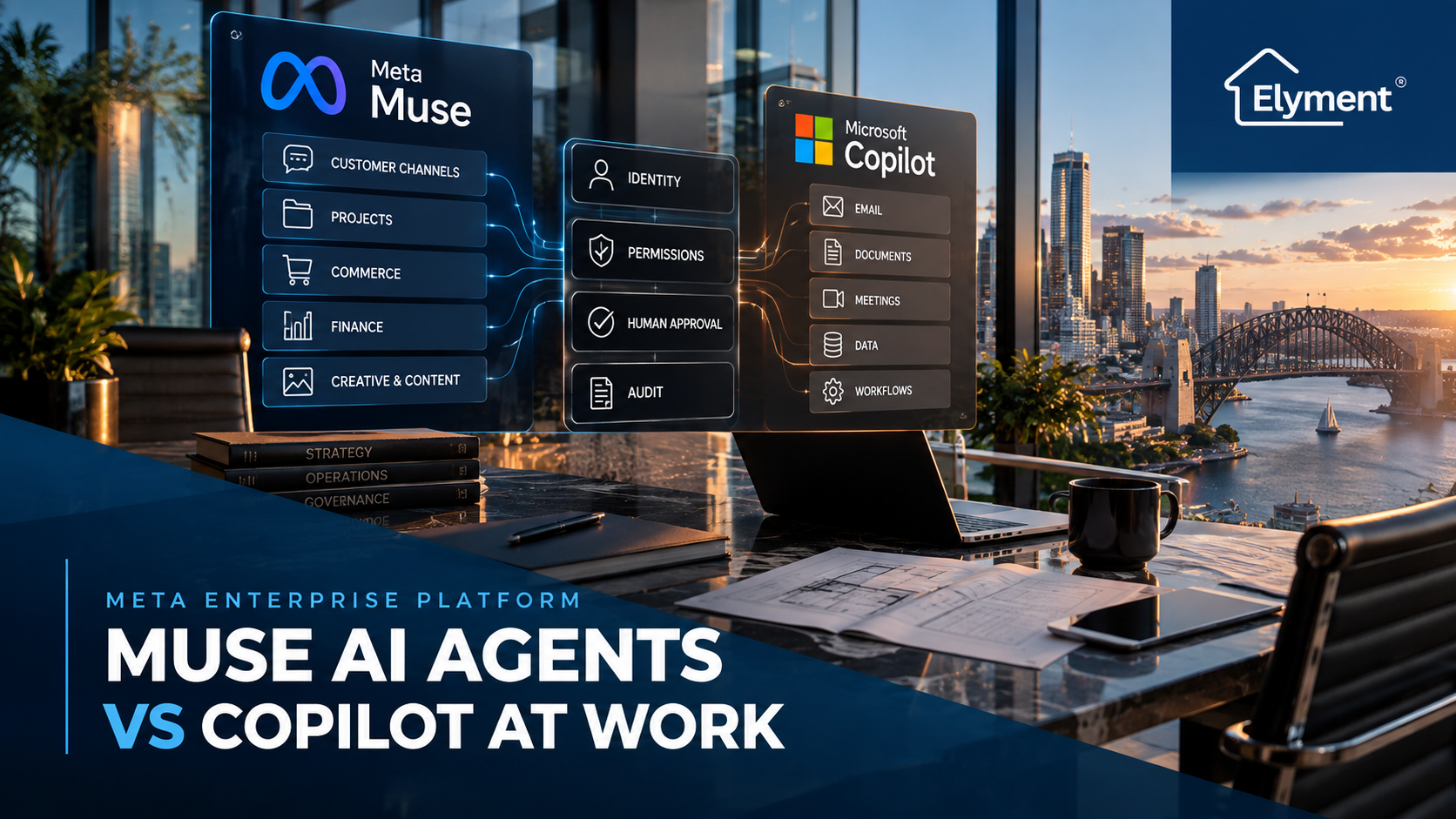
Meta now has a credible route into workplace AI, but challenging Microsoft Copilot will depend on much more than Muse's intelligence. For Sydney and NSW organisations, the decisive issues are likely to be business-data access, identity, permissions, integrations, auditability and human approval controls. Microsoft enters with deep Microsoft 365 context; Meta is approaching enterprise work through agents, business platforms and cross-application connectors.
The enterprise AI contest is changing shape.
For several years, the obvious comparison between workplace artificial-intelligence products was model quality: which assistant wrote the better email, summarised the meeting more accurately or produced the stronger spreadsheet analysis.
That comparison is becoming less useful.
As AI systems become agents capable of reading business information, moving between software platforms and completing multi-step work, the strategic question becomes architectural. Which platform can be trusted with the organisation's context, identities, permissions, systems and operational decisions?
Meta has now entered that contest directly.
On 28 September 2026, Meta announced the Meta Enterprise Platform, saying the new business would initially bring together Muse, Meta Business Agent, Muse API, Muse Code and other parts of its AI stack for businesses and developers.
That announcement places Meta closer to Microsoft, Google, Salesforce and other vendors trying to become the operating layer through which businesses deploy AI. But Meta and Microsoft are arriving from very different starting positions.
The Contest Is No Longer Muse Versus A Chatbot
Muse was introduced initially as a personal AI agent rather than a traditional enterprise productivity suite. Meta designed it to work across applications on a person's behalf, using a dedicated virtual environment and agentic capabilities rather than simply waiting for isolated prompts.
Meta then extended that model towards business use.
Its Muse for Small Business announcement lists connectors including Asana, Box, Canva, Dropbox, Figma, QuickBooks, Klaviyo, Notion, Shopify, Slack, Stripe and Zoom, alongside Facebook and Instagram business accounts. Meta also says nothing publishes, sends or spends through these business workflows without user approval.
That matters because it reveals the broader strategy.
Meta does not necessarily need to recreate Word, Excel, Outlook, Teams or SharePoint to become relevant at work. Its opportunity is to build an intelligent agent layer capable of moving across the collection of systems a business already uses.
Microsoft is taking almost the opposite route.
Its current Copilot strategy starts inside the Microsoft environment and expands outward. Microsoft's Work IQ connects agents with organisational knowledge, people, content and business context. The company is also embedding AI more deeply across Word, Excel, PowerPoint, Outlook, Teams and other Microsoft services.
The result is not simply a competition between assistants. It is a competition between two theories of how workplace AI should be assembled.
Where does the agent begin?
Meta direction: Cross-application agent and business ecosystem.
Microsoft direction: Microsoft 365 work environment.
Operational implication: The organisation's existing software stack becomes strategically important.
How does it acquire context?
Meta direction: Connectors, Meta business systems and agent access.
Microsoft direction: Work IQ, Microsoft 365 data and connected enterprise systems.
Operational implication: Context quality depends on permissions and system integration, not only the model.
How does it complete work?
Meta direction: Muse agents, APIs, business tools and connected services.
Microsoft direction: Chat, Cowork, Code, agents and Autopilot.
Operational implication: Businesses must define which actions can occur automatically.
Where does governance sit?
Meta direction: Enterprise controls are an important part of Meta's emerging platform story.
Microsoft direction: Microsoft builds on existing tenant, identity, security and administrative architecture.
Operational implication: IT governance may matter more than conversational performance.
What creates switching cost?
Meta direction: Connected workflows, agent memory and integrations.
Microsoft direction: Microsoft 365 data, applications, identities, agents and workflows.
Operational implication: A successful pilot can quickly become infrastructure.
Microsoft's Advantage Is Context Already Sitting Inside The Business
Microsoft does not have to persuade many organisations to move their documents, spreadsheets, calendars, email and collaboration history into a completely new ecosystem before Copilot becomes useful.
Much of that operational context may already exist inside Microsoft 365.
In September, Microsoft described an expanded Copilot architecture built around Home, Cowork, Code and Autopilot. Its Copilot product announcement says Autopilot can operate persistently, carry its own identity, memory, computer and workspace, and work across applications such as Teams, Outlook and documents subject to organisational permissions and governance.
That changes the practical enterprise discussion.
Consider a Sydney property group already using Outlook for client communication, Teams for internal coordination, Excel for budgets, SharePoint for project files and Power Platform for workflow automation.
An agent working within that environment does not merely need access to five applications. It needs to understand which project folder belongs to which job, which employee can approve a payment, which version of a document is current, which conversation relates to a supplier and which information a particular user is permitted to see.
This is why workplace context is becoming valuable infrastructure.
Elyment previously examined this issue in its analysis of AI moving from chatbots into workplace memory. The enterprise-platform question now extends that issue from retrieval into action.
Meta's Opportunity Is The Business Stack Outside Microsoft 365
Microsoft's installed enterprise footprint is substantial, but real organisations rarely operate inside one software ecosystem.
A Sydney renovation business might manage enquiries through Instagram and WhatsApp, accounting through QuickBooks or Xero, creative assets through Canva, projects through Asana, payments through Stripe, meetings through Zoom and documents through Microsoft or Google.
A retailer may add Shopify. A design practice may add Figma. A professional-services business may have separate CRM, document-management and matter-management systems.
Meta's growing connector strategy becomes interesting in precisely this fragmented environment.
Instead of assuming one productivity suite is the centre of work, Muse can potentially operate as an orchestration layer across specialised applications.
Elyment has already examined customer-facing automation in Meta Business Agent across Instagram and WhatsApp. Meta Enterprise Platform expands the strategic question beyond customer enquiries: can Meta connect front-office conversations to the systems where operational work is actually completed?
A Sydney Project Example Shows Why This Matters
Consider a multi-site property-services operator handling renovation projects across Sydney.
A new enquiry arrives through a digital channel for floor removal, concrete grinding and levelling before a commercial fitout.
A useful enterprise agent would need to do substantially more than summarise the client's message.
- Identify the client, site and requested scope.
- Retrieve previous correspondence and relevant project history.
- Check whether photos, plans or access information are missing.
- Create or update the job record.
- Prepare a preliminary scope for internal review.
- Check scheduling constraints against existing work.
- Request approval before client-facing commitments are made.
- Record the approved outcome in the appropriate system.
- Follow up on missing information without duplicating previous communication.
The language model may be involved at every stage, but model intelligence is only one component.
The harder problems are knowing which system is authoritative, which employee owns the job, which actions require approval, which data can cross between platforms and what should happen when the agent encounters contradictory information.
This is where enterprise AI becomes an operational-design problem rather than an AI-writing problem.
The Permission Model May Decide More Than The Model Benchmark
Agentic AI changes risk because agents do things.
An assistant that incorrectly drafts a paragraph creates one class of problem. An agent that can send a message, modify a record, schedule work, access financial information or trigger a purchase creates another.
For NSW organisations evaluating either ecosystem, a useful governance model separates permissions by action.
- Read: what information can the agent inspect?
- Reason: what information can it combine or infer?
- Draft: what can it prepare without approval?
- Write: which business records can it change?
- Communicate: when can it contact customers, suppliers or staff?
- Spend: can it create or approve financial transactions?
- Delete: what can it remove or permanently alter?
- Delegate: can one agent instruct another agent or automated system?
This is more useful than a broad instruction such as "give the AI access to the project".
Australian organisations also need to treat personal information as a governance issue rather than a configuration afterthought.
The Office of the Australian Information Commissioner's guidance on commercially available AI products recommends due diligence, human oversight and assessment of privacy and security risks when organisations deploy AI systems handling personal information.
The Australian Cyber Security Centre also publishes guidance on secure adoption of artificial intelligence and agentic systems, reinforcing the need to consider AI as part of the organisation's broader cyber-security environment.
The Approval Gate Is Becoming A Product Feature
One of the more significant details in Meta's small-business rollout is not a headline model capability. It is the statement that publishing, sending and spending require approval.
That is an operating-control decision.
Enterprise buyers should increasingly ask vendors exactly where equivalent approval gates exist.
Before an agent goes live, a business should be able to answer:
- What can it do without asking?
- What requires human confirmation?
- Who is authorised to provide that confirmation?
- How is the decision logged?
- Can permissions differ by employee, project or business unit?
- What happens when the agent fails midway through a task?
- How is access removed when a staff member, contractor or agent role changes?
These are operational questions, but they will determine whether persistent agents can safely move from experimentation into day-to-day business infrastructure.
Meta Also Has To Rebuild Enterprise Confidence
Meta is not entirely new to workplace software.
Workplace from Meta was launched as an enterprise collaboration platform, but Meta later announced that the product would be discontinued, with the final shutdown scheduled for May 2026.
That history does not determine the future of Meta Enterprise Platform, but it is relevant to procurement.
Enterprise software buyers make multi-year decisions involving integrations, staff training, data migration, contracts, security reviews and workflow redesign. Product-roadmap durability therefore matters alongside feature capability.
For CIOs, operations leaders and procurement teams, reasonable questions include:
- What service commitments will Meta provide?
- How portable are workflows and agent configurations?
- What happens to organisational data if a service is replaced?
- Can connectors be migrated without rebuilding the operational process?
- What administrative and audit controls will be available at enterprise scale?
Microsoft faces a different challenge. Its strength is the depth of the existing ecosystem, but that same depth can make implementation complex. Organisations may have years of accumulated SharePoint permissions, duplicate files, abandoned Teams spaces, inconsistent naming conventions and excessive access rights.
Giving an intelligent agent access to a disorganised information environment does not automatically make the environment organised.
The Real Cost Will Extend Beyond The AI Licence
Enterprise buyers should resist comparing Meta and Microsoft through subscription price alone.
The operating cost of agentic AI can include:
- connector and API usage;
- identity and access management;
- security reviews;
- data clean-up before deployment;
- workflow redesign;
- staff training;
- agent monitoring;
- exception handling;
- integration development;
- audit and compliance processes;
- model or compute consumption; and
- the cost of correcting automated mistakes.
Microsoft already publishes established Copilot enterprise licensing and agent options. Meta's September Enterprise Platform announcement, by comparison, outlines the strategic product stack without yet presenting the same level of mature enterprise packaging in that announcement.
This makes pilot design particularly important.
Elyment's earlier analysis of Muse Glimmer and local AI economics reached a related conclusion: compute price is only one component of the true operational cost. Security, hardware, support, integration and governance still have to be counted.
Do Not Start With A Company-Wide Rollout
For Sydney businesses assessing the emerging Meta platform or an expanded Microsoft Copilot deployment, a controlled workflow is a more informative test than a broad licence rollout.
A practical sequence is:
- Choose one measurable workflow. Use a process with enough repetition to measure improvement, but not one where an early failure creates unacceptable legal, financial or safety consequences.
- Map the systems involved. Identify email, files, CRM, project management, accounting, messaging and any external platforms the workflow touches.
- Identify the system of record. Decide which source wins when two platforms contain conflicting information.
- Map permissions. Define read, write, communicate, approve, spend and delete rights separately.
- Place human approval gates. Customer commitments, payments, contractual changes and material project decisions should have deliberately designed controls.
- Test exceptions. Do not test only the ideal workflow. Test missing data, conflicting instructions, failed integrations and unavailable systems.
- Measure operational outcomes. Track cycle time, rework, manual touches, errors and completion quality rather than simply counting prompts.
- Scale only after ownership is clear. Every production agent should have a human business owner as well as technical ownership.
This is consistent with the wider shift Elyment examined after Microsoft Build 2026 moved workplace AI beyond conventional chatbots. Once AI can carry out work rather than merely suggest it, workflow design and governance become part of deployment.
What Sydney And NSW Organisations Should Compare
A procurement comparison between Muse and Copilot should therefore look beyond demonstrations.
Business context
Questions to test: Can the agent reliably locate the correct project, customer, document and workflow?
Identity
Questions to test: Does the agent have its own identity, and can its permissions be independently revoked?
Connectors
Questions to test: Are the systems the business actually uses supported without fragile custom work?
Approvals
Questions to test: Can high-impact actions require named human authorisation?
Auditability
Questions to test: Can the organisation reconstruct what the agent accessed, changed and communicated?
Privacy
Questions to test: How is personal, client, employee and commercially sensitive information handled?
Security
Questions to test: Can access be restricted by role, system, data type and action?
Failure recovery
Questions to test: What happens when an agent stops halfway through a process?
Cost
Questions to test: What is the total cost per successfully completed workflow, not simply the licence cost?
Portability
Questions to test: How difficult would it be to move the workflow to another provider?
Can Meta Actually Challenge Microsoft Copilot At Work?
Meta now has several of the ingredients required to become a serious participant in enterprise AI: large-scale infrastructure, advanced models, Muse, developer interfaces, business agents and a growing connector ecosystem.
Its potential point of differentiation is particularly relevant to organisations whose work is distributed across social channels, commerce platforms, creative software, accounting tools and specialist SaaS applications rather than concentrated inside one productivity suite.
Microsoft starts from a different position. It already sits inside the daily productivity environment of many enterprises and is turning that installed context into an agent platform through Work IQ, Copilot, managed runtime and persistent agents.
The competitive question will therefore not be settled by whichever company produces the most impressive AI demonstration.
It will be settled inside real organisations, where agents have to find the right information, respect permissions, survive exceptions, obtain approvals, leave an audit trail and complete useful work repeatedly.
For Sydney and NSW businesses, that is the more important shift. Enterprise AI is moving from a software feature towards an operational layer. Once that happens, choosing an AI platform begins to resemble choosing infrastructure.
Review The Workflow Before The Agent Becomes Infrastructure
Map integrations, permissions, approval gates, data handling and operational ownership before workplace AI moves from experimentation into live business processes.
The Next Enterprise AI Battle Will Be About Control
Meta's new enterprise move makes the workplace AI market more interesting because it challenges the assumption that the dominant office suite must automatically become the dominant agent platform.
Muse suggests another possibility: the primary AI layer could sit across software rather than inside one software family.
Whether that architecture proves practical at enterprise scale will depend on what Meta builds next around administration, security, compliance, integration, portability and commercial support.
Microsoft, meanwhile, must demonstrate that deeper context can be converted into reliable automation without magnifying organisations' existing permission, information-management and governance problems.
For operators, the useful question is therefore not simply which AI is smarter.
It is which architecture can complete the organisation's work while keeping the organisation in control.
Sources and Further Reading
- Meta: Launching Meta Enterprise Platform
- Meta: Muse for Small Business
- Microsoft: Work IQ
- Microsoft: Introducing the new Copilot with Home, Code and Autopilot
- OAIC: Guidance on privacy and commercially available AI products
- Australian Cyber Security Centre: Artificial intelligence guidance
- Elyment: AI moving from chatbots into workplace memory
- Elyment: Meta Business Agent across Instagram and WhatsApp
- Elyment: Muse Glimmer and local AI economics
- Elyment: Microsoft Build 2026 and workplace AI agents
Review the Workflow Before the Agent Becomes Infrastructure
Map integrations, permissions, approval gates, data handling and operational ownership before workplace AI moves from experimentation into live business processes.
Request a Workflow Review