Meta's Max Humanoid Robot: Could AI Bring Household Help Closer?
Meta’s Max humanoid robot signals a push towards household AI, but safety, reliability, cost and consumer availability remain practical concerns for homeowners.
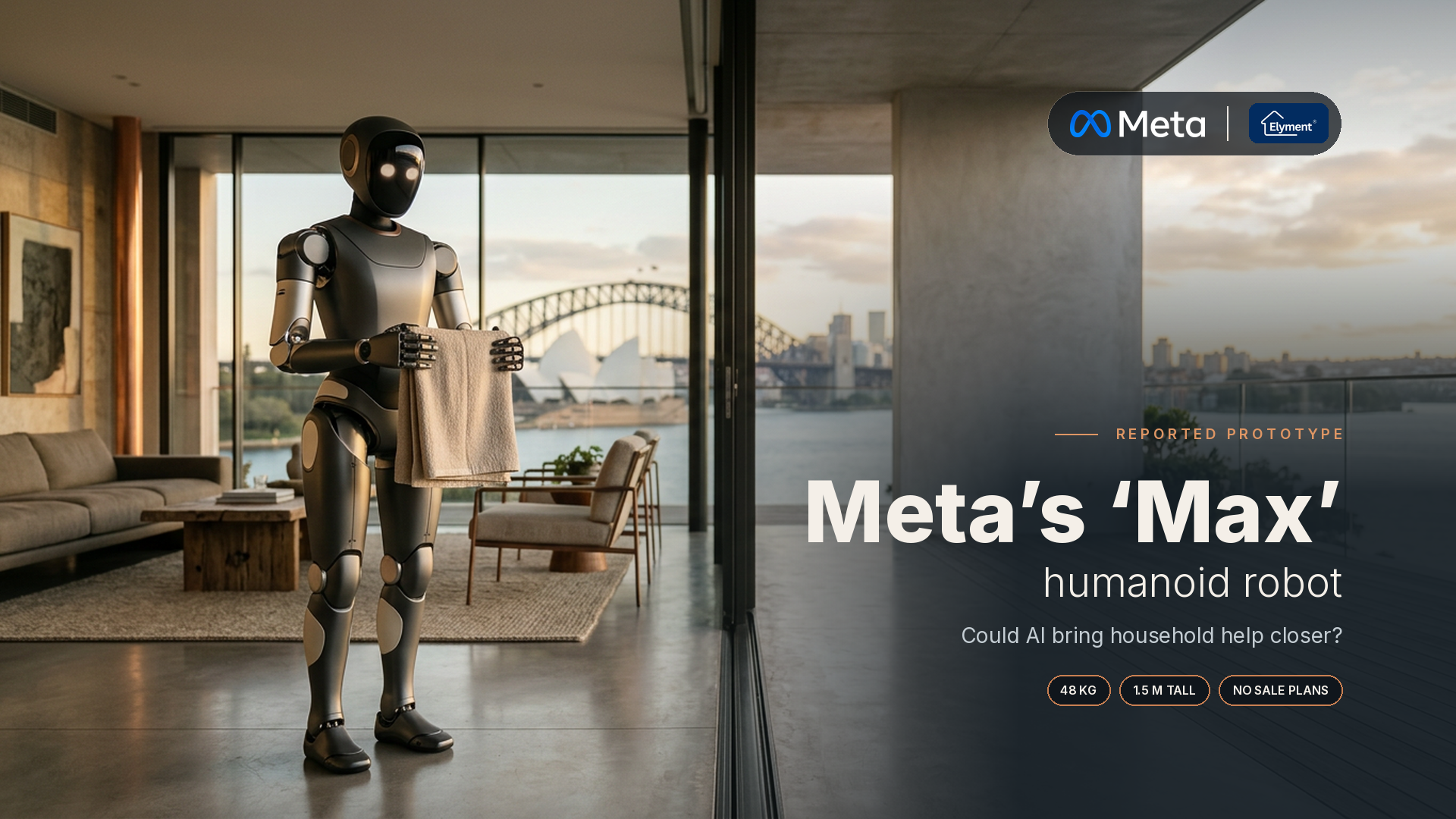
Not yet, and possibly not for years.
Max is a reported research prototype that Meta built with Shanghai robotics firm Fourier, not a product Sydney households can buy. Meta says the work is internal and it has no plans to sell the units.
For NSW homeowners, the useful takeaway is practical: any household robot will be limited by real homes, including stairs, floor transitions, strata rules and privacy law, long before it is limited by software.
What Has Actually Been Reported
On 31 October 2026, The Information reported that Meta had built a humanoid prototype with Chinese robotics company Fourier in about three months and had started work on a second version.
Reuters relayed the report but, as carried by The Star, said it could not immediately verify it.
Neither Meta nor Fourier has published specifications, images or a launch plan.
That distinction matters. Most of what is circulating comes from a single report citing people familiar with the project. The details are specific, but they are reported details, not a product sheet.
Reported prototype details
- Internal name "Max", built with Fourier in about three months
- Status: Reported, not officially announced.
- What it suggests: Meta is buying speed by using an established humanoid maker's hardware.
- About 48 kg (106 lb) and roughly 1.5 m tall
- Status: Reported.
- What it suggests: Smaller than an adult, but heavy enough to matter on stairs, decks and suspended floors.
- Nvidia Jetson Thor computer
- Status: Reported.
- What it suggests: On-board AI processing rather than relying only on the cloud.
- Five-fingered hands for small objects, speakers and expressive face display
- Status: Reported.
- What it suggests: Designed for interaction and fine handling, not just carrying.
- Internal demonstration at a late-August robotics summit
- Status: Reported.
- What it suggests: A working prototype exists inside Meta.
- Max 2 started in September, with a new torso, better hands, a projector and stair-navigation sensors
- Status: Reported.
- What it suggests: Multi-level homes are already a design problem the team is working on.
- "Internal research and experimentation", with no plans to sell these units
- Status: Meta statement to The Information.
- What it suggests: No price, no release date and no Australian availability.
Meta has framed humanoid robots as a possible physical extension of Muse, its AI agent, with household tasks as a long-term goal.
We covered the software side of that strategy in our analysis of Meta Muse and its move from AI glasses to digital employee.
Max is the first reported sign of what a body for that agent might look like.
Why Household Chores Are the Hardest Test
The commercial logic is easy to see. The Australian Bureau of Statistics' How Australians Use Their Time survey found that people spent an average of 4 hours 25 minutes a day on unpaid work in 2024.
Of those who did domestic activities, women averaged 3 hours 27 minutes and men 3 hours. A third of people said they always or often felt rushed.
The problem is that household work is far messier than factory or warehouse work. A logistics robot repeats a narrow task on a flat, mapped floor. A home robot has to deal with:
- Objects that move every day, from school bags to dog bowls.
- Soft, fragile and wet items that demand very different grip pressure.
- Children, pets and older residents who move unpredictably.
- Clutter, cords and rugs that change the floor surface from room to room.
- Tasks with no single right answer, such as how to fold or where things "belong".
That is why most humanoid programmes, including the one described in our report on why Tesla's Optimus timeline slipped, have started in industrial settings and treated the home as a later goal.
Which Chores a Robot Like Max Might Suit First
Based on the reported hardware, the realistic early tasks are ones that use light lifting, simple handling and conversation, rather than strength or fine judgement.
Potential household tasks and their limitations
- Fetching and carrying small items between rooms
- Plausibility: Higher.
- Main constraint: Reliable navigation around clutter and people.
- Tidying toys, shoes and loose items
- Plausibility: Moderate.
- Main constraint: Recognising objects and knowing where they go.
- Loading a dishwasher or unloading shopping
- Plausibility: Moderate.
- Main constraint: Grip control on wet, fragile and odd-shaped objects.
- Laundry folding
- Plausibility: Lower.
- Main constraint: Soft materials are notoriously hard for robot hands.
- Cooking near heat and sharp tools
- Plausibility: Low.
- Main constraint: Safety, liability and supervision.
- Personal care for older or disabled residents
- Plausibility: Low in the near term.
- Main constraint: Safety standards, consent and regulatory approval.
Floor cleaning is the obvious exception. Dedicated machines already do it well, as our look at the Roborock Saros Z70 showed.
A humanoid has to beat specialised appliances on cost and reliability, not just on novelty.
The Sydney Home Is the Real Bottleneck
The detail most coverage skips is the house itself. A 48 kg bipedal robot meets the same physical obstacles as a person with reduced mobility, but with less tolerance for surprises. Sydney's housing stock is mostly not built for that.
NSW did not adopt the National Construction Code's livable housing design requirements, which call for features such as step-free entry and easier circulation.
The Australian Building Codes Board's NSW variation states that Part H8 does not apply to Class 1a houses in NSW.
In practice, steps at entries, raised thresholds and split levels are still common in both older and newer homes.
Home features that could affect household robots
- Changes in floor height between rooms
- Why it matters: Small lips and ramps are trip points for bipeds.
- Renovation consideration: Level transitions during floor replacement, using levelling compound where needed.
- Mixed surfaces such as tile, timber, rugs and polished concrete
- Why it matters: Changes in friction affect balance and braking.
- Renovation consideration: Consistent finishes and well-specified slip resistance.
- Stairs, especially narrow or open-riser types
- Why it matters: Reported Max 2 stair sensors show this is still being solved.
- Renovation consideration: Stair carpet removal or resurfacing with clear nosings.
- Uneven or dipping slabs
- Why it matters: Undulations confuse mapping and balance.
- Renovation consideration: Survey flatness before new flooring goes down.
- Suspended timber floors and older decks
- Why it matters: Concentrated foot loads and vibration.
- Renovation consideration: Check subfloor condition when replacing coverings.
- Narrow hallways and tight kitchens
- Why it matters: Limits turning and two-handed tasks.
- Renovation consideration: Layout decisions during kitchen and laundry upgrades.
Commercial operators already know this. Warehouse automation depends on tightly specified slabs, as covered in our piece on concrete grinding for warehouse robot floor requirements.
Homes will not need warehouse tolerances, but the principle carries over: robots perform best on floors that are flat, consistent and free of abrupt changes.
A laser floor survey is the simplest way to know what a floor actually looks like before new surfaces go down.
The Compliance Questions No Prototype Answers
Even a technically capable household robot would run into NSW rules that a lab demonstration never tests.
- Privacy and recording
- A home robot relies on cameras and microphones. The Surveillance Devices Act 2007 (NSW) restricts recording private conversations without consent and limits optical surveillance on premises without permission.
- Cleaners, carers, tradespeople and guests would all be inside its field of view.
- The Office of the Australian Information Commissioner also sets out privacy expectations around surveillance and monitoring.
- Strata living
- Apartment owners would need to consider building by-laws covering common property, lifts, noise and security.
- NSW Fair Trading's guidance on strata by-laws explains how schemes set and enforce those rules.
- A robot riding the lift or recording in a shared lobby raises questions few by-laws currently address.
- Product safety
- Any robot sold in NSW would sit under the Australian Consumer Law.
- NSW Fair Trading's product safety guidance covers bans, recalls and supplier obligations.
- A heavy, mobile machine working near children is a new category for regulators.
- Workplaces inside homes
- When a cleaner, carer or contractor works in a home, that home is also a workplace for them. A robot working alongside them adds a new hazard to consider.
- Supply chain scrutiny
- Reported reliance on a Chinese manufacturing partner and US-made chips puts any future product in the middle of trade and security debates.
- That could affect pricing and availability in Australia.
What Remains Unconfirmed
The following details remain unconfirmed:
- Whether Max can complete any household task reliably without supervision.
- How engineering work was split between Meta and Fourier.
- The cost of the prototype or any future consumer version.
- Whether a future product will be humanoid, wheeled or something else.
- Any release timeline, in Australia or elsewhere.
- How data from in-home cameras and microphones would be stored and used.
Until Meta publishes something itself, the safest reading is that Max is evidence of serious intent, not evidence of imminent household help.
What Sydney Property Owners Should Take From This
Nobody should renovate today for a robot that may not arrive for years.
But many of the features that would help a future household robot are features that already make homes safer, easier to clean and better suited to ageing in place.
Six practical considerations for property owners
- Remove unnecessary level changes
- When replacing floors, especially between kitchens, living areas and hallways.
- Prepare the subfloor properly
- Grinding, patching and levelling before installation prevents the dips and lips that cause trips now and navigation problems later.
- Choose consistent, low-maintenance surfaces
- Consider polished concrete, epoxy or microcement in suitable areas, with appropriate slip resistance.
- Plan stairs carefully
- When replacing stair coverings, consider clear nosings and even risers.
- Allow wiring and Wi-Fi coverage
- Plan for docking and charging points during any electrical work.
- Check your strata by-laws
- Do this before assuming any connected device can use common property.
The broader workforce question, whether automation will displace trade and service roles, is a separate debate we examined in Anthropic's robot findings and Sydney trade jobs.
For homeowners, the near-term reality is simpler: physical works still have to be planned, sequenced and delivered by people.
Planning a Renovation That Will Last?
Talk to Elyment about floor preparation, level transitions, compliance considerations and project sequencing for your Sydney property.
Sources and References
News and reporting
- The Information – Meta built humanoid prototype with Chinese startup
- The Star – Meta builds humanoid robot with Chinese startup Fourier, The Information says
Government and regulatory references
- Australian Bureau of Statistics – How Australians Use Their Time
- Australian Building Codes Board – NSW Livable Housing Design variation
- NSW Government – Surveillance Devices Act 2007
- Office of the Australian Information Commissioner – Surveillance and Monitoring
- NSW Fair Trading – Strata By-laws
- NSW Fair Trading – Product Safety
Related Elyment articles
- Meta Muse: From AI Glasses to Digital Employee
- Tesla Optimus: Why the Late 2025 Launch Was Pushed to 2026
- Beyond the Floor: How the Roborock Saros Z70 Redefines Robot Vacuuming
- Concrete Grinding: Sydney Warehouse Robot Floor Requirements
- Floor Levelling Sydney: What a Laser Floor Survey Reveals
- Anthropic's Robot Findings: Are Sydney Trade Jobs Safe?
Elyment contact
Planning a Renovation That Will Last?
Talk to Elyment about floor preparation, level transitions, compliance considerations and project sequencing for your Sydney property.
Book a ReviewRelevant next actions
Explore the ELYMENT service most closely connected to this article.