Quartz Epoxy Flooring Sydney: Better Grip, but Harder to Clean?
Quartz epoxy flooring gives extra grip, but its textured surface can trap dirt and complicate cleaning. See what Sydney owners should weigh before installation.
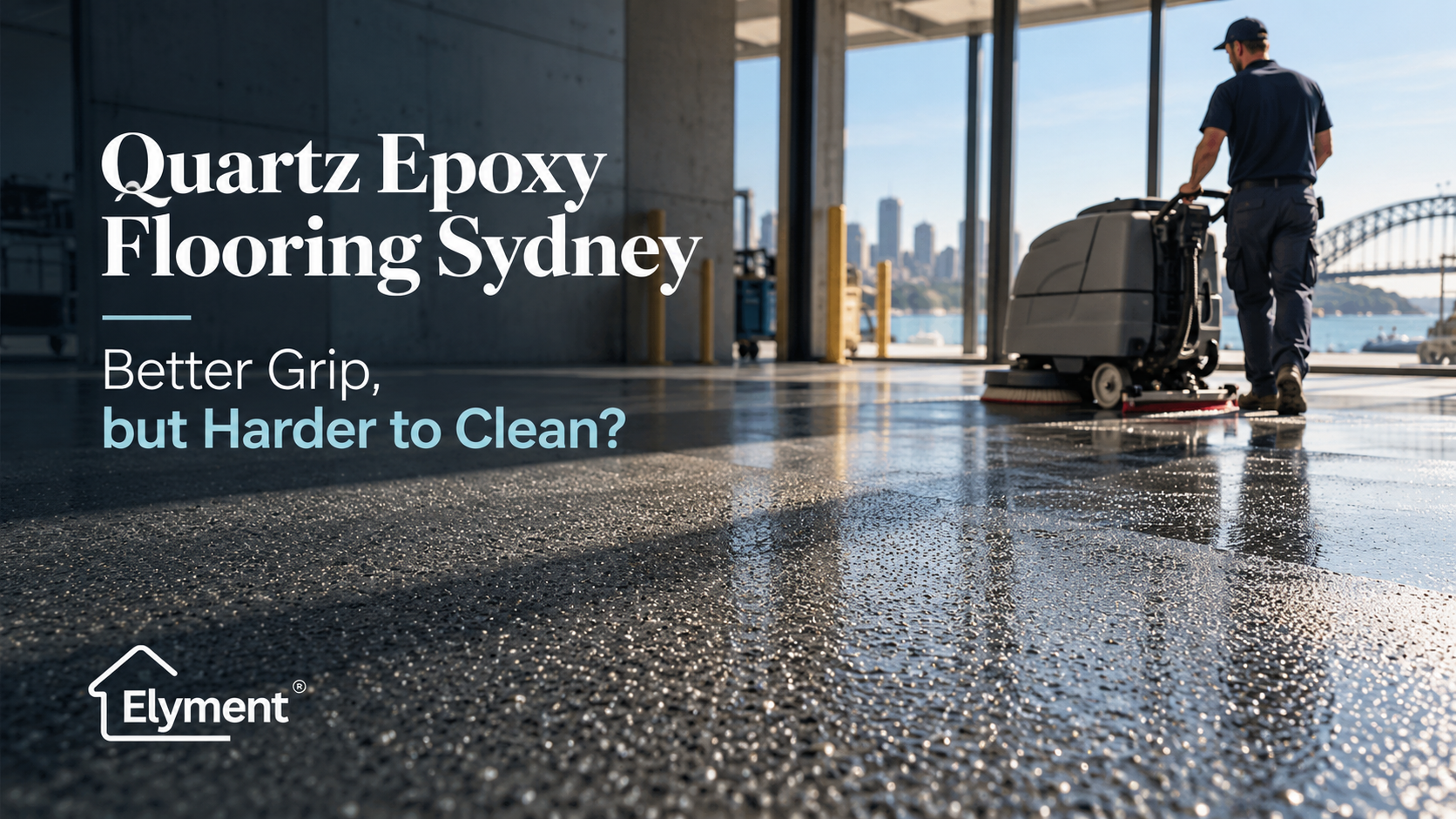
Quartz epoxy flooring can improve traction in Sydney commercial spaces, but a coarser surface may require more intensive cleaning to remove trapped dirt, grease and residue. The correct specification depends on actual foot traffic, contamination, footwear, cleaning equipment and the complete coating system. NSW property operators should request representative sample panels and system-specific slip-test evidence before approving installation, rather than assuming every quartz finish provides the same performance.
The Floor That Grips Better May Demand More From the Cleaning Team
A textured floor presents a deceptively simple purchasing decision. A facilities manager wants a surface that remains reliable when shoes are wet, a business owner wants to minimise cleaning labour, and a flooring contractor must deliver an installed system that satisfies both requirements.
Those objectives do not always align.
Quartz epoxy flooring uses graded mineral aggregate incorporated into a resin flooring system to create a textured wearing surface. Depending on aggregate selection, broadcast density, coating thickness and finishing coats, the result can range from comparatively fine texture to a substantially more pronounced profile.
The attraction is clear. Where a smooth floor may present unacceptable slip risk under foreseeable conditions, a correctly specified textured system can provide additional traction.
Yet the same surface profile that interacts with footwear may also retain fine debris, grease or cleaning residue. A standard mop that performs adequately on smooth epoxy may not clean a more heavily textured surface to the same standard.
Across Sydney commercial renovations, this creates a specification issue with direct operational consequences: the floor must be selected for the conditions in which it will be used and maintained, not merely for its appearance immediately after installation.
Why Quartz Epoxy Is Not a Single Flooring Specification
The expression "quartz epoxy" describes a category of resin flooring configurations rather than one universally defined product.
A typical broadcast system may involve substrate preparation, a compatible primer, a resin body coat, graded quartz aggregate and one or more finishing coats.
Each element influences the completed surface.
Sika Australia's Sikafloor MultiDur EB-24 system provides a useful technical example. The published system incorporates a quartz broadcast within an epoxy assembly and identifies a nominal thickness of approximately 2 to 4 mm.
Its technical information also distinguishes between aggregate gradings and associated slip-resistance classifications under AS 4586:2013.
For that particular system, Sika identifies indicative classification ranges of P3 to P4 for quartz sand measuring 0.3 to 0.8 mm and P4 to P5 for a coarser 0.7 to 1.2 mm grading.
Crucially, Sika states that the final P classification depends on the application of finishing coats and directs users to its technical department.
These are manufacturer-published system configurations, not blanket guarantees for quartz epoxy installations.
Altering the resin, aggregate, coating consumption or finishing method may change the completed surface. A test report for one specified assembly should not automatically be treated as evidence for another.
What changes the finished texture?
- Aggregate grading: Particle size and distribution influence the surface profile.
- Broadcast method: The amount and consistency of aggregate incorporation affect texture uniformity.
- Resin build: Coating thickness and product selection determine how the aggregate is embedded.
- Finishing coats: The type, quantity and application method can alter the exposed texture.
- Installation quality: Uneven distribution, inconsistent coverage and local variations can affect appearance and performance.
The appropriate purchasing question is therefore not simply whether the proposed floor contains quartz.
It is whether the complete specified assembly has evidence of performance suitable for the intended workplace.
The Cleaning Contractor Belongs in the Specification Meeting
Flooring specifications are frequently discussed between building owners, designers, project managers and installers. For textured commercial floors, the cleaning contractor should also have an opportunity to assess the proposed surface before the selection is finalised.
That discussion can identify whether the existing cleaning methods, equipment and labour allowance are capable of maintaining the proposed profile.
Consider a hypothetical Sydney commercial tenancy where a fine-textured resin floor can be maintained using the existing cleaning equipment, but a more aggressively textured sample retains visible residue after the same cleaning cycle.
The second floor may offer different traction characteristics. However, approving it without changing the cleaning specification transfers an unresolved operational problem from the construction team to the facilities team.
This becomes particularly relevant in areas exposed to oily contamination, outdoor grit, tracked-in rainwater or frequent cleaning chemicals.
Four maintenance questions to settle before approval
- What contaminants are expected during normal operations, including foreseeable spills?
- Which cleaning products, brushes, pads and machines are approved by the coating manufacturer?
- Can the cleaning method remove residue from the actual finished texture without damaging the surface?
- How frequently will cleaning, inspection and periodic deep cleaning be required?
A textured resin floor is not inherently uncleanable. The practical issue is whether its maintenance requirements match the resources available after handover.
Sika's Australian flooring documentation refers installers and owners to its Sikafloor cleaning regime. Its Sikafloor-264 T AU product guidance also emphasises housekeeping, prompt treatment of chemical spills and compatible cleaning chemicals.
Cleaning equipment and chemical selection must be checked against the actual installed system. A cleaning method suitable for one coating should not automatically be assumed suitable for another.
Different Commercial Spaces Create Different Texture Demands
Sydney commercial properties may contain several operating environments within the same building. A loading area, public entrance, staff corridor and equipment room should not automatically receive identical surface specifications.
Warehouse Pedestrian Walkways
- Primary concern: Footwear, dust, tracked moisture and traffic patterns.
- Specification priority: Appropriate pedestrian traction and maintainable cleaning access.
Commercial Kitchen Support Areas
- Primary concern: Grease, water, cleaning chemicals and hygiene requirements.
- Specification priority: Cleanability, drainage, chemical compatibility and slip-risk controls.
Strata Car Park Pedestrian Routes
- Primary concern: Rainwater, oil contamination and vehicle interface.
- Specification priority: Slip-risk assessment, suitable system durability and traffic segregation.
Retail Back-of-House Areas
- Primary concern: Frequent cleaning, trolley movement and operational access.
- Specification priority: Balance between traction, cleaning effort and wheeled-equipment movement.
Plant and Service Rooms
- Primary concern: Maintenance fluids, equipment access and intermittent traffic.
- Specification priority: Chemical suitability, maintenance access and condition-specific slip resistance.
These are assessment priorities, not prescribed slip classifications. The appropriate rating and flooring construction must be established for the actual location, relevant requirements and foreseeable use.
For example, a pronounced texture that helps address contamination risks in one area may be unnecessarily difficult to maintain in an adjacent, predominantly dry corridor.
In some projects, separately specified zones may be more practical than applying the same aggressive texture throughout the tenancy.
This requires careful detailing of transitions, changes in grip, cleaning methods and the movement of people and equipment between areas.
What NSW Slip-Resistance Evidence Actually Establishes
Under NSW workplace safety obligations, flooring should be assessed in the context of the risks present in the workplace.
SafeWork NSW's guidance on slips, trips and falls identifies factors including surface condition, contaminants, drainage, cleaning methods, footwear and pedestrian movement.
The agency also refers to AS 4586:2013, incorporating its 2017 amendment, for classification of new pedestrian surface materials.
A classification provides information about performance under a defined test method. It does not establish that a particular floor is safe in every possible operating condition.
The project team must distinguish between three different questions:
- What classification is appropriate? Determine the intended application, relevant building requirements and workplace risk profile.
- What does the evidence cover? Review the test method, tested specimen, complete coating assembly and reported classification.
- Does the installed floor correspond? Confirm whether the approved products, aggregate grading, application build and final finish match the evidence relied upon.
For existing installations, an appropriate in-situ assessment may also be necessary. New-product testing and testing of an installed floor answer different questions.
Importantly, a manufacturer's technical document does not replace project-specific assessment or an applicable compliance determination.
Why the final coat matters
Adding or altering a finishing coat may change how much aggregate texture remains exposed.
Sika's MultiDur EB-24 data illustrates why a quoted aggregate size or nominal coating thickness is insufficient on its own. The manufacturer specifically qualifies its slip-resistance classifications by the application of finishing coats.
Accordingly, a contractor should be able to identify precisely which completed coating configuration is being offered and what evidence supports the claimed result.
A Sample Panel Should Be a Performance Trial, Not a Colour Swatch
Small decorative samples can demonstrate colour and general appearance. They are less useful for evaluating how a real cleaning machine interacts with the finished surface.
Where cleaning demands or slip risks materially affect the project, a representative sample panel or trial area provides a more meaningful basis for selecting the system.
Its construction should reproduce the proposed primer, resin, quartz grading, broadcast approach and finishing coats as closely as practicable.
A practical sample approval process
- Define the exposure. Record expected pedestrian activity, footwear, spills, moisture and operating conditions.
- Confirm the specification. Identify the actual resin products, aggregate grading, application thickness and topcoat arrangement.
- Review evidence. Obtain available slip-test documentation and assess its relevance to the intended finished assembly.
- Trial the cleaning method. Use an agreed, representative contaminant and manufacturer-compatible cleaning process.
- Record the outcome. Assess observable residue, cleaning effort, appearance and any practical equipment limitations.
- Approve the reference. Document the accepted sample and the criteria against which subsequent works will be inspected.
Sample approval should not be represented as a substitute for formal slip testing where that testing is necessary.
Its value lies in identifying maintenance and finish issues while changes can still be made without extensive removal or rework.
For an occupied commercial tenancy, that early decision may protect both the fit-out programme and the operating budget.
Commercial Epoxy Flooring Cost: What Actually Changes the Quote?
Comparing commercial epoxy flooring cost solely by square metre can conceal important differences in system specification and project scope.
Two quotations may describe "quartz epoxy flooring" while allowing for materially different preparation, aggregate consumption, coating thickness, finishing coats and testing.
Neither the word "quartz" nor a nominal slip-resistance claim establishes the price or completeness of a commercial flooring package.
The items worth separating in a written quotation
- Existing flooring removal: Uplift and disposal of tiles, vinyl, existing resin or other unsuitable material.
- Substrate preparation: Grinding, surface profiling, cleaning, contamination treatment and repairs.
- Substrate investigation: Moisture assessment, concrete condition, compatibility checks and any required bond testing.
- System build: Primer, resin layers, specified quartz grading, broadcast method, finish coats and total nominal thickness.
- Complex detailing: Coving, floor wastes, joints, edges, thresholds and changes in level.
- Testing and samples: Trial panels, laboratory evidence, independent testing where specified and acceptance records.
- Site logistics: Freight, material handling, access restrictions, ventilation, isolation and waste removal.
- Programme requirements: Out-of-hours installation, staged access, cure periods and business reopening constraints.
The existing concrete condition can be particularly significant.
Sika's published system instructions identify substrate soundness, contamination and surface irregularities as matters requiring appropriate preparation. A resin finish should not be assumed to correct substantial underlying defects.
Elyment's concrete grinding and coating preparation service addresses the removal of unsuitable surface layers and preparation of concrete before subsequent flooring works.
Where flatness, defects or finished-height requirements need correction, floor levelling and substrate assessment may also form part of the project.
Those requirements should be determined before treating a coating quotation as a complete installed-floor price.
A cheaper initial quotation may prove more expensive if necessary substrate repairs, testing, cleaning compatibility or operational shutdowns were excluded.
The Sydney Fit-Out Programme Must Allow for Testing and Curing
The timing of a quartz epoxy installation matters almost as much as the selected finish.
A commercial tenancy cannot necessarily resume unrestricted operations when the surface first becomes suitable for foot traffic.
Manufacturers distinguish between stages such as pedestrian access, light traffic and full cure. Temperature, humidity, product selection and the installed system influence those periods.
In Sydney CBD retail premises, Parramatta commercial facilities and Inner West warehouses, access restrictions can complicate sequencing further.
The project programme may need to account for:
- After-hours grinding and dust-controlled preparation.
- Delivery routes and loading-dock access.
- Isolation of adjacent occupied areas.
- Ventilation and environmental conditions during application.
- Manufacturer-specific intervals between coating layers.
- Separate milestones for pedestrian access and heavier traffic.
- Final inspection, cleaning guidance and release to operations.
In a strata-controlled building, the works may also need to follow applicable by-laws, building-management procedures and approvals relating to common property or contractor access.
These are project-specific requirements, not automatic legal conditions for every epoxy installation.
A staged approach can reduce disruption, but it must preserve coating continuity, environmental controls and an acceptable completed finish.
Handover Should Include More Than a Finished Floor
The flooring contractor's work may be substantially complete before the facilities team has enough information to maintain the installed surface correctly.
That gap creates an avoidable risk.
An effective handover package should identify the actual coating products and construction, relevant performance evidence, approved cleaning requirements and any maintenance limitations.
The property operator should seek:
- Final product and system identification.
- Documentation of the agreed aggregate and finishing-coat configuration.
- Applicable slip-resistance evidence and any specified verification results.
- Manufacturer-compatible cleaning and maintenance instructions.
- Confirmed cure and return-to-service conditions.
- Procedures for reporting damaged, contaminated or worn areas.
- Relevant warranties, limitations and contractor contact information.
These records give facilities managers a reference when cleaning methods change, contractors are replaced or local repairs are required.
SafeWork NSW also emphasises ongoing inspection, maintenance, appropriate cleaning and workplace risk management. A floor's initial classification cannot replace those responsibilities.
Where Elyment Fits Into the Decision
Elyment Property Services includes coating, flake and quartz epoxy systems within its published flooring service range.
For Sydney property owners, facilities teams and commercial renovation managers, the practical objective is to coordinate the preparation and coating works around a clearly defined operating requirement.
That may include reviewing the proposed floor area and existing substrate, identifying grinding or levelling requirements, clarifying the quartz system specification, coordinating specialist installation and planning access around the building's operational constraints.
Elyment's epoxy flooring service for Sydney commercial and residential properties provides a starting point for discussing system selection and preparation.
Where a particular slip classification or project-specific certification is required, the scope should identify the appropriate qualified parties and evidence before work proceeds.
The strongest project decision is one that can be explained to the owner, installer, safety adviser and cleaning team using the same agreed specification.
Specify the Floor Around the Way Your Business Operates
ELYMENT PROPERTY SERVICES | SYDNEY & NSW
Review substrate preparation, quartz epoxy system options, cleaning requirements, slip-resistance evidence and installation sequencing before committing to your next commercial flooring project.
Request a Commercial Flooring Project Review →
The Decision Is About Maintained Performance
Quartz epoxy flooring can provide a valuable textured surface where workplace conditions justify it.
But the strongest specification is not necessarily the roughest finish available.
It is the complete flooring system that provides appropriate, evidenced slip resistance for the intended environment while remaining practical to clean, inspect and maintain throughout its working life.
For Sydney commercial properties, that means involving the cleaning and operations teams early, assessing a representative sample and comparing quotations against the same defined scope.
Better grip and manageable maintenance are compatible objectives. Achieving both requires the right system, evidence and project planning.
Technical References and Further Reading
- Sika Australia: Sikafloor MultiDur EB-24, system information and slip-resistance classifications.
- Sika Australia: Sikafloor MultiDur EB-14, aggregate, coating and system information.
- SafeWork NSW: Slips, trips and falls on the same level.
- SafeWork NSW: Guide to preventing slips, trips and falls at work.
ELYMENT PROPERTY SERVICES | SYDNEY & NSW
Specify the Floor Around the Way Your Business Operates
Review substrate preparation, quartz epoxy system options, cleaning requirements, slip-resistance evidence and installation sequencing before committing to your next commercial flooring project.
Review Your Flooring ProjectRelevant next actions
Explore the ELYMENT service most closely connected to this article.