Self-Levelling Cement Is on Site but the Water Is Off: Does the Sydney Floor Levelling Job Need to Be Rebooked?
Water off with self-levelling cement on site can stop a Sydney floor levelling job. Check supply needs early to avoid rebooking, delays, waste and higher costs.
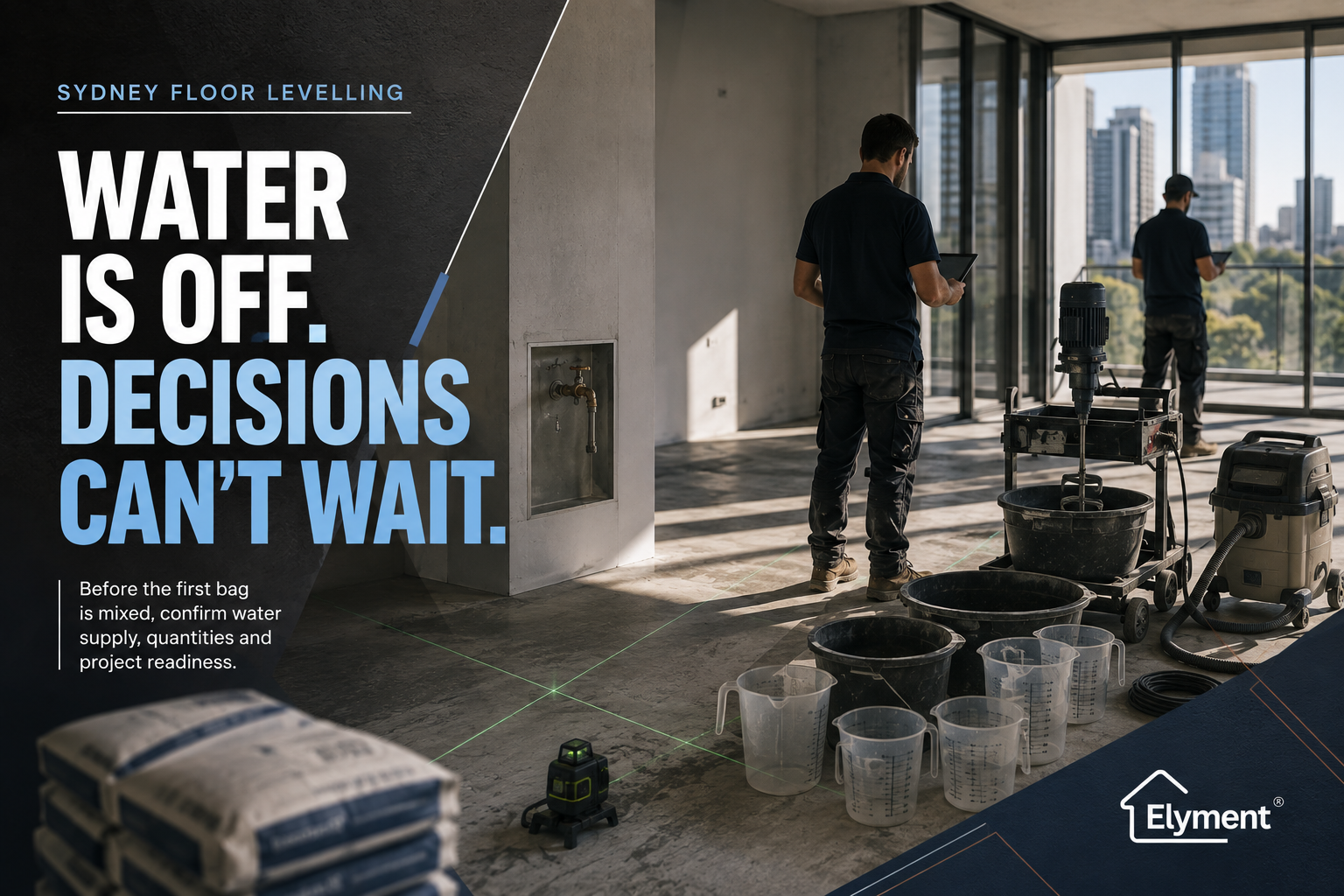
A Sydney floor levelling job does not automatically need to be rebooked because the mains water is off. Work may still proceed if the crew can provide enough suitable clean water for every planned batch, maintain the selected product's mixing requirements and meet site safety and amenity needs. If water quantity, quality or continuity cannot be verified before mixing starts, postponing or resequencing the pour is usually the lower-risk decision.
Bags of self-levelling cement can be stacked inside the apartment. The concrete can be ground. The floor can be vacuumed. Laser levels can be set and the mixing station can be assembled.
Then somebody turns the tap and nothing happens.
On a Sydney renovation project, that small operational failure can affect far more than the next bucket of self levelling compound. Water availability can determine whether the crew should release the entire pour, whether primer timing remains workable, whether a multi-room application can remain continuous and whether the site has the facilities required for workers to remain there.
The correct response is therefore not to ask whether the contractor can find a few bottles of water. It is to establish whether the complete levelling operation still has a reliable water plan.
A Water Outage Is a Project-Release Problem, Not Simply a Mixing Problem
Elyment's existing guidance on applying self-levelling compound deals with preparation, priming, mixing and placement. The more difficult situation arises when those technical preparations have been completed but one of the resources needed to execute the work is suddenly unavailable.
That shifts the issue from application technique to project delivery.
A levelling crew normally needs to know before the first bag is opened that it has sufficient resources to complete the planned pour. Those resources can include:
- the specified levelling compound and primer;
- a verified quantity of suitable mixing water;
- reliable electrical power for mixing and extraction equipment;
- clean mixing buckets and calibrated water measures;
- a protected mixing location;
- an unobstructed route from the mixing station to the pour area;
- enough labour to maintain the planned batch rate;
- appropriate worker amenities and drinking water;
- a lawful and controlled method for cleaning equipment and managing residues; and
- enough uninterrupted access to complete the nominated work zone.
If one of those resources fails before the pour starts, the supervisor can still make a controlled decision. If it fails after twenty bags have been placed, the options become much narrower.
The Important Number Is Total Water Demand, Not the Size of the First Bucket
Self-levelling cement is manufactured around a defined water-to-powder relationship. The ratio varies between products, which is why the selected manufacturer's current technical data should govern the installation rather than a generic rule.
As an illustration, the ARDEX K 15 technical data specifies 4.5 to 5.0 litres of water for a standard 20 kg bag under its normal mix design. Other products may specify different quantities, additives, depths, temperatures and methods.
That example demonstrates why an apparently modest levelling job can create a substantial water requirement.
10 bags
- Water at 4.5 L per bag: 45 L
- Water at 5.0 L per bag: 50 L
20 bags
- Water at 4.5 L per bag: 90 L
- Water at 5.0 L per bag: 100 L
40 bags
- Water at 4.5 L per bag: 180 L
- Water at 5.0 L per bag: 200 L
60 bags
- Water at 4.5 L per bag: 270 L
- Water at 5.0 L per bag: 300 L
These figures are an example only, not a universal mixing specification. The project's selected product must be checked independently.
More importantly, mixing water is only part of the site's total requirement. The project may also require water for compatible primer preparation, controlled tool cleaning and other activities. Worker drinking water and hygiene requirements remain a separate workplace consideration.
This is why arriving with two 20-litre containers does not necessarily solve a 40-bag pour.
Can Water Simply Be Brought to the Sydney Site?
Potentially, yes.
A mains connection is convenient, but it is not inherently the only possible source of mixing water. On the right project, a contractor may be able to transport a controlled quantity of suitable clean water to the site in sealed containers or another appropriate supply system.
The decision should be made before batching starts and should address five questions.
- Is the water suitable for the selected product?
- Unknown construction water, contaminated storage tanks or another unverified source should not be treated as interchangeable with clean mixing water simply because it is available.
- Is there enough water for the complete planned pour?
- Calculate the requirement from the actual number of bags and the manufacturer's nominated ratio, then allow for the wider site operation rather than stopping at the theoretical mixing quantity.
- Can the supply maintain the batching rate?
- Forty litres sitting in a storeroom is different from 200 litres staged beside a controlled mixing station in measured containers.
- Can the water be measured consistently?
- The crew still needs calibrated containers or another controlled method. A replacement water source does not justify estimating each batch.
- Are the site's other water-dependent requirements still satisfied?
- Bringing process water for the levelling compound does not automatically resolve worker drinking water, handwashing, sanitary amenities or other site requirements.
Why Improvising the Mix Is More Expensive Than Rebooking
When a crew, builder or owner is trying to protect a programme, there can be pressure to make the available water stretch further.
That is the wrong part of the project to improvise.
Adding excessive water to increase flow can affect strength and hardness. Reducing water outside the permitted range can affect workability and placement. Changing the ratio from bucket to bucket can create inconsistent behaviour across what is supposed to become one continuous substrate.
ARDEX's technical guidance specifically warns against over-watering levelling cements to extend working time. The broader principle applies regardless of brand: the product specification controls the mix, not the inconvenience of the site.
A delayed pour is visible immediately. A weak or inconsistent preparation layer may only become visible after timber, vinyl, carpet, microcement or another finish has been installed over it.
At that point the financial consequence can include:
- removal of the finished flooring;
- mechanical removal of defective levelling material;
- new grinding or surface preparation;
- additional primer and levelling compound;
- replacement flooring or adhesive;
- additional labour;
- extended property downtime; and
- disagreement over responsibility for the failure.
When the Job Can Usually Continue Without Mains Water
A water outage does not have to become a lost day if the alternative arrangement is properly controlled.
Verified clean water is already staged in sufficient quantity
- Likely decision: Potentially proceed
- Operational reason: The pour is not dependent on the unavailable mains connection.
Additional clean water can be delivered before mixing begins
- Likely decision: Potentially proceed
- Operational reason: The crew can establish the full supply before releasing the pour.
Only a small quantity of water is available and total demand is unknown
- Likely decision: Do not start yet
- Operational reason: The crew risks running out during placement.
Water source is available but its condition is uncertain
- Likely decision: Verify or replace source
- Operational reason: Availability alone does not establish suitability.
Water outage also removes required site amenities
- Likely decision: Resolve facilities before proceeding
- Operational reason: Mixing water does not replace workplace facility requirements.
Large continuous multi-room pour has no secure backup supply
- Likely decision: Rebook or resequence
- Operational reason: The consequence of a mid-pour interruption is significantly higher.
The Risk Increases as the Pour Becomes Larger and More Continuous
A small isolated room and a whole apartment should not be treated as the same water-risk decision.
Elyment's analysis of self-levelling cement across multiple rooms explains why continuity becomes more important when material must move through bedrooms, corridors, living areas and doorways within controlled working times.
Once the project depends on a sequence of continuous batches, water becomes part of production capacity.
Consider a crew pouring a Sydney apartment where the floor has already been laser-mapped and the bags have been calculated around an expected average depth. If 45 bags are required and the available water only supports the first 20, beginning the application does not save the programme.
It converts a known delay into a technical interface inside the floor.
Depending on the product and installation design, a premature stop may create an unwanted cold joint, edge, ridge or difference in elevation requiring later preparation.
Where staging is deliberately designed, separate pours can be entirely legitimate. The problem is allowing a water shortage to decide the stopping point instead of the floor plan.
Primer Timing Can Turn a Water Delay Into a Second Problem
The floor may already have been prepared before the water problem is discovered.
That matters because primers have their own drying conditions and application windows. If the floor has been primed for a planned pour and the project is then delayed, the crew should confirm whether the primer remains within the selected system's permitted condition and timing.
The correct response is product-specific. Depending on the system, the surface may remain acceptable, require inspection, require another treatment or need re-preparation if it has become contaminated.
What should not happen is an assumption that a primed floor can sit indefinitely simply because nobody has walked over it.
In active Sydney renovations, other trades can reintroduce dust rapidly. Plaster sanding is a particular example. Elyment's analysis of Gyprock dust before self-levelling compound explains why a technically prepared substrate can lose its readiness when the construction sequence changes.
Water for the Product and Water for the Workplace Are Two Different Checks
NSW site management adds another consideration.
SafeWork NSW's Managing the Work Environment and Facilities Code of Practice addresses access to drinking water and workplace facilities. SafeWork NSW's construction guidance also identifies water, handwashing and appropriate amenities as part of site welfare arrangements.
That does not mean the water used to mix a levelling product and the water supplied to workers are the same requirement.
They should be assessed separately:
- Process water: must meet the requirements of the selected levelling, primer or preparation system.
- Worker drinking water: must remain available in accordance with workplace requirements.
- Hygiene and amenities: must remain suitable for the worksite arrangement.
A contractor arriving with enough water to mix 30 bags has therefore solved only one part of the water-outage problem.
Sydney Strata Projects Have an Additional Scheduling Risk
The cost of postponement can be greater in an apartment building than in an empty detached house.
A Sydney strata floor levelling booking may already be tied to:
- lift protection and lift reservation;
- loading dock access;
- building-manager attendance;
- approved working hours;
- parking or loading-zone access;
- resident notices;
- noise restrictions for grinding and preparation;
- the flooring installer's next booking; and
- a move-in, settlement, lease commencement or handover date.
That creates understandable pressure to keep the booked day alive.
The better response is not to lower the technical threshold. It is to establish a water contingency before the crew travels.
On larger strata and commercial projects, water readiness can sensibly sit beside access, power and floor-clearance confirmation as a pre-start item.
The 15-Minute Go-or-No-Go Check Before the First Bag Is Mixed
When the water is unexpectedly unavailable, the site supervisor can reduce uncertainty by working through a short release process.
- Confirm why the water is off.
- Determine whether the interruption is temporary, building-wide, related to plumbing works, controlled by strata or caused by a site fault.
- Confirm whether and when supply will return.
- A verified 20-minute interruption is a different scheduling problem from an unknown outage.
- Check the selected product data.
- Confirm the exact water ratio, batch size and any relevant temperature or mixing requirements.
- Calculate the full mixing-water demand.
- Multiply the actual bag quantity by the nominated ratio rather than estimating from the room size.
- Verify an alternative supply if required.
- Establish source, cleanliness, available volume, location and measurement method before starting.
- Check the condition of any primer already installed.
- Make sure a delay has not moved the floor outside the applicable installation sequence.
- Confirm worker facilities remain adequate.
- Treat drinking water and amenities as separate requirements from the levelling mix.
- Release or postpone the pour as one decision.
- Avoid starting merely because enough water exists for the first few batches.
Sometimes the Better Decision Is to Use the Day for Preparation
Rebooking the pour does not always mean losing the entire site day.
Where the programme and product sequence permit it, the crew may be able to redirect labour towards preparation that does not depend on the unavailable water supply.
Possible activities can include:
- completing laser level mapping;
- confirming finished-floor datum and transitions;
- mechanically removing remaining high points;
- vacuuming or preparing areas that have not yet reached primer stage;
- checking cracks and service penetrations;
- staging unopened bags in a dry location;
- reconfirming quantities after preparation exposes the true floor profile; and
- coordinating the revised cure and flooring-installation programme.
This approach needs to respect the selected levelling system's sequence. Preparation should not simply be pushed further than is sensible if the eventual pour date remains uncertain.
It can also be an opportunity to reassess whether every low area genuinely needs additional compound. Elyment's analysis of when concrete grinding can reduce levelling-compound demand examines how selective high-point removal can change material quantity, floor height and project logistics.
The Cost Decision Should Compare a Controlled Delay With an Uncontrolled Failure
When the water is off, project teams often see only the immediate rebooking cost.
That can include a second mobilisation, labour disruption, another lift booking or a changed flooring-installation date.
Those costs are real, but they should be compared with the potential cost of beginning an application that cannot be reliably completed.
Controlled rebooking
- Immediate impact: Programme delay and remobilisation
- Potential downstream exposure: Usually known and measurable
Verified alternative water supply
- Immediate impact: Additional logistics and water handling
- Potential downstream exposure: Manageable if the full operation is controlled
Start with uncertain water quantity
- Immediate impact: Appears to protect the programme
- Potential downstream exposure: Mid-pour interruption and unplanned termination risk
Alter the specified water ratio
- Immediate impact: May appear to make limited water stretch further
- Potential downstream exposure: Material performance, finish and warranty exposure
Good project control is not measured by whether the crew pours something on the booked date. It is measured by whether the substrate handed to the next trade is suitable for the specified flooring system.
Confirm the Site Is Ready Before the Pour Is Released
Review substrate preparation, levelling quantities, water and power requirements, access constraints, trade sequencing, cure windows and flooring handover requirements before self-levelling cement is mixed on site.
What Owners, Builders and Project Managers Should Confirm Before Levelling Day
The simplest way to manage a water outage is to identify the dependency before the project reaches the pour date.
A practical pre-start confirmation can cover:
- the exact self levelling cement being installed;
- expected and contingency bag quantities;
- manufacturer mixing ratio;
- estimated total water requirement;
- working mains water at the nominated mixing location;
- alternative clean-water arrangements if the building supply is unreliable;
- electrical supply and permitted leads;
- mixing location and route to the floor;
- building access and lift bookings;
- other trades working in the area;
- primer and preparation sequence;
- expected curing window; and
- the next flooring trade's scheduled start.
Elyment's broader Sydney flooring preparation and floor levelling services approach substrate preparation as a coordinated delivery process covering removal, grinding, levelling, moisture considerations and install-ready handover rather than treating the pour as an isolated task.
The Bottom Line for Sydney Floor Levelling Projects
Self-levelling cement being on site does not mean the crew should pour simply because the labour, bags and equipment have already arrived.
Nor does a failed mains water supply automatically mean the entire job must be abandoned.
The deciding issue is whether the project can still establish a complete and controlled water supply for the selected levelling system before the application begins, while maintaining the site's wider operational and workplace requirements.
If sufficient suitable water can be verified, measured and staged, the project may be able to continue without mains water. If the supply is uncertain, insufficient or likely to interrupt a continuous application, rebooking or resequencing is usually cheaper than creating an uncontrolled stop inside the floor.
On a well-run Sydney renovation, water availability should be treated the same way as power, access, substrate readiness and material quantity: as a release condition that is checked before the first bag is opened.
Quick Operational Answers
Can Self-Levelling Cement Be Mixed With Water Brought From Another Location?
Potentially. The alternative water must be suitable for the selected manufacturer's requirements, available in sufficient quantity and capable of being measured consistently. The complete pour should be planned before batching starts.
Should Extra Water Be Added if the Compound Is Difficult to Spread?
Not beyond the manufacturer's permitted mixing range. Excess water can adversely affect cementitious levelling products. Mixing, temperature, batch timing and the specified product requirements should be checked instead.
Does a Water Outage Automatically Cancel a Sydney Floor Levelling Booking?
No. A verified alternative supply may allow work to continue. Rebooking becomes appropriate when sufficient suitable water, site amenities or reliable pour continuity cannot be established.
Why Should the Full Bag Quantity Be Calculated Before Organising Backup Water?
Because a continuous levelling operation can require hundreds of litres of mixing water. Having enough for the first batches but not the complete planned zone can create a more difficult technical problem than postponing before the pour begins.
Sources and References
- Elyment: Applying self-levelling compound
- ARDEX Australia: ARDEX K 15 Technical Data
- Elyment: Self-levelling cement across multiple rooms
- Elyment: Gyprock dust before self-levelling compound
- SafeWork NSW: Managing the Work Environment and Facilities Code of Practice
- Elyment: When concrete grinding can reduce levelling-compound demand
- Elyment: Sydney flooring preparation and floor levelling services
- Elyment: Contact
Confirm the Site Is Ready Before the Pour Is Released
Review substrate preparation, levelling quantities, water and power requirements, access constraints, trade sequencing, cure windows and flooring handover requirements before self-levelling cement is mixed on site.
Request a ReviewRelevant next actions
Explore the ELYMENT service most closely connected to this article.