Self-Levelling Compound After Plastering: Can Fine Gyprock Dust Stop the Primer Bonding?
Fine Gyprock dust can weaken primer adhesion before self-levelling compound is poured. Learn the prep steps that help prevent bonding failure and costly repairs
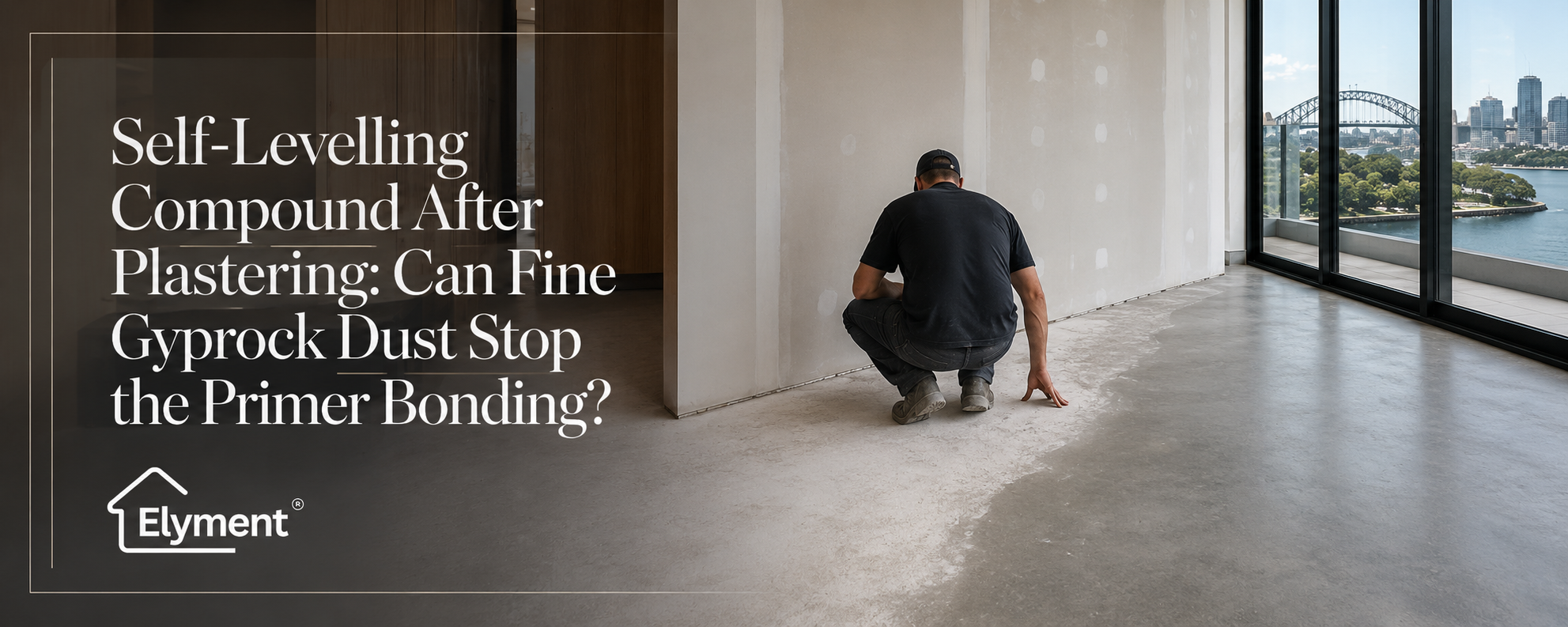
Yes. Fine Gyprock sanding dust can form a loose layer between concrete and a floor primer, reducing wetting and adhesion even when the slab looks clean. In Sydney and NSW renovations, the bigger risk is sequencing: plaster sanding, cleaning, grinding, priming and levelling are often compressed into the same handover window. The floor should be vacuumed, inspected and mechanically prepared where required, then protected from fresh dust before primer and self-levelling compound are applied.
This Is A Trade-Handover Problem, Not Simply A Cleaning Problem
The most useful way to look at Gyprock dust before floor levelling is not to ask whether somebody has swept the room. The question is whether the concrete substrate has been formally handed from one trade condition to another.
Plasterboard finishing is inherently a dust-producing activity. Joint compounds are applied, dried and sanded to create the final wall and ceiling surface. CSR Gyprock itself describes airborne dust generation during sanding in its plasterboard joint-compound guidance.
That matters because flooring primer sits at the opposite end of the project requirement. A flooring system needs a substrate that is sound, compatible and sufficiently free from material that can interrupt the bond.
For example, ARDEX states in its P 51 flooring primer technical guidance that the substrate must be dry, firm and free from dust and release agents before application.
The operational conflict is obvious. One trade finishes by creating very fine airborne material. The next trade begins with a system that depends on a correctly prepared surface.
If nobody owns the handover between those two conditions, the primer can become the point where the programme failure is hidden rather than corrected.
Why Fine Plaster Dust Is More Difficult Than Visible Debris
Large plaster fragments are usually easy to identify. Fine sanding dust is more difficult because it can settle as a pale, almost transparent film across concrete.
A slab may look clean from standing height while still carrying loose material within its surface texture, around perimeter edges, beside door jambs, underneath temporary protection and along areas where sanding equipment or extension leads were used.
The bonding problem is primarily an interface problem.
The primer needs to interact with the intended substrate. If a loose layer sits between the concrete and the primer, part of the flooring system may effectively be bonded to contamination rather than to the slab itself.
That does not mean every trace of plaster dust will automatically cause a levelling failure. It means the condition should be removed and assessed rather than treated as acceptable simply because it is difficult to see.
This distinction is particularly important when planning self-levelling compound work in Sydney, where the primer, levelling product, concrete condition and intended finished flooring need to operate as one compatible system.
The Mistake Is Often Made Before The Flooring Team Arrives
In a compressed renovation programme, plastering can be shown as complete on the programme while sanding and touch-ups are still occurring.
At the same time, the flooring contractor may have already been booked because timber, vinyl, hybrid flooring or carpet installation is scheduled immediately afterwards.
The sequence can look efficient on paper:
- Complete plastering.
- Clean the property.
- Prime the concrete.
- Pour self-levelling compound.
- Install the finished flooring.
The problem is that “complete plastering” and “floor ready” are not the same project milestone.
Final sanding may still occur after the first clean. Painters may complete wall repairs. Cornices may require patching. Electricians may cut into finished walls. Cabinet installers may disturb dusty surfaces. Doors being trimmed or adjusted can create another cleaning requirement.
The result is recontamination.
A floor that was vacuumed on Tuesday can be unsuitable for priming on Wednesday if dust-producing work recommences in the same room.
Primer Should Not Be Used As A Substitute For Substrate Preparation
Primer performs an important technical role, but it should not be treated as a general-purpose solution for whatever happens to be sitting on the slab.
Depending on the product and substrate, primer may regulate suction, improve adhesion, reduce air release from porous concrete or prepare the surface for the next cementitious layer.
Some primer systems can also bind limited substrate dust in specified applications. That is not the same as deliberately applying primer over plaster sanding residue, paint dust, loose concrete particles or other construction contamination.
The selected levelling and primer manufacturer's current technical data should determine the required preparation. Product compatibility matters more than site assumptions.
This is also why a visually smooth slab should not automatically be considered ready. Elyment's analysis of concrete grinding and levelling-compound bonding examines the separate problem of concrete that appears clean but remains unsuitable for the next flooring layer.
A Stronger Handover Sequence After Plastering
On a professionally coordinated project, the transition from plastering to levelling should contain a defined hold point rather than an informal assumption that the floor is ready.
1. Finish Dust-Producing Wall And Ceiling Work
Major plaster sanding, patching and finishing should be completed before the substrate is accepted for flooring preparation wherever the construction programme allows it.
Minor defects may still appear later, but the project team should understand that further sanding after floor preparation can create another cleaning cycle.
2. Remove Temporary Floor Protection Carefully
Protection sheets, cardboard, drop cloths and plastic can trap surprisingly large quantities of fine dust.
Pulling them across a clean slab can redistribute contamination over the area that has just been prepared.
Removal should therefore form part of the handover sequence rather than being left until immediately before priming.
3. Vacuum The Full Substrate, Including Perimeters
Broad open areas are generally the easiest part of the floor to clean. Perimeters deserve greater attention.
Typical collection points include:
- Wall lines
- Door jambs
- Sliding-door tracks
- Robe tracks
- Corners
- Service penetrations
- Kitchen toe-kicks
- Temporary wall-protection edges
- Areas previously covered by stored materials
Dry sweeping alone should not be treated as the final technical preparation method where fine construction dust remains.
4. Inspect The Concrete Itself
Once loose dust is removed, a separate question remains: is the exposed concrete suitable for the chosen levelling system?
The floor may contain:
- Plaster compound adhered to the slab
- Paint overspray
- Old flooring adhesive
- Weak surface laitance
- Curing or sealing compounds
- Previous patching products
- High points
- Dense or burnished concrete
- Other contamination concealed beneath the plaster dust
Vacuuming will not correct those conditions.
5. Mechanically Prepare Only Where The System Requires It
Not every floor contaminated by plaster dust requires grinding.
If the problem is genuinely limited to loose sanding dust and the underlying slab is otherwise sound, clean and compatible, appropriate vacuum cleaning and inspection may be sufficient before the specified primer is applied.
Mechanical preparation becomes relevant where the surface itself needs correction, for example where plaster residue has adhered to the concrete, coatings remain, the slab is weak or contaminated, or the chosen product requires a more open surface profile.
This distinction prevents two different mistakes: insufficient preparation on one project and unnecessary grinding on another.
6. Vacuum Again After Mechanical Preparation
Grinding a slab and then leaving preparation dust behind simply replaces one contamination problem with another.
The completed substrate should therefore be cleaned again before the primer stage.
7. Treat Priming As A Controlled Hold Point
Once the floor has been accepted and primed, uncontrolled trade traffic should stop.
Workers should not continue sanding plaster immediately beside an open primed area. Dusty equipment should not be dragged through the room. Materials should not be unpacked in a way that deposits construction debris across the substrate.
The technical data for the selected primer should also govern dilution, application rate, drying time and the maximum permitted interval before levelling compound is installed.
The Floor Can Be Recontaminated After It Has Been Approved
This is one of the most important project-delivery issues and one that is frequently underestimated.
Substrate approval is a condition at a point in time.
It does not permanently certify the room.
If plasterers return, painters sand a repaired wall, a carpenter cuts MDF, or another contractor walks construction dust through the area, the previous inspection may no longer represent the condition of the slab.
This creates an accountability question for builders and project managers: who controls the room between floor preparation and the levelling pour?
A simple handover record can be more valuable than another general cleaning instruction. It can identify:
- The date the plastering stage was completed
- Whether final sanding was finished
- Who completed substrate cleaning
- Whether mechanical preparation was required
- Who accepted the slab for priming
- When primer was applied
- What site access remained permitted afterwards
- When the levelling pour was scheduled
Why Sydney Apartment Renovations Are Especially Sensitive To A Missed Handover
A failed sequence in a detached house can be disruptive. In a Sydney strata apartment, the same problem can affect a wider operating programme.
Levelling work may already be coordinated around lift protection, loading access, contractor hours, waste movement, neighbour impacts and flooring-installation bookings.
Discovering plaster contamination on the morning of the pour can therefore create costs beyond another round of vacuuming.
The levelling contractor may need additional preparation time. Materials may need to be moved. Installation may shift. Building access may need to be reconfirmed. Other trades may lose their planned work window.
Apartment owners planning the substrate stage can review apartment floor levelling and strata preparation requirements before locking in the installation programme.
Where The Cost Actually Appears
- Site condition: Loose fine plaster dust only
- Likely response: Detailed vacuuming and substrate inspection
- Potential project impact: Usually manageable if identified before priming
- Site condition: Plaster compound bonded to the slab
- Likely response: Localised scraping or mechanical preparation
- Potential project impact: Extra preparation labour and possible programme movement
- Site condition: Dust plus paint, adhesive or sealer contamination
- Likely response: Broader substrate-preparation review
- Potential project impact: Grinding, cleaning or a revised primer system may be required
- Site condition: Floor cleaned, then plastering recommences
- Likely response: Repeat cleaning and acceptance
- Potential project impact: Lost labour and duplicated mobilisation
- Site condition: Contamination discovered after priming
- Likely response: Product-specific technical assessment
- Potential project impact: Potential removal, re-preparation and re-priming
- Site condition: Weak bond discovered after levelling
- Likely response: Investigation and possible removal of affected material
- Potential project impact: Significant delay and rectification cost
Owners comparing preparation allowances should therefore look beyond the number of bags required. Elyment's Sydney floor levelling cost and inclusions guide explains why substrate preparation, depth and site conditions can materially affect the final scope.
Concrete Grinding Introduces A Separate NSW Safety Requirement
Gyprock sanding dust and concrete grinding dust should not be treated as though they are the same hazard.
However, if the flooring response involves mechanically grinding concrete, NSW work health and safety requirements relating to respirable crystalline silica become relevant.
SafeWork NSW's current crystalline silica guidance requires businesses to identify applicable crystalline-silica processing, assess risk and implement suitable controls. Those controls may include dust extraction, wet suppression, isolation, cleaning and appropriate personal protective equipment depending on the work.
This means an operational decision to “just grind it clean” should still be planned as a controlled construction activity, not used as an improvised housekeeping solution.
What Owners And Builders Should Confirm Before The Levelling Crew Starts
- Has final plaster sanding actually finished?
- Will any plasterers or painters return after the substrate clean?
- Has temporary protection been removed without redistributing dust?
- Has the complete slab been vacuumed, including edges and tracks?
- Is there plaster compound physically adhered to the floor?
- Are paint, glue, curing compounds or other contaminants also present?
- Does the slab itself require grinding or another preparation method?
- Which primer and levelling compound will be used?
- Does the preparation comply with the manufacturer's current technical data?
- Who controls access after the substrate is approved?
- What happens if another trade contaminates the floor before the pour?
These questions turn a vague cleaning responsibility into a defined project-delivery process.
The Better Sequence Protects Both Trades
Plasterers should not be expected to certify a concrete substrate for a flooring system they are not installing.
Equally, flooring contractors should not be expected to absorb unlimited cleaning and preparation caused by unfinished preceding trades unless that work forms part of the agreed scope.
The project manager, builder or owner should establish the interface.
The plastering package should reach a defined completion condition. The floor should then be cleaned and technically assessed. Any required concrete preparation should be completed. The substrate should be accepted. Primer should be applied in accordance with the specified system. Access should then be controlled until levelling is complete.
That sequence is less about adding another process to a renovation and more about stopping the same work from being done twice.
The Bottom Line
Fine Gyprock dust can interfere with primer bonding when it remains as a loose contaminating layer on the slab. The solution is not to assume that stronger primer will compensate for poor preparation, nor to assume that every dusty slab needs grinding.
The stronger approach is controlled sequencing.
Finish the dust-producing plaster work, clean and inspect the substrate, mechanically prepare only where the concrete or selected flooring system requires it, clean again, prime in accordance with the product specification and prevent other trades from recontaminating the floor before self-levelling compound is installed.
For Sydney and NSW renovation projects, that handover can be the difference between a levelling stage that proceeds as planned and a minor housekeeping issue becoming a programme delay, rectification cost or flooring defect.
Sources and References
- CSR Gyprock: Plasterboard joint-compound guidance
- ARDEX: P 51 Flooring Primer Technical Guidance
- Elyment: Self-Levelling Compound Sydney
- Elyment: Concrete Grinding and Levelling-Compound Bonding
- Elyment: Apartment Floor Levelling and Strata Preparation Requirements
- Elyment: Sydney Floor Levelling Cost and Inclusions Guide
- SafeWork NSW: Crystalline Silica Guidance
Confirm The Substrate Before Plaster Dust Becomes A Flooring Problem
Review plastering handover, substrate cleaning, concrete preparation, primer requirements, floor levelling and renovation sequencing before the next flooring stage is locked into the programme.
Request a ReviewRelevant next actions
Explore the ELYMENT service most closely connected to this article.