Smoke-Damaged Carpet Removal Sydney: When Must the Carpet, Underlay and Gripper Rods All Come Out?
Smoke-damaged carpet in Sydney may require carpet, underlay and gripper rods to be removed. Learn when full removal is needed to avoid odours and contamination.
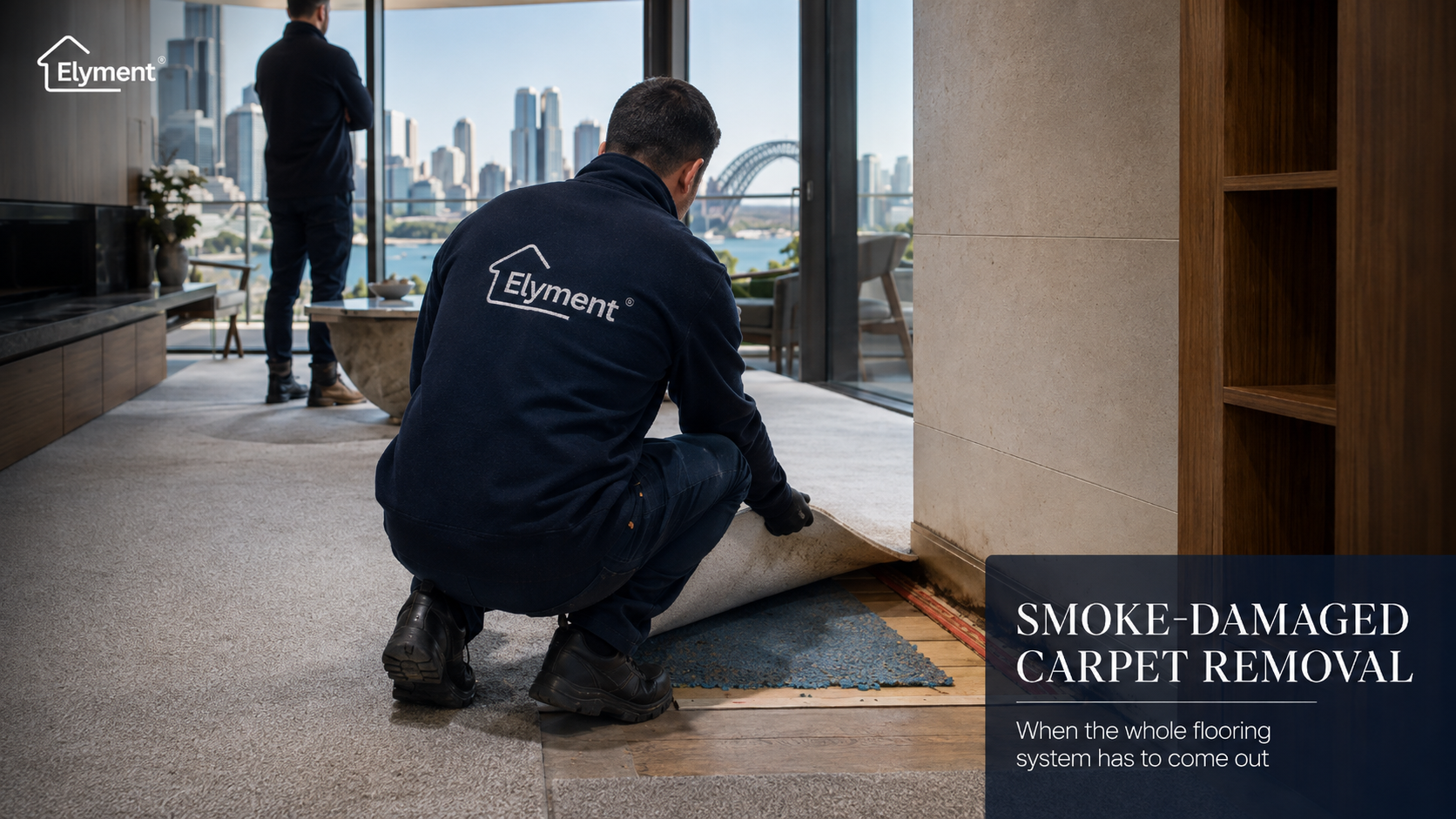
Smoke-damaged carpet, underlay and gripper rods will often need to be removed together when soot, combustion odours or fire-fighting water have penetrated the flooring system. In Sydney homes and strata apartments, the decision should follow a contamination and substrate inspection rather than appearance alone. Carpet can look recoverable while porous underlay, timber grippers and floor edges continue retaining odour or residues that compromise the remediation and subsequent flooring installation.
After a fire, the most visible damage is not necessarily the most consequential. A carpet may show little scorching yet still sit above underlay exposed to smoke, soot or contaminated fire-fighting water. Around the perimeter, timber gripper rods can absorb the same environment while soot collects beside skirting, thresholds and penetrations.
That changes the flooring scope from conventional flooring removal and substrate preparation into part of a broader property remediation sequence.
For Sydney property owners, insurers, strata managers and renovation teams, the critical question is therefore not simply whether the carpet can be lifted. It is where the smoke and moisture travelled, which materials absorbed it, and what must be removed before the floor can legitimately be handed to the next trade.
The Carpet Is Only The Top Layer Of The Problem
A typical stretched-carpet installation is a layered assembly. The carpet sits above underlay, while gripper rods or smooth-edge systems secure it around the perimeter. Staples, joins, doorway interfaces and skirting edges create further locations where residue can accumulate.
Following a smoke event, those layers do not behave in the same way. Carpet fibres may capture particulate contamination. Underlay can absorb moisture and odour. Timber gripper rods are porous and sit precisely where smoke residue can accumulate at floor-to-wall junctions.
This is why a scope that says only "remove carpet" can be inadequate after significant smoke exposure. The project team needs to define the condition of the complete flooring build-up.
- Carpet
- Post-fire concern: Smoke particles, soot, odour, scorching or water exposure.
- What should be assessed: Extent of exposure, visible residue, odour and physical damage.
- Underlay
- Post-fire concern: Absorbed odour, water and hidden contamination.
- What should be assessed: Condition beneath the carpet, not simply the appearance of the surface.
- Gripper rods
- Post-fire concern: Porous timber contamination, corrosion or heat damage.
- What should be assessed: Perimeter exposure, moisture, soot and physical integrity.
- Concrete or timber substrate
- Post-fire concern: Residue, moisture, staining, adhesives or damage.
- What should be assessed: Whether cleaning, grinding, repair or further investigation is required.
- Skirting and doorway edges
- Post-fire concern: Concentrated smoke deposits and hidden residues.
- What should be assessed: Whether flooring removal exposes additional contaminated interfaces.
When The Entire Carpet System Usually Comes Out
There is no useful rule that every carpet in every smoke-affected property must automatically be discarded. A contained incident in one part of a building can produce a very different flooring condition from a heavily smoke-charged room or a property where suppression water travelled through the carpet.
Complete removal becomes considerably more defensible when several indicators occur together.
- The room received direct smoke or soot exposure.
- Persistent smoke odour remains within the flooring system.
- Fire-fighting or suppression water reached the carpet and underlay.
- Underlay is wet, stained, degraded or strongly odorous.
- Gripper rods are smoke affected, damp, charred, distorted or corroding around their fixings.
- Soot is visible around skirting lines, floor penetrations or doorway edges.
- The flooring assembly prevents the underlying substrate from being properly inspected or remediated.
- The insurer, hygienist or specialist restoration scope requires removal.
In these circumstances, retaining one inexpensive concealed component can become operationally counterproductive. If the carpet and underlay are removed but contaminated grippers remain around the perimeter, the project may carry an unresolved odour or cleanliness issue into reinstatement.
Underlay Can Determine The Scope Even When The Carpet Looks Acceptable
Underlay deserves particular attention because it is concealed during the first visual inspection.
A room can appear relatively clean from standing height while the underlay below has absorbed water or retained combustion odours. Once that occurs, judging the installation solely from the carpet face becomes unreliable.
Elyment has previously examined whether existing carpet underlay can be reused in ordinary renovation conditions. Smoke damage creates a materially different decision because the assessment is no longer merely about age, resilience or compression. Contamination and remediation outcomes become central.
Where fire-fighting water has entered the floor, moisture also needs to be separated conceptually from smoke damage. The work can start resembling a water-damage project as much as a conventional carpet removal.
Why Gripper Rods Become A Disproportionately Important Detail
Gripper rods are easy to overlook because they represent a small proportion of the flooring system. Operationally, however, they occupy a sensitive location.
They run around room perimeters, beneath carpet edges and beside skirting. Those are also locations where smoke residue and contaminated moisture can collect.
If timber grippers have been materially exposed, attempting to preserve them can create three problems:
- The remediation boundary becomes incomplete.
- New carpet or another floor finish may be installed beside material that remained within the affected environment.
- Substrate inspection is restricted.
- Removing the rods exposes fixing holes, slab edges and perimeter conditions that may otherwise remain concealed.
- The next installation inherits the old perimeter.
- A small saving during demolition can transfer uncertainty into the reinstatement stage.
Gripper removal itself also needs care. On concrete floors, pulling fixed timber strips can leave holes or localised damage. Elyment has separately examined why old carpet gripper fixing holes can become a flooring problem once a new finish is installed.
Smoke Damage Changes The Sequence Of A Sydney Flooring Project
Normal carpet replacement can move quickly from removal to preparation and installation. A smoke-damaged property often requires additional hold points because flooring demolition intersects with remediation, building access, waste handling and insurer decisions.
A more controlled sequence is:
- Confirm that the area is safe to enter.
- Fire-affected structures can involve hazards beyond flooring, including damaged electrical services, unstable materials, ash and other residues.
- Establish the affected boundary.
- Identify which rooms received smoke, soot, heat or suppression water rather than automatically treating the entire property as identical.
- Confirm the remediation and insurance scope.
- Determine whether carpet removal is part of an insurer-managed restoration, owner-funded renovation or a broader building repair program.
- Inspect concealed flooring layers.
- Controlled lifting can establish whether underlay, grippers and the substrate are affected.
- Remove the agreed flooring assembly.
- Carpet, underlay, perimeter systems and loose fixings should be removed to the documented boundary.
- Expose and assess the substrate.
- Concrete, screed, plywood or timber should be reviewed once the floor covering is gone.
- Complete remediation before flooring preparation.
- Cleaning, drying and specialist remediation should not be confused with levelling or cosmetic floor preparation.
- Prepare the substrate for the specified replacement finish.
- Grinding, patching or self-levelling compound preparation should only proceed once the underlying condition is suitable.
- Release the floor for reinstatement.
- The new flooring trade should receive a clean, documented and properly prepared substrate rather than inheriting an unresolved fire-damage issue.
The Substrate Is The Real Handover Point
One of the most consequential moments in smoke-damaged carpet removal occurs after the final piece of underlay has been lifted.
Until then, the concrete or timber substrate is partly hidden. Once exposed, the team can see whether the fire event has left staining, residue, moisture, damaged adhesives, gripper fixing defects or another substrate condition requiring work.
This distinction matters because removal and restoration are not the same as flooring preparation.
A floor may be cleared of smoke-damaged carpet but still not be ready for engineered timber, vinyl, carpet, epoxy or another finish. Where the substrate requires mechanical correction, the scope may progress into concrete grinding, floor preparation or levelling after the remediation stage has been completed.
Do Not Grind A Fire-Affected Floor Simply Because It Is Exposed
Mechanical grinding is useful for many flooring preparation problems, but it should not become an automatic response to an unknown fire-damage condition.
The material present on or beneath an older Sydney floor should be understood before aggressive mechanical disturbance begins. This is particularly important in older properties where concealed building materials may require further investigation.
SafeWork NSW warns that fire-damaged buildings and debris can contain hazards including asbestos, ash, chemicals and residues from burnt materials. If suspect materials are exposed during carpet removal, the appropriate response is to stop the affected work and establish what is present before grinding or disturbing it further.
Strata Apartments Add Another Operational Layer
Smoke-damaged carpet removal inside a Sydney apartment may involve more stakeholders than the lot owner and removal contractor.
NSW strata rules distinguish between cosmetic work and renovations requiring approval. Installing carpet may ordinarily be cosmetic, while replacing carpet with wood, tile or another hard flooring can fall within the minor-renovation framework. Scheme-specific by-laws can also affect the process.
After a fire, additional questions can arise around common property, building services and access. The owners corporation is generally responsible for maintaining common property, so the boundary between damage within a lot and damage affecting common property should be resolved rather than assumed.
Project teams may need to coordinate:
- strata management and building management;
- insurer or loss-adjuster inspections;
- lift and loading access;
- waste movements through common areas;
- fire alarm or building-service requirements;
- neighbouring occupants;
- remediation specialists;
- flooring removal and preparation contractors;
- replacement flooring installers; and
- painting or make-good trades where perimeter finishes are affected.
The logistics can therefore become more consequential than the carpet removal itself.
Waste Is Part Of The Remediation Plan
Carpet removed from an ordinary renovation and material removed after a significant fire event should not automatically be treated as operationally identical.
The nature of the contamination matters. NSW EPA waste classification requirements provide the framework for determining appropriate waste classification and disposal where contaminants are involved.
For project managers, the practical implication is straightforward: disposal arrangements should be confirmed before crews generate a large volume of removed carpet, underlay and perimeter material.
That is particularly important in apartment buildings where material may need to travel through lifts, loading docks and shared circulation areas before reaching the waste vehicle.
Why A Partial Removal Can Cost More Than A Complete Scope
Partial retention can look financially attractive when a room contains expensive carpet or when only a limited section appears visibly affected. The difficulty emerges when the retained material prevents the property from reaching a satisfactory remediation or flooring handover.
- Retain existing underlay
- Possible downstream issue: Persistent odour or concealed moisture discovered after reinstatement planning.
- Leave old gripper rods
- Possible downstream issue: Perimeter contamination or damaged fixings remain concealed.
- Remove only visibly marked carpet
- Possible downstream issue: Actual smoke boundary extends beyond the demolition boundary.
- Install before substrate review
- Possible downstream issue: Preparation defects or moisture issues are inherited by the new flooring.
- Begin grinding immediately
- Possible downstream issue: Unknown material is mechanically disturbed before appropriate assessment.
In other words, the cheapest demolition scope is not necessarily the lowest-cost project sequence.
The Difference Between Smoke Cleaning And Flooring Readiness
A room can be visually cleaned without being ready for a floor installation.
Conversely, a substrate can be flat enough for new flooring while the property still has unresolved remediation issues. Those are separate acceptance criteria and should remain separate in the project plan.
A useful handover should answer four different questions:
- Has the affected flooring assembly been removed to the correct boundary?
- Has the fire or smoke remediation stage been completed?
- Is the exposed substrate physically suitable for preparation?
- Is the floor actually ready for the replacement flooring specification?
Treating those as distinct decisions reduces the risk of one contractor unknowingly covering a problem that belongs to an earlier stage.
What Sydney Owners Should Establish Before Approving Removal
Before a smoke-damaged flooring job is booked, the scope should be considerably more precise than "remove carpet".
Owners, strata managers and project coordinators should establish:
- which rooms form the agreed affected area;
- whether carpet, underlay and gripper rods are all included;
- whether fire-fighting water reached the floor;
- whether skirting or other perimeter finishes need removal;
- who determines when remediation is complete;
- who is responsible for waste classification and disposal;
- whether suspect underlying materials require assessment;
- what substrate condition the removal contractor must leave behind;
- whether grinding, patching or levelling is a separate stage;
- what strata access or approvals apply; and
- what condition must be achieved before replacement flooring begins.
The Project Delivery Lesson
Smoke-damaged carpet removal is fundamentally a boundary-management problem.
The correct boundary may include more than the visible carpet. It can extend through the underlay, around the gripper system and down to the substrate that must eventually support the replacement finish.
The strongest Sydney remediation projects establish that boundary before demolition begins. They separate emergency response, contamination remediation, flooring removal, substrate preparation and final installation into clear stages, with an identifiable handover between each.
That approach avoids two costly mistakes: retaining affected material because it looks serviceable, and demolishing or mechanically preparing material before the project team understands what it is dealing with.
Define The Removal Boundary Before The Replacement Floor Is Planned
Review smoke-affected carpet, underlay, perimeter grippers, substrate condition, strata requirements, disposal planning and flooring reinstatement sequencing before demolition or preparation begins.
Define The Removal Boundary Before The Replacement Floor Is Planned
Review smoke-affected carpet, underlay, perimeter grippers, substrate condition, strata requirements, disposal planning and flooring reinstatement sequencing before demolition or preparation begins.
Book a Project ReviewRelevant next actions
Explore the ELYMENT service most closely connected to this article.