Tile Removal Cost Sydney: Pedestal vs Glued Tiles
Are pedestal-supported tiles cheaper to remove than glued tiles in Sydney? Compare labour, adhesive removal, and disposal costs before planning your renovation.
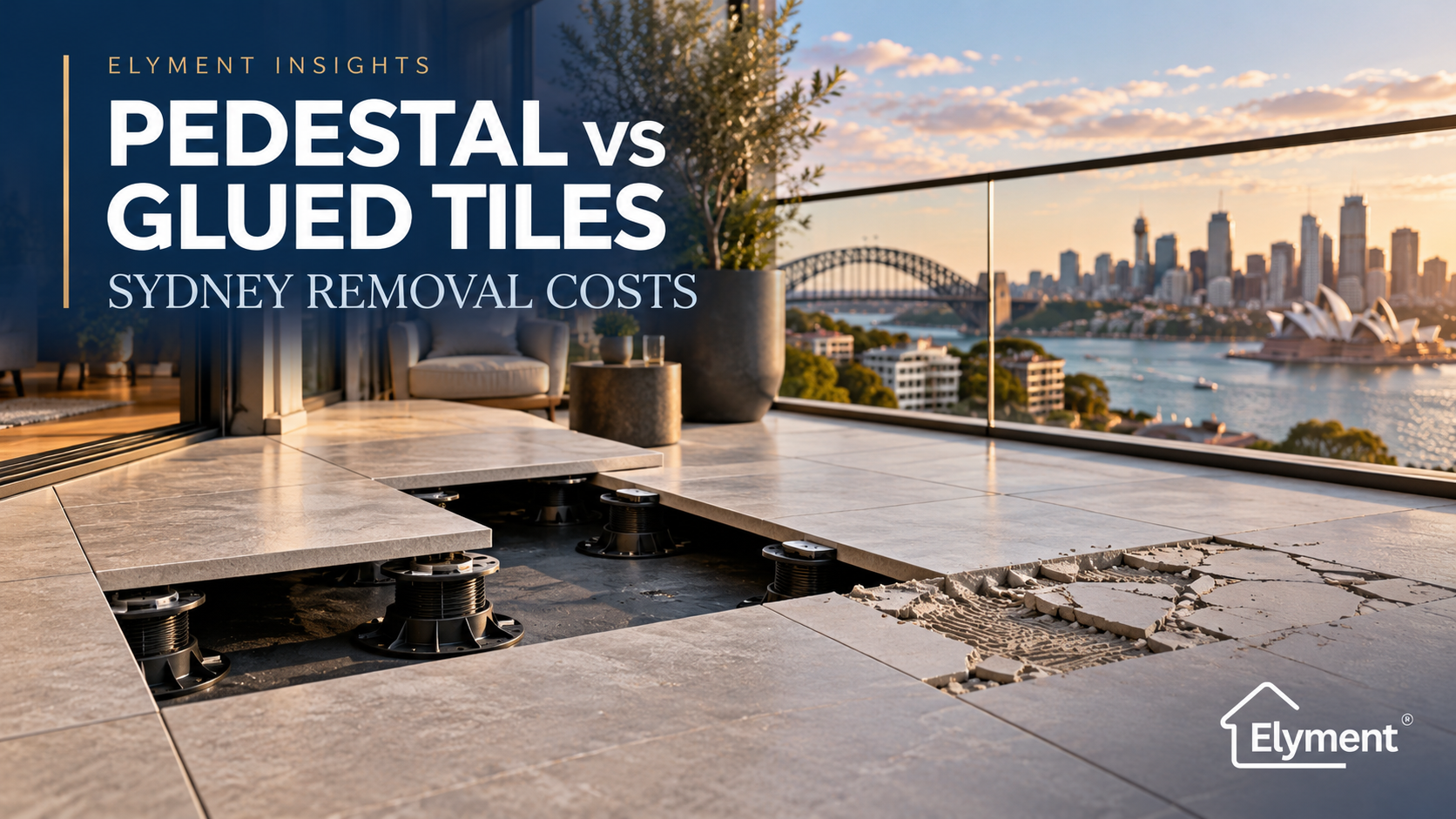
Pedestal-supported tiles are often cheaper to lift than glued tiles because they can be removed without extensive adhesive demolition or grinding. However, Sydney balcony tile removal costs also depend on paver weight, careful handling, reuse, disposal, building access and waterproofing protection. In NSW strata properties, approvals and membrane condition can outweigh the initial labour saving. Quotes should distinguish lifting costs from the complete project scope.
Two Balconies, the Same Area, Two Very Different Removal Jobs
Consider two Sydney apartments with similarly sized tiled balconies.
One has porcelain pavers resting on adjustable pedestal supports. The other has ceramic tiles bonded to a cementitious bed above a waterproofed substrate.
On the property plans, both areas may appear identical. From a demolition perspective, they are fundamentally different.
The pedestal-supported surface may be dismantled piece by piece, potentially allowing the pavers and support system to be retained. The bonded surface may require mechanical breaking, adhesive removal, waste collection and substantial assessment of the layers below.
Yet the apparently simpler project can become expensive when heavy pavers must be carefully extracted, transported through a restricted apartment building, inspected, stored and eventually reinstated.
For Sydney owners and builders, the relevant comparison is therefore not demolition speed alone.
It is the total cost of reaching the required balcony condition without unnecessarily destroying reusable materials or compromising the waterproofing assembly.
The Critical Difference Is Whether the Floor Can Be Dismantled
A pedestal paving system typically separates the walking surface from the supporting substrate.
Pavers sit on proprietary supports, often with open joints that allow rainwater to drain beneath the finished surface.
Depending on the design, the system may permit individual pavers to be removed for maintenance, drainage inspection or replacement.
This is a significant operational advantage over bonded tiles. However, it does not mean every pedestal system is freely liftable.
Some installations incorporate perimeter restraint, mechanical fixing, proprietary locking devices, adhesive-secured components or wind-uplift resistance measures. These must be identified before dismantling begins.
Bonded tiles behave differently. Adhesive or mortar connects the tile finish to the layers beneath, so removal generally requires breaking that bond, often destroying the tile in the process.
Whether the original waterproofing can survive that operation depends on the construction and its condition.
The commercial distinction is straightforward: one system may be dismantled and recovered, while the other often has to be demolished and rebuilt.
Where the Removal Costs Actually Diverge
For a meaningful tile removal cost comparison in Sydney, contractors must price the activities involved rather than applying one rate to every tiled surface.
Operational Comparison of Pedestal-Supported and Bonded Tile Removal
Initial removal
- Pedestal-supported tiles: Individual lifting and controlled dismantling.
- Glued or bonded tiles: Mechanical breaking or chipping of bonded material.
Tile recovery
- Pedestal-supported tiles: Potentially high, if pavers are sound and removable.
- Glued or bonded tiles: Usually limited because the removal process is destructive.
Adhesive removal
- Pedestal-supported tiles: Often unnecessary when the support system is genuinely unbonded.
- Glued or bonded tiles: May require additional mechanical removal.
Concrete grinding
- Pedestal-supported tiles: Not automatically required for simple paver uplift.
- Glued or bonded tiles: May be needed as part of approved substrate preparation.
Waste volume
- Pedestal-supported tiles: Can be reduced when pavers and pedestals are retained.
- Glued or bonded tiles: Often includes broken tiles, mortar and adhesive.
Handling labour
- Pedestal-supported tiles: Potentially substantial when intact heavy pavers must be protected.
- Glued or bonded tiles: Often focused on loading and removing demolition waste.
Waterproofing risk
- Pedestal-supported tiles: Associated with support removal, local loads and exposed membrane protection.
- Glued or bonded tiles: Associated with bonded-layer separation and possible membrane disturbance.
Return installation
- Pedestal-supported tiles: May require labelling, cleaning, storage and reinstatement.
- Glued or bonded tiles: Generally requires a new finish following suitable preparation.
These are scope differences, not verified Sydney market prices or published Elyment quotations.
Online contractor schedules sometimes list pedestal paver removal separately from conventional tile demolition. Those published categories can help frame an enquiry, but their rates should not be represented as Elyment prices or treated as universally applicable to NSW balcony projects.
Elyment's general Sydney tile removal cost guide provides broader context on access, grinding and strata-related quote variables. Pedestal removal requires a more specific assessment of the support system and material destination.
The Cost Question Changes When Owners Want the Pavers Back
Reuse is one of the strongest arguments for pedestal-supported paving. It is also one of the easiest ways to underestimate removal labour.
A contractor instructed to dispose of old pavers is performing a different service from a contractor responsible for returning the same pavers in reusable condition.
Three Commercially Different Outcomes
- Lift and dispose. Pavers and unwanted supports are removed, loaded and transported to an appropriate receiving facility.
- Lift and retain on site. Pavers are removed without unnecessary damage, sorted and placed in an approved temporary storage location.
- Lift, store and reinstate. Pavers are identified, inspected, protected, stored and subsequently returned as part of an agreed reconstruction sequence.
The third option can involve more handling than disposal. A paver may be lifted, carried, cleaned, stacked, moved into temporary storage and then moved back for installation.
Reuse also introduces questions about chips, staining, dimensional consistency and the availability of matching replacement pieces.
Some older pavers may be sound enough for continued service. Others may have cracks, damaged edges or characteristics that make them unsuitable for the intended replacement system.
Reusability should therefore be inspected and agreed rather than guaranteed from photographs.
The NSW Environment Protection Authority's guidance on building-material recovery and reuse supports considering material recovery rather than automatically sending useful construction products to waste.
However, reuse is a practical project decision, not an automatic cost saving.
Why a Small Sydney Balcony Can Generate a Large Handling Bill
A balcony does not need a large floor area to contain a substantial number of individual pavers.
Consider an illustrative 24-square-metre balcony finished with 600 mm by 600 mm pavers.
That area represents approximately 67 full-size paver equivalents before accounting for perimeter cuts and installation details.
If the project requires careful recovery, each individual piece must be handled in a way that minimises damage.
The operation may require:
- Removing edge restraints or approved fixings.
- Carefully lifting full-size and cut pavers.
- Recording locations where reinstatement matters.
- Separating reusable, damaged and discarded material.
- Moving materials through balcony doors and corridors.
- Using suitable lifting equipment, trolleys or team handling.
- Protecting common-area finishes and lift interiors.
- Storing pavers within an approved load and space allowance.
In a house with direct ground-level access, these movements may be relatively straightforward.
In a high-rise building at Barangaroo, Pyrmont, North Sydney or Chatswood, the same materials may require lift bookings, building-manager coordination and several controlled movements.
The weight of the recovered material must be established from the actual product specifications. Storage locations should not be selected without considering structural loading and safe access.
SafeWork NSW's hazardous manual tasks guidance identifies repetitive lifting, forceful handling and awkward postures as risks requiring appropriate controls.
These factors can make an apparently simple lift-and-stack operation considerably more demanding than its description suggests.
The Waterproofing Membrane Is Not a Demolition Surface
The most important physical constraint beneath a pedestal balcony is often the layer that is not visible before lifting begins.
Depending on the building, pedestals may sit above a waterproofing membrane, a proprietary protection layer, insulation, screed or another specified support assembly.
Once the pavers are removed, this assembly may be exposed to foot traffic, stored materials, tools and accidental impact.
A waterproofing membrane that appears intact should not automatically be declared suitable for continued service.
Its condition, age, drainage details, terminations and compatibility with the proposed works require appropriate assessment.
Common Points of Damage During Pedestal Removal
- Dragging heavy pavers across membrane surfaces or protection layers.
- Levering against pedestal bases without identifying the support arrangement.
- Cutting or removing attached components close to waterproofing details.
- Damaging drainage outlets, inspection openings or overflow arrangements.
- Disturbing membrane upturns at sliding doors, walls and balcony perimeters.
- Allowing tools, concentrated storage loads or sharp debris to damage exposed waterproofing.
For Class 2 apartment buildings, the National Construction Code provisions for external waterproofing reference AS 4654.1 and AS 4654.2 for relevant membrane systems.
The applicable NCC edition, NSW variations, original construction requirements and proposed remedial scope must be considered.
Importantly, the presence of removable pavers does not itself establish that the underlying membrane remains compliant or watertight.
Where the work involves membrane replacement, alteration or regulated remedial building work, the required design and practitioner responsibilities should be established before demolition starts.
NSW Fair Trading's remedial building work guidance explains the relevant design and building practitioner framework.
Removing Pavers for Access Is Different From Replacing a Balcony
One reason pedestal systems can offer commercial value is their ability to provide access beneath the walking surface.
A building may need to investigate a blocked drain, inspect a support, check moisture conditions or access a local section of the waterproofing assembly.
If the existing system is designed for removal and reinstatement, limited areas may be opened without demolishing the entire finish.
That possibility creates a different cost model.
The project may require temporary access and reinstatement rather than complete removal and disposal.
By contrast, investigating a problem beneath bonded tiles may require destructive opening, new materials and subsequent reinstatement of the affected floor system.
Partial uplift should nevertheless account for safe temporary openings, perimeter support and the protection of areas remaining in use.
Balustrade interfaces, drainage details and doorway thresholds are particularly important. Elyment's analysis of balcony door threshold and floor-height risks explains why these transitions should not be treated as minor finishing details.
Strata Approval Can Change the Scope Before a Single Tile Moves
Balconies in Sydney apartment buildings frequently involve common-property responsibilities, even when individual residents have exclusive use of the outdoor space.
Ownership, maintenance responsibilities and approval requirements cannot be determined from visual appearance alone.
The NSW Government's strata repairs and maintenance guidance identifies balconies among components generally managed by the owners corporation, subject to the strata plan and applicable by-laws.
Its strata renovation rules also distinguish cosmetic, minor and major renovations, with works affecting waterproofing or common property potentially requiring more extensive approvals.
Before commissioning pedestal tile removal, owners and managers should establish:
- Who owns or controls the relevant balcony components.
- Whether the work is maintenance, access investigation or renovation.
- Whether waterproofing will remain undisturbed.
- Whether approvals, drawings or regulated designs are required.
- Who is responsible for membrane inspection or repair.
- Whether temporary paver storage is permitted.
- What restrictions apply to work hours, lifts and waste removal.
A simple lifting method does not remove the need to determine whether the work is authorised.
When the Cheaper-Looking Method Stops Being Cheaper
Pedestal removal can offer a substantial labour advantage when the supports release readily, the site is accessible and the existing pavers can be removed without extensive preparation.
Several conditions can reverse that advantage.
Conditions That Can Erode the Cost Advantage of Liftable Pavers
Fixed or restrained pedestals
- Commercial consequence: Additional dismantling and potentially specialist equipment.
Fragile or discontinued pavers
- Commercial consequence: Slower handling and uncertainty around replacements.
Restricted lift access
- Commercial consequence: More labour for transport, storage and return movements.
Exposed waterproofing
- Commercial consequence: Protection, inspection and possible remediation requirements.
Limited onsite storage
- Commercial consequence: Offsite transport, storage charges and redelivery.
Drainage or support defects
- Commercial consequence: Additional investigation and potential redesign.
Required membrane replacement
- Commercial consequence: A separate waterproofing and reconstruction programme.
Equally, bonded tile removal can be relatively straightforward when tiles release readily from a sound substrate.
Where extensive grinding or mechanical adhesive removal is required, the work must also consider crystalline silica exposure.
SafeWork NSW's silica safety guidance explains the need to identify hazardous processing and implement suitable exposure controls.
The comparative advantage of pedestal uplift is therefore strongest when destructive work, secondary preparation and unnecessary material movements can genuinely be avoided.
How to Request Comparable Quotes for Pedestal and Glued Tile Removal
Two quotations can refer to the same balcony area while describing entirely different work.
A useful scope separates the following items:
- Existing construction: Confirm tile dimensions, thickness, support method and available construction records.
- Removal boundary: Identify exactly what is to be lifted, dismantled or demolished, and which components must remain.
- Material destination: Specify disposal, on-site retention, off-site storage or future reinstatement.
- Protection requirements: Define controls for exposed waterproofing, drainage, thresholds and adjacent building elements.
- Access logistics: Include lift reservations, loading locations, transport routes and site storage restrictions.
- Inspection hold points: Identify who decides whether the exposed support and waterproofing assembly is suitable for the next stage.
- Variations: Establish how concealed defects, damaged pedestals, membrane repairs and replacement materials will be assessed and authorised.
Quotations should also specify whether GST, waste charges, loading arrangements, protection materials and return visits are included.
For a complete renovation, Elyment's Sydney flooring removal and preparation services provide a broader starting point for coordinating removal, substrate work and subsequent installation.
Where structural slabs may be affected, the permitted removal depth is another important boundary. Elyment has separately examined controlled tile demolition above post-tensioned apartment slabs.
Know What Can Be Lifted. Know What Must Be Protected.
SYDNEY BALCONY & FLOORING PROJECT REVIEW
Review pedestal removal, paver recovery, waterproofing interfaces, strata requirements and site logistics before committing to your balcony renovation.
Request a Balcony Project Review →
REMOVAL PLANNING • MATERIAL RECOVERY • PROJECT COORDINATION
The Long-Term Advantage of Pedestal Paving Is Not Just Cheaper Removal
The most valuable characteristic of pedestal-supported paving may be its reversibility.
A well-designed removable system can make future maintenance, local inspection and component replacement less destructive than work involving permanently bonded finishes.
That does not mean pedestal paving is suitable for every balcony, nor that it will always produce the lowest replacement cost.
Installation requirements, wind exposure, pedestal stability, finished floor heights, drainage and waterproofing compatibility must all be considered.
For Sydney owners, the immediate cost advantage is most convincing when pavers can be lifted safely, necessary materials can be retained and the waterproofing system does not require further intervention.
Where those conditions are absent, careful handling, storage and remediation may absorb much of the apparent saving.
The soundest financial comparison is not the cost of getting tiles off a balcony. It is the cost of delivering a protected, inspected and properly prepared balcony for its next use.
Sources and References
- NSW Environment Protection Authority: Household Building and Renovation — Material Recovery and Reuse
- SafeWork NSW: Hazardous Manual Tasks
- National Construction Code 2022: Part F1 — Surface Water Management, Rising Damp and External Waterproofing
- NSW Fair Trading: Remedial Building Work — Building Practitioner Obligations
- NSW Government: Strata Repairs and Maintenance
- NSW Government: Strata Renovation Rules
- SafeWork NSW: Working Safely with Crystalline Silica and Engineered Stone
- Elyment: Tile Removal Cost Sydney — Real Quotes, Grinding and Strata
- Elyment: Why Do Balcony Door Thresholds Expose Subfloor Errors Faster Than Any Other Part of a Sydney Apartment?
- Elyment: Flooring Services
- Elyment: Tile Removal Sydney in Post-Tensioned Apartments — How Is Demolition Depth Controlled Above the Slab?
Know What Can Be Lifted. Know What Must Be Protected.
Review pedestal removal, paver recovery, waterproofing interfaces, strata requirements and site logistics before committing to your balcony renovation.
Request a Balcony Review REMOVAL PLANNING • MATERIAL RECOVERY • PROJECT COORDINATIONRelevant next actions
Explore the ELYMENT service most closely connected to this article.