Tile Removal Quotes Sydney: What Does “Fully Insured” Cover?
Comparing tile removal quotes in Sydney? A 'fully insured' claim may not cover every task. Check policy scope, exclusions and liability before booking the work.
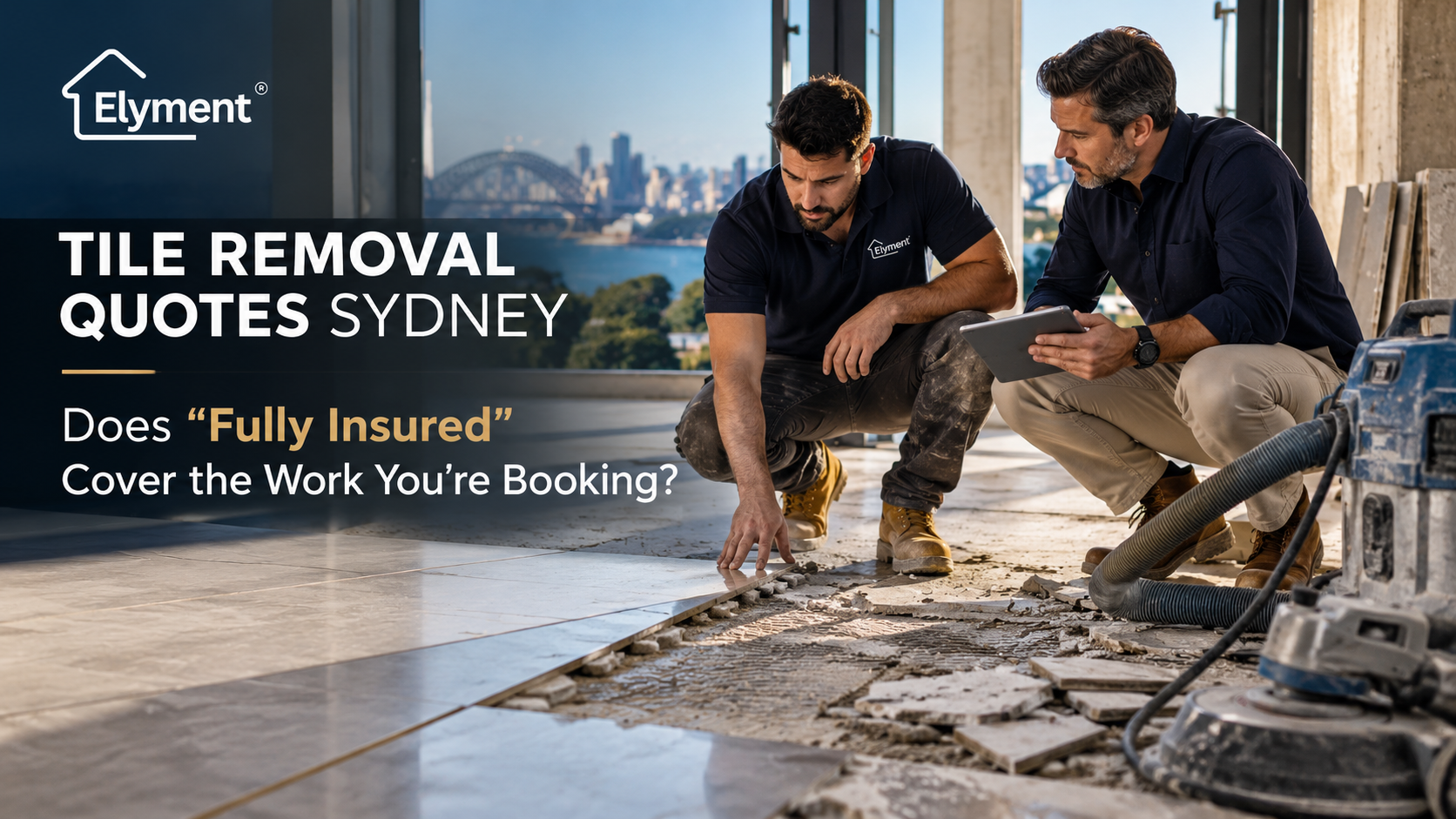
A Sydney tile removal contractor advertising "fully insured" does not necessarily have cover for every activity, damage scenario or defect. Before accepting a quote, verify the insured business, policy dates, declared work and relevant exclusions. In NSW, public liability insurance is different from responsibility for defective workmanship and any applicable Home Building Compensation insurance. A certificate of currency confirms insurance details, not the outcome of a future claim.
The Two Words That Can Conceal a Significant Contract Risk
"Fully insured" is one of the most reassuring descriptions in a renovation quotation. It is also one of the least precise.
For a Sydney property owner arranging tile removal, the expression may suggest that damage to the apartment, neighbouring property, concrete slab or existing services will automatically be covered.
That interpretation goes further than an insurance certificate ordinarily supports.
An insurance policy is issued to an identified insured business, for specified risks, during a defined period and subject to conditions, limits and exclusions. It does not operate as a blanket guarantee against every unsuccessful renovation outcome.
The distinction becomes important when a tile removal project involves mechanical demolition, adhesive grinding, concrete preparation or work inside an occupied strata building.
The commercial question is not simply whether a contractor can produce an insurance document. It is whether the insured activities correspond to the work being purchased, and which party remains responsible when something goes wrong.
First Establish Who Is Actually Insured
A professional-looking certificate is not sufficient if the business named on it cannot be connected clearly to the business accepting the contract.
Renovation projects may involve a trading name, registered company, sole trader, principal contractor and one or more subcontractors.
Those arrangements are legitimate, but the legal identity of the insured matters.
Consider a hypothetical apartment renovation in Sydney's Eastern Suburbs.
A property owner receives a tile removal quote from one trading business, receives an invoice displaying a different company name and is provided with an insurance certificate issued to a third entity.
There may be a reasonable explanation. The businesses could be related or operating within a documented contracting arrangement.
Nevertheless, the owner should establish the connection before authorising work.
The pre-contract verification should identify:
- The full legal name of the contracting business.
- The Australian Business Number (ABN), where applicable.
- The legal entity shown on the insurance certificate.
- Any trading names, related entities or additional insured parties.
- Who will perform the work and whether subcontractors are involved.
- Whether subcontracted operations fall within the relevant insurance arrangements.
A mismatch does not establish that a contractor is uninsured. It establishes a question that should be resolved in writing.
Business identity can be independently checked through the Australian Business Register.
The Insurance Certificate Must Match the Work, Not Just the Contractor
Tile removal can describe several substantially different activities.
One contractor may be engaged only to lift loose tiles and remove debris. Another may undertake mechanical demolition, remove bonded mortar, grind adhesive and prepare the exposed concrete for subsequent flooring installation.
These differences matter when considering the operations declared to an insurer.
A certificate describing general property maintenance or flooring installation should not automatically be treated as confirmation that mechanical demolition and concrete grinding are covered.
Where the description is broad or ambiguous, the appropriate step is to obtain written clarification from the insurer or authorised insurance broker.
Activities Worth Checking Against the Policy
- Mechanical tile demolition
- Insurance verification question: Does the insured business's declared activity include this form of removal?
- Adhesive and mortar grinding
- Insurance verification question: Are abrasive floor-preparation operations included or restricted?
- Work around existing services
- Insurance verification question: What exclusions or conditions may affect damage to pipes, cabling or other property?
- Occupied strata property
- Insurance verification question: How does the policy respond to third-party damage involving common property?
- Subcontracted demolition
- Insurance verification question: Are subcontractors covered, or must they maintain their own relevant insurance?
- Specialist hazardous-material work
- Insurance verification question: Are relevant exclusions, licensing and specialist insurance requirements addressed?
The purpose of this review is not to assume that an exclusion applies. It is to identify uncertainty before the contractor mobilises.
Elyment's tile removal services in Sydney describe the practical relationship between demolition, adhesive removal and substrate preparation. Those activities should also be accurately reflected in the contract and relevant insurance assessment.
Public Liability Insurance Does Not Automatically Pay to Fix Bad Work
This is the distinction most likely to be misunderstood.
Public liability insurance generally addresses specified legal liabilities involving third-party personal injury or property damage, subject to the actual policy wording.
It is not ordinarily a performance warranty guaranteeing that every aspect of the contractor's work will be completed correctly.
The distinction can be illustrated through two hypothetical renovation outcomes.
Scenario A: Accidental Damage to Other Property
A removal worker moves equipment through an apartment building and accidentally damages a common-property wall or lift entrance.
Depending on the circumstances, the contractor's legal liability and policy terms, public liability insurance may be relevant.
However, the claim is not automatically payable. Coverage, exclusions, liability and policy conditions still require assessment.
Scenario B: The Agreed Work Is Performed Incorrectly
A contractor agrees to remove tiles and prepare a floor to a specified condition, but the completed work fails to meet that agreement.
The cost of correcting the defective work itself may fall outside ordinary public liability coverage.
The contractor's contractual obligations, statutory responsibilities and any applicable warranty rights need to be considered separately.
If defective work also causes distinct damage to other property, a different insurance analysis may arise. Neither the presence nor absence of cover can be established from the certificate alone.
The NSW Government's guidance on contractor insurance distinguishes public liability, contract works, workers compensation and Home Building Compensation insurance.
Four Insurance Documents, Four Different Purposes
A contractor may need different forms of cover according to the work, workforce and contractual arrangements.
These insurance categories should not be treated as interchangeable.
Insurance Types, Principal Purposes and Limitations
- Public liability
- Principal purpose: Specified legal liabilities for third-party injury or property damage.
- Important limitation: Not a general guarantee to rectify defective workmanship.
- Contract works
- Principal purpose: Specified accidental loss or damage involving construction work and materials.
- Important limitation: Cover depends on the insured project, period and policy conditions.
- Workers compensation
- Principal purpose: Work-related injury and illness protection for workers under applicable legislation.
- Important limitation: Does not replace public liability cover for third-party property damage.
- Home Building Compensation
- Principal purpose: Last-resort protection for eligible NSW residential building work.
- Important limitation: Subject to statutory eligibility, requirements and claim-triggering circumstances.
The NSW Home Building Compensation Question
In NSW, qualifying residential building work exceeding $20,000 including GST generally requires Home Building Compensation insurance, subject to statutory exclusions and exemptions.
Importantly, a tile removal contract does not necessarily qualify simply because it exceeds that amount. The legal classification of the actual work matters, including whether it is excluded demolition work or forms part of qualifying residential renovation activities.
The insurance obligation should therefore be assessed against the complete contract rather than assumed from its price or title.
Where required, the relevant cover must be obtained and verified before work commences and before payment is accepted, including a deposit.
Property owners can consult Building Commission NSW's insurance guidance and the official HBC Check service.
This is separate from Elyment's discussion of Home Building Compensation requirements for magnesite removal, which examines statutory classification and contract structure in greater detail.
Why Policy Dates and Exclusions Can Affect the Demolition Schedule
Renovation programmes rarely remain entirely unchanged between quotation and commencement.
A project may be quoted in October, approved weeks later and rescheduled because a building lift is unavailable or another trade has not completed its work.
An insurance certificate issued during the quotation period may no longer provide current evidence when demolition actually begins.
Contractors and project managers should verify that appropriate insurance arrangements remain in place for the intended work dates.
They should also review, where relevant:
- Policy commencement and expiry dates.
- The insurer and relevant policy number.
- Policy limits, excesses and any applicable sublimits.
- Activities and locations covered by the policy.
- Restrictions involving work on existing property.
- Exclusions potentially affecting faulty workmanship or damage to the work itself.
- Any hazardous-material or pollution exclusions.
- Conditions concerning subcontractors and notification of incidents.
A certificate of currency usually provides summary evidence of the insurance arrangements at the relevant point in time. It is not the full policy wording and cannot establish that every potential claim will be accepted.
Where a material risk is uncertain, owners should request a relevant policy extract or written confirmation from the insurer or authorised broker.
Sydney Strata Projects Make Insurance Verification an Operational Decision
The consequences of unclear insurance become more complicated when demolition takes place inside an occupied residential building.
Consider an illustrative apartment renovation in North Sydney.
The owner has approval to replace existing flooring and has booked a contractor to remove tiles before a subsequent installation.
The proposed work involves transporting machinery through a shared corridor, using the building's lift and grinding adhesive from the exposed slab.
The owners corporation may require contractor information, insurance evidence, approved working hours and protection of common property.
These requirements are separate from the question of whether an individual insurance claim would eventually succeed.
The NSW Government's strata renovation guidance explains that approval requirements depend on the proposed work and applicable strata rules.
An owners corporation approving a renovation does not guarantee the contractor's insurance coverage. Similarly, holding public liability insurance does not replace the need for applicable strata approvals.
This creates a practical procurement checkpoint: verify the correct contractor documents before locking in building access and the downstream flooring installation programme.
Insurance Is Not a Substitute for Controlling Demolition Hazards
Insurance addresses certain financial consequences of defined risks. It does not remove the legal and operational obligation to manage hazards before they cause harm.
Tile removal and adhesive grinding can generate respirable crystalline silica when silica-containing materials are disturbed.
SafeWork NSW's crystalline silica guidance explains the need for appropriate risk assessment, engineering controls and safe work procedures.
Where older flooring materials, adhesives or underlying layers are suspected of containing asbestos, the material should not be disturbed until an appropriate assessment establishes the safe and lawful process.
Specialist removal may require additional licensing, notification and insurance arrangements.
A generic public liability certificate does not establish that hazardous-material work is authorised, safe or insured.
For more extensive preparation programmes, Elyment's flooring demolition and removal planning considers how strip-out, waste handling, grinding and substrate checks connect before the next trade begins.
What Happens if Damage Is Discovered After Tile Removal?
A dispute often becomes more difficult when the parties cannot establish when damage occurred, what condition existed beforehand or which contractor was responsible.
A practical approach is to maintain a clear evidence trail throughout the work.
- Record pre-existing conditions. Photograph relevant walls, thresholds, fixtures, service locations and accessible floor areas before demolition.
- Record the authorised work. Retain the signed quote, work description, agreed exclusions, insurance evidence and any written variations.
- Stop and assess unexpected damage. Where damage or an unidentified hazard is discovered, make the area safe and avoid further disturbance until it is assessed.
- Notify the appropriate parties. Follow contractual and policy notification requirements, involving the contractor, insurer, broker, building manager or independent professional where relevant.
- Agree on the next stage. Establish responsibility for investigation, rectification, associated costs and the revised schedule before unrelated trades conceal the affected area.
These records do not determine legal liability or guarantee an insurance payment.
They do, however, provide a more reliable basis for factual assessment and project coordination.
Insurance Should Be a Pre-Start Gate, Not a Last-Minute Attachment
A strong procurement process connects insurance verification to the actual work order.
For property owners, builders and renovation coordinators comparing tile removal quotes in Sydney, a practical pre-start gate involves three decisions.
1. Has the Correct Business Been Verified?
The contractor's legal identity, insurance documents and subcontracting arrangements should be consistent and understood.
2. Have the Actual Operations Been Declared?
The work description should reflect mechanical tile removal, grinding and any other significant activity included in the appointment. Relevant exclusions should be clarified with the insurer or broker where necessary.
3. Is the Project Ready to Proceed?
Applicable approvals, work controls, contractual responsibilities, insurance evidence and variations procedures should be settled before mobilisation.
Where the proposed work later changes, the insurance position may also require review. Adding concrete repairs or another specialist operation should not be treated as a purely administrative price variation.
The cost of a compliance delay cannot be reduced to one standard figure. It depends on the project's programme, contractual arrangements and the resources affected.
However, resolving insurance uncertainty before demolition is generally easier than investigating responsibility after work has commenced.
Review the Scope Before Work Starts
ELYMENT | PROPERTY & RENOVATION OPERATIONS
Plan tile removal, contractor documentation, project responsibilities and renovation sequencing before committing to your Sydney project.
Request a Renovation Project Review →
Sydney & NSW | Project Planning | Compliance Considerations | Delivery Support
The Strongest Insurance Claim Is One That Can Be Verified
Insurance verification is not about eliminating every possible renovation risk.
It is about understanding the risks that have been transferred to an insurer, the obligations that remain with the contractor and the decisions that remain with the property owner.
In a Sydney tile removal project, the phrase "fully insured" should be the beginning of that assessment, not its conclusion.
The contractor's identity, work description, policy period and relevant exclusions should align with the job being booked.
Where the evidence does not answer those questions, written clarification should precede commencement.
That approach protects more than the insurance conversation. It supports clearer contracts, safer mobilisation, more reliable scheduling and better coordination between demolition, concrete preparation and subsequent renovation trades.
Editorial Note: General NSW information as at 24 October 2026. Insurance coverage, licensing obligations and statutory requirements depend on the actual work, contracting arrangement and applicable legal and policy terms. Seek relevant professional advice where necessary.
Sources and References
Government and Regulatory Guidance
- Australian Business Register: ABN Lookup
- NSW Government: Insurance Requirements for Contractors
- Building Commission NSW: Insurance Cover
- NSW Government: HBC Check Service
- NSW Government: Strata Renovation Rules
Workplace Health and Safety
Elyment Services and Related Articles
- Elyment: Tile Removal Services Sydney
- Elyment: Flooring Demolition and Removal Sydney
- Magnesite Removal Sydney: When Is HBC Cover Required?
ELYMENT | PROPERTY & RENOVATION OPERATIONS
Review the Scope Before Work Starts
Plan tile removal, contractor documentation, project responsibilities and renovation sequencing before committing to your Sydney project.
Request a Renovation ReviewSydney & NSW | Project Planning | Compliance Considerations | Delivery Support
Relevant next actions
Explore the ELYMENT service most closely connected to this article.