Car Park Epoxy Peeling: Repair Scope & Concrete Grinding Sydney
Peeling car park epoxy may need spot grinding or full floor preparation. Learn what determines the repair scope and how to avoid repeat failure and added costs.
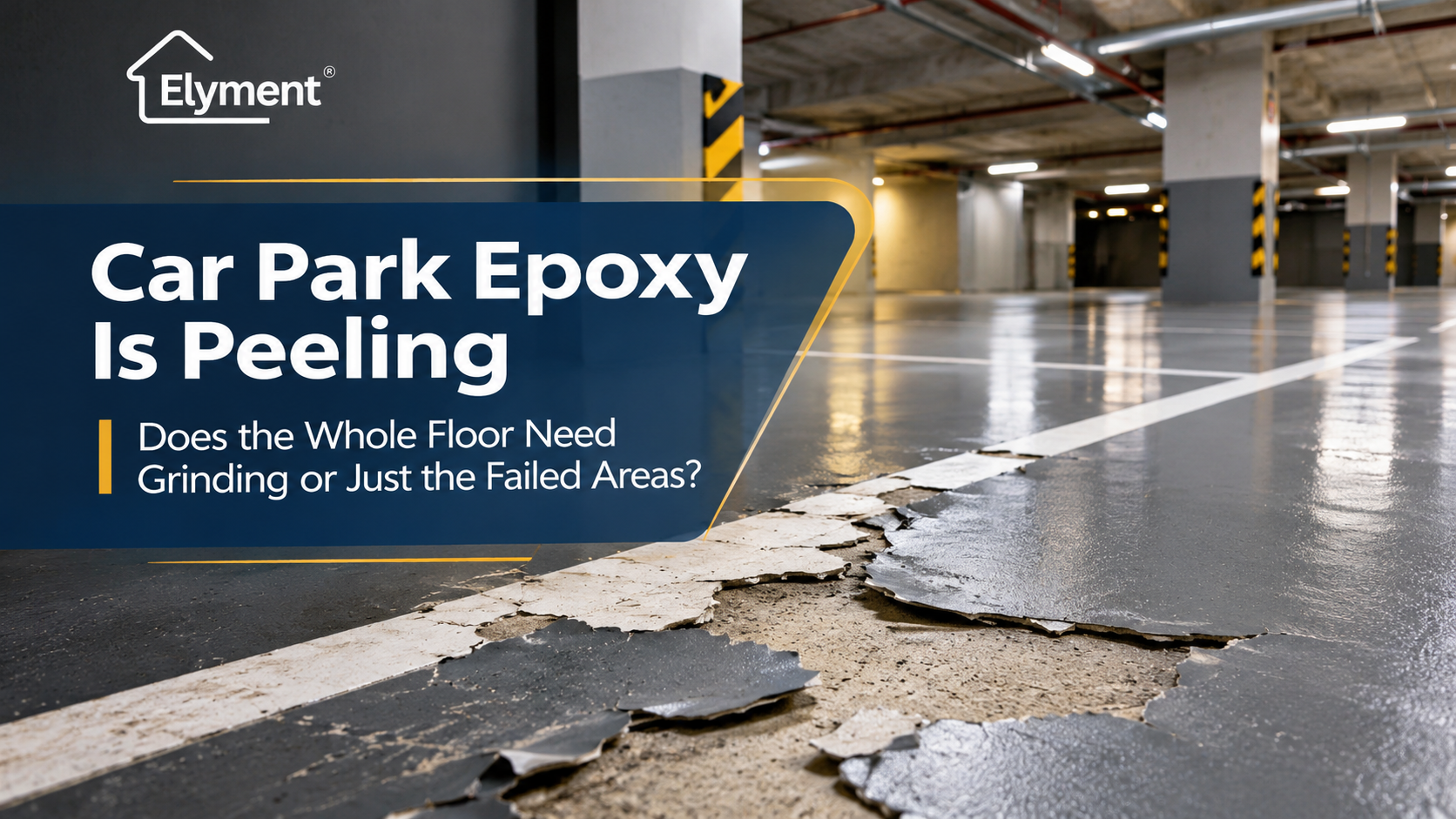
Not necessarily. In a Sydney strata or commercial car park, peeling confined to a few bays may justify selective epoxy removal and concrete preparation, provided inspection shows the surrounding coating is sound and compatible with the repair system. Peeling repeated across unrelated bays, ramps and circulation lanes points towards wider testing and potentially full strip-back. The quote should follow a mapped failure assessment, not the total floor area alone.
A peeling epoxy floor can create an expensive misunderstanding in a Sydney car park. A facility manager sees coating lifting beneath vehicle tyres, asks for concrete grinding, and receives a quotation covering the entire basement. Another contractor recommends repairing only the visibly damaged bays.
Both proposals may be reasonable. Neither is properly justified until someone establishes how far the coating failure extends.
The financial difference is considerable in principle. Removing coating that remains sound creates unnecessary preparation and replacement work. Leaving behind coating that is already losing adhesion risks another failure and a second round of expenditure.
For strata committees and commercial property managers, the first task is therefore not choosing a grinding contractor. It is establishing the physical boundary of the failure and documenting the evidence behind that boundary.
A Failed Parking Bay Does Not Define the Condition of the Basement
Consider a hypothetical 60-bay apartment car park in Sydney. Six bays show obvious peeling, particularly around tyre contact areas. The remaining bays appear serviceable.
That observation does not establish whether six bays require attention or whether the original coating system has a wider adhesion problem.
There are three different areas to consider:
- Visibly failed coating: Sections where epoxy has lifted, blistered, cracked or separated from the underlying surface.
- Suspect adjoining coating: Material surrounding the visible failure that may have lost adhesion without yet peeling.
- Apparently sound coating: Areas that show no obvious failure but still require representative assessment before being retained.
The distinction matters because the area requiring removal is not necessarily equal to the area where peeling can be seen.
For example, lifting beneath tyres may be concentrated in a small section, while examination of the surrounding surface reveals that the coating continues to separate beyond the visible edge. Conversely, an isolated damaged patch may be surrounded by firmly bonded epoxy that can remain in place, subject to the replacement system's requirements.
Elyment has separately examined the technical choice between recoating existing epoxy and stripping it back. The more specific question for a car park manager is how to establish and measure the removal boundary before asking contractors to price the work.
The Inspection Should Produce an Area Schedule, Not Just a Condition Report
A photograph of peeling epoxy proves that a defect exists. It does not tell the contractor how many square metres must be removed.
A more useful inspection records the condition against the parking layout. Each observation can then be linked to a measurable repair area.
Before requesting a firm removal price, the manager should ask the inspection team to complete the following:
- Identify the affected locations. Record bay numbers, circulation lanes, ramp sections and other affected floor areas on the existing car park plan.
- Measure visible failures. Estimate the length, width and approximate surface area of each visibly damaged section. Record adjoining suspect areas separately.
- Inspect beyond the peeling edge. Assess whether the surrounding coating remains bonded. Do not assume that a visually intact surface is a sound surface.
- Compare representative locations. Examine both failed and apparently unaffected areas, including different levels, coating applications or exposure conditions where relevant.
- Record possible contributing conditions. Note oil staining, moisture evidence, cracking, previous repairs, traffic wear and any changes in the coating's appearance or thickness.
- Define the provisional removal boundary. Mark the area proposed for stripping, any additional investigation zones and the coating intended to remain.
The resulting document should be practical: an annotated plan, photographs linked to locations, measured quantities and a record of which assumptions still require verification.
Where the underlying slab or previous floor preparation is uncertain, Elyment's Sydney flooring removal and concrete preparation services provide broader context for separating coating removal from the preparation required for the next floor system.
The Most Important Inspection Is Often Outside the Failed Area
Visible peeling identifies where the coating has already failed. Testing elsewhere helps determine whether that failure is isolated.
A qualified coating specialist may recommend adhesion testing at representative locations, particularly where the retained coating will form part of the repaired system.
One recognised method is pull-off adhesion testing. AS 1580.408.5 describes a method for assessing coating adhesion, while the Australian Engineering Consultancy & Testing Laboratory's guidance explains why the failure location must be interpreted alongside the measured strength.
The distinction is important. A test may reveal separation between the coating and concrete, failure between coating layers, or weakness within the concrete itself. Those findings have different implications for a repair.
Testing should be selected and interpreted by a suitably competent specialist. It may be destructive, and an individual result should not be treated as proof of the condition of the entire basement. Acceptance criteria depend on the coating specification and proposed repair system.
The inspection may also require investigation of moisture, contamination or defective substrate material. If these conditions remain unresolved, grinding off the visible epoxy may not address the reason the floor failed.
How the Findings Change the Grinding Scope
The distribution of defects is particularly useful when translating inspection results into a quotation.
Inspection findings, removal implications and quotation approaches
- Peeling limited to isolated bays
- Removal implication: Selective removal may be suitable if adjacent coating is verified as sound and compatible.
- Quotation approach: Measure individual repair footprints, including necessary boundary preparation.
- Failure concentrated across adjoining bays
- Removal implication: A continuous preparation area may be more appropriate than numerous individual patches.
- Quotation approach: Price a defined combined removal zone rather than separate small patches alone.
- Peeling repeated across unrelated areas
- Removal implication: Wider bond failure may make selective retention difficult to justify.
- Quotation approach: Obtain a wider-area assessment and price broader or complete removal where supported by findings.
- Unknown coating, inconsistent test results or unresolved moisture
- Removal implication: The removal extent cannot yet be established reliably.
- Quotation approach: Separate further investigation from the provisional removal and repair costs.
These are scope-setting indicators, not automatic rules. A small area of visible damage does not guarantee a small repair, and a large area of cosmetic wear does not necessarily require complete stripping.
Repair boundaries also need to account for the replacement coating specification. The contractor may need to extend removal beyond the visibly loose material, prepare sound adjoining coating, or create a defined transition between old and new surfaces.
The final extent should be supported by the inspection evidence and agreed repair methodology.
Why Two Concrete Grinding Quotes Can Be Impossible to Compare
One contractor may quote to remove all epoxy from an entire parking level. Another may allow only for visibly loose coating. A third may include removal, concrete profiling and local substrate repairs under one combined rate.
Without a common scope, comparing the total prices tells the manager very little.
For meaningful tender comparison, the request should distinguish the following quantities and activities:
- Confirmed removal area: Measured square metres supported by inspection findings.
- Provisional additional removal: A separately priced allowance for coating found to be unsound beyond the agreed boundary.
- Grinding and surface profiling: The required condition of exposed concrete before the replacement coating is applied.
- Perimeter and detail work: Treatment around columns, walls, drains, joints and existing coating transitions.
- Concrete repairs: Clearly defined inclusions or exclusions for cracks, spalling, weak patches and damaged substrate.
- Waste and safety controls: Removal of debris, dust management, protection and disposal requirements.
- Replacement coating: A separate line item identifying the proposed system, preparation requirements and final finish.
A unit rate for additional coating removal can be useful, provided the quotation states what is included, the circumstances in which that rate applies, and how additional areas will be measured and approved.
This avoids a common procurement problem: accepting a low initial price based on limited removal, only to discover that the contractor and property manager have different expectations about how much old epoxy may remain.
Commercial coating-removal scope guidance also identifies coating thickness, bonding, contamination, equipment, edges, waste and final preparation as factors that influence removal work. These should be considered separately from the simple floor-area measurement.
The Strata Approval Should Match the Evidence
For residential strata schemes, the inspection record serves another purpose: it helps explain why the proposed expenditure is proportionate to the condition of the property.
Under section 106 of the Strata Schemes Management Act 2015, NSW owners corporations have responsibilities to maintain and repair common property. The classification of particular car park surfaces and responsibility for their maintenance should be checked against the relevant strata plan, by-laws and other applicable documents.
The NSW Government's strata repair guidance explains the approval process, including that owners corporations approving work valued above $30,000 generally must obtain at least two independent quotes, subject to exceptions such as emergency repairs.
That requirement makes comparable scope particularly important.
A committee cannot reliably assess value if one price assumes the complete car park will be stripped while another covers only the obvious defects.
A defensible approval submission should therefore contain:
- A plan showing the observed defects and proposed removal areas.
- The evidence supporting retention or removal of the surrounding coating.
- The confirmed and provisional work quantities.
- Comparable quotations based on the same scope.
- Approval arrangements for any additional removal discovered during the works.
Where the slab shows significant cracking, water ingress, structural movement or other potentially serious defects, the manager should seek appropriate specialist advice rather than allowing a surface-coating quotation to become an unapproved structural repair.
Grinding Safety Changes the Scope Even When the Repair Is Small
Selective removal does not remove the need to manage site hazards.
Mechanical grinding of concrete can generate respirable crystalline silica. SafeWork NSW's crystalline silica guidance outlines risk assessment, exposure controls, dust extraction, isolation and other applicable obligations.
The contractor should also assess hazards associated with the existing coating, equipment access, air movement, nearby vehicles and the proposed removal method.
These requirements can influence the cost of even a small repair, particularly where mechanical preparation must be undertaken within an occupied basement.
However, determining how much coating must be removed is a separate decision from determining when each work area can be closed. Elyment has covered the latter in its examination of bay-by-bay coating removal in Sydney car parks.
A Written Expansion Rule Protects the Approved Budget
Even a carefully inspected coating can conceal problems.
The useful contractual safeguard is a clear rule for what happens when the contractor discovers unsound coating outside the approved removal area.
Before grinding begins, agree that additional removal requires documented findings, a revised measured area and authorisation by the appropriate project representative, except where immediate safety action is required.
That arrangement allows legitimate additional work to be considered without making the original quote meaningless.
It also establishes an important separation between the contractor identifying a defect and the property owner approving the cost of rectification.
The Decision Is About Evidence, Not the Size of the Car Park
A peeling car park floor does not automatically justify grinding every square metre. Equally, retaining most of the existing epoxy simply because it still looks intact is not an adequate repair strategy.
For Sydney strata and facility managers, the stronger approach is to map the failure, assess representative unaffected areas, verify the proposed removal boundary and obtain quotations against the same measured scope.
The immediate saving may come from avoiding unnecessary stripping. The more important protection is preventing a repair that leaves an unsound coating system beneath the new finish.
Review the Car Park Coating Removal Scope
Planning epoxy repairs in a Sydney strata or commercial car park? Elyment can discuss the inspection findings, proposed concrete preparation, removal boundaries and project coordination requirements before the scope is finalised.
Request a Project Scope Review
Sources and References
Technical standards and testing guidance
- AS 1580.408.5 — Pull-off adhesion testing of coatings.
- Australian Engineering Consultancy & Testing Laboratory: Pull-Off Adhesion Testing
- Surface Master Australia: Commercial Concrete Coating Removal
NSW legislation, strata guidance and workplace safety
- Strata Schemes Management Act 2015 (NSW) — Section 106, maintenance and repair of common property.
- NSW Government: Strata Repairs and Maintenance
- SafeWork NSW: Working Safely with Crystalline Silica
Related Elyment guides and services
- Epoxy Floor Repairs Sydney: Recoat Over Old Epoxy or Strip It Back
- Concrete Coating Removal Sydney in Car Parks: Can Old Epoxy Be Ground Off Bay by Bay?
- Elyment: Sydney Flooring Services
Review the Car Park Coating Removal Scope
Planning epoxy repairs in a Sydney strata or commercial car park? Elyment can discuss the inspection findings, proposed concrete preparation, removal boundaries and project coordination requirements before the scope is finalised.
Request a Scope ReviewRelevant next actions
Explore the ELYMENT service most closely connected to this article.