Commercial Floor Levelling Sydney: Vibrating Machinery Shutdown
See whether vibrating machinery must be shut down before commercial floor levelling in Sydney, including bonding, curing, surface finish and pour quality risks.
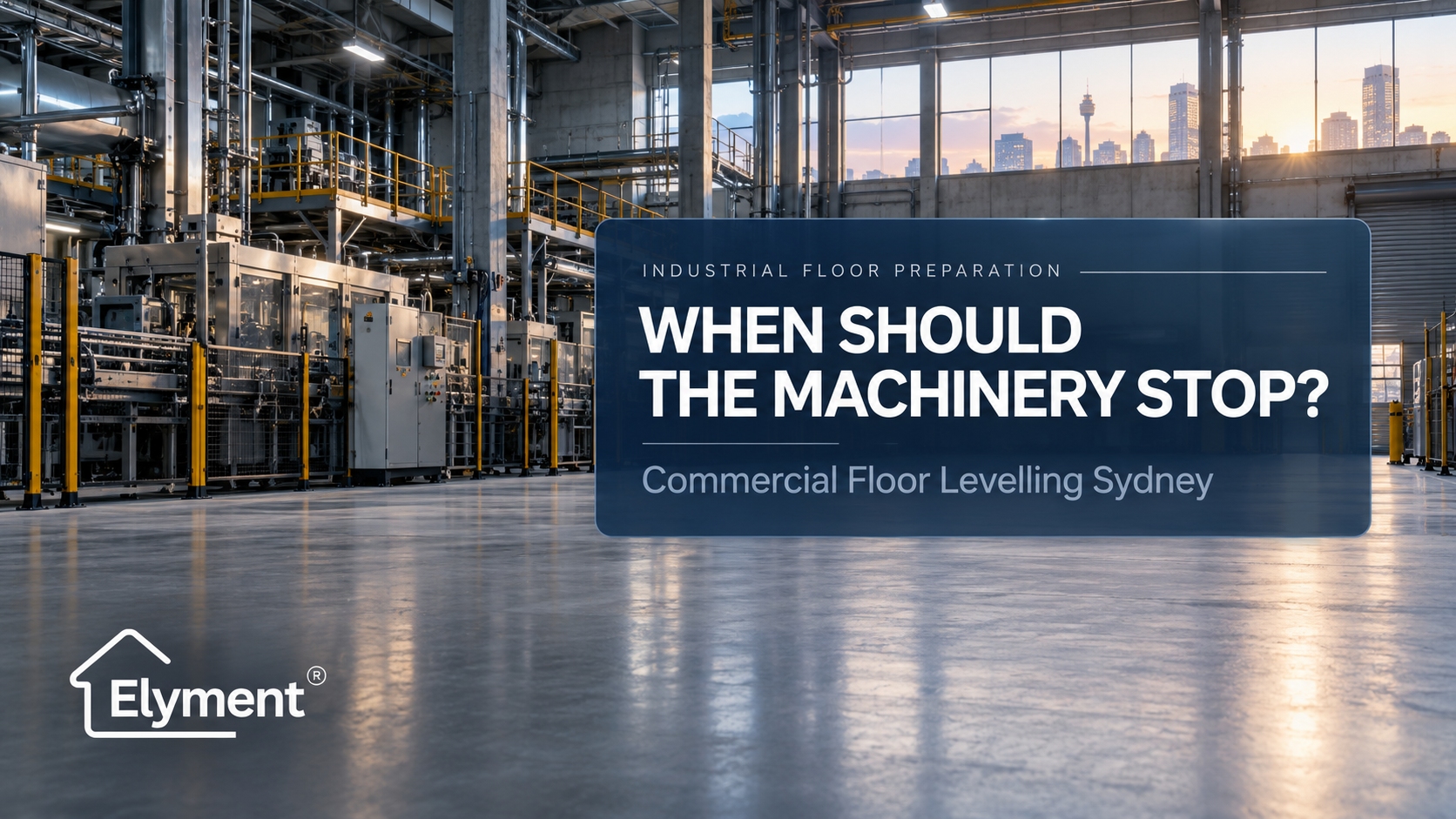
No, vibrating machinery does not always need to be shut down before commercial floor levelling in Sydney. The decision depends on whether vibration is being transmitted into the slab, how the selected levelling system responds to movement, and how long the material needs protected conditions after placement. On live NSW industrial sites, shutdown planning should be treated as a controlled project hold point, not a last-minute request from the flooring crew.
The Pour Does Not Begin With the Mixer
In an occupied office, an uneven concrete floor can often be isolated from the rest of the building long enough for preparation, priming and levelling to proceed. An operating industrial facility presents a different problem.
Pumps, compressors, production lines, presses, chillers, extraction equipment, conveyors and rotating plant can transfer movement through machinery bases, structural slabs, suspended floors and adjoining concrete. That movement may be difficult to see from standing height, but it becomes relevant when a new cementitious or resin-modified layer is being placed and developing its early strength.
This changes the project question. It is not simply whether machinery is physically close to the pour. The important question is whether its operation changes the stability of the substrate beneath the selected levelling system.
For Sydney factories, warehouses, food-production facilities, workshops and operational commercial buildings, this makes commercial floor levelling in Sydney partly a production-planning exercise.
Concrete Floor Vibration Is a Substrate Condition
Machinery vibration should not be assessed only at the machine itself. What matters to the flooring system is how movement reaches the area being prepared.
This is why industrial floor preparation should begin with the slab and operating environment, not with a generic assumption that all machinery either must run or must stop.
When Shutdown Becomes the More Defensible Programme
There is no universal rule requiring every machine in a building to be shut down for every levelling pour. There are, however, circumstances where a controlled shutdown becomes the more defensible delivery decision.
- The machinery and levelling area share the same slab or structural bay.
- Noticeable vibration can be detected within the proposed pour zone while plant is operating.
- Heavy presses, reciprocating equipment or impact processes are producing repeated movement.
- The machinery foundation or vibration-isolation arrangement is unknown.
- The existing slab contains active joints, cracks or repairs that appear responsive to plant operation.
- The selected levelling system requires a rigid, dimensionally stable substrate.
- The manufacturer's technical guidance excludes substrates subject to excessive movement or vibration.
- A failure would interrupt production for longer than the original shutdown required to prevent it.
Industry product guidance commonly emphasises that substrates must be sound, stable and appropriately prepared. Some levelling systems specifically distinguish between ordinary rigid substrates and locations subject to movement or vibration. The product specification therefore matters before the shutdown duration is agreed.
When a Full Production Shutdown May Be Unnecessary
The opposite assumption can also waste money. Stopping an entire Sydney production facility because a relatively small floor zone requires levelling may be unnecessary where movement can be adequately isolated from the work.
A project team may be able to keep other plant operating where:
- The machinery sits on an independently isolated foundation.
- The work is on a structurally separate slab or floor zone.
- Site assessment shows no meaningful movement within the levelling area during operation.
- Production can be staged away from the affected structural bay.
- Only identified high-vibration plant needs to be stopped.
- The selected flooring system is technically suitable for the verified substrate conditions.
- The protected curing period can be maintained without traffic, impact or premature restart.
The important distinction is between machine shutdown and site shutdown. An industrial facility may need to isolate one press, compressor bank or processing line without closing every operational area.
Product Selection Can Change the Shutdown Strategy
Specifying the levelling compound after the shutdown has already been negotiated reverses the correct sequence.
Cementitious underlayments, reinforced smoothing compounds, rapid-setting systems and other specialist products do not all have identical substrate requirements. Manufacturers may set different requirements for movement, thickness, reinforcement, primers, substrate type, installation temperature and the period before traffic or subsequent finishes are allowed.
Technical guidance for commercial levelling systems reinforces a fundamental principle: the finished layer cannot compensate for an unstable base. The same principle appears in Elyment's guidance on levelling across steel floor plates, where rigidity, support and movement must be resolved before the pour.
That does not mean a more flexible product makes uncontrolled vibration acceptable. It means the system selection should reflect the actual substrate and operational conditions rather than relying on a generic "self-leveller" specification.
The Most Valuable Shutdown Hours Are Usually Before and After the Pour
A common scheduling mistake is to calculate only the time required to mix and place the material. The productive shutdown window is broader.
- Complete investigation while the facility is operating. Map machinery, foundations, structural joints and areas where vibration appears to transfer into the slab.
- Finish disruptive preparation before the production stop where practicable. Removal, grinding, repairs, vacuuming and substrate testing should not consume expensive shutdown hours unnecessarily.
- Establish the machinery isolation point. The operator and project team should agree exactly which equipment must stop and who controls the isolation.
- Prime and pour under verified conditions. The planned operating state should remain stable throughout placement rather than changing midway through the work.
- Protect the early curing period. Machinery restart, forklift movement, pallet traffic, impact work and adjoining trades should be managed against the selected product's requirements.
- Use a defined restart hold point. Production should resume according to the approved programme and technical requirements, not simply because the surface appears hard.
The same handover discipline applies when assessing whether new concrete is ready for floor preparation: visual appearance alone is not a reliable technical release point.
Sydney Downtime Turns a Flooring Decision Into a Business Decision
In a live commercial environment, the most expensive element of floor levelling may not be bags of compound or grinding hours. It can be the interruption imposed on the business.
A manufacturing line may have production targets. A food facility may need sanitation and restart procedures. A warehouse may have dispatch deadlines. A commercial building may rely on pumps, mechanical plant or other equipment that cannot simply be switched off without coordination.
This is why after-hours, overnight and weekend programmes are common in Sydney commercial floor works. The objective is not merely to perform the flooring work quickly. It is to create the shortest practical window in which preparation, shutdown, placement, curing and restart can occur without transferring avoidable risk downstream.
Rapid-setting products can help compress a programme, but "rapid" should not be interpreted as permission to ignore movement, preparation, substrate suitability or manufacturer requirements.
Testing Can Prevent the Wrong Shutdown Decision
When substrate quality is uncertain, the vibration question may be only one part of the investigation. Existing toppings, weak screeds, previous repairs or contaminated concrete can introduce separate bond risks.
Elyment's guidance on pull-off testing before a floor levelling pour explains why apparent surface condition does not always reveal the strength of the layer receiving the new material.
On machinery-intensive sites, project teams may therefore need to consider two separate questions:
- Is the substrate itself strong and suitable enough to receive the levelling system?
- Will the operating environment keep that substrate sufficiently stable during installation and curing?
Solving only one does not solve the other.
Machinery Isolation Must Still Be Managed as Plant Safety
Flooring contractors should not casually switch off industrial plant simply because a pour is ready. Machinery shutdown can involve electrical, hydraulic, pneumatic, mechanical or stored-energy hazards.
SafeWork NSW guidance on workplace vibration recognises machinery as a source of vibration, while its machinery and equipment guidance addresses safe isolation procedures and lock-out/tag-out arrangements.
On an operating NSW site, responsibility for plant shutdown should therefore be established with the facility operator, principal contractor or other authorised duty holder. The flooring programme should identify the required operating condition. It should not replace the site's established machinery-isolation procedure.
What a Commercial Levelling Scope Should Define Before Booking the Pour
A well-developed scope should make the operational assumptions visible before labour and materials arrive.
- Which machinery remains operational during preparation?
- Which machinery, if any, must be stopped for placement?
- Who has authority to isolate and restart that plant?
- Does the machinery share a slab, footing or structural zone with the work?
- What existing cracks, joints or transitions remain within the levelling area?
- Which primer, levelling system and reinforcement method are specified?
- What conditions does the manufacturer require during installation and early cure?
- When can foot traffic, forklifts, machinery vibration and downstream trades resume?
- What happens if the required shutdown window is missed?
- Who signs off the floor for the next trade?
Those points shift the quotation from a simple square-metre rate to an operational delivery plan.
A Practical Industrial Example
Consider a Sydney production facility preparing a section of concrete for a new resilient floor while an adjoining packaging line and compressor remain in service.
The cheapest-looking option may be to pour beside the operating equipment and avoid disrupting production. The opposite extreme is to close the entire facility for the flooring works.
A better project response is to determine how the machinery is founded, identify which equipment is actually transmitting movement into the work zone, complete grinding and repairs in advance, select the appropriate levelling system and negotiate only the shutdown period the verified conditions require.
If the compressor is structurally isolated and the packaging line produces no meaningful movement at the substrate, neither may control the pour. If a press in another bay is transmitting repeated shocks through the same slab, that machine may become the real programme constraint even though it is physically further away.
That is the difference between scheduling flooring around machinery location and scheduling it around machinery-induced movement.
The Decision Should Be Made Before Production Is Promised Back
Commercial floor levelling in an operating Sydney facility should not begin with the assumption that all machinery can stay running or that every machine must be switched off.
The more reliable sequence is to understand the slab, identify the vibration path, review the proposed levelling system, establish the required protected period and then build the shutdown around those findings.
For operators and project managers, that approach can reduce unnecessary downtime while avoiding the larger commercial cost of removing a failed levelling layer and repeating the shutdown later.
Plan the Shutdown Before the Pour Window Is Locked In
SYDNEY & NSW | COMMERCIAL FLOOR PREPARATION
Review machinery operation, substrate condition, floor preparation, levelling-system requirements, curing windows and trade sequencing before production downtime is committed.
Sources and References
- Elyment: Commercial Floor Levelling Sydney
- Elyment: Floor Levelling Sydney over steel floor plates
- Elyment: Floor Levelling Sydney on new concrete — can preparation start before the 28-day cure is complete?
- Elyment: Floor Levelling Sydney — when does a slab need a pull-off test before the pour?
- SafeWork NSW: Workplace vibration
- SafeWork NSW: Machinery and equipment
- Elyment: Contact
Plan the Shutdown Before the Pour Window Is Locked In
Review machinery operation, substrate condition, floor preparation, levelling-system requirements, curing windows and trade sequencing before production downtime is committed.
Plan Your ReviewRelevant next actions
Explore the ELYMENT service most closely connected to this article.