Epoxy Flake Flooring Cost Sydney: Full vs Partial Flake
Compare full-flake and partial-flake epoxy flooring costs in Sydney. See how coverage, surface preparation and finish affect quotes, durability and your budget.
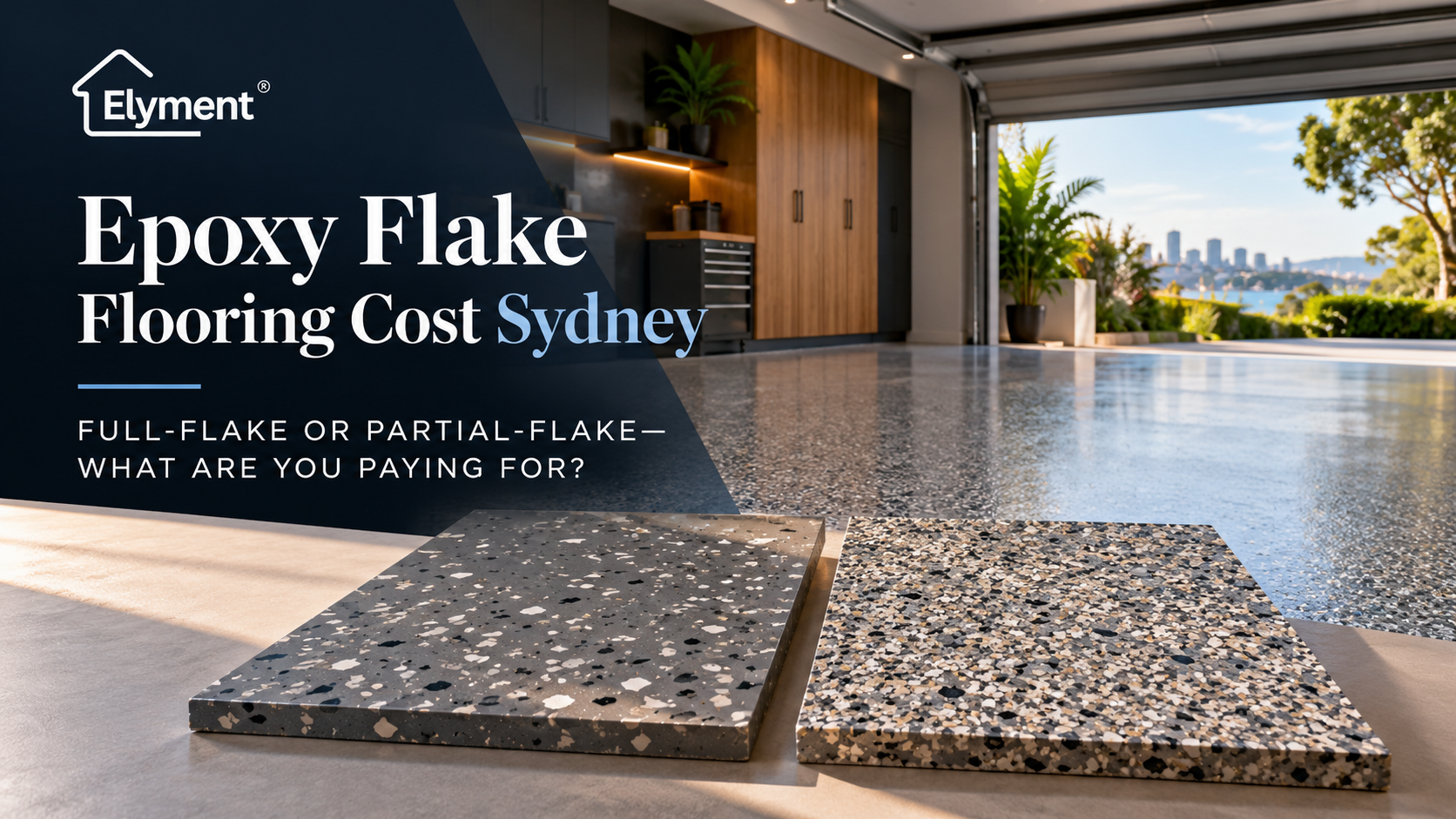
Epoxy flake flooring costs in Sydney depend on more than decorative flake coverage. Full-flake systems generally use a dense broadcast that conceals the coloured base, while partial-flake systems leave more base colour visible. Concrete preparation, resin specifications, protective topcoats and installation requirements influence the final price. Neither full coverage nor a higher quotation automatically guarantees greater durability or slip resistance.
ELYMENT Insights | Flooring & Renovation | Sydney, NSW | 27 October 2026
Two Epoxy Quotes Can Describe Two Different Floors
A Sydney homeowner requests quotations for decorative epoxy flooring across a residential double garage.
Both contractors measure the same concrete area. Both recommend decorative flakes. Both describe the proposed finish as epoxy flake flooring.
Yet the quotations differ substantially.
The first contractor proposes a partial-flake finish, with decorative flakes scattered across a coloured epoxy base. The second proposes a full-flake system, where flakes are broadcast densely enough to conceal the underlying colour.
At first glance, the distinction appears largely cosmetic. One floor has a more uniform decorative appearance, while the other reveals considerably more of its base colour.
The financial distinction can be more complicated.
Flake consumption differs. Application and finishing procedures may differ. The protective coating requirements can change. Both projects still require suitable substrate preparation.
More importantly, the two contractors may not be proposing equivalent resin systems, even if their sample photographs appear similar.
For Sydney property owners comparing epoxy flooring costs, the useful question is not simply which contractor offers the lowest price per square metre.
It is whether both quotations describe the same finished product, preparation standard and performance expectations.
Full-Flake and Partial-Flake Are Different Coverage Specifications
Decorative epoxy flake flooring generally incorporates coloured polymer flakes into a resin coating before the surface receives an appropriate protective finish.
The distribution of those flakes determines how much of the underlying coloured coating remains visible.
Partial-Flake Flooring
In a partial-flake system, decorative flakes are broadcast at a relatively light or controlled density.
The coloured base remains an important part of the final visual appearance.
A charcoal epoxy base with scattered grey and white flakes, for example, can produce a restrained architectural finish suitable for a contemporary residential garage.
Because the base remains visible, its colour consistency, coating coverage and application quality become particularly important.
Partial-flake systems generally consume less decorative flake material than full-broadcast systems using the same flake size and product.
However, lower flake consumption does not necessarily mean that the total installed flooring cost will fall by the same proportion.
Full-Flake Flooring
A full-flake system uses a substantially denser broadcast of decorative material.
In a typical full-broadcast installation, flakes are applied into the wet coating until the surface reaches the intended coverage, often described as broadcasting to rejection.
Excess loose material is removed after the coating has sufficiently cured. Depending on the specified system, the installer may scrape or otherwise prepare the broadcast surface before applying the protective clear coating.
The resulting appearance is dominated by the decorative flake blend rather than the underlying base colour.
Full-flake finishes are frequently selected for residential garages, workshops and utility areas where owners prefer a continuous decorative appearance.
Nevertheless, full-flake describes a broadcast approach, not a universal standard for resin thickness, impact resistance, slip classification or coating longevity.
How the Two Systems Compare
- Decorative Coverage
- Partial-Flake: Light to moderate, depending on specification.
- Full-Flake: Dense broadcast, generally concealing the base.
- Visible Base Colour
- Partial-Flake: Substantial.
- Full-Flake: Minimal or largely concealed.
- Flake Consumption
- Partial-Flake: Generally lower.
- Full-Flake: Generally higher.
- Appearance
- Partial-Flake: Coloured coating with decorative accents.
- Full-Flake: Continuous decorative flake pattern.
- Finishing Work
- Partial-Flake: Depends on broadcast density and specified system.
- Full-Flake: Usually includes removing excess flakes and preparing the broadcast surface.
- Protective Topcoat
- Partial-Flake: Required where specified by the coating system.
- Full-Flake: Required where specified by the coating system.
- Concrete Preparation
- Partial-Flake: Must suit the resin system and substrate.
- Full-Flake: Must suit the resin system and substrate.
- Slip Resistance
- Partial-Flake: Depends on the complete tested finish.
- Full-Flake: Depends on the complete tested finish.
- Durability
- Partial-Flake: Depends on preparation, resin and system design.
- Full-Flake: Depends on preparation, resin and system design.
These distinctions provide a starting point for comparing quotations, but they do not replace a detailed coating specification.
Where the Epoxy Flooring Cost Actually Comes From
Decorative flake material represents only one component of a professionally installed resin floor.
The complete price may include inspection, concrete preparation, crack repairs, primer, base coating, flake broadcasting, protective coats, labour, equipment, waste handling and curing-related site access.
The relative contribution of each component changes according to the floor's existing condition and the coating system selected.
1. Concrete Preparation
The existing concrete determines how much preparation must occur before either decorative finish can be applied.
A clean, sound concrete slab may need mechanical preparation to achieve the surface profile required by the coating manufacturer.
An older Sydney garage may have considerably more complicated conditions, including:
- Existing paint, sealers or deteriorated coatings.
- Oil contamination near vehicle parking positions.
- Cracks, damaged edges or isolated surface defects.
- Uneven concrete or inconsistent previous repairs.
- Moisture conditions requiring additional investigation.
- Adhesive residue from earlier floor coverings.
These conditions affect both partial-flake and full-flake installations.
A full decorative broadcast does not compensate for inadequate adhesion between the coating and the concrete.
Likewise, a partial-flake finish cannot correct underlying cracks, contamination or slab movement simply by introducing another coating layer.
Where preparation or substrate correction is necessary, Elyment's Sydney garage floor preparation and levelling services provide a relevant starting point for assessing the concrete before a decorative coating is specified.
2. Primer and Coloured Base Coating
The primer and base coating establish the foundation of the resin system.
Their chemistry, application rate, film thickness and compatibility with the prepared substrate affect material consumption and installation requirements.
For partial-flake flooring, the base colour remains prominent and must deliver an acceptable visible finish.
For full-flake flooring, the base is largely concealed, but it remains an essential component of the system.
The fact that one finished surface hides the base does not justify reducing the base coating below the manufacturer's specified requirements.
3. Decorative Flake Consumption
Flake coverage changes the quantity of decorative material required.
Full-broadcast systems generally require substantially more flake material than lightly broadcast systems.
The actual consumption depends on the product, flake dimensions, broadcast technique and manufacturer's system specification.
Contractors should therefore identify the intended broadcast method rather than relying exclusively on terms such as heavy flake, premium flake or decorative epoxy.
4. Protective Clear Coats
Protective clear coatings can represent a meaningful portion of the material and labour allowance.
Their selection affects the finished texture, surface protection, cleaning characteristics, appearance and potentially the installation schedule.
Some specified systems require more than one protective application to achieve the intended finish or performance.
The number of coats should follow the actual product system rather than an assumption that every decorative floor receives the same treatment.
5. Installation and Site Logistics
Sydney flooring quotations must also account for the practical cost of completing the work.
Equipment transport, site protection, restricted access, preparation time, coating intervals and return visits can influence the total.
A compact garage may have a relatively high square-metre rate because several fixed mobilisation and preparation costs still apply.
Larger areas can distribute some of those costs across more square metres, although additional staging requirements may offset the advantage.
Consequently, the price difference between partial-flake and full-flake flooring should not be treated as a fixed percentage.
The Protective Topcoat Deserves Its Own Line in the Quote
Decorative flakes attract attention because they establish the visible design.
Yet the exposed protective coating is often more important to everyday performance than the decorative material underneath.
Depending on the selected system, the topcoat can influence abrasion resistance, chemical resistance, ultraviolet stability, cleanability and final surface texture.
Epoxy, polyurethane and polyaspartic products do not have identical performance properties. Even within one coating category, formulations and manufacturer specifications can differ.
A Sydney garage exposed to daylight through an open roller door may need particular consideration of ultraviolet exposure.
A workshop regularly exposed to automotive fluids may require a coating system selected against the actual substances involved.
A laundry or utility area may place greater importance on cleaning requirements and wet-surface slip risk.
These are distinct performance considerations. No single description such as premium topcoat establishes that they have all been addressed.
Elyment has separately examined ultraviolet exposure and yellowing in Sydney epoxy garages.
The same principle applies when comparing decorative flake quotations: identify the actual protective product and its intended use.
Before approving a quotation, owners should request the manufacturer, product name, applicable technical data sheets and specified application rates for the protective system.
More Flakes Do Not Automatically Mean Better Slip Resistance
One of the most persistent misunderstandings surrounding decorative epoxy flooring is the assumption that heavier flake coverage automatically creates a safer walking surface.
That conclusion is not technically reliable.
Slip resistance is influenced by the final exposed surface, including its texture, coating configuration, contaminants, moisture conditions and wear.
A densely broadcast decorative floor covered by a relatively smooth protective coating may behave differently from a coating system designed with a specified anti-slip aggregate.
The relationship is not simply that more decorative material means more grip.
Manufacturer technical guidance on slip-resistant flooring explains that surface coarseness alone does not guarantee a particular slip-resistance classification.
Australian Standard AS 4586:2013 provides methods for classifying the slip resistance of new pedestrian surface materials.
Where a particular classification is required, the appropriate evidence should relate to the relevant tested surface configuration and test method.
A generic claim that a full-flake floor is non-slip does not establish a measurable classification.
Nor should owners assume that a decorative coating will retain identical slip behaviour indefinitely as it experiences wear and different cleaning conditions.
For Sydney commercial premises, strata environments and other areas where a specified slip classification matters, the coating selection should be matched to the actual use of the floor.
Elyment's analysis of quartz epoxy flooring, slip resistance and cleaning explores the related issue of balancing textured surfaces with ongoing maintenance.
The important distinction is that decorative flake density, slip resistance and durability are three different specifications.
A Sydney Double Garage: The Cost Comparison in Practice
Consider an illustrative 36-square-metre residential garage renovation in Sydney's Hills District.
The concrete has minor cracks, an existing worn coating and isolated oil contamination.
The homeowner requests both partial-flake and full-flake options.
The contractor first identifies preparation works that would be required under either proposed system.
These include suitable coating removal, concrete preparation, assessment of damaged areas and any necessary compatible repairs.
Once the substrate requirements are established, the two decorative options can be compared against a common preparation allowance.
Cost Component Comparison: Partial-Flake vs Full-Flake
- Existing Coating Removal
- Partial-Flake: Common preparation scope.
- Full-Flake: Common preparation scope.
- Concrete Preparation
- Partial-Flake: System-specific surface preparation.
- Full-Flake: System-specific surface preparation.
- Crack and Surface Repairs
- Partial-Flake: Based on slab condition.
- Full-Flake: Based on slab condition.
- Primer and Base Coat
- Partial-Flake: Specified compatible system.
- Full-Flake: Specified compatible system.
- Decorative Flakes
- Partial-Flake: Lower broadcast consumption.
- Full-Flake: Higher broadcast consumption.
- Broadcast Finishing
- Partial-Flake: As required by the system.
- Full-Flake: Typically includes excess-flake removal and preparation.
- Clear Protective Coating
- Partial-Flake: Specified product and application rate.
- Full-Flake: Specified product and application rate.
- Return-to-Service Period
- Partial-Flake: Product and site dependent.
- Full-Flake: Product and site dependent.
This is an illustrative scope comparison, not a market-price quotation or a claim about a completed Elyment project.
It demonstrates why the decorative flake allowance should be separated from the rest of the installation.
If one contractor includes extensive preparation and a different protective coating system, a higher quotation cannot be attributed exclusively to full-flake coverage.
Equally, a partial-flake quotation may provide appropriate value when it uses a suitable coating system and the owner prefers the visible base colour.
The objective is not to make both finishes cost the same.
It is to identify what the additional expenditure actually purchases.
Why a Quotation Describing Only "Flake Flooring" Is Incomplete
A quotation can state that decorative epoxy flooring will be supplied and installed without adequately defining the resulting floor.
The phrase flake flooring does not identify the broadcast density, resin system, protective coating or preparation standard.
It may not even establish whether existing coatings or surface repairs are included.
A more useful quotation should address the following components.
- Measured Area: Confirm the total square metres and whether edges, steps, upstands or adjoining areas are included.
- Existing Floor Condition: Identify the assumptions about previous coatings, contamination, moisture, cracking and surface damage.
- Preparation Method: Describe the required removal, mechanical preparation, repairs and surface condition before coating.
- Coating Specification: Identify the primer, base coat, resin products and relevant application rates.
- Flake Coverage: State whether the design is partial-flake or full-broadcast, including the selected blend and a representative sample.
- Protective Finish: Identify the clear coating product, number of applications and required finishing texture.
- Performance Requirements: Confirm any specified slip classification, vehicle-use requirements, chemical exposure or other applicable performance criteria.
- Project Delivery: Confirm site protection, waste removal, curing arrangements, access restrictions, exclusions and handover requirements.
These details create a more meaningful comparison between competing quotations.
They also help clarify which conditions may justify a variation if additional substrate problems become apparent during preparation.
NSW Contract Requirements and Site Safety Still Matter
Epoxy flooring is often treated as a relatively straightforward garage improvement.
However, residential coating work can fall within the broader NSW framework governing home building work.
Under NSW Government guidance on residential building contracts, qualifying residential building work costing more than $5,000 including GST requires a written contract.
Additional requirements apply to larger residential building contracts, including relevant home building compensation insurance obligations where applicable.
Property owners should verify the contractor's licensing requirements, the agreed scope and applicable consumer protections before work begins.
Concrete Preparation and Silica Exposure
Concrete grinding and mechanical preparation can generate respirable crystalline silica.
SafeWork NSW's crystalline silica guidance identifies the health risks associated with airborne dust generated when silica-containing materials are processed.
Appropriate risk assessment and dust-control measures are therefore part of the preparation process, regardless of whether the eventual finish is partial-flake or full-flake.
Strata and Shared Property Considerations
Where coating work is proposed in a strata property, the owner should establish whether the work affects common property or requires approval under the scheme's applicable by-laws and legal requirements.
Shared access, ventilation, odour, noise, equipment movement and temporary restrictions may also need coordination.
These issues can influence the project programme independently of the selected flake density.
The Installation Schedule Is Part of the Purchase
A coating can appear finished before it is ready for normal use.
Contractors need to account for the product-specific intervals between preparation, priming, broadcasting and protective coating applications.
Temperature, humidity and the selected materials can affect these intervals.
A Sydney homeowner may be able to inspect a recently completed garage before it is ready for vehicle parking, heavy storage or chemical exposure.
The handover instructions should therefore distinguish between:
- When limited pedestrian access is permitted.
- When furniture or storage items may return.
- When vehicles may be parked on the surface.
- When normal cleaning may begin.
- When the coating has reached the manufacturer's required cure for its intended service.
These dates should come from the selected product specifications and actual installation conditions, not a generic promise that every epoxy floor cures within the same period.
Where substantial repairs or surface correction are required, Elyment's Sydney floor levelling and substrate preparation services can form part of the wider renovation planning discussion.
What Sydney Owners Should Receive at Handover
A finished floor should be assessed against the agreed installation specification, not merely the contractor's completion photographs.
A practical handover record may include:
- Confirmation of the installed coating products and decorative flake specification.
- Relevant manufacturer instructions for cleaning and maintenance.
- Applicable curing and return-to-service requirements.
- Records of specified testing or verification, where required by the contract.
- Information about warranties, exclusions and reporting defects.
- Confirmation that the agreed preparation, protection and waste-removal scope is complete.
This documentation helps owners, builders and future maintenance contractors understand what has actually been installed.
It also reduces the likelihood that a later repair decision will depend entirely on photographs or recollection.
How Elyment Approaches Epoxy Renovation Planning
Elyment Property Services operates across property improvement, physical works and project coordination in Sydney and NSW.
For decorative epoxy flooring, effective project planning begins with understanding the condition of the existing floor and the intended use of the finished space.
Depending on the project, this may involve coordinating existing flooring removal, concrete preparation, crack repairs, floor levelling, material selection and installation sequencing.
Elyment's flooring preparation and renovation services provide a pathway for assessing these requirements before installation proceeds.
The objective is to establish a workable scope, identify preparation risks and improve coordination between the relevant project stages.
Understand Your Epoxy Flooring Quote Before Work Begins
ELYMENT PROPERTY SERVICES | SYDNEY & NSW
Review decorative flake coverage, concrete preparation, protective coating specifications and renovation scheduling before committing to your next Sydney flooring project.
The Best Epoxy Quote Defines the Floor, Not Just the Finish
Full-flake and partial-flake epoxy flooring can both be appropriate choices for Sydney residential and commercial properties.
The distinction begins with visual coverage but extends into material quantities, installation procedures and the details of the finished coating system.
Full-flake flooring generally requires more decorative material. Partial-flake flooring leaves greater emphasis on the visible coloured base.
Neither characteristic independently establishes superior durability, slip resistance or long-term value.
The most useful comparison places preparation, resin specification, decorative coverage, protective coatings and handover requirements alongside the total price.
For Sydney owners, the practical advantage of a detailed quotation is not simply knowing what the floor costs.
It is knowing exactly what that expenditure is intended to deliver.
Sources and References
Australian Government and Technical References
- NSW Government: Contracts for Residential Building Work
- Guidance on residential building contracts, written contract requirements and relevant consumer protections in NSW.
- SafeWork NSW: Crystalline Silica Technical Fact Sheet
- Information about respirable crystalline silica exposure and associated workplace health risks.
- Fosroc Australia: Technical Guidance on Slip-Resistant Flooring
- Technical guidance on flooring texture, surface characteristics and slip-resistance classifications.
- Australian Standard AS 4586:2013 — Slip Resistance Classification of New Pedestrian Surface Materials
- Australian Standard covering methods used to classify slip resistance of new pedestrian surface materials.
Related Elyment Flooring Resources
- Sydney Garage Floor Preparation and Levelling Services
- Epoxy Flooring Sydney: Why Can Sunlit Garage Floors Turn Yellow?
- Quartz Epoxy Flooring Sydney: Grip and Cleaning
- Sydney Floor Levelling and Substrate Preparation Services
- Elyment Flooring Preparation and Renovation Services
ELYMENT PROPERTY SERVICES | SYDNEY & NSW
Understand Your Epoxy Flooring Quote Before Work Begins
Review decorative flake coverage, concrete preparation, protective coating specifications and renovation scheduling before committing to your next Sydney flooring project.
Discuss Your Flooring ProjectRelevant next actions
Explore the ELYMENT service most closely connected to this article.