Floor Levelling Sydney: Can Old Bags Cause Costly Rework?
Old bags of floor levelling compound may save money upfront but risk poor curing, flooring failures and costly rework in Sydney. Check storage and expiry first.
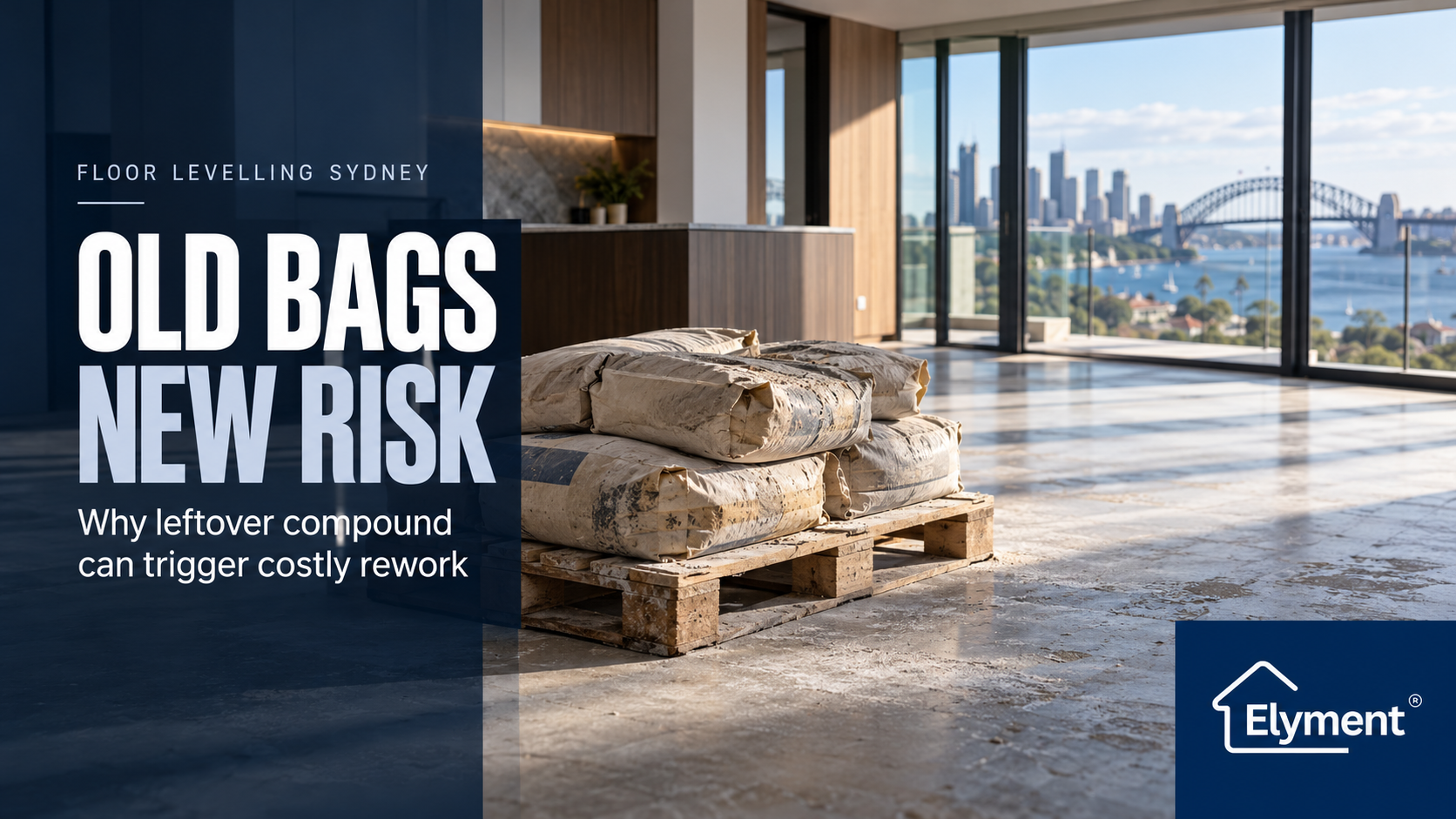
Leftover self-levelling compound is not automatically suitable for a Sydney renovation, even when the bag looks intact. Production codes, product-specific shelf life, dry-storage history and whether packaging has been opened all matter. For NSW residential work, material suitability also affects contractual responsibilities. Project teams should isolate questionable stock, seek manufacturer confirmation where necessary and verify acceptance before pouring, rather than risk replacement works and a disrupted flooring programme.
The Cheapest Bag on Site May Be the Most Expensive Material in the Room
Consider a familiar renovation situation. A Sydney builder has several unopened-looking bags of floor levelling compound left from a previous project. They have been stored in a garage, warehouse or site container.
The next project requires a similar product. Rather than ordering every bag again, the builder proposes using the remaining stock.
On paper, the saving appears sensible. The material has already been purchased, the bags are available, and the installation crew can proceed without waiting for another delivery.
But three important questions remain unanswered: when was the material manufactured, how has it been stored, and does its manufacturer still support its use?
These are not administrative details. Cementitious floor levelling products depend on controlled formulations and predictable hydration when mixed with water. Exposure to moisture during storage can compromise the powder before the installer opens the bag.
Potential consequences include inconsistent mixing, shortened or unpredictable working behaviour, impaired flow, reduced performance and uncertainty about the cured underlayment.
A visibly damaged bag is easy to reject. A dry-looking bag with an unknown history presents a more difficult procurement decision.
That distinction is particularly important for floor levelling projects across Sydney, where the compound may become a concealed preparation layer beneath expensive timber, vinyl, carpet or other floor finishes.
A Batch Code Is More Useful Than a Purchase Receipt
A receipt establishes when material was purchased. It does not necessarily establish when the product was manufactured.
Stock may spend time in distribution warehouses, retail storage facilities and contractor inventories before reaching the site.
This is why production codes deserve attention before leftover compound is included in a floor preparation specification.
ARDEX Australia's technical bulletin TB157, Reading of ARDEX Flooring Product Production Codes, explains how production information is marked on different flooring products.
For locally manufactured smoothing cement powders produced in NSW after 2022, the described code includes the manufacturing year, month, product identifier, state and batch number.
ARDEX also identifies different arrangements for imported products and certain other packaging formats. An ordinary printed barcode should not be mistaken for the manufacturing code.
The practical lesson extends beyond one supplier. Product labels should be interpreted according to the manufacturer's current guidance, not by applying a generic decoding rule to every bag.
What Should Be Recorded Before Stock Is Accepted?
- Exact product name, formulation and bag size.
- Manufacturer, production code and batch number.
- Manufacturing date confirmed from the applicable code.
- Product-specific shelf-life conditions.
- Storage location and any known exposure to moisture.
- Whether the original packaging remains unopened and undamaged.
- Supplier or manufacturer acceptance where required.
Photographing the code before the bag is opened also preserves evidence that may otherwise disappear during mixing and disposal.
There Is No Universal Twelve-Month Rule for Self-Levelling Compound
One of the most misleading shortcuts is treating every cement-based levelling compound as if it has the same shelf life.
Manufacturer documentation demonstrates why that assumption is unreliable.
ARDEX K 275
- Published shelf life: 12 months.
- Specified storage basis: Original unopened packaging, dry storage at 23°C and 50% relative humidity.
ARDEX K 55
- Published shelf life: 24 months.
- Specified storage basis: Dry conditions and original unopened packaging.
Sources: ARDEX K 275 technical data sheet and ARDEX K 55 technical data sheet.
These figures are product-specific examples, not a blanket statement about every leveller, every ARDEX formulation or every manufacturer's current specification.
The age of a bag must therefore be considered alongside its actual product data sheet. A manufacturing date alone does not prove that storage requirements were satisfied.
Equally, passing a printed shelf-life period does not establish that a bag can safely be used with a different mixing method or simply by adding more water.
Where stock is outside the published period, or its storage history cannot be established, the project team should obtain product-specific technical advice. Without suitable confirmation, that stock should not be released for the pour.
Storage Conditions Can Defeat an Otherwise Valid Date
Sydney renovation materials do not always remain in climate-controlled warehouses.
Bags may be moved through garages, commercial loading areas, basement storage rooms, vans, partially completed buildings and site containers.
Storage conditions matter because a paper sack or liner can become damaged even when the exterior initially appears serviceable.
Four Warning Signs That Need Investigation
1. Uncertain moisture exposure. Bags stored directly on damp concrete, near leaks or in exposed conditions may no longer satisfy the manufacturer's storage requirements.
2. Hard lumps or consolidated powder. Caking can indicate that the product has been affected during storage. It should not simply be broken up and returned to the mixing process.
3. Opened or repaired packaging. A sack closed with tape is not equivalent to original unopened packaging. Its remaining usable life cannot be assumed from the unopened-product specification.
4. Unreadable identification. If the product or manufacturing code cannot be reliably identified, technical acceptance becomes difficult to substantiate.
An absence of visible defects is not proof of continuing performance.
Similarly, a small trial mix that appears workable cannot establish full conformity with the manufacturer's published strength, setting, bonding and application requirements.
For a professional flooring installation, informal testing is not an adequate substitute for the manufacturer's acceptance criteria.
The Three Decisions That Should Control Leftover Stock
An effective approach is to classify leftover materials before the floor preparation crew begins mixing.
Accept
- Material condition: Product identified, within applicable shelf life, originally unopened, with acceptable storage evidence and specification.
- Project action: Authorised for use, subject to the remaining installation checks.
Hold
- Material condition: Uncertain batch date, storage history, packaging integrity or proposed application.
- Project action: Isolate stock and request supplier or manufacturer technical confirmation.
Reject
- Material condition: Damaged or moisture-affected material, or stock that cannot meet applicable acceptance requirements.
- Project action: Exclude from the work and arrange appropriate replacement or disposal.
This is a proposed project-control framework, not a manufacturer-issued classification system. Technical instructions and project specifications remain authoritative.
A contractor may find that some remaining bags are suitable while others from the same storage area are not.
That decision should be made before the material is combined in a mixing process, not once it has become part of the floor.
Who Takes Responsibility When an Owner Supplies the Leftover Bags?
Material ownership can complicate what initially appears to be a straightforward installation.
A homeowner may have purchased compound for a previous renovation. A builder may have stock remaining from another contract. A commercial tenant may ask that existing site materials be reused to reduce costs.
None of these circumstances automatically makes the material acceptable for the new work.
In applicable NSW residential building contracts, statutory warranties under the NSW Government's residential building contract guidance include requirements for suitable materials and materials being new unless otherwise specified.
Acknowledging that leftover material is being considered does not remove the need for appropriate workmanship and product suitability. The contractual position should be reviewed according to the actual circumstances.
A prudent written scope should identify:
- Who supplied and stored the material.
- Who checked the manufacturing and storage records.
- Whether the product is approved for the intended substrate and finish.
- Who is authorised to reject questionable stock.
- Who supplies replacement material if acceptance fails.
- How any programme change or variation is documented.
Written responsibilities are especially important where a project manager, flooring installer and material purchaser are separate parties.
Where the Floor Levelling Cost Really Escalates
The apparent saving from using old compound is limited to the replacement material that would otherwise have been purchased.
The potential exposure extends across an entire sequence of renovation works.
Consider an illustrative Inner West apartment project where the existing floor has already been removed, the slab prepared and the following flooring installation booked.
Several questionable bags are incorporated into the levelling work without their storage history being verified. If the completed layer subsequently exhibits unacceptable performance, the problem is no longer an inventory issue.
Depending on the observed defect, technical assessment may lead to further investigation, local remediation or removal and replacement of affected material.
Potential costs can then include:
- Investigation and technical assessment.
- Additional site attendance and labour.
- Removal of defective preparation material where required.
- Concrete grinding and substrate cleaning.
- Replacement primer and levelling compound.
- Waste collection and transport.
- Additional curing and verification time.
- Rescheduling of the final flooring installer.
- Disruption to occupancy or the commercial fit-out programme.
Not every suspect bag will produce a failed floor, and not every defect requires complete removal. The extent of remedial work must be established through appropriate assessment.
However, the financial comparison is clear: avoiding a limited material purchase is a poor saving if it introduces an unsupported risk across a substantially larger installation.
Elyment's Sydney floor levelling cost and inclusions guide explains how substrate preparation, levelling depth, access and related works affect the total delivered price.
This material-acceptance issue introduces another cost category: the possibility of repeating work that should only have been required once.
Sydney Access Restrictions Make Late Material Rejection More Disruptive
A detached home with uncomplicated access may offer flexibility to replace materials and reschedule work.
The same decision can be more difficult in a strata apartment or occupied commercial building.
Sydney renovation projects may depend on advance lift bookings, designated deliveries, permitted working hours, protection of common property and agreed access windows.
The NSW Government's strata renovation guidance also explains that changes to hard flooring can require approval, with the applicable scheme requirements to be checked in advance.
If unsuitable materials are discovered after a crew has arrived, replacing them may affect the planned pour window.
If the problem is discovered after installation, remedial grinding or removal may introduce further dust-control, noise, waste-handling and coordination requirements.
In a retail tenancy, office refurbishment or hospitality fit-out, this can affect possession dates and commercial operations.
The cost of a questionable bag therefore depends partly on where and when it is used, not simply its purchase price.
Material Acceptance Should Be a Hold Point, Not a Mixing-Day Debate
The practical solution is not to discard every unused bag automatically. It is to create a controlled acceptance process before the material becomes part of the installation.
A Six-Stage Pre-Pour Material Check
1. Identify the specified system. Confirm the compound, compatible primer, substrate, intended depth and finished flooring.
2. Inspect available inventory. Separate newly delivered materials from leftover stock. Record product names, bag quantities and visible condition.
3. Verify manufacturing details. Read batch information using the manufacturer's applicable production-code guidance.
4. Establish storage acceptability. Check shelf-life conditions, unopened packaging and the available storage history. Hold anything uncertain.
5. Resolve technical exceptions. Obtain appropriate written manufacturer confirmation where required. Do not use improvised mixing changes to compensate for uncertain stock.
6. Release the pour. Confirm approved material quantities, water ratios, application conditions, mixing arrangements and programme readiness before the crew starts.
This sequence creates a useful distinction between materials that are physically present and materials that are technically accepted for use.
It also fits alongside Elyment's broader self-levelling compound and substrate preparation service in Sydney, where the product must be matched to the site conditions and the intended floor finish.
Three Questions Worth Resolving Before Using Leftover Compound
Can self-levelling compound still be used after twelve months?
Possibly, depending on the exact product. Published shelf lives vary. Some products specify twelve months, while others specify longer periods. Use the current technical data sheet and manufacturer guidance, not a general age assumption.
Can a previously opened bag be used if it looks dry?
Its appearance alone is insufficient. An opened bag may not satisfy the conditions used to establish the manufacturer's published shelf life. Obtain explicit product-specific advice before considering it for professional installation.
Will a successful trial mix prove the material is suitable?
No. A trial mix may show immediate workability, but it does not establish all the required performance characteristics of the cured product or replace the manufacturer's documented acceptance conditions.
The Real Saving Is Avoiding Work That Must Be Done Twice
Leftover materials can represent usable inventory when their identity, condition and acceptance requirements are properly established.
But a low apparent material cost should not override technical verification.
On Sydney flooring projects, the more valuable discipline is to confirm the bag before committing the labour, the substrate and the installation programme to it.
A manufacturing code, sound storage records and a clear acceptance decision may seem minor compared with the scale of the renovation.
Yet those records can determine whether a floor preparation decision remains a manageable purchasing matter or develops into a costly remedial project.
SYDNEY FLOOR PREPARATION & PROJECT REVIEW
Know What's Going Into Your Floor Before the Pour.
Review compound selection, material condition, substrate preparation, renovation sequencing and project responsibilities before questionable stock becomes concealed work.
Discuss a Floor Preparation Review →
MATERIAL REVIEW • SUBFLOOR PREPARATION • PROJECT DELIVERY
Sources and References
Manufacturer Technical Documentation
- ARDEX Australia — Technical Bulletin TB157: Reading of ARDEX Flooring Product Production Codes
- ARDEX K 275 — Technical Data Sheet
- ARDEX K 55 — Technical Data Sheet
NSW Government Guidance
Related Elyment Services and Guides
- Elyment — Floor Levelling Sydney
- Elyment — Floor Levelling Cost Sydney
- Elyment — Self-Levelling Compound Sydney
- Elyment — Contact
Know What's Going Into Your Floor Before the Pour.
Review compound selection, material condition, substrate preparation, renovation sequencing and project responsibilities before questionable stock becomes concealed work.
Request a Floor Review MATERIAL REVIEW • SUBFLOOR PREPARATION • PROJECT DELIVERYRelevant next actions
Explore the ELYMENT service most closely connected to this article.