Heat Pump Hot Water Sydney: Can It Use an Off-Peak Circuit?
Can your new heat pump use an old off-peak hot water circuit in Sydney? Learn about wiring checks, tariff limits and possible upgrade costs before installation.
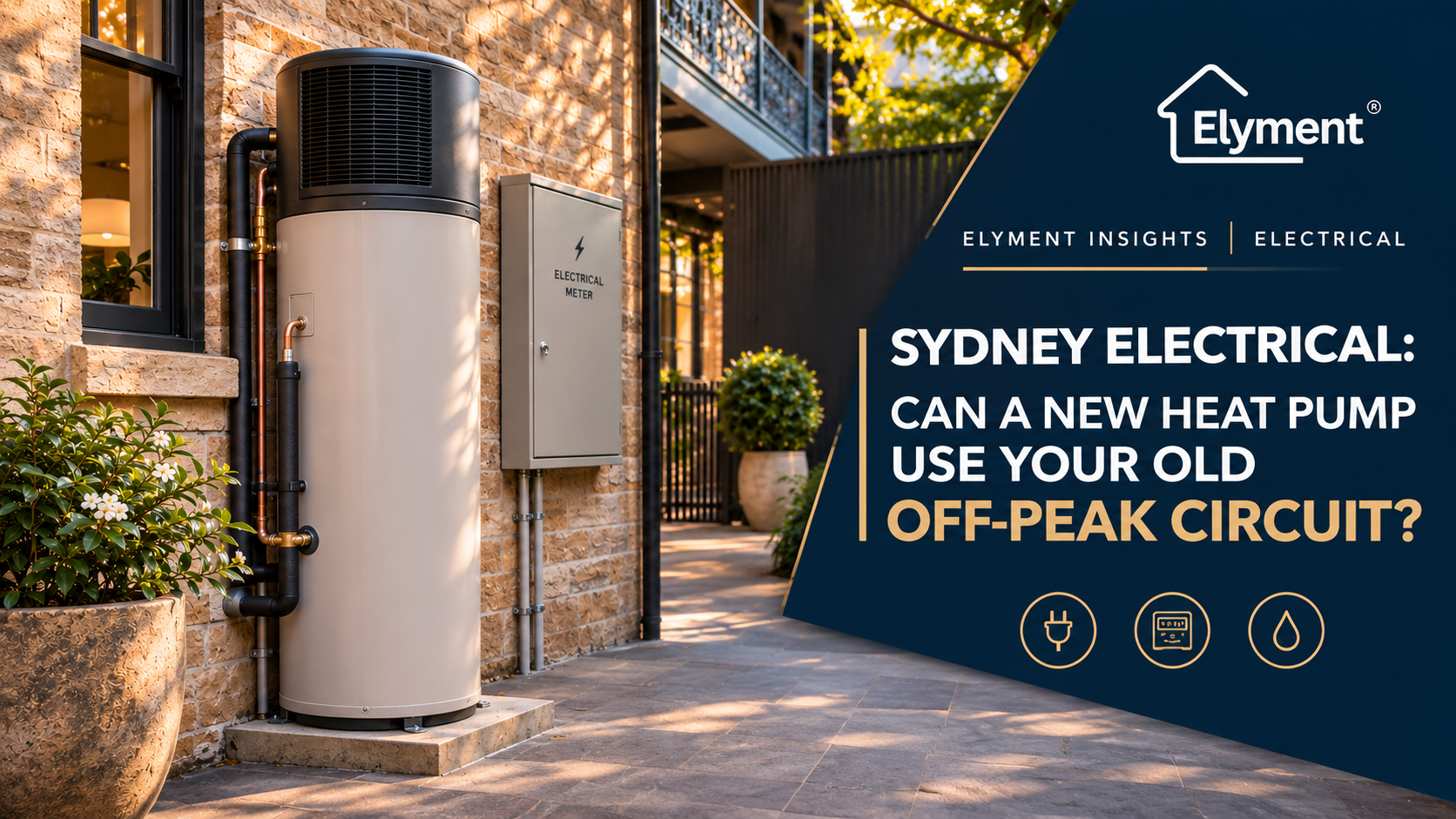
An existing off-peak hot water circuit in Sydney may be reusable for a new heat pump, but compatibility is not automatic. A licensed electrician must check the circuit, electrical protection and manufacturer's installation requirements. The electricity retailer must confirm the meter arrangement and controlled-load tariff. Ausgrid's 2026 changes to legacy hot water control systems add another consideration for affected Sydney properties.
ELYMENT Insights | Electrical Services & Property Operations | Sydney, NSW | 12 November 2026
The Old Hot Water Circuit Is Not Necessarily the Right Circuit for a Heat Pump
Across Sydney, the replacement of ageing electric storage hot water systems is creating a decision that is more complicated than removing one appliance and connecting another.
Many established homes have a dedicated off-peak electrical circuit that once supplied a conventional electric storage water heater.
The wiring may be intact. The switchboard may have a labelled hot water circuit. The household may still receive a separate controlled-load charge on its electricity bill.
None of those details independently establishes that a new heat pump can use the same electrical arrangement.
The central issue is the relationship between three separate systems:
- The physical circuit: The cable, protective devices, isolation arrangements and electrical capacity supplying the appliance.
- The heat pump: The manufacturer's requirements for electrical supply, operating periods, controls and supplementary heating.
- The electricity meter and tariff: The equipment and retail electricity arrangement determining when the circuit receives power and how consumption is charged.
A replacement can be electrically straightforward yet commercially unsuitable if the new heat pump cannot operate effectively within the available controlled-load periods.
Equally, a heat pump may be capable of using the existing circuit while the property requires a metering change before the owner can obtain the intended tariff.
For Sydney homeowners, the important decision is therefore not simply whether an old cable can be reused. It is whether the complete electrical and metering arrangement is appropriate for the specific replacement appliance.
Why Ausgrid's 2026 Controlled-Load Changes Matter
A network change introduced during 2026 has made the issue particularly relevant for properties within parts of Sydney and the Central Coast.
According to Ausgrid's controlled-load hot water update, changes began in mid-July 2026 to parts of its legacy Controlled Load Circuit network.
Under the revised arrangements described by Ausgrid, the network sends one daily signal to switch the hot water system on, rather than sending separate signals to switch it on and off.
The water heater's own thermostat then manages its heating operation.
Ausgrid is progressively retiring parts of the legacy control infrastructure as equipment reaches the end of its operational life. Smart-meter technology, managed through electricity retailers and their metering arrangements, is increasingly taking over these functions.
What the Change Does Not Automatically Mean
- Every Sydney household has already moved to a new arrangement.
- The existing controlled-load tariff has automatically been cancelled.
- Every connected hot water circuit now operates identically.
- An existing circuit is automatically compatible with any replacement heat pump.
- Homeowners can alter or bypass controlled-load equipment themselves.
Ausgrid specifically distinguishes network control from retail electricity pricing. The distributor does not set customers' retail tariffs or issue their electricity bills.
For owners replacing an older electric cylinder, that division of responsibility is significant.
The electrician can establish whether the installation is electrically suitable. Ausgrid can clarify aspects of its network-controlled equipment. However, the electricity retailer is responsible for confirming the customer's billing arrangements and coordinating applicable metering changes.
A single contractor cannot necessarily resolve all three matters during an installation visit.
What a Sydney Electrician Checks Before Quoting
A reliable quotation begins with the proposed heat pump's installation instructions and an assessment of the existing electrical installation.
The presence of a dedicated hot water circuit is useful information, but it is only the beginning of the inspection.
1. Identify the Existing Hot Water Supply
The electrician establishes whether the old water heater is supplied through a dedicated controlled-load circuit, a general electricity circuit or another approved arrangement.
Historical switchboard labels may assist identification, but must not be treated as definitive evidence of the current wiring configuration.
2. Assess Cable Capacity and Condition
The existing cable must be appropriate for the proposed appliance and installation conditions.
The electrician assesses factors including conductor size, installation method, circuit protection, cable condition and the equipment's rated electrical demand.
A heat pump generally uses less electricity than a conventional resistance-heated storage system during normal heat-pump operation. However, that does not eliminate the need for an electrical assessment.
Some models include supplementary electric heating elements, and the maximum electrical demand can differ substantially between products.
The importance of matching appliance demand to the available circuit is also relevant to dedicated electrical circuit installation and capacity assessments in Sydney homes.
3. Examine Switchboard Protection
The inspection includes the existing circuit breaker or fuse, required residual-current protection, earthing, identification and applicable isolation arrangements.
An older circuit is not automatically unsuitable because of its age. However, its condition and protection must satisfy the requirements applicable to the work being performed.
Any necessary switchboard or circuit modifications should appear as identifiable items in the quotation.
4. Confirm the Heat Pump's Maximum Electrical Demand
The selected model's installation manual determines whether the circuit is appropriately rated.
The electrician should establish whether the manufacturer's electrical specifications include:
- Compressor and fan operating demand.
- Supplementary heating element demand.
- Starting and operating characteristics.
- Dedicated circuit requirements.
- Required electrical protection and isolation.
Heat pumps with similar storage capacities can have different electrical requirements.
5. Check the Available Supply Periods
A circuit may be electrically suitable but unsuitable for a heat pump that needs a longer operating window than the controlled-load arrangement provides.
The manufacturer's guidance must be compared with the actual supply availability confirmed for the property.
A short power window may affect recovery after heavy water use or during colder conditions, depending on the model and household demand.
6. Confirm the Proposed Installation Position
The replacement heat pump may not occupy exactly the same footprint as the existing water heater.
Integrated units can be taller, while split systems introduce a separate outdoor component.
The electrician and installer must coordinate the electrical connection point, cable route, accessible isolation and location requirements with plumbing and equipment positioning.
7. Define Testing and Handover Requirements
The quotation should identify the necessary electrical testing, commissioning responsibilities and compliance documentation.
An installation is not complete merely because the heat pump switches on during a brief test.
Why the Heat Pump Model Changes the Answer
The Australian Government's YourHome hot water guidance identifies an important distinction: some heat pumps are incompatible with controlled-load operation, while others may only be suitable for arrangements providing longer electricity supply periods.
This is not a minor technical qualification.
Heat pumps work differently from conventional electric storage systems. Rather than relying primarily on a resistance heating element, they use electricity to transfer heat from the surrounding environment into stored water.
Their efficiency advantages can be considerable, but operating conditions still matter.
Heating performance, recovery time, tank capacity, supplementary heating and control settings all affect how successfully a model operates under restricted electricity availability.
Common Supply Arrangements and Their Implications
1. Existing Controlled-Load Circuit
- Potential advantage: May permit reuse of existing wiring and access to a separate tariff.
- What must be verified: Model compatibility, supply hours, circuit suitability and retailer confirmation.
2. Longer-Duration Controlled Load
- Potential advantage: May provide more time for hot water recovery.
- What must be verified: Availability, eligibility, metering requirements and applicable retail pricing.
3. Continuous General Electricity Supply
- Potential advantage: Allows operation according to the appliance's own controls.
- What must be verified: Dedicated circuit requirements, switchboard capacity and electricity rates.
4. Continuous Supply with Solar-Aware Scheduling
- Potential advantage: May allow heating during periods of rooftop solar generation.
- What must be verified: Timer compatibility, wiring, solar configuration, tariff and household demand.
These are alternative configurations, not interchangeable settings that owners can select without assessment.
A heat pump connected to a controlled-load circuit does not automatically receive electricity generated by the home's rooftop solar panels.
Whether solar generation can directly contribute depends on the wiring, metering and electricity supply arrangement.
The broader distinction between physical energy supply and intelligent scheduling is also relevant to solar-powered electrical upgrades without a home battery.
The NSW Government's heat pump water heater guidance recommends considering models with built-in timers that can support operation during suitable solar generation or lower-price electricity periods.
However, a built-in timer cannot create electricity availability when an external controlled-load circuit is disconnected.
That distinction should be understood before selecting a heat pump on the assumption that programming alone will resolve an unsuitable supply arrangement.
The Electricity Retailer Controls a Decision the Electrician Cannot Make
One of the most avoidable causes of uncertainty during a hot water replacement is contacting the electricity retailer only after the appliance has been installed.
The electrician can inspect the electrical installation, but the retailer must confirm the customer's available metering and tariff arrangements.
Before accepting an electrical quotation based on continued controlled-load supply, the property owner should ask the retailer to confirm:
- Whether the electricity account currently includes Controlled Load 1, Controlled Load 2 or another relevant tariff.
- Which meter and control arrangement currently supplies the dedicated hot water circuit.
- What supply periods and operating arrangements apply to that property.
- Whether the proposed heat pump can remain on the applicable controlled-load tariff, subject to technical suitability.
- Whether a smart-meter installation or reconfiguration is required.
- What costs, appointments or administrative steps apply to any metering changes.
- Whether alternative electricity plans would better suit the proposed operating schedule.
The Australian Energy Regulator's Energy Made Easy guidance on controlled loads explains that controlled-load arrangements are generally associated with separate circuits and identifiable electricity-bill charges.
Where metering changes are needed, the retailer can advise on the applicable process and potential costs.
Property owners should obtain account-specific confirmation rather than relying on a generic statement about Sydney off-peak electricity hours.
Which Party Resolves Each Issue?
1. Licensed Electrician
- Primary responsibility: Inspect wiring, electrical capacity, protection, connection arrangements and compliance.
2. Heat Pump Manufacturer or Supplier
- Primary responsibility: Confirm model-specific electrical requirements and suitability for interrupted supply.
3. Electricity Retailer
- Primary responsibility: Confirm available retail tariffs, meter configuration, billing and metering requests.
4. Ausgrid
- Primary responsibility: Provide information about applicable network-controlled equipment and its legacy-system changes.
5. Licensed Plumber and Relevant Installers
- Primary responsibility: Coordinate water connections, equipment positioning and installation requirements.
Where a Simple Replacement Can Become a More Expensive Project
Consider a hypothetical Sydney home replacing an older electric storage cylinder with an integrated heat pump.
The existing circuit is dedicated to hot water. The switchboard contains a labelled protective device, and the household receives a controlled-load charge on its electricity bill.
At first inspection, the electrical work appears limited.
However, the selected heat pump may require longer power availability than the existing arrangement provides.
The owner then has several possible paths, depending on technical assessment and retailer confirmation:
- Select a compatible heat pump model that can operate within the existing supply arrangement.
- Investigate an alternative controlled-load configuration with the retailer.
- Arrange appropriate metering changes and electrical modifications where required.
- Move to a suitable continuous-supply arrangement and consider the operating cost implications.
The final decision affects more than the electrician's labour.
It may change the appliance selection, electrical scope, metering appointment, commissioning process and ongoing electricity costs.
There may also be practical installation consequences.
An older Sydney terrace with a compact service courtyard may require a different equipment position from a newer detached home with an accessible external plant area.
In a strata apartment, access to shared electrical infrastructure or alterations affecting common property may create additional approval requirements.
Where the replacement is part of a broader renovation, equipment removal, plumbing work, electrical modifications and any reinstatement of surrounding surfaces should be coordinated before finishes are completed.
These factors do not make every heat pump installation complex. They explain why a quotation that assumes the old circuit can remain unchanged may be incomplete.
The Better Installation Sequence Starts Before the Old Cylinder Comes Out
The most effective approach is to separate product selection, electrical verification and retail metering decisions before committing to an installation date.
- Document the existing arrangement. Collect a recent electricity bill, the old water heater's model details and photographs of the proposed installation area. Provide safe external photographs of the switchboard and meter enclosure where useful, without removing covers.
- Shortlist suitable heat pumps. Obtain the current manufacturer installation manuals and identify their electrical supply and controlled-load requirements.
- Arrange an electrical assessment. Have a licensed electrician inspect the existing circuit and determine whether it can serve the proposed model.
- Confirm retailer arrangements. Establish whether the intended controlled-load tariff and meter configuration can be retained or whether changes are necessary.
- Finalise the scope. Separate appliance supply, plumbing, electrical work, metering arrangements and any building reinstatement in the project plan.
- Install, test and hand over. Coordinate the trades and applicable metering appointment, verify the heat pump's intended operating configuration and retain compliance and commissioning documentation.
This sequence avoids one particularly disruptive outcome: removing the existing functioning hot water system before discovering that the replacement cannot operate under the assumed electricity supply arrangement.
For occupied homes, minimising the period without reliable hot water is a practical project-delivery priority.
NSW Electrical Compliance Still Applies When the Circuit Is Reused
Reusing an existing circuit does not remove electrical licensing and compliance obligations.
Under NSW law, electrical wiring work must be undertaken by appropriately licensed personnel.
Building Commission NSW's September 2026 electrical compliance advisory confirms that a Certificate of Compliance for Electrical Work (CCEW) is required for relevant electrical installation, repair, addition and alteration work, including like-for-like replacement of water heaters.
Since 1 July 2026, required CCEWs have been submitted electronically through BCNSW eCert or an approved submission pathway.
The relevant certificate must be lodged no later than seven days after completion of the associated safety and compliance test.
Elyment's analysis of electrical compliance certificates for power point replacement in Sydney explains why even relatively small fixed electrical works can generate formal documentation obligations.
For heat pump installations, owners should retain the CCEW, appliance commissioning records, relevant installation documents and the retailer's confirmation of any metering changes.
Water and electrical installation work must also be coordinated with the applicable plumbing, manufacturer and other safety requirements.
Neither a retailer's tariff confirmation nor a manufacturer's product approval is a substitute for a licensed electrician's assessment of the actual installation.
Three Questions to Settle Before Accepting the Quote
Can a Heat Pump Use an Existing Off-Peak Hot Water Circuit?
Potentially. The existing circuit must be electrically suitable, the selected model must permit the applicable supply arrangement, and the electricity retailer must confirm the associated metering and tariff conditions. Reuse cannot be assumed from the presence of an old hot water circuit.
Does Ausgrid's 2026 Change Mean the Old Controlled-Load Tariff Is Ending?
Not automatically. Ausgrid's changes concern parts of its legacy hot water control infrastructure. The distributor states that it does not set retail electricity prices or customer tariffs. Households should confirm their account-specific billing and meter arrangements with their retailer.
Is It Better to Run a Heat Pump on Controlled Load or Continuous Electricity?
There is no universal answer. The appropriate configuration depends on the heat pump's operating requirements, household hot water demand, electricity rates, available metering arrangements and any rooftop solar generation. A model that requires continuous supply should not be placed on an incompatible interrupted circuit simply to retain an off-peak rate.
The Property Decision Is Bigger Than Reusing a Cable
The transition from conventional electric hot water to heat pump technology is often presented as an appliance-efficiency upgrade.
For Sydney properties with older controlled-load arrangements, it is also an electrical infrastructure and coordination decision.
Ausgrid's changing network-control arrangements make the distinction between the physical circuit, the electricity meter and the retail tariff particularly important.
The most reliable installation outcome begins with a specific heat pump model, an inspected electrical circuit and confirmed retailer arrangements.
Only then can the owner accurately compare the cost of reusing the existing infrastructure with the cost and operating implications of changing it.
Planning a Heat Pump or Electrical Upgrade in Sydney?
Elyment supports NSW property owners with renovation planning, electrical scope coordination, compliance considerations and practical project delivery. Establish the requirements before appliance replacement and related works begin.
Request a Property & Electrical Project Review
Sources and References
Electricity Network and Tariff Guidance
- Ausgrid – Controlled-Load Hot Water Update
- Australian Energy Regulator – Energy Made Easy: Understanding Controlled Loads
Australian Government and NSW Energy Guidance
NSW Electrical Compliance
Related Elyment Articles
- 15 Amp Power Point Installation Sydney – Dedicated Electrical Circuit and Capacity Assessments
- Solar EV Charger Installation Sydney Without a Home Battery
- Power Point Replacement Sydney: Is a CCEW Required?
Planning a Heat Pump or Electrical Upgrade?
Review your electrical scope, metering coordination, compliance requirements and installation sequence before work begins.
Request a Property & Electrical Project Review