Solar EV Charger Installation Sydney Without a Home Battery
You can charge an EV from rooftop solar without a home battery. Learn how solar diversion, charger settings and daytime use affect power bills for Sydney homes.
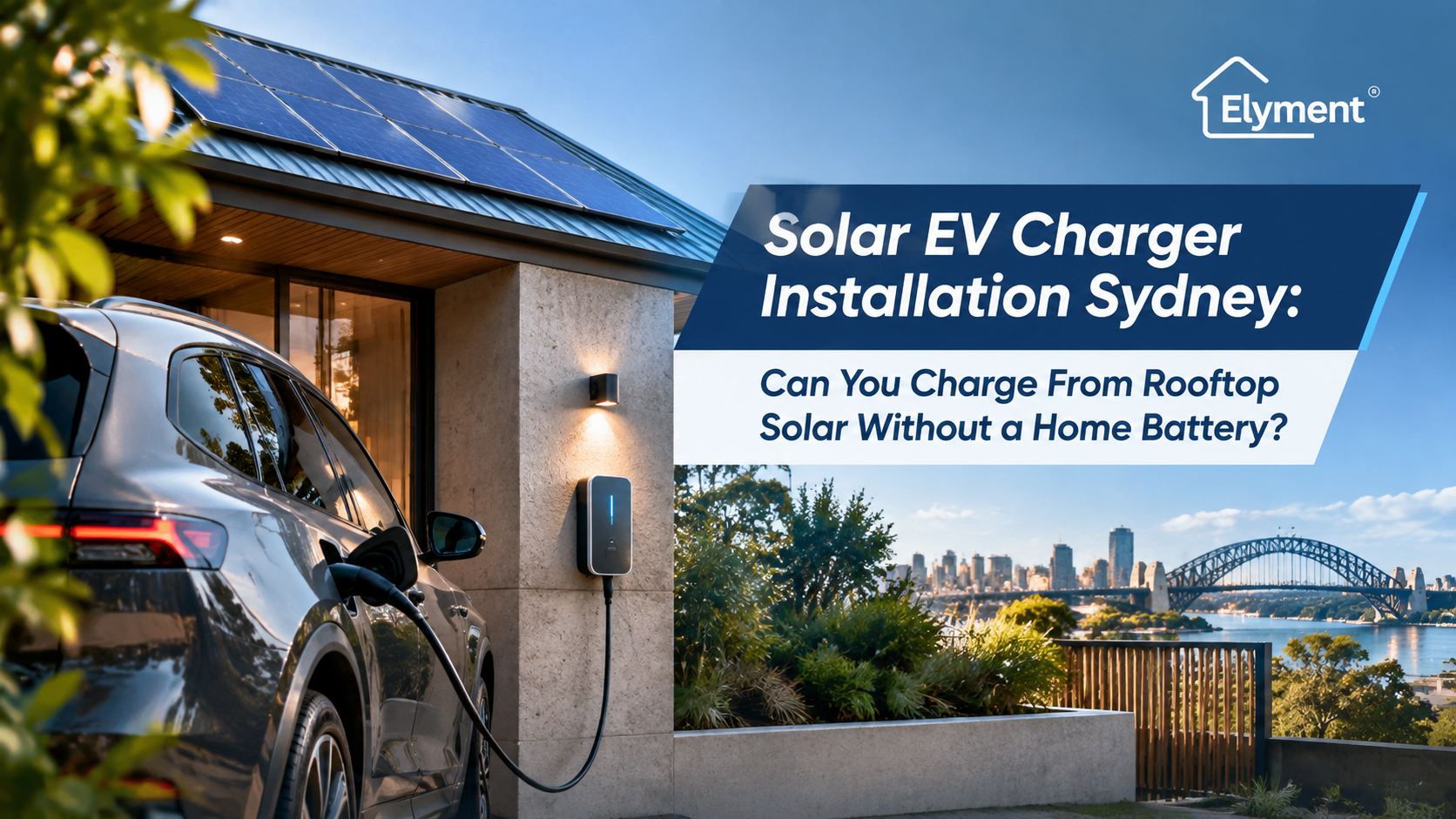
Yes. Sydney homes with grid-connected rooftop solar can charge an electric vehicle without installing a home battery. A solar-aware charger can direct unused daytime generation into the vehicle. In surplus-only mode, charging may pause when solar output falls; grid-assisted mode draws additional electricity to maintain charging. A licensed NSW electrician must assess electrical capacity, monitoring compatibility, charger configuration and compliance requirements before installation.
The Missing Home Battery Is Not the Main Obstacle
For Sydney homeowners considering electric vehicle charging, the assumption that rooftop solar must be paired with a home battery can introduce an unnecessary expense into the project.
A home battery stores electricity for later use. An electric vehicle connected during daylight hours can consume electricity being generated at that moment.
These are fundamentally different arrangements.
In a conventional grid-connected solar installation, household appliances use available solar generation while surplus electricity is ordinarily exported to the electricity network.
Adding an appropriately configured EV charger creates another potential consumer of that electricity.
Rather than exporting every unused kilowatt-hour, the household can redirect available solar generation into the vehicle's battery.
The Australian Government's electric vehicle charging guidance identifies smart charging and energy management systems as practical ways to use excess rooftop solar generation.
However, charging from solar and charging exclusively from surplus solar are not the same thing.
That distinction determines what happens when clouds arrive, household electricity demand increases or the vehicle needs more power than the panels can provide.
The Difference Between Solar Generation and Solar Surplus
A household's rooftop solar output is not automatically available in full to an electric vehicle.
Air conditioning, refrigeration, cooking appliances, hot water systems and other electrical loads may consume part of the electricity being generated.
A solar-aware charging system therefore needs to identify the electricity remaining after other household consumption.
A Practical Sydney Household Example
Consider a hypothetical detached Sydney home with an existing rooftop solar system.
Illustrative Household Electricity Measurements
1. Current Rooftop Solar Generation
- Detail: 5.2 kW.
2. Other Household Electricity Consumption
- Detail: 1.5 kW.
3. Available Solar Surplus
- Detail: 3.7 kW.
4. Potential EV Charging Allocation
- Detail: Up to approximately 3.7 kW.
These figures are illustrative rather than a prediction of actual charging performance.
Where the charger, vehicle and installation support dynamic solar charging, the system may adjust the charging rate to use the available surplus.
If rooftop output increases, more electricity may become available for the vehicle.
If household demand increases, less surplus electricity remains.
Actual charging power also depends on equipment limits, charging losses, electrical configuration and the vehicle's onboard charger.
The essential point is that a home's solar installation does not need a separate storage battery to supply electricity to a vehicle connected during the day.
It needs a suitable electrical installation and, for automated surplus charging, a compatible monitoring and control system.
Surplus-Only and Grid-Assisted Charging: Two Different Outcomes
Solar-compatible EV chargers can offer different operating modes.
The distinction is particularly important for Sydney households whose vehicles are parked at home during irregular hours.
Manufacturer guidance from myenergi's zappi charging modes provides a useful technical example.
Surplus-Only Charging
In a strict surplus-only configuration, the charger attempts to use electricity that would otherwise be exported to the grid.
Charging begins when sufficient surplus generation is available.
As available surplus changes, the charger may adjust the charging rate.
If surplus electricity falls below the minimum required to maintain charging, the vehicle may stop charging temporarily.
Charging can resume when sufficient surplus becomes available again, subject to the equipment's restart and delay settings.
For owners primarily seeking to maximise solar self-consumption, this arrangement can reduce purchased grid electricity during EV charging.
Its limitation is unpredictability.
A vehicle connected for several hours may receive relatively little electricity during cloudy conditions or periods of high household demand.
Grid-Assisted Solar Charging
Grid-assisted charging prioritises available rooftop solar but permits additional electricity to be imported when necessary.
When surplus solar is sufficient, the charger can increase its use of solar generation.
When surplus falls, the electricity network supplies some or all of the shortfall, according to the selected charging mode and settings.
This can provide a more consistent charging session.
However, the imported electricity is subject to the household's applicable retail electricity tariff.
Operating Mode Comparison
1. Strict Surplus-Only
- How it operates: Uses available excess rooftop generation.
- When solar output falls: Charging slows or pauses when insufficient surplus remains.
2. Grid-Assisted Solar
- How it operates: Uses surplus generation and permits grid imports.
- When solar output falls: Grid electricity supplements the available solar.
3. Scheduled Charging
- How it operates: Charges during selected periods, potentially aligned with solar production or electricity tariffs.
- When solar output falls: May continue drawing grid electricity unless additional control rules apply.
4. Fast or Unrestricted Charging
- How it operates: Charges at the available rate within equipment and electrical limits.
- When solar output falls: Grid imports can increase substantially.
These descriptions are general operating categories. Individual products use different names, settings and control methods.
A homeowner should therefore request a demonstration of the actual charging behaviour rather than relying solely on the phrase "solar compatible".
What Happens When Clouds Reduce Solar Output?
This is one of the most important operational questions in a solar EV charging installation.
Solar generation changes throughout the day.
A clear morning can produce a substantial surplus. Passing cloud cover may reduce that surplus within minutes.
Household electricity consumption can change just as quickly.
For example, consider a charging session where:
- Rooftop solar initially generates 5.2 kW.
- The household consumes 1.5 kW.
- The charger can access approximately 3.7 kW of surplus electricity.
- Cloud cover reduces solar generation to 1.7 kW.
- Household demand remains at 1.5 kW.
- Only approximately 0.2 kW of surplus generation remains.
At this point, a strict surplus-only charger generally cannot continue normal AC charging because the available surplus is below the minimum charging threshold.
For conventional AC charging, the minimum negotiated current is commonly 6 amps per active phase.
At approximately 230 volts, this corresponds to around 1.4 kW for single-phase charging.
Three-phase charging at the same minimum current requires approximately 4.2 kW across three phases.
Some compatible charging systems can switch between single-phase and three-phase operation, although this capability must be supported by the equipment and installation.
The minimum available surplus can therefore influence which charging configuration is appropriate.
In its ECO+ mode, myenergi states that the zappi charger can pause charging when the available surplus is insufficient. Its ECO mode can instead supplement the minimum charging requirement with grid electricity.
The practical implication is straightforward.
Without grid assistance, insufficient sunlight may interrupt charging. With grid assistance, charging can continue but electricity costs may increase.
Neither behaviour is inherently a fault.
The outcome should match the owner's charging priorities and the settings agreed during commissioning.
Why the Vehicle's Parking Schedule Matters More Than a Marketing Claim
A solar EV charger is most useful when the vehicle is physically available to receive electricity during solar generation hours.
For some Sydney households, this is straightforward.
A vehicle may remain parked at home during the working day, particularly where an occupant works remotely, follows a flexible schedule or regularly uses a second vehicle.
For others, the vehicle leaves before meaningful solar generation begins and returns after sunset.
In the second situation, installing surplus-solar controls does not create additional daytime charging opportunities.
The household may still benefit from a smart charger that schedules grid charging around electricity tariffs.
However, the commercial case for dedicated solar-diversion features is different.
Three Sydney Household Scenarios
Scenario 1: A Home-Based Worker in the Hills District
The vehicle is regularly parked at home between 9 am and 4 pm.
Surplus-only charging may be practical because the vehicle can receive electricity whenever spare generation becomes available.
Scenario 2: A Commuter in Western Sydney
The vehicle is generally unavailable during peak solar generation hours.
Grid-assisted or scheduled overnight charging may be more reliable than expecting rooftop solar alone to replenish the vehicle.
Scenario 3: A Northern Beaches Household With Irregular Vehicle Use
The vehicle is sometimes available during the day but may need a guaranteed amount of charge before an early departure.
A combination of surplus charging and a planned grid top-up may better match the household's requirements.
These are illustrative operating situations, not reports of individual projects.
The objective is to establish whether the proposed system matches how the property is actually used.
The Monitoring Equipment Is What Makes Surplus Charging Practical
An existing rooftop solar inverter does not automatically provide a newly installed EV charger with the information required to manage household surplus.
A compatible charging system needs to identify how much electricity the property is importing from or exporting to the network.
Depending on the equipment, this information may come from:
- Current transformers, commonly called CT sensors.
- A compatible energy meter.
- Approved inverter communications or integration.
- A manufacturer's energy management system.
The purpose is to distinguish solar production from electricity genuinely available for charging.
A standard billing smart meter does not automatically establish that an EV charger can access real-time import and export measurements.
The installer must confirm the required monitoring arrangement and equipment compatibility.
Incorrectly configured monitoring can produce misleading charging behaviour.
For example, a system may fail to identify surplus generation accurately or may continue importing grid electricity despite the owner expecting surplus-only operation.
Some problems only become obvious after the installation is operating under changing solar and household-load conditions.
This is why equipment installation and functional commissioning should be treated as separate, necessary stages of the project.
What a Licensed Sydney Installer Must Establish Before Work Begins
For homeowners, the most valuable installation discussion is not simply which wall-mounted charger to purchase.
It is whether the existing property infrastructure supports the charging behaviour being requested.
An appropriately licensed electrical professional should assess the site and the manufacturer's installation requirements.
1. Existing Rooftop Solar Configuration
The installer should identify the solar inverter, its available monitoring interfaces and the relationship between solar generation and household electricity consumption.
The owner should provide relevant inverter documentation where available.
2. Electrical Supply and Switchboard Capacity
The existing electrical installation must be assessed for the proposed EV charging load.
This includes the supply arrangement, circuit capacity, protective devices and any necessary load management.
Adding solar-aware controls does not eliminate the need to design the electrical installation for safe operation.
Elyment has previously examined related infrastructure considerations in its guide to 15-amp power point installations and circuit capacity in Sydney.
3. Charger and Vehicle Compatibility
The installer should establish:
- Whether the charger supports genuine surplus-solar monitoring.
- Whether the selected operating modes permit grid assistance.
- Whether the vehicle supports the intended AC charging arrangement.
- Whether single-phase or three-phase operation is appropriate.
- Whether automatic phase switching is supported, if required.
- Whether additional sensors or communications equipment are necessary.
4. Circuit Protection and Electrical Safety
EV charging equipment requires appropriate electrical protection under the applicable Australian standards and manufacturer's requirements.
The electrician must determine the correct circuit arrangement, residual-current protection, earthing, cabling and other safety measures.
Property owners should not assume that existing protective equipment is automatically suitable for a new EV charger.
For background on the difference between circuit breakers and residual-current protection, see Elyment's guide to safety switches and electrical faults in NSW properties.
5. Parking Position and Installation Access
The proposed charger location should suit the vehicle's normal parking position and the approved cable connection arrangement.
Weather exposure, mounting conditions, vehicle access, cable routing and the protection of existing building finishes may affect the project.
These practical considerations should be resolved before related garage renovation works are completed.
Commissioning Should Demonstrate Both Charging Modes
A solar EV charger should not be considered fully commissioned merely because it delivers electricity when the vehicle is connected.
Where surplus-solar control is part of the agreed scope, commissioning should also establish that the monitoring and control functions behave as intended.
Depending on the product and site conditions, appropriate functional checks may include:
- Confirming the energy monitoring equipment reports import and export in the correct direction.
- Verifying that the charger recognises available solar surplus.
- Checking the response when household electricity demand increases.
- Confirming the selected surplus-only operating behaviour.
- Testing grid-assisted charging settings where applicable.
- Reviewing charger current limits and any approved load-management functions.
- Confirming the owner understands charging schedules, manual overrides and boost functions.
- Recording the commissioned settings and providing relevant operating instructions.
Some tests may require suitable solar conditions or manufacturer-approved simulation and diagnostic procedures.
The licensed installer determines the appropriate testing method.
A charging system that works in unrestricted mode but has not been verified in its intended solar mode has not demonstrated the full functionality the owner requested.
The NSW Compliance and Approval Requirements
Solar EV charger installation involves fixed electrical infrastructure and must be approached accordingly.
The NSW Government's electrical licensing requirements establish that electrical wiring work must be undertaken by appropriately licensed personnel.
Relevant installations must comply with applicable electrical safety requirements, including the Australian and New Zealand Wiring Rules.
Under Building Commission NSW electrical compliance guidance, required electrical work must be tested and documented through a Certificate of Compliance for Electrical Work.
Since 1 July 2026, relevant CCEWs have been lodged through BCNSW eCert.
The applicable submission deadline is no later than seven days after completion of the electrical safety and compliance test.
Where a project also includes new or upgraded rooftop solar infrastructure, additional consumer energy resource commissioning requirements may apply.
Strata Properties Require an Additional Review
For Sydney apartments and townhouses within strata schemes, the installation may involve common property electrical infrastructure.
Access to rooftop solar generation, electrical metering and the proposed charging location must be established before assuming an individual resident can use solar electricity for their own vehicle.
Where common property alterations are involved, owners corporation approvals and appropriate resolutions or by-laws may be required.
The NSW Government's apartment EV charging guidance explains the relevant approval and infrastructure planning considerations.
The existence of solar panels on a strata building does not, by itself, establish that their generation can be allocated to a particular resident's charging circuit.
What Should Be Included in a Solar EV Charging Project Review?
For Sydney homeowners seeking an installation proposal, a useful project review should clarify the intended operating outcome before equipment is selected.
The following information helps establish that scope:
- Solar system: Existing inverter make, model and available system documentation.
- Electric vehicle: Vehicle model and relevant AC charging specifications.
- Charging objective: Strict surplus-only operation, grid assistance or scheduled charging.
- Typical availability: Whether the vehicle is regularly parked at home during daylight hours.
- Electrical infrastructure: Switchboard location, supply arrangement and available installation information.
- Monitoring: Compatibility and additional equipment required to measure solar surplus.
- Installation location: Garage or parking position, equipment mounting and proposed cable route.
- Approvals: Strata, property-owner or other approvals where applicable.
- Handover: Functional testing, operating instructions and NSW compliance documentation.
The distinction between basic charger installation and an integrated solar charging system should be clear in the agreed scope.
For broader installation pricing considerations, Elyment's earlier analysis of why Sydney EV charger installation quotes vary examines the implications of different electrical infrastructure requirements.
The Financial Decision Is About Electricity Timing, Not Just Equipment
A solar-aware charger can increase the amount of rooftop generation consumed within the property rather than exported.
Whether that produces meaningful savings depends on several variables.
These include the retail price of imported electricity, the household's solar feed-in tariff, available solar surplus, charging efficiency and the proportion of vehicle charging that can occur during daylight.
For each kilowatt-hour of solar generation redirected from export to household use, the economic benefit generally reflects the avoided electricity purchase offset by the export credit forgone, subject to the applicable tariff arrangements and system losses.
This does not make every solar charging session free in an economic sense.
Nor does it establish that a more expensive charger will automatically produce a favourable financial return.
Where a vehicle is rarely at home during daylight, surplus-solar functionality may deliver limited value.
Where daytime charging is frequent and the household regularly exports electricity, it may provide a practical way to increase solar self-consumption.
The appropriate decision is therefore based on measured electricity use and realistic vehicle availability, not simply the rated capacity of the rooftop solar system.
Common Questions About Solar EV Charging in Sydney
Can I Charge an Electric Vehicle Directly From Rooftop Solar Without a Battery?
Yes. A grid-connected Sydney home can use rooftop solar generation to charge an EV during daylight hours without installing a separate home battery. A compatible solar-aware charger can automatically manage charging according to the electricity available.
Will My EV Stop Charging When the Sun Goes Behind Clouds?
It depends on the charging mode. Strict surplus-only charging may pause if the available solar surplus falls below the minimum charging requirement. Grid-assisted modes can continue charging using imported electricity.
Do I Need a Special EV Charger to Use Rooftop Solar?
Not necessarily for basic daytime charging. A suitable conventional charger can consume electricity while rooftop solar is generating. However, automated surplus-only charging generally requires compatible energy monitoring and charging controls.
Will a 7 kW Charger Always Draw 7 kW From My Solar Panels?
No. The charger's rated capacity is its maximum supported output under specified conditions, not a guarantee of solar generation. Actual charging power depends on available electricity, equipment settings, vehicle capability and the electrical installation.
Can Rooftop Solar Keep My EV Charging During a Blackout?
Usually not with a conventional grid-connected solar-only system. Standard grid-connected inverters generally disconnect during a network outage. Maintaining power during an outage requires a specifically designed and approved backup arrangement.
Is a Home Battery Worth Installing Just for EV Charging?
Not automatically. A battery can shift solar electricity into evening charging periods, but the additional investment should be assessed against the vehicle's charging schedule, electricity tariffs, storage losses and wider household energy requirements.
The Final Assessment: Design Around the Charging Behaviour
The absence of a home battery does not prevent a Sydney property from charging an electric vehicle using rooftop solar generation.
What matters is whether the vehicle is available during generation hours, how much solar electricity remains after household consumption and how the charging equipment responds when that surplus changes.
Surplus-only charging offers greater control over grid imports but can produce interrupted charging sessions.
Grid-assisted charging provides greater continuity while introducing additional electricity purchases.
The most appropriate system is one whose operating behaviour has been agreed before installation and verified during commissioning.
For property owners, the important question is not simply whether a charger is advertised as solar compatible.
It is whether the complete electrical installation can deliver the desired charging outcome safely, reliably and in accordance with NSW requirements.
Planning an EV Charging or Property Infrastructure Upgrade?
Review installation requirements, electrical compliance considerations and project coordination before work begins. Elyment can assist with planning and delivery coordination, with regulated electrical work undertaken by appropriately licensed professionals.
Technical References and Further Reading
Government and Regulatory References
- Australian Government – How to Charge Your Electric Vehicle
- NSW Government – Electrical Licensing Requirements
- Building Commission NSW – Electrical Compliance Requirements
- NSW Government – Apartment EV Charging Guidance
Manufacturer Technical References
Elyment Related Articles
- 15-Amp Power Point Installation Sydney
- Safety Switches and Electrical Faults in NSW Properties
- EV Charger Installation Cost Sydney: Why Quotes Vary
Editorial Note
This article provides general information about residential solar EV charging and NSW property infrastructure. Technical configurations vary by equipment, vehicle and installation. Electrical design, installation, testing and certification must be undertaken by appropriately licensed professionals.
ELYMENT | SYDNEY PROPERTY & RENOVATION SERVICES
Physical Operations | Professional Services | Technology & Digital Solutions
Planning an EV Charging or Property Infrastructure Upgrade?
Review installation requirements, electrical compliance and project delivery considerations before committing to your upgrade.
Request a Project Review