Induction Cooktop Installation Cost Sydney: Switchboard Upgrade?
Installing an induction cooktop in Sydney? Find out when your switchboard may need upgrading, what drives installation costs and which electrical checks matter.
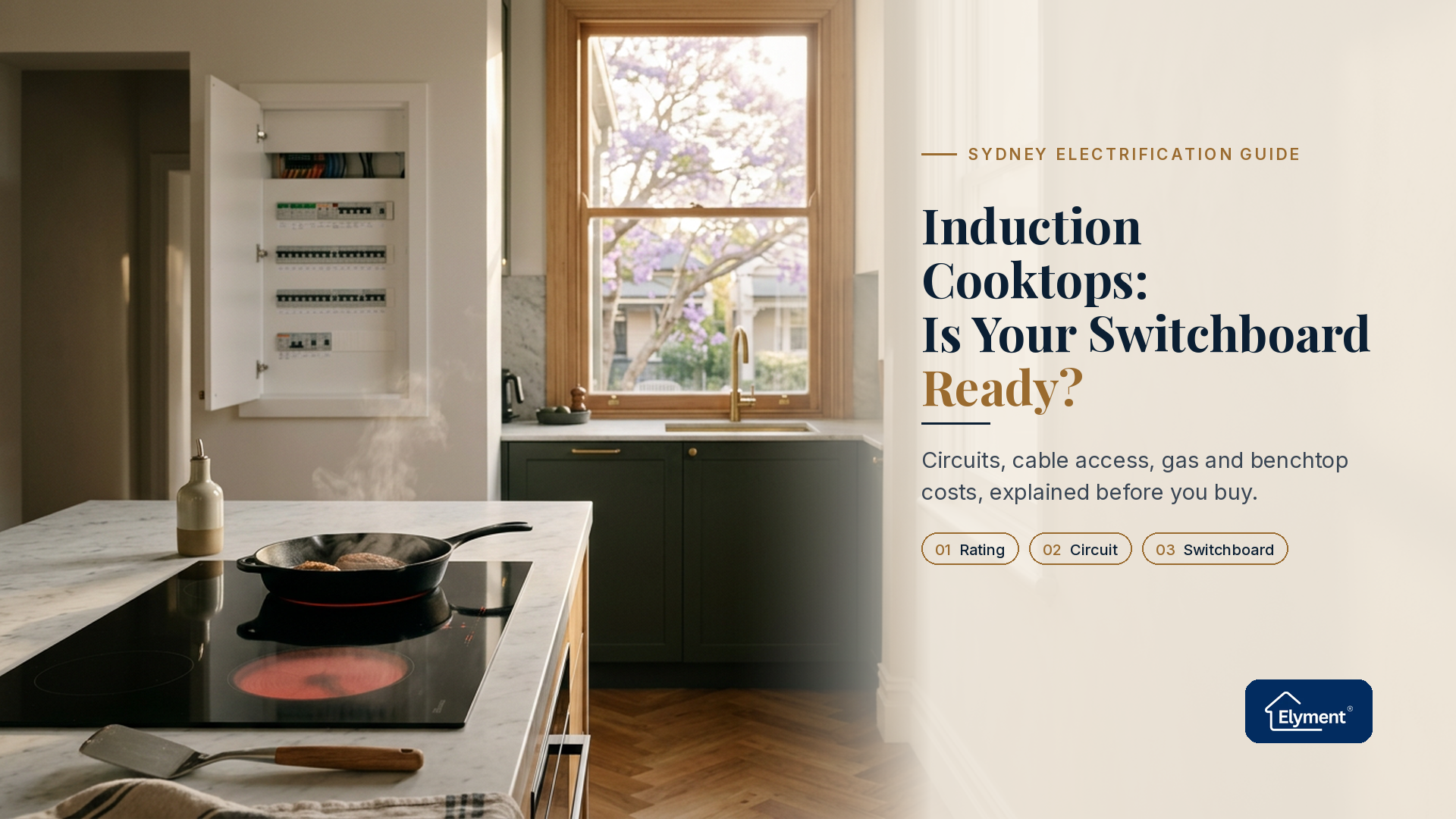
In Sydney, the electrical side usually decides what an induction cooktop really costs, not the appliance. Most built-in units need their own high-current circuit, and many older NSW switchboards don't have the space, protection or capacity to add one. If you check the rating plate before buying, confirm the circuit and cable route, and price gas disconnection and benchtop changes as separate items, a gas-to-induction conversion stays predictable and compliant.
The Purchase Decision That Sets the Electrical Budget
Most Sydney households start with the showroom and finish with the electrician. That order is the main reason induction installation quotes come in higher than people expect. The cooktop's rated power, printed on its data plate and in the installation manual, sets the size of the circuit, the cable and the protective device. It can also decide whether the switchboard has to change. Once the appliance is bought, those decisions are already made.
The NSW Government's induction cooktop guidance puts upfront costs at roughly $800 to $3,000 depending on the model, plus installation. It also warns that an induction cooktop may need a dedicated high-power circuit, which could mean paying extra for a switchboard upgrade. That second sentence is where most of the budget variation in Sydney kitchens comes from.
Induction Cooktop Configurations and Electrical Requirements
- Portable single-zone plug-in unit
- Typical electrical demand: Around 2.4 kW, standard 10 A outlet.
- What the electrician will usually assess: Whether the existing power point circuit is shared with other high-load appliances.
- 60 cm built-in, four zones
- Typical electrical demand: Commonly 7 kW to 7.4 kW, often a dedicated 32 A circuit.
- What the electrician will usually assess: New circuit, cable size, run length, spare switchboard space and RCD protection.
- 80 cm to 90 cm built-in or flex-zone models
- Typical electrical demand: Can exceed 10 kW depending on the model.
- What the electrician will usually assess: Heavier cable, larger protective device and site maximum demand.
- Upright cooker with induction top and electric oven
- Typical electrical demand: Combined load of hob and oven.
- What the electrician will usually assess: Whether one circuit can serve both, or whether two are needed.
Figures are indicative. The appliance's installation manual and a licensed electrician's assessment are the only reliable basis for sizing.
Several premium European models let the installer cap total power draw during commissioning. This can let a cooktop run on an existing circuit that would otherwise be too small. The catch is that you can't run several zones on boost at once, so it's a lifestyle decision as much as an electrical one, and it should be made before purchase.
Reading the Existing Circuit
What's already in the kitchen matters as much as the new appliance. A home that cooks on gas usually has no cooktop circuit at all, only the general power circuit feeding the benchtop outlets and perhaps a rangehood. A home replacing an old ceramic or solid-plate electric cooktop is in a better position, though an existing circuit is never assumed to be suitable.
Before quoting, a competent electrician will typically work through the following:
- Confirm the appliance rating from the model number, ideally before the order is placed.
- Identify any existing cooking circuit, including its cable size, protective device and condition.
- Check the switchboard for spare positions, the type of protection (circuit breakers or rewireable fuses) and whether safety switches (RCDs) protect the relevant circuits.
- Assess the site's maximum demand, particularly where air conditioning, a heat pump hot water system, a pool or an EV charger already draw on the supply.
- Plan the cable route from the switchboard to the cooktop position and the isolation switch.
- Price the scope in writing, separating the circuit, any switchboard work and making good.
Getting this inspection done before buying the appliance is the cheapest risk control available in a gas-to-induction conversion Sydney project.
Cable Access: Where Sydney's Housing Stock Changes the Price
The distance and the path between the switchboard and the kitchen often decide labour cost more than the cable itself. Sydney's mix of housing types produces very different access conditions.
- Federation and inter-war homes across the Inner West and Eastern Suburbs: Often have accessible roof voids and subfloors, but double-brick internal walls can make vertical drops slower and messier.
- Slab-on-ground homes from the 1960s onward: Common through the Hills District, Sutherland Shire and western suburbs, these often mean routing through the ceiling and dropping into the kitchen wall or joinery.
- Apartments: Raise questions about where the unit's switchboard sits, whether cabling crosses common property, and what the owners corporation must approve.
- Kitchens with island cooktops: May need cable brought up through the floor. On a concrete slab, that can mean cutting or chasing, which has to be coordinated with any new floor finish.
This is where electrical work and renovation sequencing meet. If flooring is being replaced at the same time, the cable path, any slab penetrations and conduit should be settled before tile removal and floor preparation and well before floor levelling or a new finish goes down.
Cutting into a freshly levelled or sealed floor to bring up a cable is an avoidable cost, and a common one.
When the Switchboard Becomes the Project
A switchboard upgrade isn't automatic, but in older Sydney housing it comes up often. The typical triggers are practical rather than cosmetic:
- No physical space: There may be insufficient space for an additional circuit breaker or combination RCBO.
- Rewireable ceramic fuses: These may still protect final circuits, which many electricians won't extend.
- Missing or inadequate RCD protection: New final subcircuits must meet current wiring rules, and an old board may not support that cleanly.
- Older board materials: Some pre-1990 meter panels contain asbestos and need careful handling under SafeWork NSW requirements.
- Supply capacity: In homes already running significant electrical loads, the incoming supply or main switch may need review, which can bring in the local distribution network.
The NSW Government's switchboard upgrade guidance treats the board as the base layer of household electrification.
That framing is useful for budgeting. If a home is likely to add an EV charger, a heat pump or a battery within a few years, designing the board once for the full load profile usually costs less than upgrading it piecemeal.
Elyment has covered the wider shift in Sydney's electrification planning and how EV charger installation quotes vary for the same structural reasons.
The protection side is explained in safety switches versus appliance protection.
Where supply itself has to change, the NSW process for altering electricity supply involves the network and, for some work, an Accredited Service Provider.
That adds lead time that should be in the program from day one.
Four Budgets, Not One
The most common source of confusion in induction installation cost discussions is that four separate scopes get quoted as if they were one. Each has its own trade, licence and paperwork.
Induction Installation Cost Breakdown
- Appliance purchase
- Who carries it out: Retailer or supplier.
- Compliance record: Manufacturer warranty, which may depend on licensed installation.
- Main cost drivers: Size, zones, power management and features.
- Electrical installation
- Who carries it out: Licensed electrician.
- Compliance record: Certificate of Compliance for Electrical Work (CCEW).
- Main cost drivers: New circuit, cable run, access and switchboard work.
- Gas disconnection
- Who carries it out: Licensed gasfitter.
- Compliance record: Gasfitting certificate of compliance.
- Main cost drivers: Capping at the appliance, isolating or removing the line, and meter decisions.
- Benchtop and joinery alterations
- Who carries it out: Stonemason, joiner or cabinet maker.
- Compliance record: SafeWork NSW requirements where legacy engineered stone is cut.
- Main cost drivers: Cut-out size change, material, splashback and making good.
The Electrical Record
Under NSW law, electrical wiring work must be done by a licensed electrician, who must lodge a CCEW through the Building Commission NSW eCert portal.
The NSW Government notes that a CCEW is often required for appliance warranty purposes, and customers can ask for a copy.
From 1 July 2026, paper and PDF CCEWs are no longer accepted.
The Gas Record
Disconnecting a gas appliance is gasfitting work.
Under the NSW gasfitter compliance framework, it must be done by a licensed gasfitter, and certificates have been lodged through eCert since 1 March 2026.
If the cooktop is the home's last gas appliance, owners should also decide whether to abolish the supply entirely.
NSW Government estimates a household can save about $400 a year in gas charges by disconnecting, but abolishing a connection involves the retailer and network and should be priced on its own.
The Benchtop Record
Induction cut-outs rarely match the gas cooktop they replace.
Enlarging a cut-out in a natural stone, laminate or timber benchtop is joinery work.
Where the benchtop is engineered stone installed before the national ban, cutting it is permitted only as a minor modification under controlled conditions, and the business doing it must notify the regulator.
SafeWork NSW's engineered stone guidance sets out what's allowed.
Many general installers won't touch it, so the stone trade should be engaged early.
Sequencing a Gas-to-Induction Conversion
When the scopes are separated, the order of work becomes clear. A reliable sequence for a Sydney kitchen looks like this:
- Shortlist two or three cooktops and collect their installation manuals.
- Book an electrical inspection covering the circuit, cable route and switchboard against those models.
- Choose the appliance with the electrical scope known, including any power-limiting setting.
- Confirm the cut-out dimensions with the benchtop trade and check whether the material is legacy engineered stone.
- Lock in strata approval where the property is in a strata scheme.
- Complete switchboard and cabling works, coordinated with any flooring removal or preparation.
- Book the gasfitter to disconnect and cap the gas cooktop on or before installation day.
- Alter the benchtop, then install and commission the cooktop.
- Collect both compliance certificates and keep them with the appliance warranty.
The Strata Dimension
In apartments, the electrical scope often reaches beyond the lot.
The unit's switchboard may be inside the apartment, but supply cabling, risers and the main switchroom are usually common property.
Under the Strata Schemes Management Act 2015, kitchen renovations and changes to wiring are generally minor renovations that need an owners corporation resolution, while work affecting common property can need a by-law.
Many buildings also limit noise, require lift protection and set trade hours.
For owners corporations, a run of electrification requests is a signal to check building-wide supply capacity before individual approvals add up.
What Project Teams Are Seeing
- The appliance is often bought before the home is assessed. Returning or exchanging a cooktop because the circuit can't support it is common and avoidable.
- Quotes that look cheap often leave out the switchboard. An installation-only price can assume a suitable circuit already exists.
- Benchtop changes are the slowest trade to book, particularly where engineered stone is involved.
- Combining works cuts cost. A kitchen refresh that brings together electrical, flooring and painting trades in one planned program avoids repeat call-outs and repairs.
- Documentation matters at sale. Buyers and their advisers increasingly ask for compliance certificates on recent electrical work.
Financing the Upgrade
Eligible NSW homeowners and landlords can use the NSW Government's Home Energy Saver loans, which offer zero-interest finance of up to $15,000 for eligible upgrades, including induction cooktops.
They're available to households with a combined taxable income of up to $210,000.
Eligibility and approved providers should be confirmed before quotes are signed, as program terms change.
What Property Owners Should Understand
- The cooktop's rated power is the starting point for every electrical decision. Check it before purchase.
- A dedicated circuit is normal. A switchboard upgrade is common in older homes, but not certain.
- Cable access, not cable length, usually drives labour cost.
- Electrical, gas, appliance and benchtop costs are separate scopes with separate certificates.
- In strata, approval comes before any trade is booked.
- If flooring or other renovation work is planned, sequencing the electrical work first protects new finishes.
Planning a Gas-to-Induction Conversion Within a Wider Renovation?
Elyment reviews the scope, sequencing and compliance steps across electrical, flooring and finishing trades so the work is planned once and delivered in the right order.
For homes moving away from gas in stages, the kitchen is often the last and most disruptive step.
Treating it as a coordinated electrification and energy project rather than an appliance swap gives owners a firmer budget, cleaner compliance records and fewer trades returning to repair each other's work.
Sources and References
- NSW Government — Induction Cooktops
- NSW Government induction cooktop guidance
- NSW Government — Switchboard Upgrades
- NSW Government switchboard upgrade guidance
- NSW Government — Altering Electricity Supply
- NSW process for altering electricity supply
- NSW Government — Electrical Safety Requirements and Consumer Rights
- Electrical safety requirements and CCEW guidance
- NSW Government — Gasfitter Compliance and Regulatory Obligations
- NSW gasfitter compliance framework
- SafeWork NSW — Working Safely With Crystalline Silica and Engineered Stone
- SafeWork NSW engineered stone guidance
- NSW Government — Home Energy Saver
- NSW Government Home Energy Saver loans
- Elyment — Tile Removal Sydney
- Tile removal and floor preparation
- Elyment — Floor Levelling Sydney
- Floor levelling services
- Elyment — Sydney Electrification Planning
- Gas Ban Prep: Sydney's Electrification Plans and Trends
- Elyment — EV Charger Installation Costs
- EV Charger Installation Cost Sydney: Why Quotes Vary
- Elyment — Surge Protection and Safety Switches
- Surge Protection Sydney: Safety Switches vs Appliance Protection
- Elyment — Energy Services
- Electrification and Energy Services
- Elyment — Contact
- Book a Project Review
Planning a gas-to-induction conversion within a wider renovation?
Elyment reviews the scope, sequencing and compliance steps across electrical, flooring and finishing trades so the work is planned once and delivered in the right order.
Book a Project ReviewRelevant next actions
Explore the ELYMENT service most closely connected to this article.