Sensor Light Installation Cost Sydney | Existing Lights
Can you add motion detection to existing lights in Sydney? Learn how wiring, sensor compatibility and electrician labour affect installation costs and outcomes.
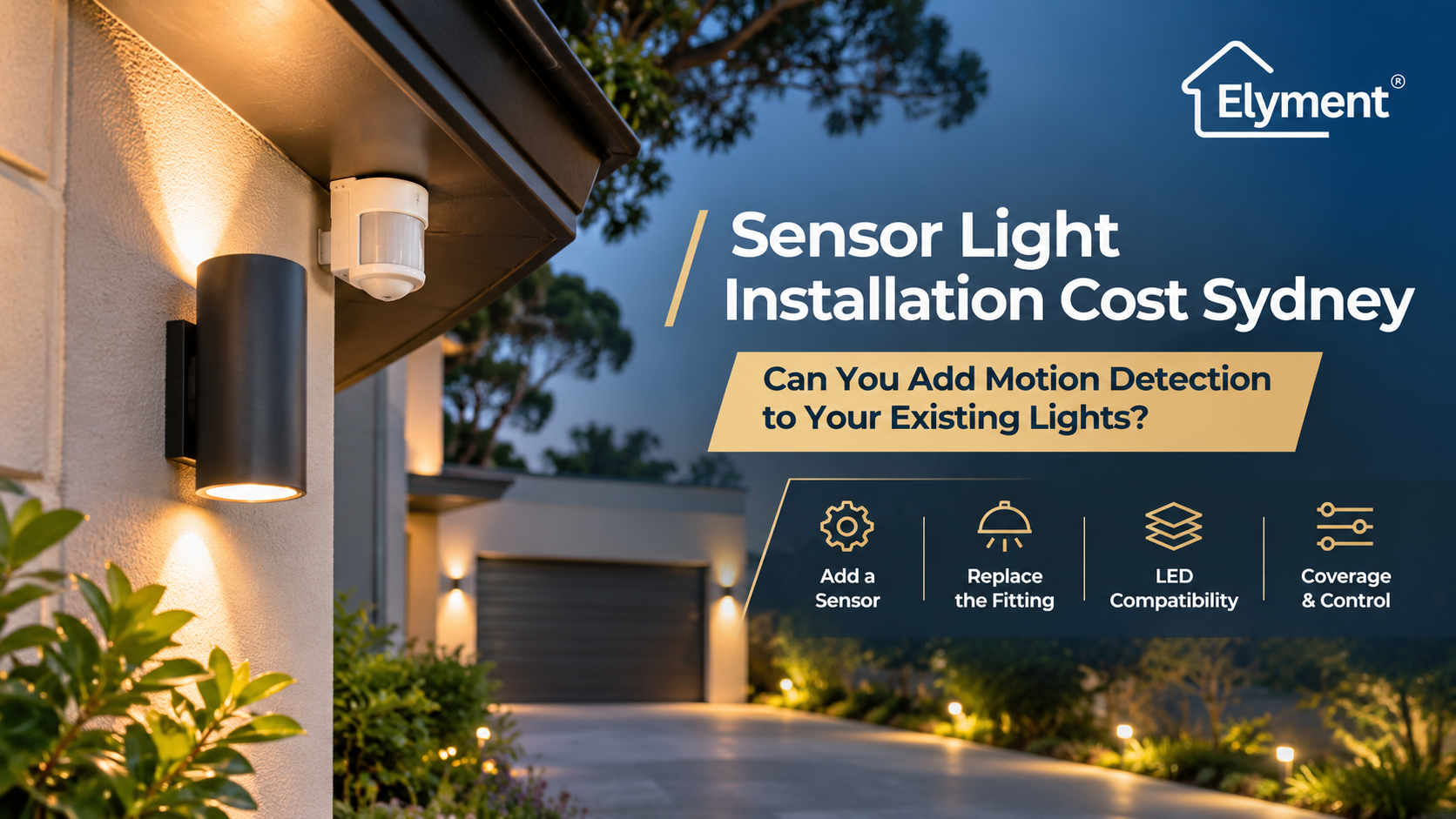
Existing outdoor lights in Sydney can often be converted to motion-activated lighting without replacing the entire fitting. A licensed NSW electrician may install a compatible standalone motion sensor or recommend an integrated sensor light where existing equipment, wiring or positioning is unsuitable. Published Sydney installation guides indicate approximately $140–$300 per fitting for standard sensor-light work, with additional costs possible for new wiring, difficult access, weatherproofing and control modifications.
ELYMENT Insights | Property Improvements & Electrical Installation Planning | Sydney, NSW | 6 November 2026
The Security Lighting Upgrade That May Not Require New Lights
A Sydney homeowner wants their driveway lights to illuminate automatically when a vehicle approaches. The existing exterior fittings work correctly, their appearance suits the property, and the owner has no particular interest in replacing them.
The requirement is not better lighting. It is better control.
Yet the first product encountered during an online search is often a complete security floodlight with a motion sensor built into its housing.
That presents a potentially unnecessary expense.
Motion detection can sometimes be added to an existing lighting installation through a separate sensor. Depending on the electrical arrangement and product compatibility, the sensor may control one fitting or a suitable group of lights.
However, the presence of an existing light does not establish that a sensor can be added without electrical alterations.
The existing switch arrangement, LED electronics, wiring access, mounting location and intended detection area all influence the installation.
For property owners across Sydney, the useful distinction is between purchasing a new light and modifying how an existing light operates.
Those two projects may deliver similar results, but their installation requirements and long-term maintenance implications can be substantially different.
How Much Does Sensor Light Installation Cost in Sydney?
Published installation prices provide a starting point for budgeting, although they rarely describe every electrical condition that might be encountered at a property.
Sydney electrical contractor Calibre Connect advertises indicative installation prices of approximately $140–$300 per fitting for both sensor lighting and outdoor security lighting.
The contractor identifies wiring access, existing electrical infrastructure, lighting compatibility, mounting requirements and outdoor exposure as factors affecting the final quotation.
These figures are a published contractor guide rather than a regulated Sydney rate or independently verified market average. The final price depends on the scope, and homeowners should establish whether the quoted amount includes the sensor or light fitting, installation materials, GST, testing and any additional work.
Comparing Common Sensor Lighting Installation Scopes
1. Separate sensor for an existing light
- Work involved: Retain the existing fitting and install compatible motion detection controls.
- Main cost consideration: Sensor supply, wiring suitability, mounting and electrician labour.
2. Replace an existing light with an integrated sensor fitting
- Work involved: Remove the existing fitting and install a suitable motion-activated replacement.
- Main cost consideration: Replacement fitting, connection compatibility, mounting and installation labour.
3. Add a sensor to several existing lights
- Work involved: Assess whether suitable lighting circuits and compatible controls can operate together.
- Main cost consideration: Connected electrical load, circuit configuration and any additional cabling.
4. Install motion detection at a new location
- Work involved: Provide a suitable installation point and any necessary electrical wiring.
- Main cost consideration: Cable routing, access, wall penetrations, mounting and making good.
5. Upgrade lighting controls and switching
- Work involved: Assess manual override, additional controls, switching arrangements and compatibility.
- Main cost consideration: Control components, electrical alterations and commissioning.
Cost reference: Calibre Connect's published Sydney guide indicates $140–$300 per fitting for standard sensor-light installation. The comparison above distinguishes installation scopes rather than assigning unsupported fixed prices to individual retrofit configurations.
The important financial consideration is that installing a separate sensor is not automatically cheaper than replacing the entire light.
A relatively inexpensive sensor positioned several metres from the existing fitting may require additional cabling and installation labour.
Conversely, an integrated sensor light installed at a suitable existing electrical point may require fewer modifications.
In some situations, retaining a premium architectural light and adding a compatible sensor could be preferable to replacing a working fixture with a basic security floodlight.
The appropriate comparison is therefore the complete installed cost of each suitable solution, not simply the retail price of the sensor or light.
Separate Motion Sensor or Integrated Sensor Light?
There are two principal approaches to introducing motion detection into an existing residential lighting arrangement.
Option One: Add a Standalone Sensor
A standalone motion sensor operates as a separate control device.
When its detection conditions are met, it activates the connected lighting load according to its design and settings.
The existing light fitting can remain in place if the electrician confirms that the selected sensor, lighting equipment and electrical installation are suitable.
This arrangement can be particularly useful where:
- The existing light is relatively new and operates correctly.
- The fitting matches the property's architectural design.
- Several compatible lights need to respond to a common detection area.
- The preferred sensor position differs from the light's mounting position.
- Future sensor replacement or adjustment should be possible without necessarily replacing the light.
The final advantage is often overlooked.
Separating the light from the sensor can provide greater flexibility because the two components perform different functions.
It may also make future maintenance more targeted, provided suitable replacement parts remain available.
Option Two: Replace the Fitting With an Integrated Sensor Light
An integrated sensor light combines motion detection and illumination within a single product.
Common examples include motion-activated LED floodlights, wall-mounted security lights and some architectural exterior fittings.
Where the existing electrical point is suitable, replacement can be comparatively straightforward.
The electrician must still confirm the supply, switching arrangement, mounting conditions and suitability of the new equipment.
An integrated fitting may be preferable where:
- The existing light is damaged, corroded or approaching the end of its useful life.
- The existing fitting provides inadequate illumination.
- The location already offers an effective detection angle.
- The proposed replacement suits the property's exposure and mounting conditions.
- The owner prefers a compact, unified product rather than separate components.
However, integration creates a maintenance trade-off.
If the sensor or electronic components fail, repair options depend on the product design and availability of replacement parts. Some integrated fittings may require complete replacement.
This is not necessarily a reason to avoid them, but it should be considered when selecting a product for a difficult-to-access location.
The Best Position for the Light May Be the Wrong Position for the Sensor
Lighting placement and movement detection are different design problems.
A light is positioned to illuminate an area. A sensor must be positioned to identify movement through its intended detection zone.
Those positions do not always coincide.
Consider a residential driveway in Sydney's Hills District.
The property has two exterior wall lights mounted beside the garage.
Both fittings provide adequate illumination, but their locations are close to the garage entrance.
A homeowner wants the lights to activate as a vehicle enters the driveway rather than when it has nearly reached the garage.
Replacing the existing fittings with integrated sensor lights may not provide the desired detection performance if the sensors remain at the original mounting positions.
A separately positioned motion sensor could offer better coverage, subject to equipment specifications and the ability to install it safely.
The design decision should begin with the intended detection area rather than the appearance of the new product.
What Affects Motion Detection Coverage?
Detection performance depends on the selected technology and its installation conditions.
Common considerations include:
- Detection range: The manufacturer's stated operating distance under specified conditions.
- Detection angle: The horizontal and vertical area monitored by the sensor.
- Mounting height: The height required for the sensor to perform as designed.
- Direction of movement: Whether movement crosses the detection zones or approaches directly towards the sensor.
- Environmental conditions: Nearby vegetation, sunlight, heat sources and weather exposure.
- Unwanted activation: Movement from neighbouring areas, passing vehicles or animals.
Many passive infrared sensors, commonly called PIR sensors, detect changes in infrared radiation across their detection zones.
Detection performance can therefore differ according to movement direction, temperature conditions and the sensor's optical arrangement.
Some products use microwave or other sensing technologies, which may behave differently around nearby surfaces and surrounding movement.
No particular detection distance or coverage angle should be assumed without checking the manufacturer's specifications.
For outdoor security lighting Sydney homeowners intend to use regularly, correct detection placement may be more valuable than purchasing a fitting with a higher advertised brightness.
LED Compatibility: A Working Light Is Not Automatically a Compatible Light
One of the technical questions in a motion sensor retrofit concerns the electronic interaction between the sensor and the existing lighting load.
Many modern LED lights use electronic drivers rather than operating in the same manner as traditional incandescent lamps.
Motion sensors also differ in their switching technology, wiring requirements and permissible connected loads.
Consequently, a sensor advertised as suitable for lighting cannot automatically be assumed compatible with every LED fitting.
Why Sensor and LED Compatibility Matters
Depending on the equipment combination, an unsuitable installation may produce symptoms such as:
- LED lights glowing faintly when they should be off.
- Lights flickering or pulsing during operation.
- Unexpected switching or unreliable activation.
- A sensor failing to operate correctly with a low connected load.
- Electrical interference or unstable control behaviour.
These symptoms can have several causes and should not be treated as proof of a particular fault.
Some electronic sensors require particular load characteristics. Certain two-wire electronic controls can also behave differently from compatible three-wire arrangements.
Relay-based products and other control designs may have different compatibility requirements.
The correct selection depends on the manufacturer's instructions, the installed circuit and the actual lighting equipment.
Elyment has separately examined why LED lights flicker when existing dimmers and downlights are incompatible.
That issue provides relevant background, although a motion sensor is not interchangeable with a dimmer and requires its own compatibility assessment.
For a sensor retrofit, an electrician should identify:
- The existing light fitting and LED driver arrangement.
- The proposed sensor's supported load types and electrical ratings.
- Whether the available wiring supports the required control arrangement.
- Whether existing switches, dimmers or other controls will remain compatible.
- How the complete installation should operate after testing and commissioning.
The objective is not simply to make the light switch on when someone walks past.
It is to ensure the lighting operates reliably under the conditions the owner expects.
Manual Override: The Small Feature That Changes How the Lighting Is Used
Automatic lighting can become inconvenient when it is the only operating mode.
A homeowner may want driveway lights to remain illuminated while unloading a vehicle, entertaining guests or completing work outdoors.
A motion sensor configured to switch the lights off after a short delay could interrupt those activities.
Manual override allows compatible systems to operate differently when continuous lighting is required.
However, override functions vary between manufacturers and individual products.
How a Clipsal Sensor Override Works
Australian electrical manufacturer Clipsal provides a useful example in its technical guidance for the 750WPR5 sensor.
According to Clipsal, when that particular sensor is operating in automatic mode, a specified sequence using the existing wall switch activates an eight-hour override period.
The connected light remains on during that period before the sensor returns to automatic operation.
The manufacturer also documents how the override can be cancelled early.
Importantly, Clipsal states that the eight-hour duration is fixed for this model.
It cannot be extended or shortened through a configurable timer.
This is a product-specific example, not a universal operating procedure for motion sensors.
Other products may offer different override arrangements, operating periods or control methods. Some may not provide a manual override function at all.
Before selecting a sensor, property owners should decide whether they require:
- Automatic motion activation.
- A manual option to keep lights continuously illuminated.
- A practical method of returning to automatic operation.
- Adjustable activation duration.
- Daylight-sensitive operation to avoid unnecessary daytime activation.
- Independent control of selected lights where appropriate.
These requirements should be discussed with the licensed electrician before purchasing equipment.
Changing the required switching arrangement after installation can increase labour and material costs.
Wiring Access: The Cost Variable That Is Difficult to See From the Driveway
Two identical sensor products can require different amounts of installation work because the buildings behind them are different.
An exterior light mounted beneath accessible eaves may offer relatively straightforward access to suitable electrical infrastructure.
A similar fitting installed on a rendered masonry wall may be more complicated to modify without disturbing finished surfaces.
In established Sydney properties, the main constraints often involve the route between the electrical supply, switching point, sensor and controlled light.
Common Conditions That Affect Installation Labour
- Accessible roof cavities: These may make inspection and suitable cable routing more straightforward.
- Double-brick construction: Concealed cable routes and wall penetrations can require additional planning.
- Concrete apartment ceilings: Restricted access can limit available installation methods.
- Rendered exterior walls: New penetrations or surface-mounted components may affect appearance and reinstatement costs.
- High mounting positions: Additional access equipment may be required.
- Existing switching arrangements: Some configurations may require electrical alteration to support the intended sensor and override functions.
- Multiple controlled lights: The electrician may need to assess how the fittings are connected and whether the proposed control equipment is suitable.
This is why an existing light point should not be treated as proof that a retrofit requires no new wiring.
It may provide a useful starting point, but the final arrangement must be assessed against the product's electrical requirements and the property's wiring configuration.
The same principle applies to other exterior electrical improvements.
Elyment's guide to outdoor power point installation costs and cable access in Sydney explains how wall construction, weather exposure and wiring routes can change the scope of apparently minor electrical work.
For motion sensor lighting, the additional consideration is the relationship between the sensor's physical location and the lighting circuit it controls.
Outdoor Exposure and Sydney's Different Building Conditions
Outdoor lighting equipment must be suitable for its installation environment.
That requirement becomes more important where a sensor is installed separately from the light because both components and their connections must be assessed for environmental suitability.
Sydney properties present different exposure conditions depending on their location and construction.
Coastal Properties
Homes near Bondi, Coogee, Bronte and other coastal areas may experience salt-laden air that can accelerate corrosion of unsuitable materials.
Appropriate enclosure materials, corrosion resistance, installation methods and environmental ratings should be considered.
Exposed Driveways and Garden Areas
Equipment installed on an exposed exterior wall may face direct rain, ultraviolet exposure and changing temperatures.
A sensor mounted beneath a sheltered eave may experience different conditions from equipment installed on an exposed boundary wall.
The relevant ingress protection rating, commonly called an IP rating, must be appropriate for the actual installation conditions.
There is no single IP rating that is automatically suitable for every outdoor location.
Apartment and Townhouse Developments
Multi-residential properties can present additional restrictions involving access, shared walls, common property and existing building services.
A lighting change that appears minor inside a private dwelling may become more complicated if a sensor needs to be mounted on an external common-property wall.
The appropriate installation method therefore depends on both the product and the building.
The NSW Compliance Requirement: Fixed Wiring Is Licensed Electrical Work
Adding a motion sensor to a permanently wired lighting circuit is electrical installation work.
In NSW, electrical wiring work must be completed by an appropriately licensed electrician, regardless of the monetary value of the work.
The NSW Government's electrical licensing guidance confirms that the requirement applies to residential, commercial and industrial electrical wiring work.
Homeowners should not attempt to modify fixed wiring, open electrical connection points or install a hardwired motion sensor themselves.
Where regulated electrical installation work is undertaken, the electrician must satisfy the applicable testing, certification and compliance requirements.
NSW Government electrical safety guidance explains the Certificate of Compliance for Electrical Work, commonly known as a CCEW, and its submission through the Building Commission NSW eCert system.
Property owners can request a copy of the applicable certificate for their records.
A complete electrical installation quotation should make clear which party is responsible for the work, electrical testing and required documentation.
For a larger renovation, the electrical scope should also identify any associated wall repairs, waterproofing reinstatement or decorative finishing work that falls outside the electrician's quotation.
Strata Buildings: Who Has Authority to Install the Sensor?
Sensor lighting can create a different problem in Sydney apartments and townhouses.
The owner may control the existing light from a switch within their property, but that does not necessarily mean the exterior wall, ceiling or lighting infrastructure belongs exclusively to their lot.
Under NSW strata arrangements, common-property boundaries and maintenance responsibilities depend on the strata plan, applicable by-laws and the nature of the installation.
The NSW Government's strata renovation guidance identifies electrical wiring and cabling changes as work that may fall within minor renovation approval requirements.
Changes affecting the building exterior, structure or common property can involve additional approval considerations.
Consequently, apartment owners should establish whether the proposed sensor installation affects:
- Common-property exterior walls or ceilings.
- Shared entry or corridor lighting.
- Common electrical infrastructure.
- Building appearance or façade requirements.
- Existing strata by-laws or renovation approval conditions.
- Other residents through unwanted light spill or frequent activation.
A property owner should not assume that replacing a light or attaching a sensor is automatically exempt from approval.
For common areas, the owners corporation or authorised building management representatives should be involved in the assessment and approval process as applicable.
This is particularly relevant where a proposed change to shared lighting affects several residents rather than one household.
A Practical Example: Two Ways to Upgrade the Same Sydney Driveway
Consider a hypothetical two-storey home in Sydney's North-West.
The driveway is illuminated by two exterior LED wall lights positioned beside the garage.
The homeowner wants the lights to operate automatically when someone approaches from the street.
Both fittings remain in good condition.
The owner is considering two installation approaches.
Approach A: Replace Both Existing Fittings
The homeowner purchases two integrated LED sensor lights.
The electrician assesses the existing installation and determines whether the new fittings can be installed at the same locations.
This approach may avoid the need for separate sensor mounting points.
However, the detection zones remain influenced by the existing fitting positions.
If the sensors face across the wrong part of the driveway, the owner may experience delayed activation or unwanted triggering.
Approach B: Retain the Lights and Install a Separate Sensor
The homeowner keeps both architectural wall lights.
The electrician assesses whether a suitable standalone sensor can control the existing lighting arrangement.
A different sensor position may provide more useful detection coverage.
The owner can potentially retain the existing lighting appearance while changing when the lights operate.
However, additional wiring or mounting work may be required to achieve that arrangement.
Which Approach Costs Less?
Neither approach can be identified as the cheaper option without inspecting the installation and defining the work.
Replacing existing fittings may be simpler when the original locations already provide suitable detection coverage.
A separate sensor may offer better long-term value where the existing lights are high quality and the detection point needs to be independent of their location.
The correct decision considers installation cost, lighting performance, control requirements and future maintenance together.
This is an illustrative project scenario, not a documented Elyment customer installation or a quotation.
The Renovation Scheduling Problem: Install the Controls Before Finishing the Walls
Motion sensor lighting is a relatively small component of a renovation, but its timing can influence other work.
Consider a property where exterior walls are being repainted, a garage is being refurbished and driveway improvements are scheduled.
If the electrical assessment takes place after repainting, the electrician may discover that the preferred sensor location requires additional cabling or a new wall penetration.
That creates a risk of disturbing newly completed finishes.
A more coordinated sequence is:
- Confirm the required lighting behaviour. Identify the areas that should trigger the lights and whether manual override is necessary.
- Assess the existing electrical installation. Have a licensed electrician review the fittings, controls, circuit and available installation locations.
- Confirm equipment and approvals. Select suitable products and resolve any required strata or building permissions.
- Complete necessary electrical alterations. Schedule wiring and installation work before final decorative finishes where practical.
- Undertake relevant surface reinstatement. Coordinate any plaster, render, waterproofing or painting work required by the agreed scope.
- Commission and test the lighting. Confirm detection performance, operating duration, daylight settings and manual override where provided.
For projects involving several trades, electrical alterations should be coordinated before final wall and ceiling finishes are treated as complete.
Elyment has examined similar sequencing considerations in its guide to replacing existing lights with ceiling fans in Sydney renovations.
While the equipment differs, both projects demonstrate why the presence of existing lighting does not automatically eliminate installation planning.
What Should Be Included in a Sensor Light Installation Quote?
Homeowners comparing quotations should request an installation scope that identifies the proposed solution and its operating requirements.
A useful quotation should address the following matters.
1. Existing lighting
- What should be confirmed? Which fittings will remain and which, if any, will be replaced?
2. Motion detection equipment
- What should be confirmed? What sensor model, technology and operating features are proposed?
3. Detection coverage
- What should be confirmed? Where will the sensor be positioned, and what area is it intended to monitor?
4. LED compatibility
- What should be confirmed? Has the proposed control been assessed for the existing lights and drivers?
5. Manual override
- What should be confirmed? Will occupants be able to keep the lights on when required?
6. Electrical wiring
- What should be confirmed? Can the existing installation be retained, or is additional cabling necessary?
7. Outdoor suitability
- What should be confirmed? Are the sensor, fitting, fixings and connections suitable for the environment?
8. Building access
- What should be confirmed? Are ladders, elevated access equipment, roof-space access or other arrangements required?
9. Surface reinstatement
- What should be confirmed? Are wall penetrations, sealing, render repairs or painting included?
10. Testing and documentation
- What should be confirmed? Who completes testing, commissioning and the applicable NSW compliance documentation?
11. Final price
- What should be confirmed? Does the quotation include equipment, labour, materials, GST and any exclusions?
A lower quotation may be reasonable where the installation is genuinely straightforward.
However, it should not be compared directly with a quotation that includes additional wiring, improved sensor positioning, manual override provisions or surface reinstatement.
The correct comparison is between equivalent scopes and outcomes.
Before Requesting a Quote, Document the Behaviour You Want
A short description of the intended lighting behaviour can be more useful than sending an electrician a photograph of a sensor purchased online.
For example, an enquiry might explain that the homeowner wants two existing driveway lights to activate when someone approaches the garage, remain illuminated for an appropriate period and allow continuous operation when required.
Useful supporting information includes:
- The Sydney suburb and property type.
- Photographs of the existing lights and wall switches.
- The number of lights to be controlled.
- The approximate distance and location where detection is required.
- Whether the lights currently use dimmers or other controls.
- Any known LED fitting or driver specifications.
- Approximate mounting heights and likely access restrictions.
- Whether the installation is exposed to weather or coastal conditions.
- Any strata, tenancy or building access requirements.
- Whether exterior painting or other renovation work is scheduled.
These details help establish the intended scope before equipment is selected.
Photographs can support a preliminary quotation, although an on-site inspection may still be necessary to confirm electrical and mounting suitability.
The Property Planning Perspective
The strongest reason to retrofit motion detection is not necessarily lower equipment cost.
It is the opportunity to retain lighting that already performs its primary function while improving how it is controlled.
For Sydney homeowners, this can be particularly relevant where exterior lighting forms part of a carefully designed façade or where several existing fittings need coordinated operation.
However, an integrated sensor light can remain the more practical option when the existing fitting is unsuitable, worn or poorly positioned for the required lighting outcome.
The decision should follow an assessment of detection requirements, electrical compatibility, wiring access and installation conditions.
From a renovation delivery perspective, these choices are best resolved before finished surfaces are disturbed or replacement equipment is ordered.
Elyment's role in broader property improvement projects is to support practical scope reviews, renovation planning and coordination of the relevant workstreams.
Any fixed-wiring installation, electrical alterations, testing and required certification must remain with an appropriately licensed electrical contractor.
The Bottom Line
Yes, motion detection can often be added to existing lights in Sydney without replacing the entire fitting.
Whether this is the most economical solution depends on the existing lighting equipment, sensor compatibility, detection requirements and electrical access.
A standalone sensor can offer greater placement flexibility and allow quality architectural fittings to remain in service. An integrated sensor light may provide a simpler installation where the existing location and wiring are suitable.
Published installation guides indicate a starting budgeting range of approximately $140–$300 per fitting for standard Sydney sensor-light work, but more complex retrofits require individual assessment and quotation.
The most important decision is not which sensor is cheapest.
It is which arrangement provides dependable lighting control without unnecessary replacement, avoidable building disruption or unplanned electrical work.
ELYMENT | PROPERTY & RENOVATION OPERATIONS
Planning a Lighting Upgrade as Part of Your Renovation?
Review electrical access, installation sequencing, property requirements and finishing work before committing to a renovation scope.
Sources and Technical References
- Calibre Connect: Sydney Lighting Installation Services and Pricing
- Clipsal: 750WPR5 Manual Override Guidance
- NSW Government: Electrical Licensing Requirements
- NSW Government: Electrical Safety and Compliance Requirements
- NSW Government: Strata Renovation Rules
Related Elyment Articles
- LED Lights Flickering Sydney: Dimmer or Downlight Fault
- Outdoor Power Point Installation Cost Sydney
- Ceiling Fan Installation Cost Sydney: Can a Fan Replace Your Existing Light?
Editorial Note: Prices are indicative published contractor figures, not fixed Elyment quotations or verified Sydney-wide averages. Actual costs depend on the site, equipment and installation scope. Electrical work must be assessed and undertaken by appropriately licensed practitioners. Strata requirements depend on the property and proposed alterations.
Information reviewed 6 November 2026.
ELYMENT | PROPERTY & RENOVATION OPERATIONS
Planning a Lighting Upgrade as Part of Your Renovation?
Understand the installation requirements before work begins. Elyment supports Sydney property owners with renovation planning, project coordination and practical scope reviews.
Request a ReviewSydney & NSW Property Improvement Projects