Tile Removal Cost Sydney: Is Cement-Sheet Underlay in Your Quote?
Check if Sydney tile removal quotes include cement-sheet underlay. Missing this detail can raise labour, disposal and floor preparation costs during renovation.
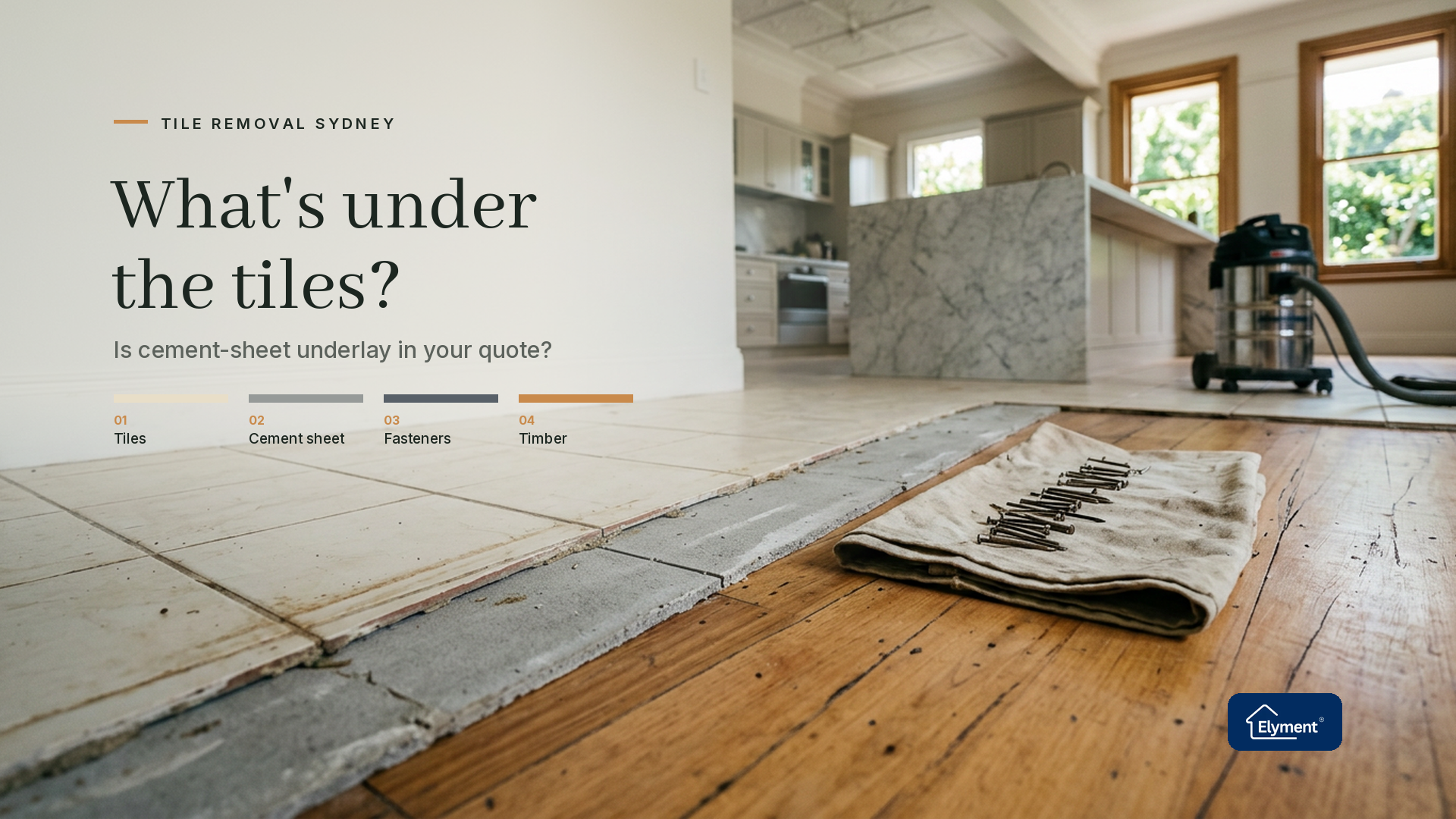
Often it isn't. In Sydney homes where tiles sit on a nailed cement-sheet underlay over timber, the work is really four separate jobs. The tiles come up, the sheet comes off, the fasteners come out and the exposed timber gets assessed. A tile removal price often covers only the first. If the house was built or renovated before 1990, any unidentified sheet should also be assessed for asbestos before it is disturbed, and that assessment is usually priced separately.
One Line on the Quote, Four Jobs on the Floor
Tiles over timber floors are common across Sydney. You find them in Federation and inter-war houses in the Inner West and on the North Shore, in post-war brick-and-tile homes in the south-west, and in plenty of first-floor bathrooms and kitchens added during later renovations. In most of them, the tiles were never laid straight onto the boards. A thin cement-based sheet was nailed or screwed down first, so the tiles had a rigid base.
When an owner asks for "tile removal", a contractor naturally prices the tiles. The quote measures the visible area, applies a rate and allows for waste. What it often doesn't describe is what happens once the last tile is up and a grey sheet, held by several hundred fasteners, sits between the crew and the timber the owner actually wants to reach.
This isn't usually a pricing trick. It's a scoping gap. Each of the four jobs takes a different crew, different tools, different handling of waste and a different amount of risk:
- Tile uplift: Releasing the tiles and adhesive from the sheet surface.
- Underlay removal: Taking the cement sheet off the timber in controlled sections.
- Fastener extraction: Pulling, cutting or punching the nails and screws that held the sheet.
- Timber assessment: Working out whether the boards, plywood or particleboard underneath can take the next floor.
A quote that prices only the first job can look very competitive. Once the floor is opened, it is also the quote most likely to need a variation.
Elyment has already looked at when tiles and fibre-cement sheets have to come out together. That's a technical decision about the floor itself. This article is about the commercial side: how each layer gets priced, where the hazardous-material assessment fits, and how to word the scope so the price still holds after demolition.
How Each Layer Is Typically Priced
Every layer is priced on a different basis, which is why two quotes for the same room can be very hard to compare. The comparison below shows the usual logic. It's not a schedule of rates.
Tile and Adhesive Uplift
- Common pricing basis: Per square metre.
- What drives the number: Tile type, adhesive bond, access and dust controls.
- Question to ask: Does the rate stop at the sheet surface?
Cement-Sheet Underlay Removal
- Common pricing basis: Per square metre or a provisional sum.
- What drives the number: Fixing density, sheet condition and whether adhesive has bonded into the sheet.
- Question to ask: Is the underlay included, excluded or provisional?
Fastener Extraction
- Common pricing basis: Hourly rate or allowance.
- What drives the number: Nail type, ring-shank or screw fixings, corrosion and what the next trade needs.
- Question to ask: Will fasteners be pulled, cut flush or punched?
Hazardous-Material Assessment
- Common pricing basis: Fixed fee from an independent assessor.
- What drives the number: Number of samples and report turnaround.
- Question to ask: Who engages the assessor and who receives the report?
Timber Assessment and Repair
- Common pricing basis: Provisional sum, then a priced variation.
- What drives the number: Moisture damage, deflection and previous patching.
- Question to ask: What happens if the timber fails inspection?
Waste and Disposal
- Common pricing basis: Lump sum or per load.
- What drives the number: Extra sheet volume, classification of the material and access to the waste vehicle.
- Question to ask: Does the waste allowance include the sheet as well as the tiles?
The pattern to look for is a low per-square-metre tile rate with the underlay listed as "excluded" or "by others", or not mentioned at all. That quote isn't necessarily wrong. It just isn't a price for reaching the timber.
For the broader cost picture on concrete slabs, including grinding and strata logistics, see Elyment's guide to real tile removal quotes, grinding and strata. Timber subfloors have a different cost structure, because the problem afterwards is metal and timber, not adhesive and concrete.
The Hazardous-Material Gate Comes Before the First Sheet Is Lifted
Cement sheet used as a tile underlay in older Sydney homes may be a modern asbestos-free product or an older sheet containing bonded asbestos. You can't tell by looking. According to NSW Government asbestos guidance, an estimated 1 in 3 NSW homes built or renovated between 1945 and 1990 contain asbestos. That includes cement sheeting, and the risk rises when the material is drilled, cut, broken or sanded.
That makes the assessment a gate, not just a line item. It should be resolved before anyone prices the sheet removal with confidence, for three commercial reasons.
The Result Changes Who Can Do the Work
Under SafeWork NSW rules for unlicensed removal, up to 10 square metres in total of non-friable asbestos-containing material can be removed without a licence, subject to strict obligations. SafeWork NSW still recommends using a licensed removalist for any amount. Above 10 square metres, a Class B asbestos removal licence is required.
A small bathroom can fall below that line. A kitchen, laundry and meals area tiled as one continuous floor usually won't. If the sheet tests positive, the removal moves from a flooring crew to a licensed removalist, with a different price, a different method and a different waste pathway.
The Result Changes the Programme
For licensed removal of more than 10 square metres of non-friable asbestos, the removalist must notify SafeWork NSW five calendar days before work starts. Licensed removal is also followed by a clearance inspection before other trades can come back into the area. Those days have to be built into the programme. They can't be squeezed between tile uplift and the floor installer's start date.
The Result Changes What the Tile Quote Is Worth
If sampling happens only after tile uplift, the crew may have to stop with the sheet half exposed, the room out of use and the next trade already booked. Sampling before work starts, or through an access point agreed with the assessor, means the tile quote and the underlay quote are priced against a known material.
A practical sequence looks like this:
- Confirm the home's build and renovation dates, and check for any existing hazardous-material report.
- Engage an independent assessor to inspect the floor and, where needed, take samples of the underlay under controlled conditions.
- Get the laboratory result in writing before the underlay scope is finalised.
- If the result is negative, price the non-asbestos sheet removal as a firm scope item.
- If it's positive, pass the sheet removal to a licensed removalist and allow for notification, removal, disposal and clearance.
- Re-sequence the tile uplift, floor preparation and installation around whichever pathway applies.
Elyment's earlier analysis of asbestos in older Sydney tile bedding covers the mortar-bed version of this risk. The underlay version is different, because the suspect material is a sheet fixed to timber with hundreds of penetrations, not a bed poured onto concrete.
Fasteners: The Labour Nobody Measures
Cement-sheet underlay is fixed far more densely than most owners expect. Manufacturers usually specify close fixing centres around each sheet's edges and through the field, so one floor can hold several hundred nails or screws. Older installations may also use ring-shank nails, which grip the timber much harder than plain nails, or a mix of nails, screws and adhesive left over from earlier repairs.
When the sheet comes away, those fasteners stay in the timber. How they're handled is a separately priced decision, and it should depend on what goes down next.
Pull Every Fastener
- When it suits: Boards will be sanded and polished, or the timber will be reused.
- Cost and risk: Slowest option; can split old boards if forced.
Cut or Grind Flush
- When it suits: A new plywood or sheet overlay is going down.
- Cost and risk: Faster; leaves metal that can damage sanding equipment later.
Punch Below the Surface
- When it suits: Boards will be filled and covered.
- Cost and risk: Moderate speed; may not suit badly corroded fixings.
Leave Proud for the Next Trade
- When it suits: Rarely appropriate.
- Cost and risk: Shifts labour and liability onto the installer, which often leads to disputes.
A floor sander and a hybrid-flooring installer need very different handover conditions. One hidden nail head can tear a sanding belt or gouge a drum. A small proud head under an overlay can show through a thin resilient floor.
The quote should say which method applies and what condition the timber will be left in. Elyment's guide to the metal check after timber floor removal explains why this matters before any grinding or levelling starts.
Reading the Timber Once It Is Exposed
The timber underneath is the reason the job is being done, but it's the one part nobody can price accurately in advance. The underlay may have protected it for decades, or hidden decades of slow leaks from a shower, laundry tub or dishwasher.
Once the sheet and fasteners are gone, the assessment usually reaches one of these results:
- Sound and serviceable: Boards are tight, dry and flat enough for the next system, and need only minor filling or sanding.
- Serviceable with an overlay: The boards are structurally sound but too gappy, cupped or damaged for a direct finish, so a new plywood or sheet layer is specified.
- Local repair needed: Moisture damage, soft spots or old patches near wet areas mean some boards or sheets have to be replaced before anything goes over them.
- Structural review needed: Deflection, rot or damage to joists or bearers takes the job beyond a flooring scope and needs a builder or engineer.
Each result has a different cost. The quote should say how the result will be documented and approved. Photos, moisture readings and marked-up floor plans let an owner approve a variation on evidence rather than on a phone call.
For localised defects, Elyment's guide to whether one soft spot can be fixed without replacing the whole floor sets out how those repairs are usually scoped.
Writing a Quote That Survives Demolition
NSW home building law gives owners some protection against scope creep, but only if the contract is set up properly. Under NSW Government guidance on residential building contracts, residential building work valued above $5,000 needs a written contract. Variations have to be in writing, signed by both parties and attached to the contract. If the variation is caused by the contractor's own fault, the owner doesn't have to pay for the extra work to fix it.
For a tile-over-timber floor, a quote that's well protected against the unknown usually has these features:
- Separate lines for each layer: Tile uplift, underlay removal, fastener treatment and waste are priced separately, not bundled into one square-metre figure.
- A stated stopping layer: The scope says whether work stops at the sheet surface, the bare timber or a finish-ready timber surface.
- Provisional sums for genuine unknowns: Timber repairs and any sheet removal awaiting test results are listed as provisional sums with a stated allowance, as the NSW home building contract template provides for work the contractor can't yet price with certainty.
- Unit rates for likely variations: A rate for replacing a square metre of subfloor, or for an extra hour of fastener extraction, lets the variation be calculated rather than negotiated under pressure.
- Clear responsibility for the assessment: The quote says who engages the hazardous-material assessor, who pays and who receives the report.
- A defined handover condition: The scope says what state the timber will be left in, so the next trade's requirements are met without arguments at the door.
Two quotes that both read "remove tiles from bathroom and kitchen" can end up thousands of dollars apart in final cost. In most cases, the cheaper headline price is simply the one carrying more provisional risk.
The Scheduling Impact Owners Underestimate
Adding underlay removal and timber assessment doesn't just add cost. It adds decision points. A realistic sequence for a non-asbestos result looks like this:
- Pre-start assessment of the floor build-up and the hazardous-material status.
- Room isolation, protection of adjoining finishes and dust controls.
- Tile and adhesive uplift down to the sheet.
- Underlay removal in controlled sections, with waste moved progressively.
- Fastener extraction or treatment to the agreed method.
- Timber inspection, moisture readings and photo documentation.
- Owner approval of any repair variation.
- Repairs, overlay or preparation for the next system.
- Handover to the flooring installer or sander.
Step seven is where projects stall. If the owner is overseas, the builder is on another site or strata needs to be consulted, the floor can sit open for days. Agreeing in advance who can approve variations up to a stated value, and how quickly, is one of the most effective ways to keep the programme moving.
Where the timber needs levelling rather than repair, the choice of system matters. Elyment's guide to levelling timber floors with a sheet overlay or structural correction covers that decision.
An Illustrative Scenario
Consider a 1960s brick home in Sydney's south with a tiled kitchen and meals area of around 22 square metres over timber boards. Two quotes come in. The first prices tile removal only, at a competitive square-metre rate. The second is higher and lists tile uplift, underlay removal, fastener extraction to a sanding-ready standard, waste, an assessor's fee and a provisional sum for subfloor repairs.
The owner wants to sand and polish the original boards. Under the first quote, the crew would finish at the sheet surface. The owner would then need a second contractor for the underlay and a third trade to deal with the fasteners, all after the hazardous-material status had been resolved.
If the sheet tested positive, the area would exceed the 10 square metre threshold and the work would need a licensed removalist and a notification period.
Under the second quote, those questions are answered before the start date. On paper the first quote was cheaper. In delivery, it covered less than half the job.
This scenario is illustrative and does not describe a specific Elyment project.
What Property Owners Should Confirm Before Accepting a Quote
- Is the cement-sheet underlay included, excluded or listed as a provisional sum?
- Has the sheet's hazardous-material status been assessed, or is that still to be done, and by whom?
- If the sheet contains asbestos and the area is over 10 square metres, who carries out the licensed removal, and how does that affect the programme?
- How will fasteners be handled, and does that suit the next floor?
- What condition will the timber be left in at handover?
- What unit rates apply if the timber needs repair?
- Who can approve variations on site, and up to what value?
- Does the waste allowance include the sheet as well as the tiles?
TILE REMOVAL OVER TIMBER, SCOPED PROPERLY
Price the Layers Before You Lift the First Tile
Get your tile uplift, underlay removal, fastener treatment, hazardous-material assessment and timber handover planned as one coordinated scope before demolition starts.
The Bottom Line
The real cost of removing tiles from a timber floor isn't set by the tiles. It's set by what's under them, and whether the quote admits it.
Cement-sheet underlay, the fasteners holding it and the condition of the timber below are three separate cost items. An unidentified older sheet also adds a regulatory gate that can change who does the work and when.
The most reliable quotes treat these as separate, visible decisions, not one convenient square-metre rate.
For Sydney owners, builders and project managers, that's the difference between a demolition price and a price for reaching the floor they actually want.
Elyment's tile removal service and flooring demolition and removal service are both scoped on that basis.
Frequently Asked Questions
Does Tile Removal Include the Underlay Underneath?
Not always. Many tile removal quotes stop at the surface of the cement sheet. Check whether the underlay is listed as included, excluded or a provisional sum.
Do I Need an Asbestos Test Before Removing Cement-Sheet Underlay?
If the home was built or renovated before 1990 and the sheet hasn't been identified, an assessment before disturbing it is the prudent step. NSW guidance says asbestos can't be confirmed by sight alone.
Can a Flooring Contractor Remove Asbestos Underlay?
Up to 10 square metres of non-friable asbestos can legally be removed without a licence under strict conditions, although SafeWork NSW recommends a licensed removalist for any amount. Above 10 square metres, a Class B licence is required.
What Happens to the Nails After the Underlay Comes Off?
They're pulled, cut flush or punched, depending on what goes down next. Boards to be sanded generally need every fastener removed. The method should be written into the quote.
Can the Original Timber Floorboards Be Saved?
Often, yes, but only once the underlay and fasteners are off and the boards have been checked for moisture damage, movement and earlier patching. The quote should include a provisional allowance in case repairs are needed.
Sources and References
- NSW Government: Asbestos in the Home
- SafeWork NSW: Unlicensed Removal (Less Than 10sqm Non-Friable Asbestos)
- SafeWork NSW: Class B Asbestos Removal Licence
- SafeWork NSW: Asbestos Notifications
- NSW Government: Contracts for Residential Building Work
- Building Commission NSW: Home Building Contract for Work Over $20,000
This article provides general project-planning information. Asbestos identification, removal and licensing, structural assessment and contract requirements should be confirmed for each property and scope of work.
Tile Removal Over Timber, Scoped Properly
Price the Layers Before You Lift the First Tile
Get your tile uplift, underlay removal, fastener treatment, hazardous-material assessment and timber handover planned as one coordinated scope before demolition starts.
Request a ReviewRelevant next actions
Explore the ELYMENT service most closely connected to this article.