Two EV Chargers at Home in Sydney: Load Sharing
Learn if two EV chargers at home in Sydney can share power through load management, and how switchboard capacity, wiring and safety checks affect upgrade costs.
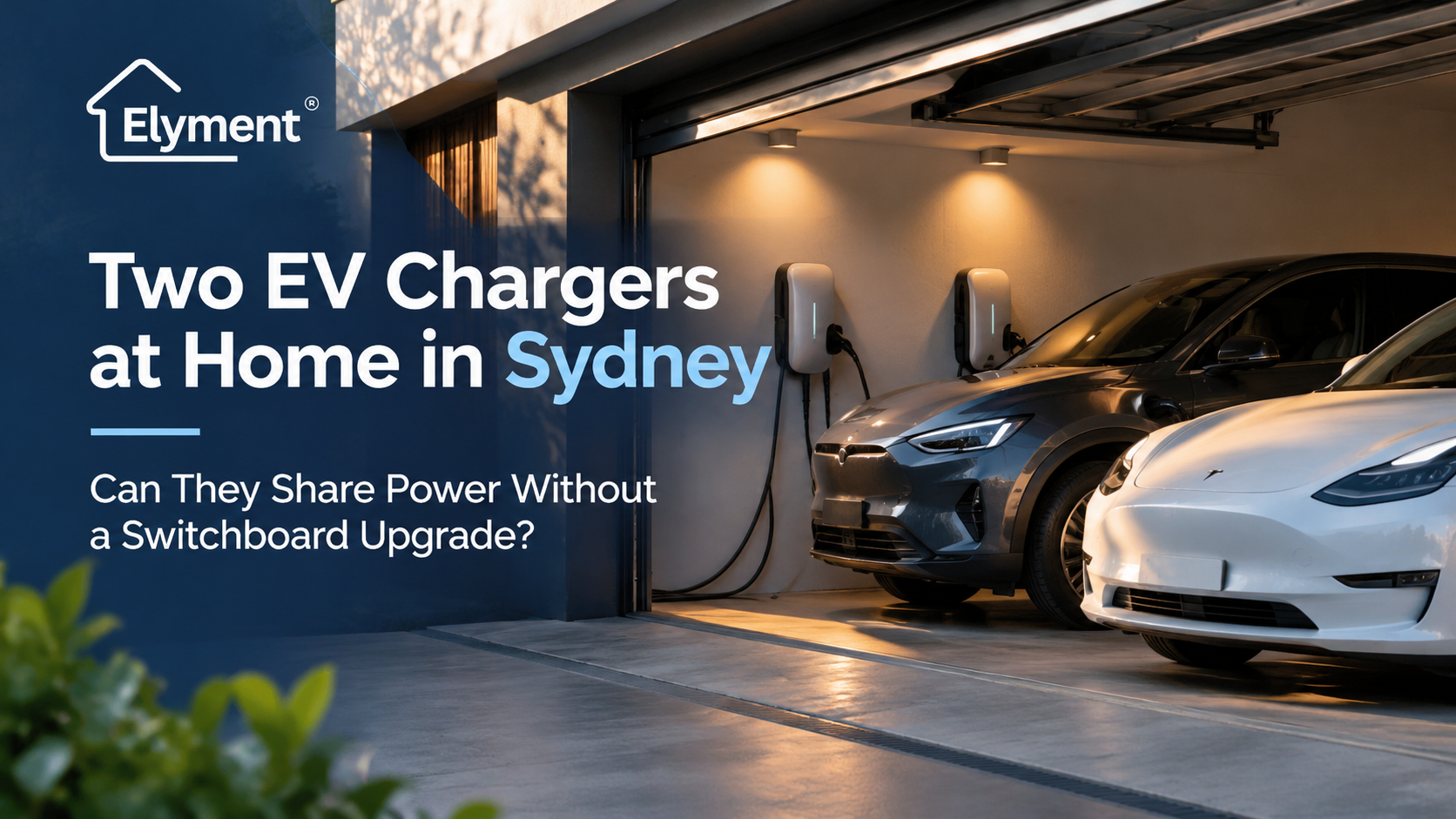
Yes, some Sydney homes can support two EV chargers without replacing the switchboard. Compatible chargers can share an agreed electrical capacity, or a charging system can prioritise one vehicle before the other. The right arrangement depends on the property's electrical supply, existing household demand, switchboard condition, charger compatibility and how much energy both vehicles need overnight. A licensed electrician must assess the installation before confirming the design.
ELYMENT Insights | Energy & Property Infrastructure | Sydney, NSW | 16 November 2026
A Second Electric Vehicle Changes the Electrical Planning Exercise
For a Sydney household with one electric vehicle, the charging decision is relatively straightforward. The owner selects a suitable charging unit, an electrician assesses the property's electrical installation and a charging schedule is established around daily travel.
A second vehicle changes the calculation.
Two cars may return home within minutes of each other, occupy separate parking spaces and remain connected overnight. Both owners may expect to leave the following morning with sufficient charge. However, the property's electricity supply has a finite capacity, and the rest of the household continues consuming electricity while the vehicles are connected.
Running two chargers at their maximum rated output is therefore not automatically the best solution.
For some properties, compatible charging equipment can distribute an available power allowance between two vehicles. In other situations, a scheduled arrangement that charges one car before the other may achieve the required result without increasing the property's peak charging demand.
The distinction is important. The question is not simply whether two charging units can be installed. It is whether both vehicles can receive the energy they need within the time available, without exceeding the electrical capacity of the property.
Three Charging Arrangements, Three Different Outcomes
Two-car households generally have three practical arrangements to consider. The appropriate choice depends on daily driving, parking arrangements, vehicle compatibility and the available electrical capacity.
1. Two Chargers Sharing Available Power
Compatible charging systems can coordinate two charging units so their combined electrical demand remains within a configured limit.
When both vehicles are connected, the available charging power is distributed between them. Depending on the system, the allocation may be shared evenly or adjusted according to charging demand and system configuration.
If one vehicle finishes charging or disconnects, the remaining vehicle may receive a greater share of the available capacity.
The main advantage is convenience. Both vehicles can remain connected without requiring the property to supply the maximum possible output of both chargers simultaneously.
2. Charging One Vehicle at a Time
A second option is to use two charging points but schedule them so only one vehicle receives the available charging capacity at a time.
For example, the first vehicle could receive priority during the early evening, with the second vehicle scheduled to charge later overnight.
This arrangement can be particularly effective when one vehicle has a substantially higher daily energy requirement than the other.
It also reduces the need to divide available charging power between two vehicles when both do not need an immediate charge.
The disadvantage is that the second vehicle may receive less charging time if the first vehicle requires more energy than expected or returns home late.
3. One Charger Shared Between Two Vehicles
Some households may not need two permanently installed chargers.
If both vehicles are parked in accessible positions and their daily charging requirements are relatively modest, one charging point can be used by each vehicle at different times.
This avoids installing a second charging unit, although the arrangement can become inconvenient when both cars regularly need substantial charging or park in different locations.
The important consideration is to distinguish between the convenience of having two physical charging points and the actual amount of electricity the household needs to deliver overnight.
Power Sharing Is Not the Same as Whole-House Load Management
The terminology used in EV charging proposals can be confusing because power sharing and dynamic load management address related but different problems.
Power sharing coordinates multiple compatible chargers. Its purpose is to keep their combined charging demand within an agreed electrical limit.
Dynamic whole-house load management considers the property's wider electricity consumption as well. A monitoring device can measure household demand and adjust EV charging when other appliances use more electricity.
Consider a Sydney home where two EVs are connected overnight while the household is also operating:
- Air conditioning or heating.
- An electric hot water system.
- An induction cooktop or electric oven.
- A swimming pool pump.
- Other significant household appliances.
If household demand increases, a suitable dynamic system may reduce the charging current available to the vehicles. When other demand falls, more capacity may become available for charging.
Some installations may require both charger-to-charger coordination and monitoring of the property's overall demand. These functions should not be assumed to be interchangeable.
The electrician needs to identify which control arrangement the proposed equipment actually supports.
What Happens to Overnight Charging Speed?
This is where the decision becomes practical for households with two electric vehicles.
A charging arrangement that protects the property's electrical capacity may still deliver enough energy overnight. However, sharing power changes how quickly each individual vehicle receives that energy.
Consider an illustrative arrangement where an electrician configures a combined EV charging allowance of 7 kW.
Illustrative charging arrangements
- One vehicle charging
- Power allocation: Up to 7 kW.
- Potential result: The connected vehicle receives the available charging capacity.
- Two vehicles sharing equally
- Power allocation: Approximately 3.5 kW each.
- Potential result: Both vehicles receive energy simultaneously at a reduced rate.
- Sequential charging
- Power allocation: Up to 7 kW allocated to one vehicle at a time.
- Potential result: One vehicle receives priority before the second begins charging.
Assume both vehicles remain connected for a ten-hour overnight period. A combined 7 kW charging allowance represents up to 70 kWh of energy supplied at the AC charging side over that period, before charging losses and vehicle limitations.
With equal sharing, each vehicle could receive approximately 35 kWh of that available supply.
However, imagine the first vehicle needs approximately 50 kWh while the second needs only 20 kWh. An equal split may not be the most useful arrangement. A sequential schedule could allocate more charging time to the first vehicle before transferring the available capacity to the second.
The example is illustrative rather than a guaranteed charging result. Actual energy delivered depends on vehicle charging limits, battery condition, charging efficiency, control settings and any changes in household demand.
This is why an electrician should understand both vehicles' actual charging requirements rather than designing the installation around the maximum advertised output of the chargers alone.
What an Electrician Should Check Before Quoting
A two-charger installation requires more than confirming that two units can be mounted on a garage wall.
The electrical assessment should establish how much capacity is available, how the charging equipment will communicate and whether the existing installation can safely accommodate the proposed arrangement.
1. Existing Electricity Supply
The electrician should establish whether the property has single-phase or three-phase supply and assess the available capacity for the proposed installation.
The incoming supply, main switch rating and existing demand all influence the charging arrangement. A property with three-phase electricity is not automatically capable of running two chargers at their maximum output.
2. Switchboard Condition and Available Space
The physical condition of the switchboard matters as much as the amount of space available.
The assessment should consider:
- Existing circuit protection and safety devices.
- Available positions for the proposed electrical equipment.
- Condition and suitability of existing components.
- Switchboard and supply capacity.
- Any necessary modifications to support the charging design.
A switchboard that has spare physical positions may still have insufficient electrical capacity. Equally, a property with limited spare positions may have other compliant design options.
3. Existing Household Electrical Demand
The electrician should consider the appliances that operate alongside the EV chargers, particularly those with substantial electrical demand.
Air conditioning, electric hot water, induction cooking, pool equipment and other electrification projects can materially change the property's maximum demand.
The assessment should reflect realistic household usage rather than assuming that every appliance will remain switched off while the cars charge.
4. Charger Compatibility
Not every pair of charging units can communicate or share power.
The electrician should verify the manufacturers' approved arrangements, supported charger models, firmware requirements, control equipment and circuit configuration.
For example, Tesla's Australian documentation describes Group Power Management for compatible Gen 3 Wall Connectors. The system can coordinate up to six connectors within a configured charging limit. Tesla also specifies that this feature is not a universal arrangement for mixing different manufacturers' chargers.
That distinction matters when a household already owns one charger and plans to purchase a second unit from another manufacturer.
5. Circuit Design and Electrical Protection
The proposed circuit arrangement must follow the charging equipment manufacturer's instructions and applicable electrical requirements.
A fixed EV charger will generally require an appropriately designed dedicated circuit and suitable protection. A manufacturer-approved power-sharing arrangement may have specific requirements for how multiple connectors are supplied and protected.
Homeowners should not assume that two chargers can simply be connected to an existing circuit because a load-sharing feature is advertised.
6. Cable Distance and Parking Layout
The distance between the switchboard and the two parking positions can influence the installation design.
The electrician should establish:
- Where each vehicle normally parks.
- Whether both charging cables can reach safely.
- The actual cable route from the electrical supply.
- Whether walls, ceilings, external surfaces or underground sections are involved.
- Whether additional mounting or protective equipment is needed.
In Sydney homes with detached garages, narrow side access or older building construction, cable routing can become a significant part of the installation scope.
7. Monitoring and Communication
Where a system relies on communication between chargers or monitoring equipment, the electrician should confirm how the components communicate and what happens if communication is interrupted.
This includes checking manufacturer requirements for wireless communication, metering devices, current transformers and control configuration where applicable.
8. Future Electrical Requirements
Households planning solar, battery storage, induction cooking, electric hot water or additional charging equipment should discuss these requirements during the initial assessment.
It may be more practical to plan the electrical infrastructure around the anticipated household demand than to complete separate upgrades whenever another appliance is introduced.
When a Switchboard Upgrade May Still Be Necessary
Load sharing can help manage demand, but it is not a universal substitute for electrical upgrades.
An existing switchboard may require replacement or modification if it is unsuitable for the proposed installation, has defective components, lacks appropriate protection or cannot accommodate the required circuit arrangement.
Similarly, load management cannot create additional electricity supply where the property's incoming infrastructure is genuinely insufficient for its requirements.
A switchboard upgrade may also be considered where the household plans to introduce several substantial electrical loads over the coming years.
Before accepting a major upgrade proposal, homeowners should ask the electrician to explain:
- Which existing component or capacity limitation requires the work.
- Whether compatible power sharing has been assessed.
- Whether sequential charging would meet the household's needs.
- Whether a limited switchboard modification is sufficient.
- Whether an alteration to the incoming electricity supply is necessary.
The objective is not to avoid every electrical upgrade. It is to avoid replacing infrastructure that does not need replacing while ensuring the final installation is safe and suitable.
NSW Compliance Must Be Included in the Installation Scope
EV charging equipment is part of the property's electrical installation. Its design, installation, testing and documentation must be handled appropriately.
In New South Wales, electrical wiring work must be performed by, or under the supervision of, an appropriately licensed electrician.
Building Commission NSW requires relevant electrical work to be supported by a Certificate of Compliance for Electrical Work (CCEW). From 1 July 2026, the required certificates are submitted through the BCNSW eCert system.
Homeowners should confirm the following before accepting an installation proposal:
- The electrical contractor holds the appropriate licence.
- The proposed charger arrangement follows manufacturer requirements.
- Required electrical protection and testing are included.
- The completed work will receive the applicable compliance documentation.
- Any additional supply or network work has been identified separately.
For further guidance, consult the NSW electrical compliance requirements and the government's electrical safety guidance for property owners.
How to Prepare for a Two-Charger Installation Quote
A more useful quotation starts with information about the vehicles and the property.
Before requesting an assessment, homeowners should prepare:
- Vehicle details: Make, model and year of both electric vehicles.
- Daily driving requirements: Approximate kilometres travelled by each vehicle.
- Charging expectations: How much charge each vehicle needs before its next departure.
- Parking arrangements: Where both vehicles are parked and when they normally return home.
- Existing equipment: Details of any EV charger already installed or purchased.
- Switchboard information: Photographs of the closed switchboard exterior and any existing electrical documentation.
- Household demand: Information about major appliances, solar, batteries and other planned electrical upgrades.
- Site access: Photographs showing the garage, proposed charger positions and likely cable routes.
This information gives the electrician a clearer starting point and helps distinguish between a straightforward dual-charger installation and a project requiring more extensive electrical investigation.
For broader budgeting context, see Elyment's guide to EV charger installation costs in Sydney. Homeowners considering solar integration can also review solar EV charger installation without a home battery.
The Better Solution Starts With How Both Cars Are Used
There is no universal reason for two electric vehicles to charge at their maximum possible rate simultaneously.
A household where one car travels 100 kilometres each day and the other is used occasionally has a different charging requirement from a household where both vehicles complete long daily journeys.
Likewise, two vehicles that remain parked for twelve hours overnight may have more flexibility than vehicles that return late and leave early.
Compatible power sharing can provide convenience by allowing both cars to charge together. Sequential charging can be more effective when one vehicle needs priority. In some homes, one charging point may still be sufficient.
The decision should follow an assessment of the electricity supply, the switchboard, the vehicles and the household's actual charging schedule.
For Sydney property owners, the most useful question to ask before purchasing another charger is not how much power the equipment can draw. It is how much power the home can safely allocate and whether that arrangement will meet both vehicles' needs by morning.
Planning Electrical and Property Upgrades?
SYDNEY PROPERTY & PROJECT OPERATIONS
Review your project requirements, contractor coordination, renovation sequencing and compliance considerations before work begins.
Discuss Your Project With Elyment
Frequently Asked Questions
Can two EV chargers share power at home?
Yes, compatible charging systems can distribute an agreed amount of electrical capacity between two charging points. The arrangement depends on charger compatibility, circuit design and the property's available capacity.
Do two EV chargers always require a switchboard upgrade?
No. Some properties can accommodate two chargers through an appropriately designed power-sharing or load-management arrangement. The existing switchboard and electrical supply must still be assessed by a licensed electrician.
Is it faster to charge two EVs simultaneously or one at a time?
Charging one vehicle at a time can give that vehicle access to more available power. Simultaneous charging divides the configured capacity between vehicles. The better arrangement depends on how much energy each vehicle needs and how long both remain parked.
Can two 7 kW chargers operate simultaneously?
Potentially, but their combined demand must be supported by the property's electrical installation and supply. A suitable load-management arrangement may limit their combined output where unrestricted simultaneous charging is not appropriate.
Does power sharing work between different EV charger brands?
Not automatically. Power-sharing compatibility is manufacturer- and model-dependent. The electrician should verify the approved configuration before recommending a second charging unit.
Do I need three-phase electricity for two EV chargers?
Not necessarily. Some two-car households can meet their charging needs with single-phase electricity and managed charging. The actual requirement depends on vehicle demand, available capacity and the proposed charging arrangement.
What should I give an electrician before requesting a quote?
Provide both vehicle models, daily driving requirements, parking arrangements, existing charger details, photographs of the closed switchboard and information about major household electrical loads.
Sources and References
- Tesla Australia: Wall Connector Power Management
- MPV Group: Can I Install Two EV Chargers at Home?
- Building Commission NSW: Electrical Compliance Requirements
- NSW Government: Electrical Safety Requirements and Consumer Rights
- ELYMENT: EV Charger Installation Cost Sydney
- ELYMENT: Solar EV Charger Installation Sydney Without a Home Battery
- ELYMENT: Induction Cooktop Installation and Switchboard Upgrades
SYDNEY PROPERTY & PROJECT OPERATIONS
Planning Your Next Property Upgrade?
Review your project scope, renovation sequencing, electrical coordination and compliance considerations. Get the right requirements established before work begins.
Discuss Your Project With Elyment