Pool Pump Replacement Sydney: Reuse the Outdoor Power Point?
Replacing a pool pump in Sydney? Check if your existing outdoor power point is safe and compliant, and when a fully licensed electrician may need to upgrade it.
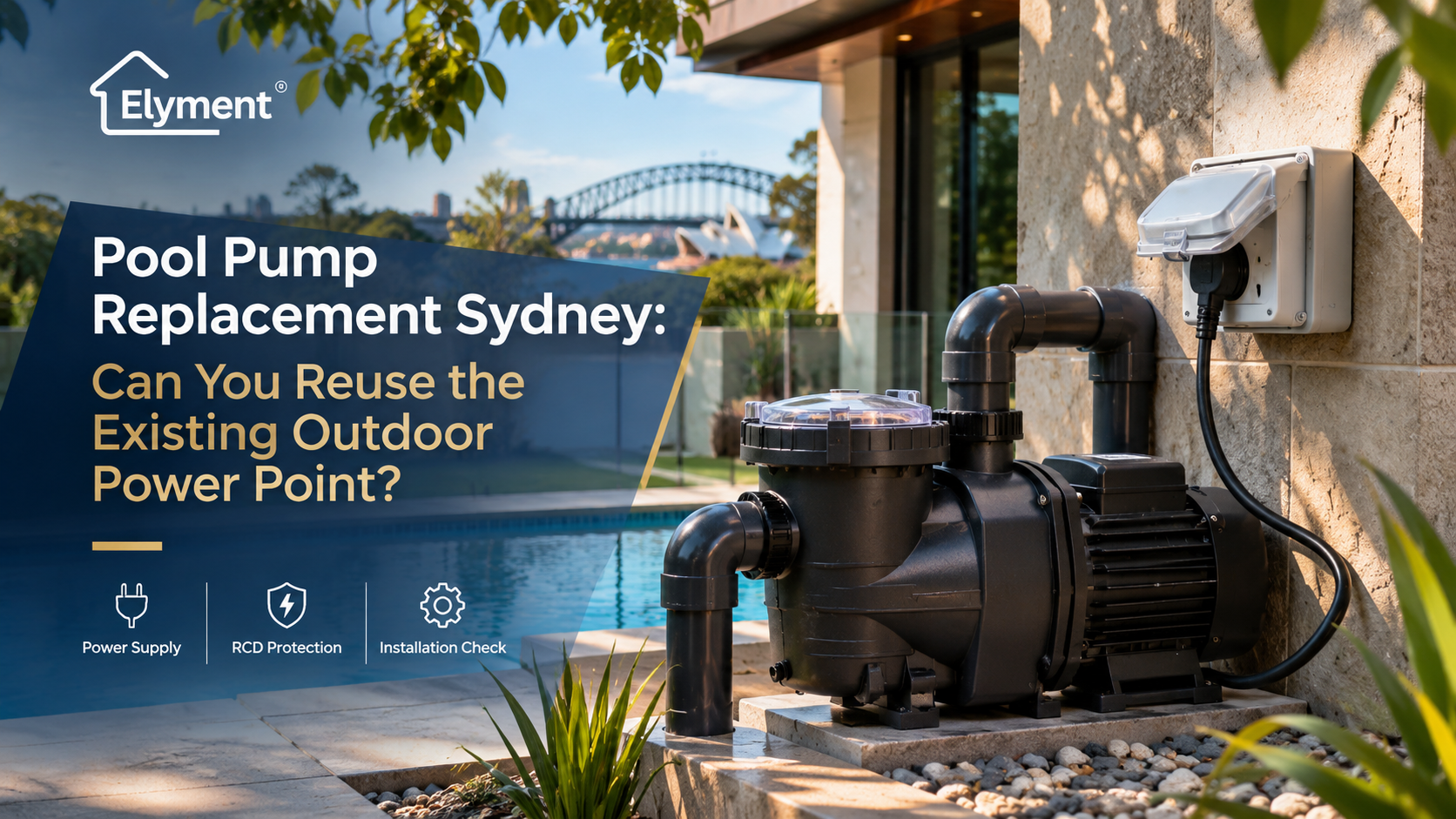
An existing outdoor power point may be suitable for a replacement pool pump in Sydney, but only after its electrical supply and installation conditions have been checked. A licensed electrician should confirm the new pump's voltage, current requirements, connection type, outlet location, weather protection and RCD protection. Some pumps require fixed wiring rather than a plug connection. Checking these details before purchasing can prevent installation delays, additional electrical work and an unsuitable equipment purchase.
ELYMENT Insights | Electrical & Property Operations | Sydney, NSW | 13 November 2026
A Replacement Pump Can Fit the Plumbing but Not the Power Supply
For Sydney property owners replacing an ageing swimming pool pump, the purchase decision often begins with water flow, operating noise, energy consumption and the price of the replacement unit.
The electrical connection is sometimes treated as a secondary issue. The existing pump already operates from an outdoor power point, so the replacement is assumed to require little more than disconnecting one machine and connecting another.
That assumption can create an avoidable problem.
Two pumps designed for similar swimming pools may have different electrical specifications, connection arrangements and installation instructions. A replacement that appears suitable mechanically may not be compatible with the existing power supply.
The consequences extend beyond inconvenience. An unsuitable connection can introduce electrical safety risks, delay commissioning and change the overall cost of the replacement.
The more effective approach is to establish whether the existing electrical infrastructure can support the proposed pump before the owner commits to buying it.
The First Check Is the Pump Specification, Not the Outdoor Socket
A power point's physical appearance does not establish which equipment it can safely supply.
Before purchasing a replacement pump, the electrician needs the exact model and the manufacturer's electrical specifications.
Relevant information includes:
- Supply voltage: Whether the proposed model is compatible with the available electrical supply.
- Rated current: The operating current and any relevant motor starting characteristics.
- Connection method: Whether the equipment uses a suitable plug and socket arrangement or requires fixed wiring.
- Circuit requirements: Whether the existing wiring, protective devices and circuit capacity are appropriate.
- Manufacturer instructions: Any model-specific requirements for electrical protection, installation location and commissioning.
The distinction is documented in AstralPool's installation manual for its CTX, E, FX and XP pump series.
The manual directs installers to verify the operating voltage shown on the pump's data plate and ensure the circuit and conductor sizes are appropriate.
It also specifies that the three-phase XP pump requires fixed wiring and is not suitable for a flexible cord and plug connection.
This is an important distinction for purchasing decisions. An existing outdoor socket cannot automatically accommodate a replacement simply because another pool pump previously used it.
Where a model requires fixed wiring or a different supply arrangement, a licensed electrician must assess and carry out the necessary electrical work.
Owners considering equipment with a different electrical connection can also review Elyment's analysis of 15-amp power point installation and circuit requirements in Sydney, which explains why changing an outlet does not automatically increase available circuit capacity.
The Existing Power Point Has Its Own Suitability Test
Even when the new pump uses a compatible plug, the existing outdoor power point may not be suitable for continued service.
A licensed electrician should assess the physical condition of the outlet and its installation environment.
Condition and Weather Exposure
Outdoor electrical fittings may be exposed to rainfall, irrigation spray, condensation, ultraviolet exposure and corrosion.
For pool equipment, the assessment should consider whether the socket enclosure, seals, mounting arrangement and electrical connections remain suitable for the actual conditions.
A weather-resistant label or enclosure does not establish that every installation arrangement is appropriate, particularly where a pump remains connected continuously.
The electrician should also consider the weather protection provided while the plug is inserted, rather than relying only on the enclosure's condition when its cover is closed.
Position Relative to the Swimming Pool
Swimming pools are subject to particular electrical installation requirements under AS/NZS 3000, including restrictions and conditions for electrical equipment within defined pool zones.
Whether a socket is permissible depends on its precise location, the applicable zone, installation characteristics and required protective measures.
A socket installed many years earlier should not automatically be assumed compliant or appropriate for a new installation merely because it has remained in use.
The electrician must determine whether the existing location is acceptable under the requirements relevant to the proposed work.
How the Cable Reaches the Equipment
A replacement pump may have a different physical configuration or connection position from the outgoing unit.
That can introduce an unexpected problem if its supplied cord cannot reach the approved socket position without strain or an unsuitable connection arrangement.
Improvised extension leads, modified plugs and temporary power boards are not appropriate substitutes for establishing a safe permanent supply.
For a broader examination of weather exposure and permanent outdoor electrical connections, see Elyment's guide to outdoor power point installation considerations in Sydney.
RCD Protection Is Part of the Pump Supply Decision
Residual current device protection is one of the most important electrical safety considerations for swimming pool equipment.
An RCD, commonly called a safety switch, is designed to detect certain electrical leakage faults and disconnect the supply to reduce electric shock risk.
It performs a different function from an ordinary circuit breaker, which primarily protects a circuit against excessive current and short circuits.
The AstralPool installation instructions specify 30 mA RCD protection for the relevant pumps and require compliance with applicable electrical installation standards.
For a replacement installation, the electrician should verify:
- Whether the existing circuit has the RCD protection required by the applicable wiring rules and pump manufacturer.
- Whether the installed device provides the appropriate protection for the proposed equipment.
- Whether the RCD and associated electrical installation are functioning correctly.
- Whether existing wiring or moisture-related faults need to be resolved before commissioning.
Building Commission NSW's RCD compliance advisory confirms that Type AC RCDs have not been permitted for new installations since May 2023.
The appropriate replacement or additional protective device must be selected by the electrician according to the equipment, the electrical installation and the applicable standards.
Owners should not assume that a functioning circuit breaker provides the required residual-current protection.
Similarly, a frequently tripping safety switch should not be bypassed or replaced with another device merely to keep the pump operating.
Elyment has separately examined the causes of safety switches repeatedly tripping in NSW properties, including moisture exposure, faulty appliances and electrical installation defects.
Three Possible Outcomes of a Pre-Purchase Electrical Assessment
The practical value of an electrician's assessment is that it turns an uncertain replacement into a defined installation scope.
Existing Supply Suitable
- What it means: The proposed pump is compatible with the existing electrical arrangement, and the relevant checks confirm suitability.
- Project implication: The equipment replacement may proceed without additional fixed electrical work.
Limited Electrical Alterations Needed
- What it means: The pump is appropriate, but the socket, protection or another electrical component requires work.
- Project implication: Arrange the licensed electrician's work before commissioning and account for any required certification.
Existing Arrangement Unsuitable
- What it means: The proposed pump requires a different supply, fixed wiring, another location or more extensive changes.
- Project implication: Reconsider the model or obtain an electrical installation scope and price before purchasing.
These are planning outcomes, not substitutes for an on-site technical assessment.
The distinction matters because the lowest-priced replacement pump may not deliver the lowest completed installation cost.
A more expensive but electrically compatible model may, in some circumstances, reduce the additional work required. Conversely, selecting a different pump solely to retain an ageing or unsafe socket would be a false economy.
The objective is to compare complete, compliant installation options rather than equipment prices in isolation.
Why Sydney Pool Replacement Projects Can Encounter Different Constraints
Sydney's residential building stock creates varied conditions for equipment replacement.
Consider three illustrative situations.
An Established Suburban Pool
A homeowner replacing an older single-phase pump may find that the existing socket, wiring and circuit protection remain suitable for a compatible replacement.
However, the electrician still needs to verify the actual installation rather than assuming that the previous pump's operation proves suitability.
A Compact Inner West Courtyard
In a densely developed property, pool filtration equipment may be installed within a confined service area, close to landscaping, walls or other building elements.
A change in equipment dimensions or power connection position can affect accessible socket locations, cable routing and installation logistics.
Moving the electrical connection may be more complicated than moving the pump itself.
A Strata-Managed Swimming Pool
For an apartment complex or another strata-managed property, the replacement may involve common-property electrical infrastructure and established contractor-access procedures.
The strata manager or owners corporation may need to coordinate access, expenditure approvals, shutdown arrangements and required electrical documentation.
Responsibility and approvals depend on the property's strata arrangements and the specific work proposed.
These operational considerations are best resolved before equipment delivery, particularly where the pool cannot remain out of service indefinitely.
What NSW Electrical Compliance Means for the Replacement
In NSW, electrical wiring work must be performed by appropriately licensed personnel.
The distinction between connecting a suitable plug-in appliance and undertaking work on the fixed electrical installation is important.
Simply plugging a compatible appliance into an existing, verified socket is not automatically electrical installation work requiring a new electrical compliance certificate.
However, replacing an outlet, altering fixed wiring, adding a circuit or performing other electrical installation work brings the relevant licensing, testing and certification requirements into consideration.
Building Commission NSW's September 2026 guidance confirms that Certificates of Compliance for Electrical Work (CCEW) are required for electrical installation work, including relevant like-for-like electrical equipment replacements.
Since 1 July 2026, applicable CCEWs must be submitted electronically through the Building Commission NSW eCert system or an approved submission pathway.
The electrical tester must lodge the certificate within the prescribed timeframe, no later than seven days after completing the relevant safety and compliance test.
Owners should confirm whether the proposed work requires a CCEW and obtain the relevant completion documents where applicable.
The NSW Government provides further information about electrical compliance requirements and customer certificates.
The key distinction is that a pool pump purchase does not eliminate the compliance obligations associated with alterations to the electrical installation supplying it.
The Better Sequence: Check the Supply Before Ordering the Pump
A replacement can be organised more efficiently when the electrical assessment becomes an early procurement step rather than a problem discovered at installation.
- Record the outgoing pump details.
- Photograph the model label and existing equipment arrangement without opening electrical fittings or touching damaged components.
- Identify the proposed replacement.
- Obtain the exact model number, data sheet and installation instructions, including electrical specifications.
- Arrange an electrical suitability assessment.
- Have a licensed electrician review the supply, circuit protection, outlet condition, location and connection method.
- Confirm the completed installation scope.
- Establish whether the existing connection can remain, whether alterations are required and what electrical work and documentation are included.
- Coordinate purchase, installation and commissioning.
- Order the approved equipment and organise the relevant pool equipment installer and licensed electrician, as required, so the pump can be installed and commissioned without avoidable return visits.
This approach is consistent with the site-assessment process described by Sydney equipment installer Heat That Pool, which reviews equipment positioning and available power before proceeding with installation.
It also creates a clearer distinction between the equipment supply price, electrical work and final commissioning responsibilities.
What Owners Should Confirm Before Approving the Replacement
Before authorising a pool pump replacement, request written confirmation of the following:
- The exact pump model and its specified electrical supply requirements.
- Whether the existing power point can be reused safely and compliantly.
- Whether the outlet location and weather protection are suitable for the proposed installation.
- Whether the required RCD protection has been verified.
- Whether any fixed electrical installation work is necessary.
- Which contractor is responsible for the electrical work and which is responsible for equipment commissioning.
- What certificates, testing records and warranties will be supplied where applicable.
The owner should also confirm whether the quotation includes the entire completed installation or only the supply and connection of the pump.
These details become particularly important where equipment is being ordered online, sourced separately or delivered to a property before the installer attends.
The Practical Conclusion: Reuse Is Possible, but It Is Not Automatic
An existing outdoor power point can sometimes remain part of a replacement pool pump installation. There is no general requirement to replace every outdoor socket simply because the connected equipment is being upgraded.
Equally, an existing socket should not be retained without regard to the new pump's electrical requirements, its physical condition, location or protective devices.
For Sydney property owners, the most useful decision happens before the purchase: establish whether the proposed model matches a safe and compliant supply arrangement.
That small change in project sequencing can reduce the likelihood of ordering incompatible equipment, discovering additional electrical work at commissioning or extending the time the swimming pool is out of service.
Planning a Pool Equipment Replacement or Property Upgrade in Sydney?
ELYMENT | PROPERTY OPERATIONS
Review installation requirements, contractor coordination and project delivery considerations before work begins. Elyment supports practical renovation planning and operational coordination across Sydney and NSW.
Sources and References
Manufacturer and Technical References
- AstralPool — CTX, E, FX and XP Pump Series Installation Manual
- AS/NZS 3000 — Electrical Installations (Australian/New Zealand Wiring Rules).
- Heat That Pool — Pool Equipment Installation Sydney
NSW Government and Electrical Compliance References
- Building Commission NSW — Residual Current Device (RCD) Compliance
- Building Commission NSW — When to Submit a Certificate of Compliance for Electrical Work (CCEW)
- NSW Government — Electrical Compliance Requirements
Related Elyment Guides
- 15-Amp Power Point Installation and Circuit Requirements in Sydney
- Outdoor Power Point Installation Cost and Considerations in Sydney
- Safety Switch Keeps Tripping in NSW: Causes and Electrical Safety Considerations
ELYMENT | PROPERTY OPERATIONS
Planning a Pool Equipment Upgrade in Sydney?
Review installation requirements, contractor coordination and project delivery considerations before work begins. Elyment supports practical renovation planning and operational coordination across Sydney and NSW.
Discuss Your Project